Thoughts on the Common Core and its implementation

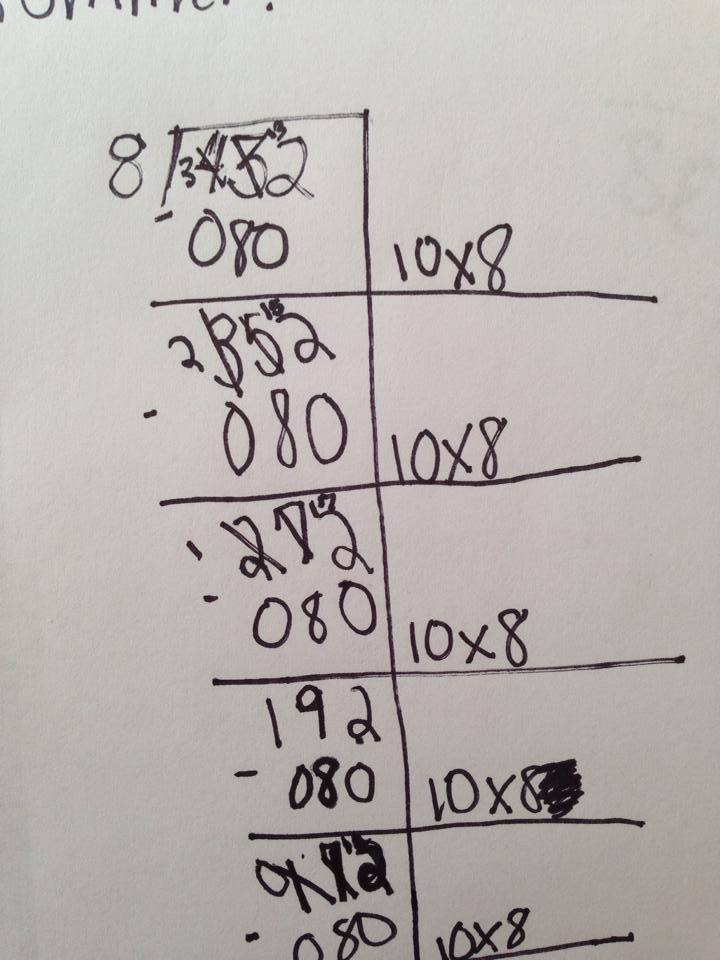
The following picture appeared on the Facebook page of Daniel Bongino, who is running for Congress in Maryland.
Source: https://scontent-a-dfw.xx.fbcdn.net/hphotos-prn1/t1/1184774_620433314716100_343011500_n.jpg

Here was his commentary on this picture:

Like many of you, I am a parent who is passionate about my child’s education in an increasingly competitive and unforgiving global economy.

Having stated that, I cannot condemn the Common Core in strong enough terms. Look at the picture I have attached to this post. I gave my daughter a relatively easy long-division problem to do today, in an attempt to gauge her progress, and this is what she gave back to me.

This is completely unacceptable. How is it that we are replacing a time-tested, efficient method of long-division with an absurd, multi-step process that not only confuses the students, but the parents too?

Compounding the Common Core disaster is the fact that in my daughter’s last school year she was taught the older, more effective method of long-division and is now completely confused.

Friends, all politics are local and it gets no more local than your kitchen table. Fight back against the Common Core, and do it quickly, by calling and emailing your local, state, and federal elected officials.

This is not a partisan issue. Your child’s education is suffering whether you are a Democrat or a Republican. Every second we lose is another second our kids are being exposed to a third-rate curriculum in a first-world economy. Count on me as an ally in this fight.
-Dan

Source: https://www.facebook.com/dan.bongino/photos/a.517057181720381.1073741827.101043269988443/620433314716100/?type=1&theater

green line

Yesterday, I discussed the mathematical logic behind this unorthodox approach to subtraction. Today, I want to briefly talk about the Common Core standards for mathematics and their implementation, as this is a topic that I’ve been following for several years.

  1. To the mindless critics who think that America is headed to communism because of the Common Core: there’s no point having a rational discussion about this. Michael Gerson is one of many conservative commentators who is not ideologically opposed to the Common Core; see http://www.washingtonpost.com/opinions/michael-gerson-gop-fear-of-common-core-education-standards-unfounded/2013/05/20/9db19a94-c177-11e2-8bd8-2788030e6b44_story.html.
  2. Also to the mindless critics: while Texas (where I live) is not a Common Core state, the standards for mathematics that we’ve had for the past 10 years or so align fairly well with the Common Core. And Texas is about as far away from a blue state as any of the 50.
  3. To the thoughtful critics who are worried about the appropriateness of the Common Core standards: as I said, while not in perfect alignment, for the last few years Texas has had content and process standards for mathematics education that are decently close to those stipulated by the Common Core. I’m more than happy to declare that the implementation of the Common Core has been thoroughly botched from sea to shining sea. Still, I believe that a good implementation is possible, and I hope that you don’t throw out the baby with the bath water when critiquing the potential of the Common Core standards.
  4. To the supporters of the Common Core standards: you better read Diane Ravitch’s thoughtful critique of how the standards have been rolled out: http://dianeravitch.net/2013/02/26/why-i-cannot-support-the-common-core-standards/. It seems to me that textbook publishers are driving the rollout of the Common Core, and educators are desperately trying to shift from the previous standards to the new standards while also trying to figure how they are being required to teach because of the textbook… and not because of the standards themselves.
  5. Also to the supporters of the Common Core standards: voters — and, more importantly, parents — will not tolerate these standards if a rationale for these standards are not carefully explained. I do think that most parents do care about the mathematical education of their children and will rationally discuss cutting-edge ways of teaching mathematics, but they have to be convinced that these cutting edge methods actually make sense. The rollout of the Common Core will be studied in public-relation circles for years to come for how *not* to make drastic changes.
  6. And though they are not specifically required by the Common Core, don’t get me started on the hours we’re wasting high-stakes testing, an intellectually lazy and ineffective way of measuring teacher quality.

Thoughts on unorthodox ways of teaching long division

The following picture appeared on the Facebook page of Daniel Bongino, who is running for Congress in Maryland.

Source: https://scontent-a-dfw.xx.fbcdn.net/hphotos-prn1/t1/1184774_620433314716100_343011500_n.jpg

Here was his commentary on this picture:

Like many of you, I am a parent who is passionate about my child’s education in an increasingly competitive and unforgiving global economy.

Having stated that, I cannot condemn the Common Core in strong enough terms. Look at the picture I have attached to this post. I gave my daughter a relatively easy long-division problem to do today, in an attempt to gauge her progress, and this is what she gave back to me.

This is completely unacceptable. How is it that we are replacing a time-tested, efficient method of long-division with an absurd, multi-step process that not only confuses the students, but the parents too?

Compounding the Common Core disaster is the fact that in my daughter’s last school year she was taught the older, more effective method of long-division and is now completely confused.

Friends, all politics are local and it gets no more local than your kitchen table. Fight back against the Common Core, and do it quickly, by calling and emailing your local, state, and federal elected officials.

This is not a partisan issue. Your child’s education is suffering whether you are a Democrat or a Republican. Every second we lose is another second our kids are being exposed to a third-rate curriculum in a first-world economy. Count on me as an ally in this fight.
-Dan

Source: https://www.facebook.com/dan.bongino/photos/a.517057181720381.1073741827.101043269988443/620433314716100/?type=1&theater

This picture was shared by a friend on Facebook; the resulting discussion follows. I’m sharing this because I think the following reactions are typical of parents when their children are taught mathematics using non-traditional methods.

While I don’t think that any of the commentators said anything personally embarrassing, I’m withholding the actual names of the correspondents for the sake of anonymity.

Anonymous #1: What in the world is this?

Me: In the worst case scenario, it’s a waste of time for children who already know how to divide.

In the best case scenario, it’s an effective and pedagogically reasonable first step — for children who don’t yet know how to divide. (FYI, this technique has been used long before the advent of the Common Core.

Here’s the justification: Young children often have a hard time coming up with the “best” first step that 43 divided by 8 is 5 with remainder 3. However, they often can come up with a reasonable first step, whether it’s subtracting off 10 groups of 8 or 40 groups of 8. The important thing is that they’re reducing 432 by a multiple of 80, not necessarily the “best” or “optimal” multiple of 80. With practice, children hopefully get better at guessing the optimal multiple of 80, thus leading to the traditional method of long division.

The idea is that the children can, with time, figure out the reason why long division works, rather than mindlessly following an algorithm that leads them to an answer that they don’t understand.

Anonymous #2: It’s the longest division problem ever. Lol

Anonymous #3: OMG John, that answer was more confusing than the picture!! LOL just kidding! What I want to see from that picture is, did she eventually get the answer right? Did she give up? If the kids learn how to get a right answer, I’m hard pressed to find a valid argument against any teaching method. If it frustrates them to the point that they give up, well then that is a problem. That picture he posted doesn’t give us any real information. It just makes us old farts think “what the hell??” Because it’s so different from what we learned.

Maybe it isn’t pulling up right, but I don’t see an answer in that picture. Is because she couldn’t do it or because he just wanted to post the weird method to promote fear of something new?

My daughter was taught the “lattice” way to do 3 digit multiplication. I wanted to cry trying to figure that out. But it made sense to her and she got the answers right.

But, I will admit that it looks crazy to me, too!

Me: I agree that the person who posted the picture did not (deliberately?) show if the student ultimately got the right answer. I can say that the partial steps that are shown are correct.

I’m for teaching any technique in elementary school that’s (1) logically correct, whether or not it’s the way it’s (mythically) “always been taught,” (2) encourages students to think mathematically, as opposed to mindlessly following a procedure with no real conceptual understanding, and (3) prepares students for algebra in a few years’ time.

I’ll also say this: unorthodox teaching practices usually go over better when both the practices and the rationale for the practices are clearly explained to parents. Sadly, while a lot of thought has gone into improving mathematics education, not much thought has gone into justifying these new practices to parents, and that’s a shame.

Anonymous #2: The problem isn’t teaching the method. I’m all for showing kids multiple ways to do things. The problem is forcing all kids to use this method. We are all different and therefore we all think differently. If it makes sense this way to you great however if it doesn’t make sense then why not let kids use the way that works for them. Yes teaching different methods is great but forcing kids to use methods they don’t understand is foolish.

Me: No argument from me.

Anonymous #4: I am troubled by this and other styles of math that no longer require children to learn and memorize simple mathematical tables of simple addition, subtraction, multiplication, and division. It disappoints me to no end that people allow children to avoid learning thoroughly these tables, as though they are not necessary in life. I am appalled here that kids are encouraged as early as 3rd grade to start using a calculator for basic math!

I appreciate different styles of doing math here, Subtraction and Division are quite different in (European Country) than in America. But sometimes it just seems that so many new methods are obscure attempts to help an overly super small subset of kids which are then exposed to them, and at times, forced on them; much to the chagrin of parents.

Me: (Anonymous #4), I agree about the importance of children memorizing mathematical tables at a young age. I disagree that this particular algorithm — unorthodox long division — necessarily tells children that such memorization isn’t particular useful.

My own daughter struggled with long division when she first learned it. She already knew that 36 divided by 4 was 9 and hence knew the “right” step when computing 368 divided by 4. However, when the problem changed to something like dividing 384 by 4, she had difficult with the first step, as she didn’t have anything memorized for “38 divided by 4.”

My friends who are elementary teachers tell me that this particular conceptual barrier is fairly common when children first learn long division.

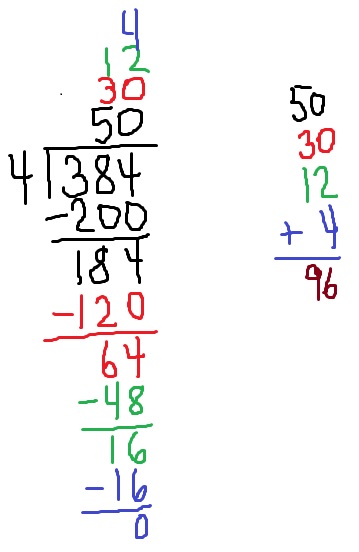
For 384 divided by 4, the best first step is subtracting 90 groups of 4 from 384, but she was having trouble immediately coming up with the largest multiple of 10 that would work. However, subtracting *any* multiple makes progress toward the solution, even if it isn’t necessarily the “best” step for solving the problem as fast as possible.

In those early stages of her learning, she computed 384 divided by 4 using suboptimal steps. I can’t remember exactly how she did it, but a reconstruction from memory is shown in the attached picture. She knew that 50 times 4 was less than 384, so it was “safe” to subtract 200. When she did this, I didn’t correct her by telling her that she should have subtracted 90 groups of 4. Instead, I let her make this step (emphasis, step — and not mistake) and let her proceed.

The step that always surprised me was when she’d occasionally subtract 12 groups of 4… she had memorized her multiplication table up to 12 and instinctively knew that subtracting 12 groups of 4 brought her closer to the correct answer than subtracting 10 groups of 4.

Obviously, as she got better at long division, she made fewer and fewer suboptimal steps when dividing. That’s the beauty of this unorthodox method… children don’t have to stress so much about making the best next move, as any next move will bring them closer to the answer. Hopefully, with practice, children get better at making the best moves quicker, but that’s a skill that they develop as they get used to long-division algorithm.
longdivision

Me: One more thought: (Anonymous #1), I’m sorry if I’ve completely commandeered your original post! 🙂

Anonymous #1: John you crack me up! I have never had such lengthy discussion about anything I have ever posted! I still have NO idea how to do all these extra steps-but I know who I will be asking for help when the time comes for me to deviate from my old school method of math!

Is there an easy function without an easy Taylor series expansion?

After class one day, a student approached me with an interesting question:

Is there an easy function without an easy Taylor expansion?

This question really struck me for several reasons.

  1. Most functions do not have an easy Taylor (or Maclaurin) expansion. After all, the formula for a Taylor expansion involves the nth derivative of the original function, and higher-order derivatives usually get progressively messier with each successive differentiation.
  2. Most of the series expansions that are taught in Calculus II arise from functions that somehow violate the above rule, like f(x) = \sin x, f(x) = \cos x, f(x) = e^x, and f(x) = 1/(1-x).
  3. Therefore, this student was under the misconception that most easy functions have easy Taylor expansions, while in reality most functions do not.

It took me a moment to answer his question, but I answered with f(x) = tan x. Successively using the Quotient Rule makes the derivatives of tan x messier and messier, but tan x definitely qualifies as an easy function that most students have seen since high school. It turns out that the Taylor expansion of f(x) = \sin x can be written as an infinite series using the Bernoulli numbers, but that’s a concept that most calculus students haven’t seen yet.

Earlier posts on Taylor series:

https://meangreenmath.com/2013/07/01/reminding-students-about-taylor-series-part-1/

https://meangreenmath.com/2013/07/02/reminding-students-about-taylor-series-part-2/

https://meangreenmath.com/2013/07/03/giving-students-a-refresher-about-taylor-series-part-3/

https://meangreenmath.com/2013/07/04/giving-students-a-refresher-about-taylor-series-part-4/

https://meangreenmath.com/2013/07/05/reminding-students-about-taylor-series-part-5/

https://meangreenmath.com/2013/07/06/reminding-students-about-taylor-series-part-6/

https://meangreenmath.com/2013/07/24/taylor-series-without-calculus-2/

Engaging students: Inverse Functions

In my capstone class for future secondary math teachers, I ask my students to come up with ideas for engaging their students with different topics in the secondary mathematics curriculum. In other words, the point of the assignment was not to devise a full-blown lesson plan on this topic. Instead, I asked my students to think about three different ways of getting their students interested in the topic in the first place.

I plan to share some of the best of these ideas on this blog (after asking my students’ permission, of course).

This student submission again comes from my former student Brittney McCash. Her topic, from Algebra II: multiplying binomials.

green line

C3. How has this topic appeared in the news.

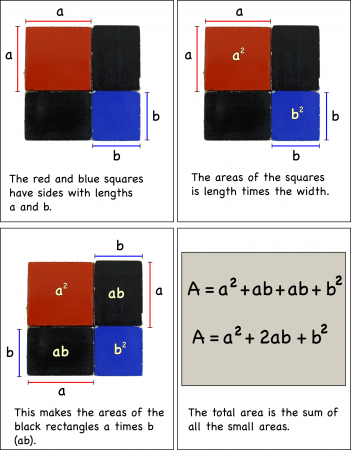
For the engagement on this aspect of my topic, I would bring a binomial cube with me. I would pose the question, “What do we do when we multiply two binomials together?” The students, of course would not know the answer. I would then say, “Well let’s what one man did that they even did a news article about him!” This in itself catches the students attention because they are piqued about what exactly I am talking about. I would then pass out a copy of this news article so that the students could read. After popcorn reading out loud, we would discuss the article and about how we could use the binomial cube. I would then take out my cube (If possible, put students in groups and give each group a binomial cube to work with) and ask the students, “How in the world did he use this cube to multiply those binomials (points to equation on board)?” I would give them the hint that they have to add up the sides of the square and solve for the perimeter, and see what they can come up with. This is a great engagement for the kids because not only is it hands on, but the article brings in outside aspects of what they’re learning so that they realize they are not the only ones having to learn the material. It’s also a great way to introduce multiplying binomials because it starts at the beginning of adding variables (which they already know how to do), and it’s a visual representation of concept that is sometimes hard to grasp. It’s also a great way to lead into the FOIL, Box, etc…methods to take it into a deeper explanation. For those that have not heard of the binomial cube, here are some pictures of what the students will be working out.

ARTICLE: News Article about Binomial Cube

multiplybinomial

green line<!–[if gte mso 9]>

B2. How does this topic extend what your students should have learned in previous courses?

            A great way to start off with this engagement would be to take the students back to sixth grade. Start off with asking students, “Who remembers when we had to learn how to add and subtract fractions?” Most, if not all, of the students should raise their hands. You can then ask, “Okay, good. So does anyone remember what the next step was after we learned how to add and subtract fractions? What did we learn how to do next?” The answer I am looking for here is multiplying and dividing. After that is established, you can lead in with, “Okay, so who can tell me what the next step would be with what we have previously been learning (adding and subtracting binomials)?” The answer is multiplication and division. Make sure to let them know that you will only be focusing on the multiplication aspect for now. Then you can pose some questions like, “What does multiplying binomials look like? How do we do it? Is there more than one way?” You can then go into a deeper exploration of multiplying binomials and the different ways you can do so. This is a good way to introduce multiplying binomials because not only did I bring in one concept students were already familiar with, I brought in two. I utilized something they already knew (even if subconsciously) back in middle school, and applied that same order to something more complex. It showed them that there was a purpose for learning what they did, and why there is a reason we go in the order that we do. Then you have the aspect of taking something they had been previously working on this semester and extending it further. This helps the students connect with what they are learning and realizing there is a purpose. Because multiplication is repeated addition, we are taking something they have previously learned, and extending it further. Another reason this is a good plan is because you start off with such a basic question, that every student knows the answer. This allows for immediate attention because all the students know what you are talking about, the more they understand, the more likely they are to participate in classroom discussion.

green line<!–[if gte mso 9]>

E1. How can technology be used to effectively engage students with this topic?

In multiplying binomials, technology is a wonderful thing. It can allow students the opportunity to learn in new and interesting ways. When thinking of an engage for this topic, I thought of the 9th grade Algebra 1 class I am currently teaching. High School students are sometimes the hardest to keep entertained, and I think I found the perfect video to help keep there attention. This video is a group of students who did a rap about the FOIL method. What better way to relate to students then students themselves! I would start class off by telling the class, “Today we are going to start of by watching a fun video over something we will be learning today.” Proceed to play the video, and observe how every student is watching. The video is fun while also informing. It describes the method, though not thoroughly, but it gives the students an idea of what will be coming. This video helps show that other students all over the state/world are learning the same thing, and are bringing a fun new aspect to the learning of the material. After the video is played, you might ask the class to try and guess at what exactly you will be covering today. It’s always good to see their minds work and try to figure it out. This question also allows them to connect the video back to the classroom environment and settle down. You can then begin your lesson on multiplying binomials. At the end of the lesson, I would bring up the video again, and ask the class if they can recall what FOIL stands for and to give me an example. I would probably make this their exit ticket for the day and have them write it down on a piece of paper. (This video runs a little long, and I would recommend editing some parts out for time sake. )

Resources:

http://www.youtube.com/watch?v=MG-c7NWFS8U

http://www.noozhawk.com/article/santa_barbara_montessori_school_open_house_binomial_cube_20140118

http://montessorimuddle.org/2012/02/02/using-the-binomial-cube-in-algebra/

Engaging students: Inverse Functions

In my capstone class for future secondary math teachers, I ask my students to come up with ideas for engaging their students with different topics in the secondary mathematics curriculum. In other words, the point of the assignment was not to devise a full-blown lesson plan on this topic. Instead, I asked my students to think about three different ways of getting their students interested in the topic in the first place.

I plan to share some of the best of these ideas on this blog (after asking my students’ permission, of course).

This student submission again comes from my former student Allison Myers. Her topic, from Algebra II: inverse functions.

green line

CURRICULUM

How can this topic be used in your students’ future courses in mathematics or science?

Functions are a composition of one or more actions that maps one object onto another (each input maps to one output). Inverse functions are a composition of reverse actions that “undo” the actions of the original function.

Inverse functions have real-world applications, but also students will use this concept in future math classes such as Pre-Calculus, where students will find inverse trigonometric functions. Inverse trigonometric functions have a whole new set of real-world applications, such as finding the angle of elevation of the sun, or anything which models harmonic motion.

Students will also see this concept again in Calculus, where they will differentiate inverse trigonometric functions to solve real-world applications involving rate of angular rotation or the rate of change of angular size.

green lineTECHNOLOGY

How can technology be used to effectively engage students with this topic?

In the past, I taught a lesson where the Explore portion of the lesson utilized dry erase markers and transparency sheets to allow students to discover what happens graphically when computing an inverse (trigonometric) function. My goal was for my students to understand why we compute inverses the way we do. To my horror, my theoretical 15-minute, super insightful Explore became messy, full of problems, and confusing to my students.

While reflecting after the lesson, I began to consider how using technology would have better served my students (in their understanding) and myself (in my goals for the lesson). I found Glencoe’s directions for using the TI-Nspire to compute inverse functions (see image below). Using the TI-Nspire, I would start the lesson with a real-world example and data and have my students complete Step 1. Next, I would explain our need to “undo/reverse” the data, and allow the students to come up with different ways to do so. After that, I would ask the students to make conjectures about possible formulas. Using the TI-Nspire would be less messy and time-consuming (as compared to my experience with markers and transparencies), and would also allow the teacher to be within the context of a real-world problem. I believe if we used this (or similar) technology, combined with the constructivist-style teaching, students would come away with not only a better understanding for computing inverse functions but also their real-world applications.

TIInspireSource: http://glencoe.com/sites/common_assets/mathematics/alg2_2010/other_cal_keystrokes/TI-Nspire/Nspire_423_424_C07L2B_888482.pdf

green lineCULTURE

How has this topic appeared in pop culture (movies, TV, current music, video games, etc.)?

Inverse functions are used every day in real life. For example, when a computer reads a number you type in, it converts the number to binary for internal storage, then it prints the number out again onto the screen that you see – it’s utilizing an inverse function. A basic example involves converting temperature from Fahrenheit to Celsius.

Another example, if one considers music notes on paper to be a function of the sound produced, then the software Sibelius can be considered the inverse function, as it takes a musician’s music and converts it back to music notes.

The Doppler shift and Flight 370

The following report from CNN (http://www.cnn.com/2014/03/24/world/asia/malaysia-airlines-satellite-tracking/index.html?hpt=hp_t1; the video from CNN can be found at http://www.cnn.com/video/data/2.0/video/world/2014/03/24/lead-foreman-satellite-data-mh370.cnn.html) discusses in layman’s terms how applied mathematicians were able to track the final moments of Flight 370. Here are the relevant paragraphs:

The mathematics-based process used by Inmarsat and the UK’s Air Accidents Investigation Branch (AAIB) to reveal the definitive path was described by McLaughlin as “groundbreaking.”

“We’ve done something new,” he said.

Here’s how the process works in a nutshell: Inmarsat officials and engineers were able to determine whether the plane was flying away or toward the satellite’s location by expansion or compression of the satellite’s signal.

What does expansion or compression mean? You may have heard about something called the Doppler effect.

“If you sit at a train station and you listen to the train whistle — the pitch of the whistle changes as it moves past. That’s exactly what we have,” explained CNN Meteorologist Chad Myers,who has studied Doppler technology. “It’s the Doppler effect that they’re using on this ping or handshake back from the airplane. They know by nanoseconds whether that signal was compressed a little — or expanded — by whether the plane was moving closer or away from 64.5 degrees — which is the latitude of the orbiting satellite.”

Each ping was analyzed for its direction of travel, Myers said. The new calculations, McLaughlin said, underwent a peer review process with space agency experts and contributions by Boeing.

It’s possible to use this analysis to determine more specifically the area where the plane went down, Myers said. “Using trigonometry, engineers are capable of finding angles of flight.”

My understanding is that even though the pings from a satellite to the plane and back were occurring, even though the plane’s location was not being transmitted. From the Doppler shift of those pings, the plane’s trajectory could be reconstructed.

Someday, for teaching purposes, I hope that a formal write-up of this procedure is published. The details will probably be over the heads of most students, but this is a eye-catching, though indescribably tragic, example of how mathematics can be creatively used to solve a mystery.

Engaging students: Introducing variables and expressions

In my capstone class for future secondary math teachers, I ask my students to come up with ideas for engaging their students with different topics in the secondary mathematics curriculum. In other words, the point of the assignment was not to devise a full-blown lesson plan on this topic. Instead, I asked my students to think about three different ways of getting their students interested in the topic in the first place.

I plan to share some of the best of these ideas on this blog (after asking my students’ permission, of course).

This student submission again comes from my former student Christine Gines. Her topic, from Pre-Algebra: introducing variables and expressions.

green line

APPLICATIONS

As we all know, introducing variables in a Mathematics class often intimidates students. As teachers, we can minimize this by creating activities where students are eased into the new topic in a fun and educational environment.  This can be achieved through the following activity that introduces variables:

In this activity, students discover “the value of words.” On notebook paper, have students write the letters of the alphabet in order down the left side of the paper. Down the right side of the notebook paper, have them write the numbers from 0 to 25. The letters should corresponding to the numbers. The numbers are the values to each letter, or variable.

To begin, you could have your students find the value of their own name and last name.

Ex. Chris –> C=2, H=7, R=17, I=8, S=18

= 2+7+17+8+18 = 52

You could ask the following questions:

  • Which has a higher value – first or last name?
  • What is the difference in the values of your first and last names?
  • Find words whose values are equal to 25, 36, or 100.
  • What is the three-letter word with the greatest value?
  • Are the greatest values always associated with words that contain the most letters?

You could also pair your students and have them write codes to each other. Furthermore, challenge them to write their code with value restrictions and allowing them to *,/,+,-.

This activity develops algebraic thinking in a concrete manner students can understand without presenting them with an overwhelming amount of new information. It is a very flexible activity in which you could make it your own and get the kids excited about it. For example, the activity could even be competitive by challenging students to write an expression for CAT where the value would equal 2 (C+A*T = 2+0*10). This is definitely something I would use to introduce variables.

More about this game can be found here:  http://illuminations.nctm.org/Lesson.aspx?id=1156

green lineCURRICULUM

A variable expression is a combination of variables, numbers and operations. The only new information being presented is the unknown represented as variables and how to solve for that variable. Students don’t know this, but it’s quite similar to what they have been doing in school for years. Take 2x=4 for example. We know x=2 because 4/2=2. This expression is equivalent to just writing 4/2=_, which is a simple division problem that students have seen time and time again.

Variable expression are not always given, though. Students will learn how to construct them by analyzing word problems for key clues. This is where the vocabulary students have been working with comes into play.  Common words that they will see are sum, difference, quotient, product, etc.

A key rule to +/- fractions is “Whatever you do to the top, you have to do to the bottom.” This theme directly correlates with solving expression with respect to the left and right side of the equal sign. Therefore, we can conclude that variable expressions are a combination of skills that students have learned previously with the exception of written variables.

green line

TECHNOLOGY

With the fast growth of  technology, more and more useful sources are becoming readily available to us and it’s important to take advantage of this. Math Play is a website that provides a variety of interactive online games organized by content and all grade levels.

One game in particular, Algebraic Expressions Millionaire Game, serves perfectly as an introduction to constructing variable expressions. The game has the theme of “Who wants to be a millionaire?” and challenges students to chose an equivalent representation of an expression written in words. The problems increase in difficulty as you progress, using clues such as less than, difference, sum, product, quotient, etc.  This Algebraic Expressions Millionaire Game can be played online alone or in two teams. The link to this game can be found below:

http://www.math-play.com/Algebraic-Expressions-Millionaire/algebraic-expressions-millionaire.html

This game is a great way for students to develop a conceptual idea of what variable expressions represent. It also builds a foundation for solving and constructing word problems. Try pairing students to compete against each other to add motivation. You could even hold a tournament!


Engaging students: Fractions, percents, and decimals

In my capstone class for future secondary math teachers, I ask my students to come up with ideas for engaging their students with different topics in the secondary mathematics curriculum. In other words, the point of the assignment was not to devise a full-blown lesson plan on this topic. Instead, I asked my students to think about three different ways of getting their students interested in the topic in the first place.

I plan to share some of the best of these ideas on this blog (after asking my students’ permission, of course).

This student submission again comes from my former student Billy Harrington. His topic, from Pre-Algebra: fractions, percents, and decimals.

green line

Application:

1) Problems that arise with integrating fractions, percents, and decimals include instances such as shopping during a sale at a certain store or shop. The type of shop does not matter whether it is a flea market, or a high-end clothing store. A sale affects all types of stores in the same way. When an item is (1/3) of its original price, people must convert this into a fraction and then convert to a decimal to find out the whole dollar value which will most likely involve decimals as well as the fractions/percentages indicating the amount of money off the original price.

I used this website as an example of problems:

http://www.bbc.co.uk/skillswise/worksheet/ma18comp-l1-w-problem-solving-with-fractions-decimals-and-pct

Another really good exercise in percentages, fractions, and decimals is budgeting a certain income over a year. Students should calculate the percent of their budget that they spend on a home, food, necessities, and their leisure activities. Some students can be told to start budgeting using fractions, while another group of students is told to budget based on percentages. When the class is done, students can come together for a class discussion, and share the benefits, and obstacles of budgeting using the method they performed.

2) For a full activity, each student will get one full sheet of printer paper, and a pair of scissors (or be split into small groups of 2 to 4 four people in each group to save paper). Each student/group will start by acknowledging that their full page represents 1 part of 1 whole and represent this as a fraction and a decimal. Students will then continue by cutting their paper in half and notice that there are now two pieces in front of them. They will continue to cut their paper in half another five to six times and then represent each stage by a fraction.

Stage 1

1 part of 1

Represented (1/1)

Stage 2

1 part of 2

Represented (1/2)

Stage 3

1 part of 4

Represented (1/4)

Stage 4

1 part of 8

Represented (1/8)

Stage 5

1 part of 16

Represented (1/16)


green line

Curriculum

1)     When students get to their upper level math classes or even when they get to college, they must calculate their own grade/GPA. Not all classes or grades are going to be graded equally and on the same scale. Some classes are graded on a 1000 point scale where as some classes are weighted on a 75 point scale. To convert their weighted total number of points to calculate their letter grade, students must either set their percentage total in a proportion and weigh out the actual score on a 100 point scale to calculate their grade based on the letter grade scale. A student may say, “I have a 130 in this class, this must be an A!” This may be great, or it could be terrible depending on the grading scale, that’s why students must weigh it against the total point value, then convert it to a percent to find out their true letter grade and see in fact if their 130 is truly a good grade worthy of passing.

2)     Students will always need basic math in their lives, even throughout adulthood. Percentages, fractions and decimals should be part of that foundation of mathematics that they know. A big part of this topic that students should learn is budgeting, even if it is a small allowance they receive on a weekly, or bi-weekly basis. If they’re given $20 every other week, how are they going to spend or save that money over the 2-week period they have? Students could spend it all, save it all, or spend some, and save some. Students could calculate the percent of money they did spend if they decided to spend money and see what fraction, percent or decimal value best represents what money they spent, and/or saved.


green line

Culture

1 & 2) Percentages, fractions, and decimals is actually really important in the media world such as music and film industries. Take ITunes for example as the sole business that sells music, and also a different assortment of films. The consumers are drastically affected by other media sources, such as a television, or even a newspaper. If a “huge hit” is coming from this new movie coming out next Friday, chances are that a huge percentage of people are going to partake in the new film and go watch it at the local theater. If the movie is a success, then chances are that the movie will reach the top of the box office. The box office is determined by profits over a short amount of time when a movie/film is released into theaters. Movies such as Harry Potter and the Hunger Games were big sell-outs in the box office because there was such a huge profit made off of the films. Profits based on ticket sales are depicted by a percentage of average sales, which means the higher the percent of people that went and watched the new movie, means that the profits are going to be higher. Based on these statistics, movies are then ranked in the box office to see which movie was the most successful at the end of the year.

Rank 1 in Box Office for 2013 –

Hunger Games Catching Fire at over $420 million dollars

This concept applies in Theater as well such as Broadway plays they make huge profits on ticket sales

3) A huge way fractions, percents, and decimals has influenced the world and our culture is by our economy and our market system. Our current economic system is currently in shambles and is desperately trying to fix itself through many irregular and unorthodox ways that sometimes turn out for the worse. The economy is not easy to understand and explaining how the market works to an average citizen probably will not go well,  so the market and its different branches are represented in simple, yet intricate graphs, percentages, and decimals to represent how the current day has progressed. There are some days where the DOWJONES may be below 13% where as some days the NASDAQ may be up 10%. Different branches of the economy are each shown in simple percentages, if people don’t understand the values of percents, fractions, and decimals; there is almost no hope for that person to understand the current economic situation.