Engaging students: Scientific notation

In my capstone class for future secondary math teachers, I ask my students to come up with ideas for engaging their students with different topics in the secondary mathematics curriculum. In other words, the point of the assignment was not to devise a full-blown lesson plan on this topic. Instead, I asked my students to think about three different ways of getting their students interested in the topic in the first place.

I plan to share some of the best of these ideas on this blog (after asking my students’ permission, of course).

This student submission comes from my former student Kelley Nguyen. Her topic, from Pre-Algebra: scientific notation.

green line

How could you as a teacher create an activity or project that involves your topic?


First, I would introduce the topic with a comparison towards abbreviating. For example, when text messaging, one could type “Idk” instead of “I don’t know.” For scientific notation, we’re getting a number and abbreviating it using powers of 10.


My activity would be a matching game, where there will be a set of pictures and a set of numbers (in basic units). I would ask the students to match each picture with one of the given lengths, e.g. a tree would be 5 meters in height. The students will then guess on more difficult pictures, such as the earth’s width or the length of the Atlantic Ocean from one continent to another. As they start working with these bigger numbers, I will introduce scientific notation, where one can shorten very small or very large numbers with the powers of 10. When it comes to these large numbers, students seem to be scared or uninterested in writing such lengthy numbers.


Another fun activity is to give half of my students a number and the rest of my students the numbers in scientific notation. Then, I can then ask them to find their match as they roam around the room.


green line

How can this topic be used in your students’ future courses in mathematics or science?


Scientific notation can definitely help in mathematics when working with very small or very large numbers. When writing numbers such as 3,200,000,000, you can shorten the solution with powers of 10. In this case, we can rewrite the solution to be 3.2 × 10⁹. This also goes for the length and width of very small or very large objects. For example, finding the length of a microchip in meters – that number would be entirely small, using a negative exponent of 10.


In science, scientific notation is especially important when dealing with mass, weight, etc. For example, when computing the mass of the sun in kilograms, one wouldn’t answer 1,989,100,000,000,000,000,000,000,000,000 kilograms. Instead, one will write 1.9891 × 1030. With this shorthand notation, students can move on to problems more quickly rather than spending the time to write and count out every zero. As scientists, they will learn that abbreviation is very useful when collecting data or computing expressions.


green line

What interesting things can you say about the people who contributed to the discovery and/or the development of this topic?


It has been debated on who discovered scientific notation, but there are many Greek mathematicians and scientists who contributed to the development of this notation. It was first brought about by Archimedes, who studied the Egyptian city of Alexandria. In one project, Archimedes used Greek letter numerals to calculate the number of grains of sand there were in the Archimedean universe. Of course, now, that’s quite impossible to do, but Archimedes did manage to compute that amount and resulted in a very large number. With that being said, that was the start to developing scientific notation and being able to notate very small or very large numbers as short expressions.


Other mathematicians and scientists that contributed to scientific notation include Galileo and Copernicus, who both played a big role in the world of science. Galileo used scientific notation when experimenting with the solar system. Copernicus had an idea of scientific notation when he was attempting to make a scaled model of the solar system.


References


Engaging students: Independent and dependent events

In my capstone class for future secondary math teachers, I ask my students to come up with ideas for engaging their students with different topics in the secondary mathematics curriculum. In other words, the point of the assignment was not to devise a full-blown lesson plan on this topic. Instead, I asked my students to think about three different ways of getting their students interested in the topic in the first place.

I plan to share some of the best of these ideas on this blog (after asking my students’ permission, of course).

This student submission comes from my former student Emily Bruce. Her topic, from Probability: independent and dependent events.

green line

How can this topic be used in your students’ future courses in mathematics or science?

The concept of probability can be used in a variety of different courses and professions. In sciences classes, the students might want to calculate the probability that the universe was created from the big bang, or they might want to use probability to predict phenotypes. This can later be used by biologists and doctors to determine the chances that a certain disease or genetic mutation will be passed on to a child. Probability and statistics are also commonly used in meteorology to predict weather patterns. In reality, we use the concepts of probability every day when we determine the best choice to make or a reasonable risk to take. Since it correlates with statistics and data analysis well, one could argue that every future course has the potential to expand on this topic.


green line

What interesting things can you say about the people who contributed to the discovery and/or the development of this topic?

Probability has been around for several hundred years. The first time we see probability address was in the fifteenth century. Italian mathematicians published two works on the subject, but the calculations of probabilities were not commonly known. It wasn’t until the seventeenth century that probability really came to light and became a branch of mathematics. It all started with gambling! A man named Chevalier de Méré was a big gambler. He bet that if he rolled a dice four times he could roll at least one 6. He won a lot of money using this bet. Then he wanted to go a step further and started betting that if he rolled two dice twenty four times, he would get two sixes at least once. Similarly, he won the bet more often than not. Eventually he wanted to know why this was happening, so he called on some mathematician friends to research it. That was the start of hundreds of years of researching and developing what we know today as probability.


References:


Brief History of Probability. (2000). Retrieved September 4, 2014. http://www.teacherlink.org/content/math/interactive/probability/history/briefhistory/home.html.


green line

A2. How could you as a teacher create an activity or project that involves your topic?

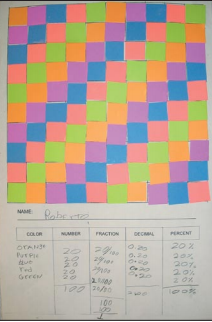
One way I, as a teacher, can create an activity that involves decimals, fractions and percents is to incorporate it with art. I found inspiration from an article titled, “Masterpieces to Mathematics: Using Art to Teach Fraction, Decimal, and Percent Equivalents.” Each student would receive a 100 square grid and a large amount of colored squares (red, green, blue, purple, orange) to create and glue on their square grid paper in a design of their choosing:

As seen on the image above, when the students were done with their masterpiece, they would have another sheet consisting of columns: color, number, fraction, decimal, and percent. They would list the colors they used under the color column, and then count the amount of squares of each color and record it in the number column. They would then convert the number of each color used compared to the total amount of squares (100) to a fraction, decimal, and percent. To further their understanding, I could ask the students to block out the outer squares and ask to calculate the new number of each color, fraction, decimal, and percent from the new total (64).

Percent

References: http://www.17centurymaths.com/contents/napier/jimsnewstuff/Napiers%20Bones/NapiersBones.html

http://www.decodeunicode.org/u+0025

< http://mason.gmu.edu/~jsuh4/math%20masterpiece.pdf>

< http://english.stackexchange.com/questions/177757/why-are-decimals-read-as-fractions-by-some-cultures>

< http://www.princeton.edu/~achaney/tmve/wiki100k/docs/Decimal_separator.html&gt;


Engaging students: Adding a mixture of positive and negative numbers

In my capstone class for future secondary math teachers, I ask my students to come up with ideas for engaging their students with different topics in the secondary mathematics curriculum. In other words, the point of the assignment was not to devise a full-blown lesson plan on this topic. Instead, I asked my students to think about three different ways of getting their students interested in the topic in the first place.

I plan to share some of the best of these ideas on this blog (after asking my students’ permission, of course).

This student submission comes from my former student Donna House. Her topic, from Pre-Algebra: adding a mixture of positive and negative numbers.

green line

How can this topic be used in your students’ future courses in mathematics or science?

Version 1

It would be difficult to do well in any future course in mathematics or science without understanding the concept of adding and subtracting positive and negative numbers. This concept is used for temperature, altitude, growth and decay, magnitude, distance, size, profit and loss, and many other topics.

An example from physics would be the students solving a problem involving force. They need to discover how much drag force is needed to stop a drag racing car at the end of the track. The forward force (speed) of the car is positive and needs to be “cancelled out” or reduced to zero in order to stop the car. The students will need to determine if the regular brakes (negative) on the car are sufficient to stop the racer in time, or if additional drag forces (negative) need to be added.

Version 2 (Written as an Engage)

How much force is needed to stop a drag racing car? If you do not stop the car in time, it will crash into the wall, or the fence, or maybe even the water tower and then where would you declare your undying love to Betty Sue? If you stop the car too quickly, you will lose the race and Betty Sue won’t love you anymore. And all this happened because you did not know about adding and subtracting positive and negative numbers!

To stop that racing car you will need to know how much drag force is needed to cancel out the forward force (speed) of the car. Since the forward force is positive, the drag force is negative. But the regular brakes may not give enough drag force to stop the car in time. You may need to add some negative numbers! Remember, your entire future with Betty Sue depends on adding positive and negative numbers!


green line

C1. How has this topic appeared in pop culture?

What if you thought you won the lottery, but found out you were wrong? In November of 2007 a scratch-off lottery card game in England was pulled from the shelves because customers did not understand the concept of negative numbers. Many people tried to claim their prizes only to be told they did not win. Why was there so much confusion? The cards involved negative numbers!

The “Cool Cash” scratch-offs had a cute picture of a penguin on the front. One scratched off windows trying to reveal a temperature that was lower than the temperature revealed on the card. All of the temperatures revealed were below zero and had negative signs. The problem was that many people could not understand whether -6 was larger or smaller than -8. What do you think?

http://www.manchestereveningnews.co.uk/news/greater-manchester-news/cool-cash-card-confusion-1009701


green line

D3. How did people’s conception of this topic change over time?           

Negative numbers have struggled for recognition since ancient times. Negative numbers were ignored by mathematicians for centuries, and considered to be false, non-existent, or simply absurd. Whenever a solution was found to be negative, it was discarded as nonsense. They got no respect. Eventually, the concept of adding and subtracting negative and positive numbers was used to indicate debt and payment, but not much else. Mathematicians just did not quite understand what negative numbers are, even though the negatives cried out to be seen as real numbers.

As time passed, negative numbers began to be recognized as useful, but were generally considered imaginary. They were not accepted as real numbers until the middle of the 18th century, but were still commonly ignored as solutions. The negatives protested peacefully. In the 19th century, negative numbers were finally accepted, but still not widely liked. However, their usefulness caused them to be recognized and they happily indicated the weather, the distance below sea level, and whether or not a golfer’s score was below par.

Today negative numbers have a very good relationship with positive numbers, and are loved by many people. The usefulness of adding and subtracting positive numbers cannot be denied. (Just try to break a world record in racing without this concept!)

http://webspace.ship.edu/kgmcgi/m400/Presentations/Chapter 5 Something Less Than Nothing.ppt

http://en.wikipedia.org/wiki/Negative_number#History


Engaging students: Solving two-step algebra problems

In my capstone class for future secondary math teachers, I ask my students to come up with ideas for engaging their students with different topics in the secondary mathematics curriculum. In other words, the point of the assignment was not to devise a full-blown lesson plan on this topic. Instead, I asked my students to think about three different ways of getting their students interested in the topic in the first place.

I plan to share some of the best of these ideas on this blog (after asking my students’ permission, of course).

This student submission comes from my former student Delaina Bazaldua. Her topic, from Pre-Algebra: solving two-step algebra problems.

green line

How can technology (YouTube, Khan Academy [khanacademy.org], Vi Hart, Geometers Sketchpad, graphing calculators, etc.) be used to effectively engage students with this topic?

I have a love for TED ED videos because of how the videos can explain math, science, etc. with real world examples which is often foreign to students. Bill Nye has always been a hero of mine growing up; his witty ways to communicate math and science to students is admirable. With that being said, when I found, http://ed.ted.com/on/vUO3lcyK#watch, I was really excited that Bill Nye and TED ED made a video that included a subject that was seemingly abstract to students and related it to something very common such as, in this case, cupcakes. Bill Nye takes the viewer on an errand he has to run to pick up cupcakes for his niece and nephew. Of course, since they’re siblings, they have to have an equal amount of cupcakes or World War III may happen. This creates balance between the equal sign. From there, he and we determine the amount of cupcakes in each box (the x) that he is giving to his niece and nephew.


green line

How could you as a teacher create an activity or project that involves your topic?


Every child loves playing games and students in Pre Algebra are no exception to this assumption. In order to manipulate math into games, the resource I found used Bingo as a game to play with a high school class: http://makingmathfun.wikispaces.com/file/view/Two-Step+EQ+BINGO.pdf. I find this as an exceptional game for students to receive practice solving two-step algebraic equations because they may not necessarily realize they’re learning math in the process of playing even though they inevitably are. I am a strong believer in making something seemingly difficult much more fun so that it can be enjoyed by more people. If Bingo is fulfilling this dream, then I am doing my job because passion in math through a game for example leads to understanding of the material and to hard-working students. Playing games to teach algebra makes math seem like less of a chore and hassle, which unfortunately, it is often perceived as. If I can, as a teacher, change this perspective, I could have an effect on students’ lives for the rest of their education career and possibly even their life.


green line

What interesting (i.e., uncontrived) word problems using this topic can your students do now?


As I had previously mentioned, algebra is often viewed by students as abstract and unrelated to the real world. I felt like I needed to include word problems that translate to things that happen in life such as the TED ED/Bill Nye video example that portrayed two-step algebraic equations; math isn’t just simply numbers, but instead is applicable to everyday activities. I found a great PDF file, http://cdn.kutasoftware.com/Worksheets/PreAlg/Two-Step%20Word%20Problems.pdf, which includes 14 word problems that students are familiar with. Another great characteristic about word problems is you can receive a deeper understanding about what a student knows and doesn’t know based on what numbers they write from the word problem that forms their equation. Way too often teachers give students the numbers they need to work with instead of allowing the students to figure out the numbers on their own from a problem that they may actually encounter in life. This habit becomes a disadvantage and a hindrance to students which is why they feel that math is foreign to the world around them and become frustrated with “a pointless subject.” These two reasons make word problems extremely important and useful for students and I believe the worksheet I chose is perfect for accomplishing the goal of allowing students to learn with relevant scenarios.


References:

http://ed.ted.com/on/vUO3lcyK#watch

http://makingmathfun.wikispaces.com/file/view/Two-Step+EQ+BINGO.pdf

http://cdn.kutasoftware.com/Worksheets/PreAlg/Two-Step%20Word%20Problems.pdf


Engaging students: Order of operations

In my capstone class for future secondary math teachers, I ask my students to come up with ideas for engaging their students with different topics in the secondary mathematics curriculum. In other words, the point of the assignment was not to devise a full-blown lesson plan on this topic. Instead, I asked my students to think about three different ways of getting their students interested in the topic in the first place.

I plan to share some of the best of these ideas on this blog (after asking my students’ permission, of course).

This student submission comes from my former student Chais Price. His topic, from Pre-Algebra: order of operations.

green line

How could you as a teacher create an activity or project that involves your topic?

With a concept as foundational as the order of operations, an interactive activity involving precise directions given from the teacher to the class would be appropriate and hopefully engaging. To clarify on this topic, imagine a teacher that explains to the class that we have a problem to solve. That problem could be that there is a hidden homework pass locked away inside a box. The only way to unlock the box to get the homework pass out is by following a set of simple instructions in order (possibly even a scavenger hunt). After the class completes the instructions, they are then to vocalize what they just did emphasizing he order. The Teacher can start off with saying from this point on everything I say is fair game as far as any directions I give you. So everyone stand up. Take off your shoes left shoe first then right. Next bring your shoes to the front of the class room and return to your desk. Do 5 jumping jacks and spin around twice and be seated. After students do this and recite back verbally their actions in order the teacher can then ask them do repeat the given directions backwards.


green line

  • How can this topic be used in your students’ future courses in mathematics or science?

The topic of the order of operations will be used in all high school math classes and most undergraduate math courses. It is truly a fundamental topic. Without knowing the order of which operation to apply first, the challenge remains. How then can our solution be correct?If you add or subtract before you apply an exponential or division step then the answer will be incorrect. If the answer is correct then it is purely coincidence. One example of this is anywhere the quadratic formula is used which is quite often. Any time something doesn’t factor nicely we use the quadratic formula. Just take what is inside the radical for instance. B^2-4ac. If b = 2, a= 2, and c=-2 and we apply the b^2- 4 before we multiply 4ac then we are left with a 0 inside the radical which would not be correct. We need to apply the order like this: b^2= 4 and -4ac = – ((4)(2)(-2)). Thus we have 4+16= 20 inside the radical if we did the steps in the order we were supposed to.


green line

How can technology (YouTube, Khan Academy [khanacademy.org], Vi Hart, Geometers Sketchpad, graphing calculators, etc.) be used to effectively engage students with this topic? Note: It’s not enough to say “such-and-such is a great website”; you need to explain in some detail why it’s a great website.

I personally use technology such as YouTube and other sites where I can find videos of certain topics. I find these sites to be an abundant source of learning material. Take the topic of order of operations like we are discussing today. Each student has somewhat of a different learning style. With resources such as YouTube you are certain to find someone who can explain the topic to meet an individual learning style. These sites can be composed of lectures, examples, and misc. They are not put out just by teachers but students as well. When I searched order of operations on YouTube I found about 20 different videos on the first page. They ranged from beginning order of operations to multiple lessons building upon the concept. One video was even taken in the classroom with actual students (hopefully with permission). In addition I also found this video that I thought was pretty interesting. I will let you be the judge of that.


Mister, C. [learningscienceisfun]. ( 2010, October 31). PEMDAS- Order of Operations RAP [Official Music Video] Mister C. Retrieved from https://www.youtube.com/watch?v=OWyxWg2-LTY

Engaging students: Fractions, decimals, and percents

In my capstone class for future secondary math teachers, I ask my students to come up with ideas for engaging their students with different topics in the secondary mathematics curriculum. In other words, the point of the assignment was not to devise a full-blown lesson plan on this topic. Instead, I asked my students to think about three different ways of getting their students interested in the topic in the first place.

I plan to share some of the best of these ideas on this blog (after asking my students’ permission, of course).

This student submission comes from my former student Belle Duran. Her topic, from Pre-Algebra: fractions, decimals, and percents.

green line

D1. What interesting things can you say about the people who contributed to the discovery and/or development of this topic?

In the early 17th century, calculating left all remainders in fraction form since the decimal has not been invented yet; this left a lot of redundant calculating for early mathematicians as well as a lot of room for small errors. Napier thought this to be “troublesome to mathematical practice” that he created an early version of a calculator known as Napier’s logarithms (an early appearance of the notorious laziness of mathematicians). They made computing numbers so simple that they became standard for astronomers, mathematicians, and anyone who did extensive computation; except for, of course, the people who had to construct the tables (consisting of over 30,000 numbers). Since it required a lot of computation, Napier resorted to expressing the logarithms in decimals. While Napier did not invent the decimal, he was considered one of the earliest to adopt and promote its use.

In 31 BC, ruler of Rome, August, taxed the sales of goods and slaves that were based on fractions of a hundred; trading usually involved large amounts of money that 100 became a common base for mathematical operations (“per cento” is Italian for “of hundred”). From the term, abbreviations were created such as “p 100 oder p cento”. In 1425, an uneducated scribe wrote “pc” and adorned the c with a little loop; from there, the sign evolved to a combination of loop and fraction bar.

green line

D5. How have different cultures throughout time used this topic in their society?

Dating back to around 1650 B.C., Egyptian mathematicians used unit fractions; they would write five sevenths as 5/7= ½ + 1/7 + 1/14. Also, they did not use the same fraction twice, so they could not write 2/7 as 1/7+1/7, but 2/7=1/4+1/28.

In the Middle Ages, a bar over the units digit was used to separate a whole number from its fractional part, the idea deriving from Indian mathematics. It remains in common use as an under bar to superscript digits, such as monetary values.


green line

A2. How could you as a teacher create an activity or project that involves your topic?

One way I, as a teacher, can create an activity that involves decimals, fractions and percents is to incorporate it with art. I found inspiration from an article titled, “Masterpieces to Mathematics: Using Art to Teach Fraction, Decimal, and Percent Equivalents.” Each student would receive a 100 square grid and a large amount of colored squares (red, green, blue, purple, orange) to create and glue on their square grid paper in a design of their choosing:

As seen on the image above, when the students were done with their masterpiece, they would have another sheet consisting of columns: color, number, fraction, decimal, and percent. They would list the colors they used under the color column, and then count the amount of squares of each color and record it in the number column. They would then convert the number of each color used compared to the total amount of squares (100) to a fraction, decimal, and percent. To further their understanding, I could ask the students to block out the outer squares and ask to calculate the new number of each color, fraction, decimal, and percent from the new total (64).

Percent

References: http://www.17centurymaths.com/contents/napier/jimsnewstuff/Napiers%20Bones/NapiersBones.html

http://www.decodeunicode.org/u+0025

< http://mason.gmu.edu/~jsuh4/math%20masterpiece.pdf>

< http://english.stackexchange.com/questions/177757/why-are-decimals-read-as-fractions-by-some-cultures>

< http://www.princeton.edu/~achaney/tmve/wiki100k/docs/Decimal_separator.html&gt;


Did chaos cause mayhem in Jurassic Park?

I’ll happily link to this very readable introduction to chaos theory and the butterfly effect: http://plus.maths.org/content/did-chaos-cause-mayhem-jurassic-park

A sampling:

Suppose that we want to predict the future state of a system — the weather, for example — that is sensitive to initial conditions. We could measure its current state, and then iterate the system’s governing function on that seed value. This would yield an answer, but if our measurement of the system’s current state had been slightly imprecise, then the true result after a few iterations might be wildly different. Since empirical measurement with one hundred percent precision is not possible, this makes the predictive power of the model more than a few time-steps into the future essentially worthless.

The popular buzz-word for this phenonemon is the butterfly effect, a phrase inspired by a 1972 paper by the chaos theory pioneer Edward Lorenz. The astounding thing is that the unpredictability arises from a deterministic system: the function that describes the system tells you exactly what its next value will be. Nothing is left to randomness or chance, and yet accurate prediction is still impossible. To describe this strange state of affairs, Lorenz reportedly used the slogan

Chaos: When the present determines the future, but the approximate present does not determine the approximate future.

Chaotic dynamics have been observed in a wide range of phenomena, from the motion of fluids to insect populations and even the paths of planets in our solar system.

Different definitions of e: Index

I’m doing something that I should have done a long time ago: collect past series of posts into a single, easy-to-reference post. The following posts formed my series on the different definitions of e that appear in Precalculus and Calculus.

Part 1: Justification for the formula for discrete compound interest

Part 2: Pedagogical thoughts on justifying the discrete compound interest formula for students.

Part 3: Application of the discrete compound interest formula as compounding becomes more frequent.

Part 4: Informal definition of e based on a limit of the compound interest formula.

Part 5: Justification for the formula for continuous compound interest.

Part 6: A second derivation of the formula for continuous compound interest by solving a differential equation.

Part 7: A formal justification of the formula from Part 4 using the definition of a derivative.

Part 8: A formal justification of the formula from Part 4 using L’Hopital’s Rule.

Part 9: A formal justification of the continuous compound interest formula as a limit of the discrete compound interest formula.

Part 10: A second formal justification of the continuous compound interest formula as a limit of the discrete compound interest formula.

Part 11: Numerical computation of e using Riemann sums and the Trapezoid Rule to approximate areas under y = 1/x.

Part 12: Numerical computation of e using \displaystyle \left(1 + \frac{1}{n} \right)^{1/n} and also Taylor series.


Different definitions of logarithm: Index

I’m doing something that I should have done a long time ago: collect past series of posts into a single, easy-to-reference post. The following posts formed my series on how the different definitions of logarithm are in fact equivalent.

Part 1: Introduction to the two definitions: an antiderivative and an inverse function.

Part 2: The main theorem: four statements only satisfied by the logarithmic function.

Part 3: Case 1 of the proof: positive integers.

Part 4: Case 2 of the proof: positive rational numbers.

Part 5: Case 3 of the proof: negative rational numbers.

Part 6: Case 4 of the proof: irrational numbers.

Part 7: Showing that the function f(x) = \displaystyle \int_1^x \frac{dt}{t} satisfies the four statements.

Part 8: Computation of standard integrals and derivatives involving logarithmic and exponential functions.