Snell’s Law and a mystery novel

Lately, for my own leisure reading, I’ve been enjoying the murder-mystery novels of Dorothy Sayers. Her books are an enjoyable trip back in time, as she paints a very vivid portrait of English life of during the interwar years of the 1920s and 1930s. (Of course, at the time she was writing, no one had any idea that the Great War would not actually be the war to end all wars, as was the popular sentiment of the time.) Indeed, her first novel was published literally a century ago in 1923. The lead character, Lord Peter Wimsey (back then, the aristocracy was still part of English culture), has a distinctive way of speaking that makes the novels so delightful. A hallmark of the Sayers novels is that she didn’t merely write whodunit stories; instead, she strove to write novels in which a detective story happens to happen.

As an aside, I learned in her novel Gaudy Night that the adjective Oxonian means “related to Oxford,” which led me to further learn that my hometown of Oxon Hill, Maryland was so named because somebody, centuries ago, thought that the landscape of that part of the state reminded him of Oxford, England. While that comparison might have been reasonable centuries ago, it certainly would raise eyebrows today.

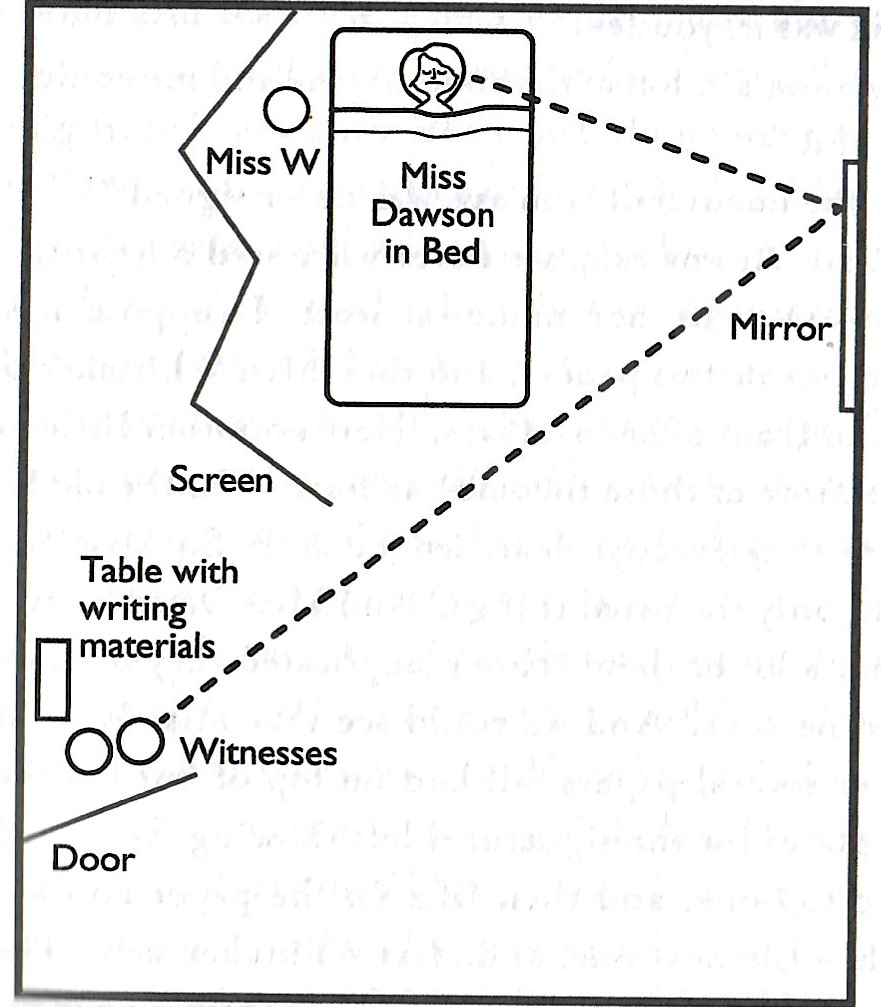
Anyway, with all that as background, in her story Unnatural Death, the following figure depicts an aerial view of a witness’s testimony at a key point in the story. I think I can describe this much of the scene without giving away the plot: the witnesses stood just inside the door of elderly Miss Dawson’s bedroom. A screen blocked direct observation of Miss Dawson as she lay in bed, but the witnesses could see Miss Dawson in the mirror.

As I read the novel, I immediately noticed that the mirror in the figure was not a perfect reflector… at the mirror, the angles of reflection of the dashed path of light are quite different. Indeed, I pulled out my protractor: the angle where the word “Mirror” is located has a measure of about 52 degrees, while the opposite reflected angle has a measure of about 72 degrees.

As this is was part of a murder-mystery novel, I thought: what could be the cause of this disparity? To be a good detective, any explanation, no matter how implausible, must be thought of and reasoned out.

One explanation of the different angles is that, somehow, the speed of light changed in the room. This is the same principle behind Snell’s Law, which explains the refraction of light as it travels between air and water. Since the speed of light in air (c_1) is different than the speed of light in water (c_2), the angle of incidence (\theta_1) is different from the angle of refraction (\theta_2), but they are related through the formula

\displaystyle \frac{\sin \theta_1}{c_1} = \frac{\sin \theta_2}{c_2}.

This relationship occurs because of Fermat’s principle, which says that light always travels in a path that requires the least amount of time. Ordinarily, this means that light travels in a straight line. However, if the speed of light should change (say, when traveling through both air and water), then the path of the light is refracted.

Fermat’s principle also explains why light reflects at equal angles if the speed of light is constant (as amusingly illustrated in this PBS video by Dianna Cowern, a.k.a. Physics Girl). However, if the speed of light should somehow change in the room at the point where the light reflects, then the light would bounce at a different angle for the same reason that Snell’s Law works.

In this case, the angles \theta_1 and \theta_2 are complementary to the 52-degree and 72-degree angles, respectively. By the cofunction trigonometric identities, this means that

\sin \theta_1 = \cos 52^\circ \quad and \quad \sin \theta_2 = \cos 72^\circ,

so that Snell’s Law can be rewritten as

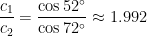
\displaystyle \frac{c_1}{c_2} = \frac{\cos 52^\circ}{\cos 72^\circ} \approx 1.992.

In other words, one explanation for the unusual path of light is that the speed of light was almost exactly twice as fast in one part of room than in the other part… and the exact threshold of this change occurred at the point where the light hit the mirror. Perhaps there was some kind of fog, mist, or other contaminant in the air near poor Miss Dawson that was so thick that light slowed to half its usual speed. So that’s one explanation.

The other explanation, of course, is that the artist who drew the picture just did a lousy job depicting the reflected light.

As this was part of a murder-mystery, both options are still open to investigation. (Yes, that was tongue-in-cheek.)

For what it’s worth, the figure in my book was not exactly the same as Sayers’ original drawing — clearly, modern word processing was used that was unavailable in the 1930s. One of these days, I may visit the Wade Center in Wheaton, Illinois, which has an impressive collection of Sayers’ works, to peruse a first-run printing of Unnatural Death to see if the figure in my book is faithful to the one that appeared when the novel was first published.

Parabolas from String Art: Index

I’m doing something that I should have done a long time ago: collecting a series of posts into one single post. The links below show my series on numerical integration.

Part 1: Introduction

Part 2: Identifying the highest points of the strings

Part 3: These nine points lie on a parabola: Method #1

Part 4: These nine points lie on a parabola: Method #2

Part 5: These nine points lie on a parabola: Method #3

Part 6: Proof that all of the highest points lie on a parabola without calculus, Part 1

Part 7: Proof that all of the highest points lie on a parabola without calculus, Part 2

Part 8: Proof that all of the highest points lie on a parabola with calculus

Part 9: Proof that the strings are indeed tangent to the parabola, with calculus

Part 10: Conclusion

An algebra and trigonometry–based proof of Kepler’s First Law

The proofs of Kepler’s Three Laws are usually included in textbooks for multivariable calculus. So I was very intrigued when I saw, in the Media Reviews of College Mathematics Journal, that somebody had published a proof of Kepler’s First Law that only uses algebra and trigonometry. Let me quote from the review:

Kepler’s first law states that bounded planetary orbits are elliptical. This law is presented in introductory textbooks, but the proof typically requires intricate integrals or vector analysis involving an accidental degeneracy. Simha offers an elementary proof of Kepler’s first law using algebra and trigonometry at the high school level.

https://doi.org/10.1080/07468342.2022.2026089

Once upon a time, I taught Precalculus for precocious high school students. I wish I had known of this result back then, as it would have been a wonderful capstone to their studies of trigonometry and the conic sections.

The preprint of this result can be found on arXiv. (The proof only addresses Kepler’s First Law and not the Second and Third Laws.) The actual article, for those with institutional access, was published in American Journal of Physics Vol. 89 No. 11 (2021): 1009-1011.

Square roots and Logarithms Without a Calculator: Index

I’m doing something that I should have done a long time ago: collect past series of posts into a single, easy-to-reference post. The following posts formed my series on computing square roots and logarithms without a calculator (with the latest post added).

Part 1: Method #1: Trial and error.

Part 2: Method #2: An algorithm comparable to long division.

Part 3: Method #3: Introduction to logarithmic tables.

Part 4: Finding antilogarithms with a table.

Part 5: Pedagogical and historical thoughts on log tables.

Part 6: Computation of square roots using a log table.

Part 7: Method #4: Slide rules

Part 8: Method #5: By hand, using a couple of known logarithms base 10, the change of base formula, and the Taylor approximation \ln(1+x) \approx x.

Part 9: An in-class activity for getting students comfortable with logarithms when seen for the first time.

Part 10: Method #6: Mentally… anecdotes from Nobel Prize-winning physicist Richard P. Feynman and me.

Part 11: Method #7: Newton’s Method.

Part 12: Method #8: The formula \sqrt{b} \approx \displaystyle \frac{a+b}{2\sqrt{a}}

Abraham Lincoln and Geometry

While re-reading the wonderful parallel biography Team of Rivals: The Political Genius of Abraham Lincoln by Doris Kearns Goodwin, I was reminded of this passage from Lincoln’s time on the Illinois traveling law circuit in the 1850s, the interlude between his term in the House of Representatives and his ascent to the presidency:

Life on the circuit provided Lincoln the time and space he needed to remedy the “want of education” he regretted all his life. During his nights and weekends on the circuit, in the absence of domestic interruptions, he taught himself geometry, carefully working out propositions and theorems until he could proudly claim that he had “nearly mastered the Six-books of Euclid.” His first law partner, John Stuart, recalled that “he read hard works — was philosophical — logical —mathematical — never read generally.”

[Law partner William] Herndon describes finding him one day “so deeply absorbed in study he scarcely looked up when I entered.” Surrounded by “a quantity of blank paper, large heavy sheets, a compass, a rule, numerous pencils, several bottles of ink of various colors, and a profusion of stationery,” Lincoln was apparently “struggling with a calculation of some magnitude, for scattered about were sheet after sheet of paper covered with an unusual array of figures.” When Herndon inquired what he was doing, he announced “that he was trying to solve the difficult problem of squaring the circle.” To this insoluble task posed by the ancients over four thousand years earlier, he devoted “the better part of the succeeding two days… almost to the point of exhaustion.”

Doris Kearns Goodwin, Team of Rivals: The Political Genius of Abraham Lincoln, pages 152-153

I have two thoughts on this: one mathematical, and one political (albeit the politics of the 19th century).

I must admit that I’m charmed by the mental image of Lincoln, like so many amateur (and professional) mathematicians before and after him, deeply engrossed after a hard day’s work by the classical problem of squaring the circle, described by Wikipedia as “the challenge of constructing a square with the area of a circle by using only a finite number of steps with a compass and straightedge.”

A subtle historical detail was left out of the above account, one that I would not expect a popular history book to include. While it’s known today that squaring the circle is impossible, this was not a settled question during Lincoln’s lifetime. Indeed, the impossibility of squaring the circle was settled in 1882, seventeen years after Lincoln’s death, when Ferdinand von Lindemann proved the transcendence of \pi — that \pi is not a root of any polynomial with integer coefficients. All this to say, when Lincoln spent two days attempting to square a circle, he was actually working on a celebrated open problem in mathematics that was easily understood by amateur mathematicians of the day… in much the same way that the Twin Prime Conjecture attracts attention today.

(As a personal aside: I still remember the triumph I felt a student many, many years ago when I read through this proof in Field Theory and Its Classical Problems and understood it well enough to stand at the chalkboard for the better part of an hour to present it to my teacher.)

Politically, I was reminded of the wonderful book Abraham Lincoln and The Structure of Reason by David Hirsch and Dan Van Haften. Hirsch and Van Haften argue that Lincoln’s studies of geometry were not merely for idle leisure or personal satisfaction, in the same way that people recreationally solve crossword puzzles today. Instead, they argue that Lincoln’s penchant for persuasive rhetoric was shaped (pardon the pun) by his study of geometry, and that Lincoln’s speeches tended to follow the same six-part outline that Euclid employed when writing geometric proofs in The Elements.