Engaging students: Adding and subtracting a mixture of positive and negative integers

In my capstone class for future secondary math teachers, I ask my students to come up with ideas for engaging their students with different topics in the secondary mathematics curriculum. In other words, the point of the assignment was not to devise a full-blown lesson plan on this topic. Instead, I asked my students to think about three different ways of getting their students interested in the topic in the first place.

I plan to share some of the best of these ideas on this blog (after asking my students’ permission, of course).

This student submission again comes from my former student Diana A’Lyssa Rodriguez. Her topic, from Algebra: adding and subtracting a mixture of positive and negative integers.

green line

A2. How could you as a teacher create an activity or project that involves your topic?

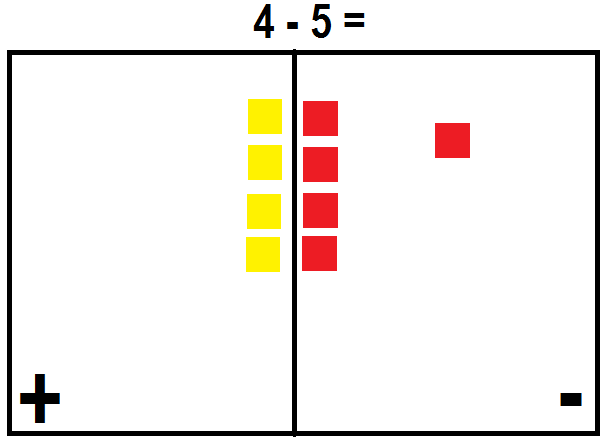
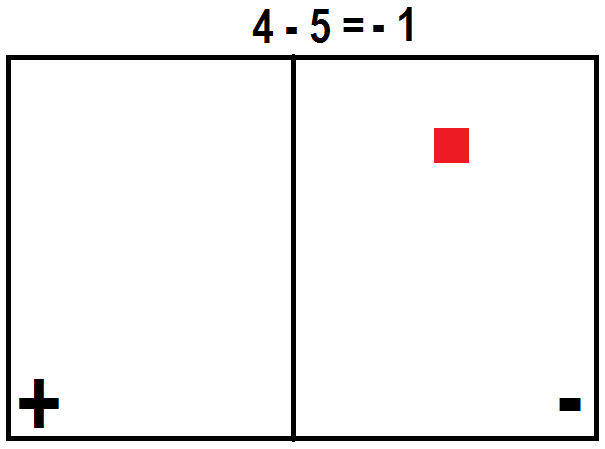
Algebra tiles are a fun, hands-on way to help students understand how to add or subtract positive and negative integers. Using a mat with a positive and negative side, students can manipulate the 1-tiles. Using the yellow side of the tile for the positive numbers and the red side for the negative numbers, students pair together opposing colors and take those away. The tiles leftover is the answer to the problem. Here is an example:

Step 1:

algebratile1

Step 2:

algebratile2

Step 3:

algebratile3

green line

B1. How can this topic be used in your students’ future courses in mathematics or science?

Adding and subtracting positive and negative integers is a one of the most crucial foundation skills that students must learn. This concept is demonstrated and needed in almost every math scenario. In its simplest form, students begin to learn this concept around the first grade, 1+1=2. This process is carried over into third grade with multiplication. Then negative numbers are introduced while in sixth grade. Adding and subtracting opposing integers is a continuous concept that consistently builds upon itself, even through algebra, geometry, calculus, or most especially the real world. There is not just one future math course students will use this in; they will use it for the rest of their lives, even if they do not realize it.


green line

E1. How can technology (YouTube, Khan Academy [khanacademy.org], Vi Hart, Geometers Sketchpad, graphing calculators, etc.) be used to effectively engage students with this topic?

YouTube is always a great resource when trying to engage students. The video below explains how positive and negative numbers work when adding and subtracting them.

A lot of the time students struggle with numbers in general, which makes it harder for them to understand why a concept in math works. This video explains how positive and negative numbers work in relation to each other by using characters from Batman instead of numbers. Using the balance and watching the arrow move in either direction, depending on the type of character that was added into or taken out, allows students to see why positive and negative numbers work the way they do. Once they understand this, it makes working with numbers a whole lot easier. This video also does a wonderful job of maintaining the students’ interest by keeping it related to popular culture by incorporating Batman and the Matrix.


 

Engaging students: Ratios and rates of change

In my capstone class for future secondary math teachers, I ask my students to come up with ideas for engaging their students with different topics in the secondary mathematics curriculum. In other words, the point of the assignment was not to devise a full-blown lesson plan on this topic. Instead, I asked my students to think about three different ways of getting their students interested in the topic in the first place.

I plan to share some of the best of these ideas on this blog (after asking my students’ permission, of course).

This student submission again comes from my former student Avery Fortenberry. His topic, from Algebra: ratios and rates of change.

green line

In this viral YouTube video a man asks his wife the question “If you are traveling 80 miles per hour, how long does it take to travel 80 miles.” The wife overthinks the question and instead of trying to calculate how long it would take using the information of 80 miles per hour and how that they were going to travel one hour, she tries to think of how quick the tires are spinning and estimating the speed using her speed in running. The couple later goes on to talk on the Comedy Central show Tosh.0 where the wife explains the reason she was confused was that she had not slept well the night before and she was stressed with just finishing her finals. This video stresses the importance of making sure people understand that 80 miles per hour means you travel 80 miles in one hour.


green line

The history of a rate of change is interesting when you consider the history of calculus itself. An important concept of calculus is finding derivatives, which is finding the rate of change or slope of a line. Calculus’s discovery was credited to both Isaac Newton and Gottfried Leibniz who both published their work around roughly the same time. This caused a dispute between the two men and they both accused the other of stealing their work. While both contributed much to the world of mathematics, it was many of Leibniz’s concepts of calculus that we still use today such as his notation dy/dx used for derivatives. Despite that Leibniz died poor and dishonored while Newton had a state funeral.


green line

One of my favorite websites is khanacademy.org. This website has helped me from when I was in high school all the way to now it is still helping me understand concepts I may not have fully understood in class. It is a valuable resource to use when teaching about rates of change because there are countless videos over rates of change and slope and derivative that explain in detail all the concepts of it. Also, it has multiple practice problems that help you practice and study for an exam. I even used it for this project to help refresh my memory on rates of change and I was also looking at its word problems to help think of a word problem on my own for the A1 section of this project. Khan Academy also teaches you by reviewing all difficult steps in problems so that you can understand all the concepts.


Resources:

https://www.youtube.com/watch?v=Qhm7-LEBznk

http://www.uh.edu/engines/epi1375.htm

www.Khanacademy.org


Another poorly written word problem (Part 8)

Textbooks have included the occasional awful problem ever since Pebbles Flintstone and Bamm-Bamm Rubble chiseled their homework on slate tablets while attending Bedrock Elementary. But even with the understanding that there have been children have been doing awful homework problems since the dawn of time (and long before the advent of the Common Core), this one is a doozy.

There’s no sense having a debate about standards for elementary mathematics if textbook publishers can’t construct sentences that can be understood by students (or their parents).


badproblem3

On its face, problems 11 and 12 don’t look so bad. For #11, the appropriate inequality is

1400 + 243 + w \le 2000

1643 + w \le 2000

w \le 357

For #12, the inequality is

7 + g \le 15

g \le 8.

These indeed are the answers that the textbook is expecting. However, both answers are wrong because both w and g have to be positive. So the answers should be 0 \le w \le 357 and 0 \le g \le 8. Which would be no big deal — except that these problems appeared before compound inequalities were introduced. (Notice that problems 7 through 10 only contain a single inequality.)

So, in a nutshell, the correct answers for these problems require skills that students have not yet learned at the time that they would attempt these problems.

Another poorly written word problem (Part 7)

Textbooks have included the occasional awful problem ever since Pebbles Flintstone and Bamm-Bamm Rubble chiseled their homework on slate tablets while attending Bedrock Elementary. But even with the understanding that there have been children have been doing awful homework problems since the dawn of time (and long before the advent of the Common Core), this one is a doozy.

There’s no sense having a debate about standards for elementary mathematics if textbook publishers can’t construct sentences that can be understood by students (or their parents).


badproblem2

Based only on how the questions are worded, should the answers to #53 and #54 be

5x - 10 < 6x -8 \qquad \hbox{and} \qquad x + 20 < 4x - 1?

Or should they be

5x - 10 < 6(x -8) = 6x - 48 \qquad \hbox{and} \qquad x + 20 < 4(x - 1) = 4x -4?

My answer: I have no idea. An argument could be made for either interpretation. And if a problem can be read two different ways by reasonable readers, then it should never be published in a textbook.

Another poorly written word problem (Part 6)

Textbooks have included the occasional awful problem ever since Pebbles Flintstone and Bamm-Bamm Rubble chiseled their homework on slate tablets while attending Bedrock Elementary. But even with the understanding that there have been children have been doing awful homework problems since the dawn of time (and long before the advent of the Common Core), this one is a doozy.

There’s no sense having a debate about standards for elementary mathematics if textbook publishers can’t construct sentences that can be understood by students (or their parents).


badproblem1

This one makes my blood boil. According to its advocates, the whole point of the Common Core standards was to increase the rigor in secondary mathematics. However, this one is SIMPLY WRONG.

The textbook does correctly note that the proper definition of a function is a set of ordered pairs. The “correct” answer, according to the textbook, is answer G — the plotted points do not match the ordered pairs.

However, answer H is also wrong. The textbook would have students believe that order is important when listing the elements of a set. However, order is not important — the domain of \{-3, 1, -1, 3\} is the same as \{-3, -1, 1, 3\} or latex \{3, -3, -1, 1\}$. This is standard mathematical notation — in an ordered pair (or ordered n-tuple), the order is important. For a set, the order is not important.

Specifying that the domain is \{-3,-1,1,3\} and the range is \{2,5,8,11\} does not uniquely determine the function. In fact, there are 24 different functions that have this domain and range (where we distinguish between the range of a function and its codomain).


In other words, in trying to be clever about properly defining a function and showing different representations of a function, the textbook promotes a misconception about sets… which makes me wonder if the textbook’s attempt at trying to be ultra-careful about the definition of a function is really worth it.

Another poorly written word problem (Part 5)

Textbooks have included the occasional awful problem ever since Pebbles Flintstone and Bamm-Bamm Rubble chiseled their homework on slate tablets while attending Bedrock Elementary. But even with the understanding that there have been children have been doing awful homework problems since the dawn of time (and long before the advent of the Common Core), this one is a doozy.

There’s no sense having a debate about standards for elementary mathematics if textbook publishers can’t construct sentences that can be understood by students (or their parents).


badproblem4

This one really annoys me. The area is less than 55 square inches, and so the appropriate inequality is

\frac{1}{2} (5)(2x+3) < 55

5(2x+3) < 110

2x + 3 < 22

2x < 19

x < 9.5

However, part (c) asks for the maximum height of the triangle. But there isn’t a maximum possible height. If the height was actually equal to 9.5 inches, then the area would be equal to 55 square inches, which is too big! Also, if any height less than 9.5 is chosen (for the sake of argument, say 9.499), then there is another acceptable height that’s larger (say 9.4995).

Technically, the problem should ask for the greatest upper bound (or supremum) of the height of the triangle, but that’s too much to expect of middle school or high school students learning algebra.

This problem could have been salvaged if it had stated that the area is less than or equal to 55 square inches. However, in its present form, part (c) of this problem is unforgivably awful.

Mathematics that Swings: The Math Behind Golf

From the YouTube description:

Mathematics is everywhere, and the golf course is no exception. Many aspects of the game of golf can be illuminated or improved through mathematical modeling and analysis. We will discuss a few examples, employing mathematics ranging from simple high school algebra to computational techniques at the frontiers of contemporary research.