Engaging students: Fractions, decimals, and percents

In my capstone class for future secondary math teachers, I ask my students to come up with ideas for engaging their students with different topics in the secondary mathematics curriculum. In other words, the point of the assignment was not to devise a full-blown lesson plan on this topic. Instead, I asked my students to think about three different ways of getting their students interested in the topic in the first place.

I plan to share some of the best of these ideas on this blog (after asking my students’ permission, of course).

This student submission again comes from my former student Perla Perez. Her topic, from Algebra: fractions, decimals, and percents.

green line

A2. How could you as a teacher create an activity or project that involves your topic?

This past summer when I worked as a program assistant for TexPrep, we had the opportunity to have a pizza party. How fun! Well it took longer than we thought to pick out a place and figure out how much we all had to pay. I got to thinking about how this could be a great engaging activity for students to get excited about decimals, fractions, and percents.

The activity will go as follows:

Students are split up into groups of four with each group given a pizza place. Every person has one of the following roles: the researcher, the recorder, the calculator, and the presenter (to compare with other groups). Their goal is to find the pizza place that is the cheapest, gives the most pizza, and figure out how much each individual would have to pay. By comparing each other’s work during presentations, students get to compare, contrast, and see the different methods used to solve the problems. This also gives the teacher an opportunity to understand their comprehension level of the subject and see if converting a percentage is difficult for them or not. When all the groups are finished gathering their information they will present. Afterwards (if allowed), we will reward ourselves with eating pizza! Through this activity students will have to come up their own way to solve these problems. It leads them to work with: Decimals, since they must include every penny (including tax); Fractions, when it comes to figuring out how much each individual owes; and Precents, when asked to compare prices between pizza places.

green line

C3. How has this topic appeared in the news?

Decimals, fractions, and percent are used in media to represent a variety of concepts from the percent of the candidate poll elections to percent chance of rain. Now some of these topics might not sound interesting to most students, but current events such as the movement to raise minimum wage to $15.00 can grab their attention. Students can then be given questions such as: How does that affect the regular worker financially? Are employees working the same hours? Do employees get fewer hours and more pay, or do they keep their regular hours? In the Time article “Here’s Every City in America Getting a $15 Minimum Wage”, it mentions how some restaurants are increasing their prices from 4% to 21% which begs to question, is everything in the market going to increase as well? All the answers to these questions can be found in the news and prompt their interest in actually doing the math to find out the answers. The news also gives them the real world application student’s consistently are trying to find. Engaging students about the news and simply prompting them before the lesson allows students to continue thinking about it as they go forth in the lesson.

Helpful links:

green line

E1. How can technology (YouTube, Khan Academy [khanacademy.org], Vi Hart, Geometers Sketchpad, graphing calculators, etc.) be used to effectively engage students with this topic?

As we continue to advance in technology, we begin to see how there are many ways a student can learn. The internet is full of different educational games, activities, calculators, and above all videos that are useful to educators. There are videos basically for everything. So what better way to engage students than with a video that knows exactly how they feel like in this one: https://www.youtube.com/watch?v=cGqQOQavbls. The video is a great representation of how a unique activity such as magic can be used to stimulate students in understanding the idea of how fractions, decimals, and percentages relate to one another. Aside from funny videos students also like to interact in games like: http://www.math-play.com/Fractions-Decimals-Percents-Jeopardy/fractions-decimals-percents-jeopardy.html and http://www.topmarks.co.uk/maths-games/7-11-years/fractions-and-decimals. The first game allows students to practice converting fractions, decimals, and fractions from one to another and shows them how they are related. The last website gives teachers a variety of tools to choose from, all of which can help a lot in the classroom.

References:


My Mathematical Magic Show: Index

I’m doing something that I should have done a long time ago: collecting a series of posts into one single post. The links below show the mathematical magic show that I’ll perform from time to time.

Part 1: Introduction.

Part 2a, Part 2b, and Part 2c: The 1089 trick.

Part 3a, Part 3b, and Part 3c: A geometric magic trick.

Part 4a: Part 4b, Part 4c, and Part 4d: A trick using binary numbers.

Part 5a, Part 5b, Part 5c, and Part 5d: A trick using the rule for checking if a number is a multiple of 9.

Part 7: The Fitch-Cheney card trick, which is perhaps the slickest mathematical card trick ever devised.

Part 8a, Part 8b, and Part 8c: A trick using Pascal’s triangle.

Part 6: The Grand Finale.

And, for the sake of completeness, here’s a recent picture of me just before I performed an abbreviated version of this show for UNT’s Preview Day for high school students thinking about enrolling at my university.

magician


Engaging students: Solving one-step algebra problems

In my capstone class for future secondary math teachers, I ask my students to come up with ideas for engaging their students with different topics in the secondary mathematics curriculum. In other words, the point of the assignment was not to devise a full-blown lesson plan on this topic. Instead, I asked my students to think about three different ways of getting their students interested in the topic in the first place.

I plan to share some of the best of these ideas on this blog (after asking my students’ permission, of course).

This student submission again comes from my former student Jason Trejo. His topic, from Algebra: solving one-step algebra problems.

green line

A2) How could you as a teacher create an activity or project that involves this topic?

How can I engage my students with solving for a variable? Off the top of my head, I came up with 3 tried and true surefire ways that would not only further my students understanding but also be a ton of fun for them: Algeblocks with accompanying interactive whiteboard, using a balance and counters, and possibly using snacks (e.g. cookies, chips, candies, etc.)

First things first, the Algeblocks:
algeblocks

Essentially, Algeblocks are made of a variety of cubes and rectangles that represent ones, tens hundreds, thousands, and even the variables x and x2. Although obscured in the picture, the Algeblocks mat in the back represents a balance where the fulcrum is “=” and each end of the balance represent both sides of the equation. There is even a place that represents negative numbers! Using the problem “x+4=8”, students would have 8 green blocks to the left of the fulcrum and 4 green blocks with an x block. Students would then add or take away tiles to solve the equation. As for problems such as “4x=16”, the students would display the problem using the blocks and then group the green blocks with the x’s to find there answer. Now that I think of it, I would essentially do the same thing but use either a real balance with any type of manipulative.


green line

B1) How can this topic be used in you students’ future courses in mathematics or science?

Being able to solve single step algebraic problems is a foundation to algebra in general, correct? This means that this will continue to pop up regardless of what math class (and even science classes like chemistry). There will always be problems given to students where they will need to solve for a variable and the final step of even the most excruciatingly, horrific looking algebra problems is usually adding, subtracting, multiplying, dividing, etc. to get the “x” all alone. In reality, solving an initial value problem (like I currently do in my Differential Equations class) boils down to one step algebraic solutions.


green line

E1) How can technology (YouTube, Khan Academy [khanacademy.org], Vi Hart, Geometers Sketchpad, graphing calculators, etc.) be used to effectively engage students with this topic?

Interestingly enough, I have the perfect example that ties both Khan Academy and the “use of a balance” activity I mentioned earlier. A quick Google search for “one-step equations” gives a link to Khan Academy that allows for a digital balance and you are to solve the equation given with the balance. This would be an amazing tool for teachers to use when they don’t have actual balances for their class or even have their students create a profile on Khan Academy and use it to be able to track extra problems the students can do. Besides Khan Academy, there are even some cheesy yet fun games (like “Equations Pong” off the XP Math website) that would give the students more practice with these equations while feeling like a reward since they are playing a game. Plus, students can go head-to-head in “Equations Pong” and a vast majority of students like to best their friends in anything and everything.


References:

Information on Algeblocks: http://www.hand2mind.com/brands/algeblocks

Image of Algeblock Mats: https://cdn.hand2mind.com/productimages/76986_Algeblocks_Mats_BQS-web.jpg

Khan Academy use for subject: https://www.khanacademy.org/math/algebra/solving-linear-equations-and-inequalities/why-of-algebra/e/one_step_equation_intuition

Equations Pong Game: http://www.xpmath.com/forums/arcade.php?do=play&gameid=105


Engaging students: Factoring polynomials

In my capstone class for future secondary math teachers, I ask my students to come up with ideas for engaging their students with different topics in the secondary mathematics curriculum. In other words, the point of the assignment was not to devise a full-blown lesson plan on this topic. Instead, I asked my students to think about three different ways of getting their students interested in the topic in the first place.

I plan to share some of the best of these ideas on this blog (after asking my students’ permission, of course).

This student submission again comes from my former student Irene Ogeto. Her topic, from probability: Venn diagrams.

green line

A2. How could you as a teacher create an activity or project that involves your topic?


As a warm up activity to a lesson on Venn diagrams, I could set up a model Venn diagram made out of tape on the classroom floor or in the hallway outside of the class. The topic for the activity would be comparing the number of students who prefer to play indoor sports versus the number of students who prefer to play outdoor sports. I would ask the students who prefer to play outdoor sports such as soccer, baseball, football or field hockey to stand in the circle that represents outdoor sports. Then I would ask the students who prefer to play indoor sports such as bowling or table tennis to stand in the other circle. Next, I would ask the students who prefer to play both indoor and outdoor sports such as basketball, volleyball or badminton to stand where the circles intersect. Lastly, I would ask the students who don’t prefer to play any sports to stand outside the two circles.


With this activity we can explore these questions:

  • How many students prefer to play indoor sports?
  • What is the percentage of students in our class prefer to play indoor sports?
  • How many students prefer to play both indoor and outdoor sports?
  • What percentage of students in our class prefer play both indoor and outdoor sports?
  • What percentage of the students in our class prefer to play sports?

green line

C1. How has this topic appeared in pop culture (movies, TV, current music, video games, etc.)?


Venn diagrams have appeared in children’s TV shows such as Cyberspace. In this episode of Cyberspace which is was aired on PBS in Season 1, the Cyberspace squad uses a Venn diagram to rescue the Lucky Charms. The squad uses the terms “or” and “and” with respect to sets to find the Lucky Charms. Motherboard tells them that the Lucky Charms is both blue and tall. One circle represents the blue bunnies and the other circle represents the bunnies of another color. The area where the two circles intersect represents the area where the tall and blue bunnies are. The squad works together to find the Lucky Charms using applications of Venn diagrams. Venn diagrams can be used to explore possibilities and combinations of things. This video can serve as an introduction to a lesson on Venn diagrams. It enables students to see how math is part of culture, as it is found in television shows.


Episode 112: “Of All the Luck” http://www.pbs.org/parents/cyberchase/episodes/season-1/


green line

D1. What interesting things can you say about the people who contributed to the discovery and/or the development of this topic?


John Venn (1834-1923) the famous mathematician, devised a way to picture sets by creating what is now known as Venn diagrams in 1881. John Venn was born in Hull, New England, United Kingdom. He was a lecturer, president of a college, and a priest for some of the years in his life. Venn wanted to show how different groups of things could be represented visually. John Venn called Venn diagrams Eulerian circles because they were similar to the Euler circles created by Leonhard Euler. While they share similarities, Euler circles and Venn diagrams are different. Venn diagrams are more sophisticated and are used to represent all possible combinations of classes. Euler circles differ in the sense that the circles do not always have to intersect and do not always represent all possible combinations. Some people still refer to Venn diagrams as Eulerian circles to this day and often some people use the two terms interchangeably. Despite the differences, both diagrams are used in math every day.


References:

http://www.venndiagram.net/the-history-behind-the-venn-diagram.html

http://www.mathresources.com/products/mathresource/maa/venn_diagram.html

http://www.pbs.org/parents/cyberchase/episodes/season-1/


Engaging students: Rational and irrational numbers

In my capstone class for future secondary math teachers, I ask my students to come up with ideas for engaging their students with different topics in the secondary mathematics curriculum. In other words, the point of the assignment was not to devise a full-blown lesson plan on this topic. Instead, I asked my students to think about three different ways of getting their students interested in the topic in the first place.

I plan to share some of the best of these ideas on this blog (after asking my students’ permission, of course).

This student submission again comes from my former student Emma Sivado. Her topic, from Algebra: rational and irrational numbers.

green line

D.1: What interesting things can you say about the people who contributed to the discovery and/or the development of this topic?

The famous story on the first discovery of irrational numbers is one of violence. We all know the Pythagorean theorem, a2+b2=c2 , but what happens if we have a right triangle with height 1 and base 1? The hypotenuse becomes √2. So, √2, what’s the big deal? Well this is where we turn to history for the answer. Hippassus was an ancient greek philosopher who belonged to the Pythagorean school of thought. Now the Pythagorean’s had a saying, “All is number.” What do we think this means? What Pythagoras meant was that everything in the universe had a numerical attribute. For example, one is the number of reason, five is the number of marriage. So one day when Hippassus was playing with the length of the diagonal of the unit square, or the hypotenuse of a right triangle with base 1 and height 1, he discovered the number √2. Hippassus tried to write √2 as a fraction, or rational number, and found it to be impossible. Therefore, √2 is what we call an irrational number. Well this is where the history turns violent. There are numerous stories to explain the death of Hippassus, but all of them point to his ultimate cause of death being the discovery of these irrational numbers. Irrational numbers were so against Pythagoras and the Pythagorean school of thought that they had this man killed!

https://brilliant.org/discussions/thread/discovery-of-irrational-numbers/

http://www.math.tamu.edu/~dallen/history/pythag/pythag.html


green line

B.1: How can this topic be used in your students’ future courses in mathematics and science?

I believe that the irrational number would be a great place to introduce a simple proof. Students will have to do proofs in multiple math classes in the future and to give them an example with an interesting story might be a good place to start. For example, after telling the story of the discovery of irrational numbers ask the students how Hippassus might have proven that this was true; possibly his dying words. Then give them an outline or fill in the black of the proof that √2 is irrational. This example I found on homeschoolmath.net is given in good language and gives good explanations of why everything is done in the order it is:

Let’s suppose √2 is a rational number. Then we can write it √2  = a/b where a, b are whole numbers, b not zero.

We additionally assume that this a/b is simplified to lowest terms, since that can obviously be done with any fraction.

From the equality √2  = a/b it follows that 2 = a2/b2,  or  a2 = 2 · b2.  So the square of a is an even number since it is two times something.

From this we know that a itself is also an even number. Why? Because it can’t be odd; if a itself was odd, then a · a would be odd too. Odd number times odd number is always odd.

Okay, if a itself is an even number, then a is 2 times some other whole number. In symbols, a = 2k where k is this other number. We don’t need to know what k is; it won’t matter. Soon comes the contradiction.

If we substitute a = 2k into the original equation 2 = a2/b2, this is what we get:

2 = (2k)2/b2
2 = 4k2/b2
2*b2 = 4k2
b2 = 2k2

This means that b2 is even, from which follows again that b itself is even. And that is a contradiction!!!

WHY is that a contradiction? Because we started the whole process assuming that a/b was simplified to lowest terms, and now it turns out that a and b both would be even. We ended at a contradiction; thus our original assumption (that √2 is rational) is not correct. Therefore √2 is rational.


Obviously this would have to be presented slowly, but I believe that the students could do this and understand it.

http://www.homeschoolmath.net/teaching/proof_square_root_2_irrational.php


green line

I would begin by showing the movie clip from Life of Pi when Pi is reciting all the digits of Pi that he knows, or another video of someone reciting a ridiculous number of digits of pi. Then I would ask the students how many digits of Pi there are? When no one could tell me an exact answer I would introduce the irrational number and explain how the decimals will go on forever because this number cannot be written as a fraction like a rational number. At the end of class you could show the kids the Princeton University Pi Day celebration complete with Einstein look alike contests, and pi reciting competitions to win $314.15!

http://www.pidayprinceton.com/


References:


Engaging students: Adding and subtracting a mixture of positive and negative integers

In my capstone class for future secondary math teachers, I ask my students to come up with ideas for engaging their students with different topics in the secondary mathematics curriculum. In other words, the point of the assignment was not to devise a full-blown lesson plan on this topic. Instead, I asked my students to think about three different ways of getting their students interested in the topic in the first place.

I plan to share some of the best of these ideas on this blog (after asking my students’ permission, of course).

This student submission again comes from my former student Diana A’Lyssa Rodriguez. Her topic, from Algebra: adding and subtracting a mixture of positive and negative integers.

green line

A2. How could you as a teacher create an activity or project that involves your topic?

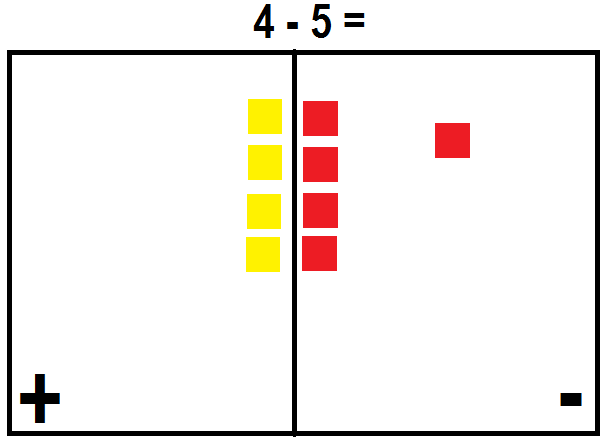
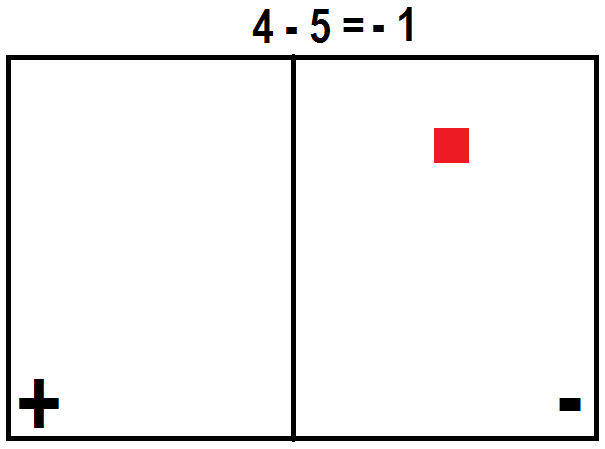
Algebra tiles are a fun, hands-on way to help students understand how to add or subtract positive and negative integers. Using a mat with a positive and negative side, students can manipulate the 1-tiles. Using the yellow side of the tile for the positive numbers and the red side for the negative numbers, students pair together opposing colors and take those away. The tiles leftover is the answer to the problem. Here is an example:

Step 1:

algebratile1

Step 2:

algebratile2

Step 3:

algebratile3

green line

B1. How can this topic be used in your students’ future courses in mathematics or science?

Adding and subtracting positive and negative integers is a one of the most crucial foundation skills that students must learn. This concept is demonstrated and needed in almost every math scenario. In its simplest form, students begin to learn this concept around the first grade, 1+1=2. This process is carried over into third grade with multiplication. Then negative numbers are introduced while in sixth grade. Adding and subtracting opposing integers is a continuous concept that consistently builds upon itself, even through algebra, geometry, calculus, or most especially the real world. There is not just one future math course students will use this in; they will use it for the rest of their lives, even if they do not realize it.


green line

E1. How can technology (YouTube, Khan Academy [khanacademy.org], Vi Hart, Geometers Sketchpad, graphing calculators, etc.) be used to effectively engage students with this topic?

YouTube is always a great resource when trying to engage students. The video below explains how positive and negative numbers work when adding and subtracting them.

A lot of the time students struggle with numbers in general, which makes it harder for them to understand why a concept in math works. This video explains how positive and negative numbers work in relation to each other by using characters from Batman instead of numbers. Using the balance and watching the arrow move in either direction, depending on the type of character that was added into or taken out, allows students to see why positive and negative numbers work the way they do. Once they understand this, it makes working with numbers a whole lot easier. This video also does a wonderful job of maintaining the students’ interest by keeping it related to popular culture by incorporating Batman and the Matrix.


Engaging students: Ratios and rates of change

In my capstone class for future secondary math teachers, I ask my students to come up with ideas for engaging their students with different topics in the secondary mathematics curriculum. In other words, the point of the assignment was not to devise a full-blown lesson plan on this topic. Instead, I asked my students to think about three different ways of getting their students interested in the topic in the first place.

I plan to share some of the best of these ideas on this blog (after asking my students’ permission, of course).

This student submission again comes from my former student Avery Fortenberry. His topic, from Algebra: ratios and rates of change.

green line

In this viral YouTube video a man asks his wife the question “If you are traveling 80 miles per hour, how long does it take to travel 80 miles.” The wife overthinks the question and instead of trying to calculate how long it would take using the information of 80 miles per hour and how that they were going to travel one hour, she tries to think of how quick the tires are spinning and estimating the speed using her speed in running. The couple later goes on to talk on the Comedy Central show Tosh.0 where the wife explains the reason she was confused was that she had not slept well the night before and she was stressed with just finishing her finals. This video stresses the importance of making sure people understand that 80 miles per hour means you travel 80 miles in one hour.


green line

The history of a rate of change is interesting when you consider the history of calculus itself. An important concept of calculus is finding derivatives, which is finding the rate of change or slope of a line. Calculus’s discovery was credited to both Isaac Newton and Gottfried Leibniz who both published their work around roughly the same time. This caused a dispute between the two men and they both accused the other of stealing their work. While both contributed much to the world of mathematics, it was many of Leibniz’s concepts of calculus that we still use today such as his notation dy/dx used for derivatives. Despite that Leibniz died poor and dishonored while Newton had a state funeral.


green line

One of my favorite websites is khanacademy.org. This website has helped me from when I was in high school all the way to now it is still helping me understand concepts I may not have fully understood in class. It is a valuable resource to use when teaching about rates of change because there are countless videos over rates of change and slope and derivative that explain in detail all the concepts of it. Also, it has multiple practice problems that help you practice and study for an exam. I even used it for this project to help refresh my memory on rates of change and I was also looking at its word problems to help think of a word problem on my own for the A1 section of this project. Khan Academy also teaches you by reviewing all difficult steps in problems so that you can understand all the concepts.


Resources:

https://www.youtube.com/watch?v=Qhm7-LEBznk

http://www.uh.edu/engines/epi1375.htm

www.Khanacademy.org


Another poorly written word problem (Part 8)

Textbooks have included the occasional awful problem ever since Pebbles Flintstone and Bamm-Bamm Rubble chiseled their homework on slate tablets while attending Bedrock Elementary. But even with the understanding that there have been children have been doing awful homework problems since the dawn of time (and long before the advent of the Common Core), this one is a doozy.

There’s no sense having a debate about standards for elementary mathematics if textbook publishers can’t construct sentences that can be understood by students (or their parents).


badproblem3

On its face, problems 11 and 12 don’t look so bad. For #11, the appropriate inequality is

1400 + 243 + w \le 2000

1643 + w \le 2000

w \le 357

For #12, the inequality is

7 + g \le 15

g \le 8.

These indeed are the answers that the textbook is expecting. However, both answers are wrong because both w and g have to be positive. So the answers should be 0 \le w \le 357 and 0 \le g \le 8. Which would be no big deal — except that these problems appeared before compound inequalities were introduced. (Notice that problems 7 through 10 only contain a single inequality.)

So, in a nutshell, the correct answers for these problems require skills that students have not yet learned at the time that they would attempt these problems.

Another poorly written word problem (Part 7)

Textbooks have included the occasional awful problem ever since Pebbles Flintstone and Bamm-Bamm Rubble chiseled their homework on slate tablets while attending Bedrock Elementary. But even with the understanding that there have been children have been doing awful homework problems since the dawn of time (and long before the advent of the Common Core), this one is a doozy.

There’s no sense having a debate about standards for elementary mathematics if textbook publishers can’t construct sentences that can be understood by students (or their parents).


badproblem2

Based only on how the questions are worded, should the answers to #53 and #54 be

5x - 10 < 6x -8 \qquad \hbox{and} \qquad x + 20 < 4x - 1?

Or should they be

5x - 10 < 6(x -8) = 6x - 48 \qquad \hbox{and} \qquad x + 20 < 4(x - 1) = 4x -4?

My answer: I have no idea. An argument could be made for either interpretation. And if a problem can be read two different ways by reasonable readers, then it should never be published in a textbook.

Another poorly written word problem (Part 6)

Textbooks have included the occasional awful problem ever since Pebbles Flintstone and Bamm-Bamm Rubble chiseled their homework on slate tablets while attending Bedrock Elementary. But even with the understanding that there have been children have been doing awful homework problems since the dawn of time (and long before the advent of the Common Core), this one is a doozy.

There’s no sense having a debate about standards for elementary mathematics if textbook publishers can’t construct sentences that can be understood by students (or their parents).


badproblem1

This one makes my blood boil. According to its advocates, the whole point of the Common Core standards was to increase the rigor in secondary mathematics. However, this one is SIMPLY WRONG.

The textbook does correctly note that the proper definition of a function is a set of ordered pairs. The “correct” answer, according to the textbook, is answer G — the plotted points do not match the ordered pairs.

However, answer H is also wrong. The textbook would have students believe that order is important when listing the elements of a set. However, order is not important — the domain of \{-3, 1, -1, 3\} is the same as \{-3, -1, 1, 3\} or latex \{3, -3, -1, 1\}$. This is standard mathematical notation — in an ordered pair (or ordered n-tuple), the order is important. For a set, the order is not important.

Specifying that the domain is \{-3,-1,1,3\} and the range is \{2,5,8,11\} does not uniquely determine the function. In fact, there are 24 different functions that have this domain and range (where we distinguish between the range of a function and its codomain).

In other words, in trying to be clever about properly defining a function and showing different representations of a function, the textbook promotes a misconception about sets… which makes me wonder if the textbook’s attempt at trying to be ultra-careful about the definition of a function is really worth it.