
Last summer, Math With Bad Drawings had a nice series on the notion of infinity that I recommend highly. This topic is a perennial struggle for math majors to grasp, and I like the approach that the author uses to sell this difficult notion.
Month: October 2015
Interpreting statistical significance

Source: http://www.xkcd.com/1478/
Win $1,000,000 by Playing Minesweeper!
Yes, you read that headline correctly: it is possible for a mathematician to win $1,000,000 by playing Minesweeper. Here’s how:
First, the source of the $1,000,000. In 2000, the Clay Mathematics Institute created a list of important unsolved problems in mathematics (see also Wikipedia), offering each one a prize of $1,000,000 for a solution. Specifically, according to the rules,
[A] proposed solution must be published in a refereed mathematics publication of worldwide repute… and it must also have general acceptance in the mathematics community two years after.
Of the eight problems on the list, one (the Poincare conjecture) has been solved so far. Incredibly, the mathematician who produced the proof turned down the $1,000,000. He was also awarded the Fields Medal, considered the Nobel Prize of mathematics, but he refused that as well.
The Millennium Problems parallel the famous 23 Hilbert problems posed by eminent mathematician David Hilbert in 1900. The Hilbert problems were unsolved at the time and were posed as a challenge to the mathematicians of the 20th century. These problems certainly generated a lot of buzz in the mathematical community, and most have been solved since 1900. (Sadly, none of the solvers won $1,000,000 for their work!)
What does this have to do with Minesweeper?
One of the problems is the famed P vs. NP problem. From Clay Mathematics:
Suppose that you are organizing housing accommodations for a group of four hundred university students. Space is limited and only one hundred of the students will receive places in the dormitory. To complicate matters, the Dean has provided you with a list of pairs of incompatible students, and requested that no pair from this list appear in your final choice. This is an example of what computer scientists call an NP-problem, since it is easy to check if a given choice of one hundred students proposed by a coworker is satisfactory (i.e., no pair taken from your coworker’s list also appears on the list from the Dean’s office), however the task of generating such a list from scratch seems to be so hard as to be completely impractical. Indeed, the total number of ways of choosing one hundred students from the four hundred applicants is greater than the number of atoms in the known universe! Thus no future civilization could ever hope to build a supercomputer capable of solving the problem by brute force; that is, by checking every possible combination of 100 students. However, this apparent difficulty may only reflect the lack of ingenuity of your programmer. In fact, one of the outstanding problems in computer science is determining whether questions exist whose answer can be quickly checked, but which require an impossibly long time to solve by any direct procedure. Problems like the one listed above certainly seem to be of this kind, but so far no one has managed to prove that any of them really are so hard as they appear, i.e., that there really is no feasible way to generate an answer with the help of a computer. Stephen Cook and Leonid Levin formulated the P (i.e., easy to find) versus NP (i.e., easy to check) problem independently in 1971.
In 2000, Richard Kaye (University of Birmingham, UK) made connected Minesweeper to the P vs. NP problem. Famed mathematical journalist Ian Stewart did a very nice job of describing the connection between the two, so I’ll simply refer to his post for a detailed description. Dr. Kaye’s website also gives a lot of information about the connection.
Classroom door for math class

Proving theorems and special cases: Index
I’m doing something that I should have done a long time ago: collecting a series of posts into one single post. The following links comprised my series on attempting to prove theorems by looking at special cases.
Famous propositions that are true for the first few cases (or many cases) before failing.
Part 1: The proposition “Is 

Part 2: The Polya conjecture is true for over 900 million cases before failing.
Part 3: A conjecture about the distribution of prime numbers is true for the first 
Mathematical induction
Part 4: Pedagogical thoughts on mathematical induction.
Part 5: More pedagogical thoughts on mathematical induction.
Famous unsolved problems in mathematics
Part 6: The Goldbach conjecture.
Part 7: The twin prime conjecture.
Part 8: The Collatz conjecture.
Part 9: The Riemann hypothesis.
Theorems in secondary mathematics that can be proven using special cases
Part 10: The sum of the angles in a convex polygon with 

Part 11: The Law of Cosines.
Part 12: Trig identities for 

Part 13: Uniqueness of logarithms.
Part 14: The Power Law for derivatives, or 
Part 15: The Mean Value Theorem.
Part 16: An old calculus problem of mine.
Part 17: Ending thoughts.
A Mathematical Horror Story
One of my guilty pleasures in the 1990s, when I was far too old to be watching children’s cartoons, was the fantastic show “Pinky and the Brain.” In the clip below, the Brain tells a scary campfire story. (Well, it’s about math, and what’s scarier than math?)
Natural logarithms

Voiceless Video Syllabus
I’m a couple months late with this… after all, school started in August… but nevertheless I recently stumbled on this voiceless video syllabus by Joshua Katz, a mathematics teacher in Florida.
I really enjoyed this.
Well done, sir. Your students are very lucky to have you as a teacher.
Langley’s Adventitious Angles (Part 2)
As a follow-up to yesterday’s triangle problem, here’s another one in the same equivalence class that I found at http://thinkzone.wlonk.com/MathFun/Triangle.htm (via the comments at Math With Bad Drawings). The author of this webpage tantalizingly calls this the World’s Hardest Easy Geometry Problem: solve for 
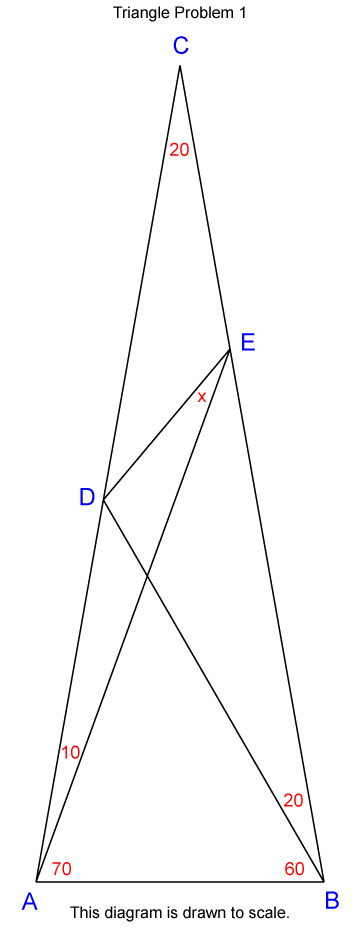
This figure is similar to the figure in yesterday’s post, except the values of 

So as to not ruin the fun, I won’t give the answer here. Instead, I’ll leave a thought bubble so you can think about the answer. In case you’re wondering: yes, I did figure this out for myself without using the Laws of Sines and Cosines. But I needed over an hour to solve this problem , and that’s after I had time to read and reflect upon the solution to the problem I posed in yesterday’s post.

Langley’s Adventitious Angles (Part 1)
Math With Bad Drawings had an interesting post about solving for

I had never heard of this problem before, but it’s apparently well known and is called Langley’s Adventitious Angles. See Math With Bad Drawings, Wikipedia, and Math Pages for more information about the solution of this problem. Math Pages has a nice discussion about mathematical aspects of this problem, including connections to the Laws of Sines and Cosines and to various trig identities.
I’d encourage you to try to solve for
I recommend this problem for advanced geometry students who need to be challenged; even bright students will be stumped concerning coming up with the requisite trick on their own. Indeed, the problem still remains quite challenging even after the trick is shown.
 Mean Green Math