Area of a Triangle and Volume of Common Shapes: Index

I’m using the Twelve Days of Christmas (and perhaps a few extra days besides) to do something that I should have done a long time ago: collect past series of posts into a single, easy-to-reference post. The following posts formed my series on different ways of finding the area of a triangle as well as finding the volumes of common shapes.

Part 1: Deriving the formula A = \displaystyle \frac{1}{2} bh.

Part 2: Cavalieri’s principle and finding areas using calculus.

Part 3: Cavalieri’s principle and finding the volume of a pyramid and then the volume of a sphere.

Part 4: Finding the area of a triangle using the Law of Sines.

Part 5: Finding the area of a triangle using the Law of Cosines.

Part 6: Finding the area of a triangle using the triangle’s incenter.

Part 7: Finding the area of a triangle using a determinant and the coordinates of the vertices.

Part 8: Finding the area of a triangle using Pick’s theorem.


A Curious Square Root: Index

I’m using the Twelve Days of Christmas (and perhaps a few extra days besides) to do something that I should have done a long time ago: collect past series of posts into a single, easy-to-reference post. The following posts formed my series on expressions containing nested square roots that nevertheless can be simplified.

Part 1: Simplifying \sqrt{5 - \sqrt{6} + \sqrt{22+8\sqrt{6}}}.

Part 2: DIfferent ways of calculating \sin 15^\circ.


Reminding students about Taylor series: Index

I’m doing something that I should have done a long time ago: collect past series of posts into a single, easy-to-reference post. The following posts formed my series on how I remind students about Taylor series. I often use this series in a class like Differential Equations, when Taylor series are needed but my class has simply forgotten about what a Taylor series is and why it’s important.

Part 1: Introduction – Why a Taylor series is important, and different applications of Taylor series.

Part 2: How I get students to understand the finite Taylor polynomial by solving a simple initial-value problem.

Part 3: Making the jump to an infinite series, and issues about tests of convergence.

Part 4: Application to f(x) = e^x, and a numerical investigation of speed of convergence.

Part 5: Application to f(x) = \displaystyle \frac{1}{1-x} and other related functions, including f(x) = \ln(1+x) and f(x) = \tan^{-1} x.

Part 6: Application to f(x) = \sin x and f(x) = \cos x, and Euler’s formula.


Area of a Circle: Index

I’m using the Twelve Days of Christmas (with a week-long head start) to do something that I should have done a long time ago: collect past series of posts into a single, easy-to-reference post. The following posts formed my series on the formula for the area of a circle.

Part 1: Why the circumference function C(r) = 2 \pi r is the derivative of the area function A(r) = \pi r^2.

Part 2: Finding the area of a circle via integration by trigonometric substitution.

Part 3: Finding the area of a circle via a double integral.

Part 4: Justifying the formula A(r) = \pi r^2 to geometry students by slicing a circle into pieces and rearranging the pieces as a parallelogram (approximately).


Common Core, Subtraction, and the Open Number Line: Index

While the implementation of the Common Core has left much to be desired (understatement of the day), I do endorse — whether it’s done through Common Core or not — the fostering of deeper conceptual understanding when teaching mathematics to elementary school students. I have plenty of opinions on teaching for conceptual understanding, Common Core mathematics, and (where the Common Core has utterly failed) assessing for conceptual understanding:

Division 1: A discussion about the usefulness of unorthodox ways of teaching long division.

Division 2: A continuation of the above discussion.

Subtraction 1: Introducing a viral picture about the Common Core, and its easy solution.

Subtraction 2: The pedagogical rationale for using an open number line (even though I personally do not endorse this technique as superior to other ways of teaching subtraction).

Subtraction 3: The abject failure of current developmentally inappropriate ways of assessing the depth of a student’s mathematical knowledge.

Subtraction 4: The importance of engaging parents when unorthodox methods are used to teach mathematics to children.


Hands on SET

Every so often, I’ll publicize through this blog an interesting article that I’ve found in the mathematics or mathematics education literature that can be freely distributed to the general public. Today, I’d like to highlight “Hands-on SET®,” by Hannah Gordon, Rebecca Gordon, and Elizabeth McMahon. Here’s the abstract:

SET® is a fun, fast-paced game that contains a surprising amount of mathematics. We will look in particular at hands-on activities in combinatorics and probability, finite geometry, and linear algebra for students at various levels. We also include a fun extension to the game that illustrates some of the power of thinking mathematically about the game.

The full article can be found here: http://dx.doi.org/10.1080/10511970.2013.764368

Full reference: Hannah Gordon, Rebecca Gordon & Elizabeth McMahon (2013) Hands-on SET®, PRIMUS: Problems, Resources, and Issues in Mathematics Undergraduate Studies, 23:7, 646-658, DOI: 10.1080/10511970.2013.764368

Lessons from teaching gifted elementary school students (Part 4c)

Every so often, I’ll informally teach a class of gifted elementary-school students. I greatly enjoy interacting with them, and I especially enjoy the questions they pose. Often these children pose questions that no one else will think about, and answering these questions requires a surprisingly depth of mathematical knowledge.

Here’s a question I once received:

What is the chance of winning a game of BINGO after only four turns?

When my class posed this question, I was a little concerned that the getting the answer might be beyond the current abilities of a gifted elementary student. As discussed over the past couple of posts, for a non-standard BINGO game with 44 numbers, the answer is

\displaystyle 4 \times \frac{4}{44} \times \frac{3}{43} \times \frac{2}{42} \times \frac{1}{41} = \displaystyle \frac{4}{135,751}

After we got the answer, I then was asked the question that I had fully anticipated but utterly dreaded:

What’s that in decimal?

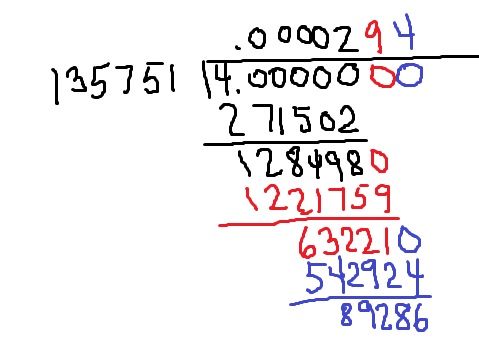
With these gifted students, I encourage thinking as much as possible without a calculator… and they wanted me to provide the answer to this one in like fashion. For my class, this actually did serve a purpose by illustrating a really complicated long division problem so they could reminded about the number of leading zeroes in such a problem.

Gritting my teeth, I started on the answer:

biglongdivisionAt this point, I was asked the other question that I had anticipated but utterly dreaded… motivated by child-like curiosity mixed perhaps with a touch of sadism:

How long do we have before the digits start repeating?

My stomach immediately started churning.

I told the class that I’d have to figure this one later. But I told them that the answer would definitely be less than 135,751 times. My class was surprised that I could even provide this level of (extremely) modest upper limit on the answer. After some prompting, my class saw the reasoning for this answer: there are only 135,751 possible remainders after performing the subtraction step in the division algorithm, and so a remainder has to be repeated after 135,751 steps. Therefore, the digits will start repeating in 135,751 steps or less.

What I knew — but probably couldn’t explain to these elementary-school students, and so I had to work this out for myself and then get back to them with the answer — is that the length of the repeating block n is the least integer so that

135751 \mid 10^n - 1

which is another way of saying that we’ve used the division algorithm enough times so that a remainder repeats. Written in the language of group theory, n is the least integer that satisfies

10^n \equiv 1 \mod 135751

(A caveat:this rule works because neither 2 nor 5 is a factor of 135,751… otherwise, those factors would have to be taken out first.)

Some elementary group theory can now be used to guess the value of n. Let G be the multiplicative group of integers modulo 135,751 which are relatively prime which. The order of this group is denoted by \phi(135751), called the Euler totient function. In general, if m = p_1^{a_1} p_2^{a_2} \dots p_r^{a_r} is the prime factorization of m, then

\phi(m) = n \left( \displaystyle 1 - \frac{1}{p_1} \right) \left( \displaystyle 1 - \frac{1}{p_2} \right) \dots \left( \displaystyle 1 - \frac{1}{p_r} \right)

For the case at hand, the prime factorization of 135,751 can be recovered by examining the product of the fractions near the top of this post:

135751 = 7 \times 11 \times 41 \times 43

Therefore,

\phi(135,751) = 6 \times 10 \times 40 \times 42 = 100,800

Next, there’s a theorem from group theory that says that the order n of an element of a group must be a factor of the order of the group. In other words, the number n that we’re seeking must be a factor of 100,800. This is easy to factor:

100,800 = 2^6 \times 3^2 \times 5^2 \times 7

Therefore, the number n has the form

n = 2^a 3^b 5^c 7^d,

where 0 \le a \le 6, 0 \le b \le 2, 0 \le c \le 2, and 0 \le d \le 1 are integers.

So, to summarize, we can say definitively that n is at most 100,800, and that were have narrowed down the possible values of n to only 7 \times 3 \times 3 \times 2 = 126 possibilities (the product of one more than all of the exponents). So that’s a definite improvement and reduction from my original answer of 135,751 possibilities.

At this point, there’s nothing left to do except test all 126 possibilities. Unfortunately, there’s no shortcut to this; it has to be done by trial and error. Thankfully, this can be done with Mathematica:

biglongdivision2The final line shows that the least such value of n is 210. Therefore, the decimal will repeat after 210 digits. So here are the first 210 digits of \displaystyle \frac{4}{135,751} (courtesy of Mathematica):

0.000029465712959757202525211600651192256410634175807176374391348866675015285338597874048809953517837805983013016478699972744215512224587664\
179269397647162820163387378361853688002298325610861061796966504850792996…

For more on this, see https://meangreenmath.com/2013/08/23/thoughts-on-17-and-other-rational-numbers-part-6/ and https://meangreenmath.com/2013/08/25/thoughts-on-17-and-other-rational-numbers-part-8/.

Lessons from teaching gifted elementary school students (Part 4b)

Every so often, I’ll informally teach a class of gifted elementary-school students. I greatly enjoy interacting with them, and I especially enjoy the questions they pose. Often these children pose questions that no one else will think about, and answering these questions requires a surprisingly depth of mathematical knowledge.

Here’s a question I once received:

What is the chance of winning a game of BINGO after only four turns?

When my class posed this question, I was a little concerned that the getting the answer might be beyond the current abilities of a gifted elementary student.  Still, what I love about this question is that it gave me a way to teach my class some techniques of probabilistic reasoning that probably would not occur in a traditional elementary school setting.

As discussed yesterday, for a non-standard BINGO game with 44 numbers, the answer is

\displaystyle 4 \times \frac{4}{44} \times \frac{3}{43} \times \frac{2}{42} \times \frac{1}{41}

For a standard BINGO board with 75 numbers, the denominators are instead 75, 74, 73, and 72.

Now, for the next challenge: getting my students to simplify this product. I’m always mystified when college students blindly multiply numerators and denominators together without bothering to attempt to cancel common factors. Fortunately, this class already understands how to simplify fractions, and so the next step was easy:

\displaystyle 4 \times \frac{1}{11} \times \frac{3}{43} \times \frac{1}{21} \times \frac{1}{41}

 So I was ready for the next step: cancelling 3 from the numerator and denominator. To my surprise, this was a major stumbling block. I tried probing around to prod them to perform this cancellation, but no luck. Eventually, I guessed the issue that my class was facing: they were familiar with the mechanics of both adding and multiplying fractions and also with writing fractions in lowest terms, but they weren’t yet comfortable enough with fractions to cancel 3 from the numerator of one fraction and the denominator of a different fraction.

So, toward this end, I asked my class if it was OK to shuffle a couple of the numerators and rewrite this product as

\displaystyle 4 \times \frac{1}{11} \times \frac{1}{43} \times \frac{3}{21} \times \frac{1}{41}

It took a moment, but then they agreed that this was OK because the order of multiplication doesn’t matter, even volunteering the word commutative to explain their reasoning. (I’m going to try to remember this technique for future reference as a way to get students new to fractions more comfortable with similar cancellations.) Once they got past this conceptual barrier, it was straightforward to continue the simplification:

\displaystyle 4 \times \frac{1}{11} \times \frac{1}{43} \times \frac{1}{7} \times \frac{1}{41}

= \displaystyle \frac{4}{135,751}

So I explained that if a game of BINGO took one minute, we could play round the clock for 135,751 minutes (about 96 days) and expect to win in the minimal number of turns only four times. Not very likely at all. (Though I didn’t discuss this with my class, the answer is even smaller with a standard BINGO game with 75 numbers: you’d expect to win only once every 211 days.)