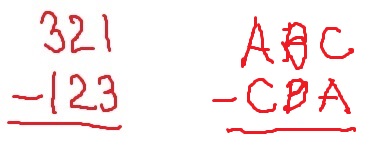
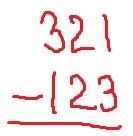
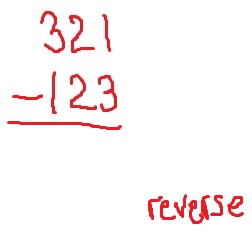
My Mathematical Magic Show: Part 3c

Last March, on Pi Day (March 14, 2015), I put together a mathematical magic show for the Pi Day festivities at our local library, compiling various tricks that I teach to our future secondary teachers. I was expecting an audience of junior-high and high school students but ended up with an audience of elementary school students (and their parents). Still, I thought that this might be of general interest, and so I’ll present these tricks as well as the explanations for these tricks in this series. From start to finish, this mathematical magic show took me about 50-55 minutes to complete. None of the tricks in this routine are original to me; I learned each of these tricks from somebody else.

green line

In the last couple of posts, I discussed a trick for predicting the number of triangles that appear when a convex x-gon with y points in the middle is tesselated. Though I probably wouldn’t do the following in a magic show (for the sake of time), this is a natural inquiry-based activity to do with pre-algebra students in a classroom setting (as opposed to an entertainment setting) to develop algebraic thinking. I’d begin by giving the students a sheet of paper like this:

trianglechart

Then I’ll ask them to start on the left box. I’ll tell them to draw a triangle in the box and place one point inside, and then subdivide into smaller triangles. Naturally, they all get 3 triangles.

Then I ask them to repeat if there are two points inside. Everyone will get 5 triangles.

Then I ask them to repeat until they can figure out a pattern. When they figure out the pattern, then they can make a prediction about what the rest of the chart will be.

Then I’ll ask them what the answer would be if there were 100 points inside of the triangle. This usually requires some thought. Eventually, the students will get the pattern T = 2P+1 for the number of triangles if the initial figure is a triangle.

Then I’ll repeat for a quadrilateral (with four sides instead of three). After some drawing and guessing, the students can usually guess the pattern T=2P+2.

Then I’ll repeat for a pentagon. After some drawing and guessing, the students can usually guess the pattern T=2P+3.

Then I’ll have them guess the pattern for the hexagon without drawing anything. They’ll usually predict the correct answer, T = 2P+4.

What about if the outside figure has 100 sides? They’ll usually predict the correct answer, T = 2P+98.

What if the outside figure has N sides? By now, they should get the correct answer, T = 2P + N - 2.

This activity fosters algebraic thinking, developing intuition from simple cases to get a pretty complicated general expression. However, this activity is completely tractable since it only involves drawing a bunch of figures on a piece of paper.

My Mathematical Magic Show: Part 3b

Last March, on Pi Day (March 14, 2015), I put together a mathematical magic show for the Pi Day festivities at our local library, compiling various tricks that I teach to our future secondary teachers. I was expecting an audience of junior-high and high school students but ended up with an audience of elementary school students (and their parents). Still, I thought that this might be of general interest, and so I’ll present these tricks as well as the explanations for these tricks in this series. From start to finish, this mathematical magic show took me about 50-55 minutes to complete. None of the tricks in this routine are original to me; I learned each of these tricks from somebody else.

green line

This is a magic trick that my math teacher taught me when I was about 13 or 14. I’ve found that it’s a big hit when performed for grade-school children. Here’s the patter:

Magician: Tell me a number between 5 and 10.

Child: (gives a number, call it x)

Magician: On a piece of paper, draw a shape with x corners.

Child: (draws a figure; an example for x=6 is shown)

geom_magic1Important Note: For this trick to work, the original shape has to be convex… something shaped like an L or M won’t work. Also, I chose a maximum of 10 mostly for ease of drawing and counting (and, for later, calculating).

Magician: Tell me another number between 5 and 10.

Child: (gives a number, call it y)

Magician: Now draw that many dots inside of your shape.

Child: (starts drawing y dots inside the figure; an example for y = 7While the child does this, the Magician calculates 2y + x - 2, writes the answer on a piece of paper, and turns the answer face down.

geom_magic2Magician: Now connect the dots with lines until you get all triangles. Just be sure that no two lines cross each other.

Child: (connects the dots until the shape is divided into triangles; an example is shown)

geom_magic3Magician: Now count the number of triangles.

Child: (counts the triangles)

Magician: Was your answer… (and turns the answer over)?

The reason this magic trick works so well is that it’s so counter-intuitive. No matter what convex x-gon is drawn, no matter where the y points are located, and no matter how lines are drawn to create triangles, there will always be 2y + x - 2 triangles. For the example above, 2y+x-2 = 2\times 7 + 6 - 2 = 18, and there are indeed 18 triangles in the figure.

This trick works by counting the measures of all the angles in two different ways.

Method #1: If there are T triangles created, then the sum of the measures of the angles in each triangle is 180 degrees. So the sum of the measures of all of the angles must be 180 T degrees.

geom_magic4Method #2: The sum of the measures of the angles around each interior point is 360 degrees. Since there are y interior points, the sum of these angles is 360y degrees.

geom_magic5The measures of the remaining angles add up to the sum of the measures of the interior angles of a convex polygon with x sides. So the sum of these measures is 180(x-2) degrees.

geom_magic6These two different ways of adding the angles must be the same. In other words, it must be the case that

180T = 360y + 180(x-2),

or

T = 2y + x - 2.

green lineI’m often asked why it was important to choose a number between 5 and 10. The answer is, it’s not important. The trick will work for any numbers as long as there are at least three sides of the polygon. However, in a practical sense, it’s a good idea to make sure that the number of sides and the number of points aren’t too large so that the number of triangles can be counted reasonably quickly.

After explaining how the trick works, I’ll again ask a child to stand up and play the magician, repeating the trick that I just did, before I move on to the next trick.

My Mathematical Magic Show: Part 3a

Last March, on Pi Day (March 14, 2015), I put together a mathematical magic show for the Pi Day festivities at our local library, compiling various tricks that I teach to our future secondary teachers. I was expecting an audience of junior-high and high school students but ended up with an audience of elementary school students (and their parents). Still, I thought that this might be of general interest, and so I’ll present these tricks as well as the explanations for these tricks in this series. From start to finish, this mathematical magic show took me about 50-55 minutes to complete. None of the tricks in this routine are original to me; I learned each of these tricks from somebody else.

green line

For my second trick, I’ll show something that my math teacher taught me when I was about 13 or 14. Everyone in the audience has a piece of paper and a pen or pencil. Here’s the patter:

Magician: Tell me a number between 5 and 10.

Child #1: (gives a number, call it x)

Magician: On a piece of paper, draw a shape with x corners. Don’t draw something really, really tiny… make sure it’s big enough to see well.

Audience: (draws a figure; an example for x=6 is shown) The Magician also draws this figure on the board.

geom_magic1Important Note: For this trick to work, the original shape has to be convex… something shaped like an L or M won’t work. Also, I chose a maximum of 10 mostly for ease of drawing and counting (and, for later, calculating).

Magician: Tell me another number between 5 and 10.

Child #2: (gives a number, call it y)

Magician: Now draw that many dots inside of your shape.The Magician also draws y dots inside the figure on the board, an example for y = 7 is shown.

geom_magic2Audience: (starts drawing y dots inside the figure) The Magician also calculates 2y + x - 2 and says, “Now while you’re doing that, I’m going to write a secret number on the board,” discreetly writes the answer on the board, and then covers up the answer with a piece of paper and some adhesive tape.

Magician: Now connect the dots with lines until you get all triangles. Just be sure that no two lines cross each other. For example, your figure could look like this:

geom_magic3

Audience: (quietly connects the dots until the shape is divided into triangles)

Magician: Now count the number of triangles.

Audience: (counts the triangles)

Magician: Was your answer… (removes the adhesive tape and displays the answer)?

The reason this magic trick works so well is that it’s so counter-intuitive. No matter what convex x-gon is drawn, no matter where the y points are located, and no matter how lines are drawn to create triangles, there will always be 2y + x - 2 triangles. For the example above, 2y+x-2 = 2\times 7 + 6 - 2 = 18, and there are indeed 18 triangles in the figure.

In tomorrow’s post, I’ll explain why this trick works.


My Mathematical Magic Show: Part 2c

Last March, on Pi Day (March 14, 2015), I put together a mathematical magic show for the Pi Day festivities at our local library, compiling various tricks that I teach to our future secondary teachers. I was expecting an audience of junior-high and high school students but ended up with an audience of elementary school students (and their parents). Still, I thought that this might be of general interest, and so I’ll present these tricks as well as the explanations for these tricks in this series. From start to finish, this mathematical magic show took me about 50-55 minutes to complete. None of the tricks in this routine are original to me; I learned each of these tricks from somebody else.

green line

For my first trick, I chose the most boring of the routine. Everyone in the audience had a piece of paper and many had calculators. Here is the patter for the first trick:

To begin this trick, write down any three-digit number on your piece of paper. Just make sure that the first digit and the last digit are different.

(pause)

Now, reverse the digits and write down a new number. For example, if your number was 321, the new number will be 123.

(pause)

Now, subtract the small number from the big number. If your second number is larger, then put that number on top so that you can subtract the two numbers.

(pause)

Your difference is probably a three-digit number. However, if you ended up with a two-digit number, you can make it a three-digit number by putting a 0 in the hundreds place.

Next, I want you to reverse the digits of the difference to make a new three-digit number. Write this new number under the difference.

(pause)

Finally, add the last two three-digit numbers that you wrote down.

If everyone follows the instructions and does the arithmetic correctly, everyone will get a final answer of 1,089.

The next part of my mathematical magic show is showing everyone why the trick works. Yesterday, I gave an explanation suitable for upper elementary students. Today, I’ll give a more abstract explanation using algebra.

The succinct explanation can be found on Wikipedia:

The spectator’s 3-digit number can be written as 100 × A + 10 × B + 1 × C, and its reversal as 100 × C + 10 × B + 1 × A, where 1 ≤ A ≤ 9, 0 ≤ B ≤ 9 and 1 ≤ C ≤ 9. (For convenience, we assume A > C; if A < C, we first swap A and C.) Their difference is 99 × (AC). Note that if AC is 0 or 1, the difference is 0 or 99, respectively, and we do not get a 3-digit number for the next step.

99 × (A − C) can also be written as 99 × [(A − C) − 1] + 99 = 100 × [(A − C) − 1] − 1 × [(A − C) − 1] + 90 + 9 = 100 × [(A − C) − 1] + 90 + 9 − (A − C) + 1 = 100 × [(A − C) − 1] + 10 × 9 + 1 × [10 − (A − C)]. (The first digit is (A − C) − 1, the second is 9 and the third is 10 − (A − C). As 2 ≤ A − C ≤ 9, both the first and third digits are guaranteed to be single digits.)

Its reversal is 100 × [10 − (A − C)] + 10 × 9 + 1 × [(A − C) − 1]. The sum is thus 101 × [(A − C) − 1] + 20 × 9 + 101 × [10 − (A − C)] = 101 × [(A − C) − 1 + 10 − (A − C)] + 20 × 9 = 101 × [−1 + 10] + 180 = 1089.

However, I don’t particularly care for the succinct explanation, and so I’d prefer to give my audience the following explanation. Let’s write our original three-digit number as ABC, which of course stands for 100 \times A + 10 \times B + C. Then, when I reverse the digits, the new three-digit number will be CBA, or 100 \times C + 10 \times B + A.

1089trick10

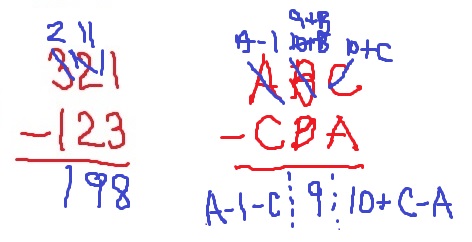
Of course, because the first number is bigger than the second number, this means that the first hundreds digit is bigger than the second hundreds digit. This means that the first ones digit has to be less than the second ones digit. In other words, when we subtract, we have to borrow from the tens place. However, the tens digits are the same for both numbers. That means that I have to borrow from the hundreds place also.

I’ll illustrate this for both subtraction problems:
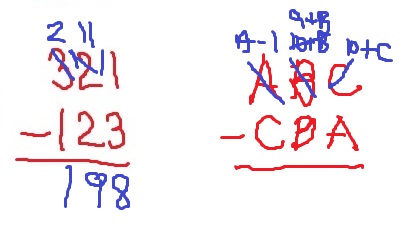
1089trick11Now I’ll subtract. The hundreds digit will be A - 1 - C. The tens digit will be 9 + B - B, or simply 9. Finally, the ones digit will be 10 + C - A. This is a little hard to write on a board, so I’ll add some dotted lines to separate the hundreds digits from the tens digit from the ones digit:
1089trick12The next step is to reverse the digits and add:
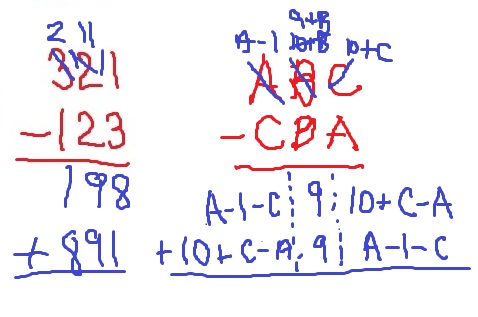
1089trick13I’ll begin with the ones digit:

(10 + C - A) + (A - 1 - C) = 10 - 1 = 9.

No matter what, the ones digit is a 9.

Continuing with the tens digits, I get 9 + 9 = 18. I’ll write down 8 and carry the 1 to the next column.

Finally, adding the hundreds digits (and the extra 1), I get

1 + (A - 1 + C) + (10 + C - A) = 1 - 1 + 10.

Therefore, no matter the values of A, B, and C, the end result must be 1089.

green lineTo complete the routine, I’ll ask a volunteer (usually a young child) to play the magician and repeat the trick for the audience. I consider this an important pedagogical step — the child enjoys being the magician on stage, while the audience lets the routine sink in one more time before I move on to the next magic trick.

My Mathematical Magic Show: Part 2b

Last March, on Pi Day (March 14, 2015), I put together a mathematical magic show for the Pi Day festivities at our local library, compiling various tricks that I teach to our future secondary teachers. I was expecting an audience of junior-high and high school students but ended up with an audience of elementary school students (and their parents). Still, I thought that this might be of general interest, and so I’ll present these tricks as well as the explanations for these tricks in this series. From start to finish, this mathematical magic show took me about 50-55 minutes to complete. None of the tricks in this routine are original to me; I learned each of these tricks from somebody else.

green line

For my first trick, I chose the most boring of the routine. Everyone in the audience had a piece of paper and many had calculators. Here is the patter for the first trick:

To begin this trick, write down any three-digit number on your piece of paper. Just make sure that the first digit and the last digit are different.

(pause)

Now, reverse the digits and write down a new number. For example, if your number was 321, the new number will be 123.

(pause)

Now, subtract the small number from the big number. If your second number is larger, then put that number on top so that you can subtract the two numbers.

(pause)

Your difference is probably a three-digit number. However, if you ended up with a two-digit number, you can make it a three-digit number by putting a 0 in the hundreds place.

Next, I want you to reverse the digits of the difference to make a new three-digit number. Write this new number under the difference.

(pause)

Finally, add the last two three-digit numbers that you wrote down.

If everyone follows the instructions and does the arithmetic correctly, everyone will get a final answer of 1,089.

The next part of my mathematical magic show is showing everyone why the trick works. The explanation depends on the mathematical sophistication of the audience. Today, I’ll give an explanation suitable for upper elementary students. Tomorrow, I’ll give a different explanation using algebra.

For today’s explanation, I’ll give an example:

1089trick2

Of course, because the first number is bigger than the second number, this means that the first hundreds digit is bigger than the second hundreds digit. This means that the first ones digit has to be less than the second ones digit. In other words, when we subtract, we have to borrow from the tens place.

However, the tens digits are the same for both numbers. That means that I have to borrow from the hundreds place also.

1089trick5

So, when I subtract, I’m guaranteed that the middle number will be a 9. Also, I’m guaranteed that the hundreds digit and the ones digit will add up to 9. In this example, the sum of the hundreds digits and the ones digits is equal to

2 - 1 + 11 - 3.

We know that 11-1 is equal to 10, and adding 2 and subtracting 3 is like subtracting 1. Therefore, the sum of the hundreds digit and the ones digit must be equal to 9.1089trick9

The next step was reversing the digits of the difference:

1089trick7

Finally, I asked you to add these last two numbers. Remember, I had rigged things so that the hundreds and ones digits add up to 9. So the last digit of the sum must be 9. Also, I rigged things so that the tens digit must be 9. So, when I add, I get a sum of 18, and I leave the 8 and carry the 1. Finally, the hundreds and ones digits add up to 9 again. Adding the extra 1, I write down a sum of 10.

1089trick8In tomorrow’s post, I’ll explain how the trick works using algebra.

My Mathematical Magic Show: Part 2a

Last March, on Pi Day (March 14, 2015), I put together a mathematical magic show for the Pi Day festivities at our local library, compiling various tricks that I teach to our future secondary teachers. I was expecting an audience of junior-high and high school students but ended up with an audience of elementary school students (and their parents). Still, I thought that this might be of general interest, and so I’ll present these tricks as well as the explanations for these tricks in this series. From start to finish, this mathematical magic show took me about 50-55 minutes to complete. None of the tricks in this routine are original to me; I learned each of these tricks from somebody else.

green line

For my first trick, I chose the most boring of the routine. Everyone in the audience had a piece of paper and many had calculators. I also had a small white board to write on at the front of the room. I began,

To begin this trick, write down any three-digit number on your piece of paper. Just make sure that the first digit and the last digit are different.

After waiting 10 seconds, I then said,

Now, reverse the digits and write down a new number. For example, if your number was 321, the new number will be 123.

And, to be sure my instructions are clear, I’ll write these numbers on my white board:

1089trick1

Next, I’ll say:

Now, subtract the small number from the big number. If your second number is larger, then put that number on top so that you can subtract the two numbers.

1089trick2

After waiting a minute or so, I’ll say,

Your difference is probably a three-digit number. However, if you ended up with a two-digit number, you can make it a three-digit number by putting a 0 in the hundreds place.

Next, I want you to reverse the digits of the difference to make a new three-digit number. Write this new number under the difference.

1089trick3

After everyone’s done, I’ll give my final instruction:

Finally, add the last two three-digit numbers that you wrote down.

1089trick4After everyone’s done, I’ll point to someone and say, “Your final number was 1,089.” If he followed my instructions and did the arithmetic correctly, he’ll say, “You’re right.” Then I’ll point to someone else and say, “You also got 1,089.” She’ll also say, :”You’re right.” Then I’ll say, “Everyone got 1,089, right?”

Another (and more dramatic) way to end the routine is to hand a book of mine to someone, with the following instructions:

Your last number should have four digits. Cross out the last digit; you now will have a number with only three digits. Turn to that page number in this book. Then find the word on that page corresponding to the number you crossed out. For example, if you crossed out a one, point to the first word on the page. If you crossed out a two, point to the second word on the page. And so on.

Got it? The word you’re pointing to is XXXXXX.

And of course, I’ll get this right because, before starting the routine, I had already memorized the ninth word on page 108 of my book (the XXXXXX above). This looks really dramatic because it looks essentially random to the audience.

In tomorrow’s post, I’ll explain how the trick works.

My Mathematical Magic Show: Part 1

Last March, on Pi Day (March 14, 2015), I put together a mathematical magic show for the Pi Day festivities at our local library, compiling various tricks that I teach to our future secondary teachers. I thought that this might be of general interest, and so I’ll present these tricks as well as the explanations for these tricks in this series.

Before showing my own tricks, however, I have to pay homage to Arthur Benjamin, who is a Professor of Mathematics at Harvey Mudd College who’s also made a second career doing mathematical magic shows. See his Amazon page for the books that he’s published and his webpage at Harvey Mudd.

Geometric magic trick

This is a magic trick that my math teacher taught me when I was about 13 or 14. I’ve found that it’s a big hit when performed for grade-school children.

Magician: Tell me a number between 3 and 10.

Child: (gives a number, call it x)

Magician: On a piece of paper, draw a shape with x corners.

Child: (draws a figure; an example for x=6 is shown)

geom_magic1Important Note: For this trick to work, the original shape has to be convex… something shaped like an L or M won’t work. Also, I chose a maximum of 10 mostly for ease of drawing and counting (and, for later, calculating).

Magician: Tell me another number between 3 and 10.

Child: (gives a number, call it y)

Magician: Now draw that many dots inside of your shape.

Child: (starts drawing y dots inside the figure; an example for y = 7While the child does this, the Magician calculates 2y + x - 2, writes the answer on a piece of paper, and turns the answer face down.

geom_magic2Magician: Now connect the dots with lines until you get all triangles. Just be sure that no two lines cross each other.

Child: (connects the dots until the shape is divided into triangles; an example is shown)

geom_magic3Magician: Now count the number of triangles.

Child: (counts the triangles)

Magician: Was your answer… (and turns the answer over)?

The reason this magic trick works so well is that it’s so counter-intuitive. No matter what convex x-gon is drawn, no matter where the y points are located, and no matter how lines are drawn to create triangles, there will always be 2y + x - 2 triangles. For the example above, 2y+x-2 = 2\times 7 + 6 - 2 = 18, and there are indeed 18 triangles in the figure.

Why does this magic trick work? I offer a thought bubble if you’d like to think about it before scrolling down to see the answer.

green_speech_bubbleThis trick works by counting the measures of all the angles in two different ways.

Method #1: If there are T triangles created, then the sum of the measures of the angles in each triangle is 180 degrees. So the sum of the measures of all of the angles must be 180 T degrees.

geom_magic4Method #2: The sum of the measures of the angles around each interior point is 360 degrees. Since there are y interior points, the sum of these angles is 360y degrees.

geom_magic5The measures of the remaining angles add up to the sum of the measures of the interior angles of a convex polygon with x sides. So the sum of these measures is 180(x-2) degrees.

geom_magic6In other words, it must be the case that

180T = 360y + 180(x-2), or T = 2y + x - 2.

A mathematical magic trick

In case anyone’s wondering, here’s a magic trick that I did my class for future secondary math teachers while dressed as Carnac the Magnificent. I asked my students to pull out a piece of paper, a pen or pencil, and (if they wished) a calculator. Here were the instructions I gave them:

  1. Write down just about any number you want. Just make sure that the same digit repeated (not something like 88,888). You may want to choose something that can be typed into a calculator.
  2. Scramble the digits of your number, and write down the new number. Just be sure that any repeated digits appear the same number of times. (For example, if your first number was 1,232, your second number could be 2,231 or 1,322.)
  3. Subtract the smaller of the two numbers from the bigger, and write down the difference. Use a calculator if you wish.
  4. Pick any nonzero digit in the difference, and scratch it out.
  5. Add up the remaining digits (that weren’t scratched out).

I asked my students one at a time what they got after Step 5, and I responded, as the magician, with the number that they had scratched out. One student said 34, and I answered 2. Another said 24, and I answered 3. After doing this a couple more times, one student simply stated, “My mind is blown.”

This is actually a simple trick to perform, and the mathematics behind the trick is fairly straightforward to understand. Based on personal experience, this is a great trick to show children as young as 2nd or 3rd grade who have figured out multiple-digit subtraction and single-digit multiplication.

I offer the following thought bubble if you’d like to think about it before looking ahead to find the secret to this magic trick.

green_speech_bubbleWhat the magician does: the magician finds the next multiple of 9 greater than the volunteer’s number, and answers with the difference. For example, if the volunteer answers 25, the magician figures out that the next multiple of 9 after 25 is 27. So 27-25 = 2 was the digit that was scratched out.

This trick works because of two important mathematical facts.

(1) The difference D between the original number and the scrambled number is always a multiple of 9. For example, suppose the volunteer chooses 3417, and suppose the scrambled number is 7431. Then the difference is


7431 - 3417 = (7000 + 400 + 30 + 1) - (3000 + 400 + 10 + 7)

= (7000 - 7) + (400 - 400) + (30 - 3000) + (1 - 10)

= 7 \times (1000-1) + 4 \times (100-100) + 3 \times (10-1000) + 1 \times (1-10)

= 7 \times (999) + 1 \times (0) + 4 \times (-990) + 3 \times (-9)

Each of the numbers in parentheses is a multiple of 9, and so the difference D must also be a multiple of 9.

A more algebraic proof of (1) is set apart in the block quote below; feel free to skip it if the above numerical example is convincing enough.

More formally, suppose that the original number is a_n a_{n-1} \dots a_1a_0 in base-10 notation, and suppose the scrambled number is a_{\sigma(n)} a_{\sigma(n-1)} \dots a_{\sigma(1)} a_{\sigma(0)}, where \sigma is a permutation of the numbers \{0, 1, \dots, n\}. Without loss of generality, suppose that the original number is larger. Then the difference D is equal to

D = a_n a_{n-1} \dots a_1a_0 - a_{\sigma(n)} a_{\sigma(n-1)} \dots a_{\sigma(1)} a_{\sigma(0)}

D = \displaystyle \sum_{i=0}^n a_i 10^i - \sum_{i=0}^n a_{\sigma(i)} 10^i

D = \displaystyle \sum_{i=0}^n a_{\sigma(i)} 10^{\sigma(i)} - \sum_{i=0}^n a_{\sigma(i)} 10^i

D = \displaystyle \sum_{i=0}^n a_{\sigma(i)} \left(10^{\sigma(i)} - 10^i \right)

The transition from the second to the third line work because the terms of the first sum are merely rearranged by the permutation \sigma.

To show that D is a multiple of 9, it suffices to show that each term 10^{\sigma(i)} - 10^i is a multiple of 9.

  • If \sigma(i) > i, then 10^{\sigma(i)} - 10^i = 10^i \left( 10^{\sigma(i) - i} - 1 \right), and the term in parentheses is guaranteed to be a multiple of 9.
  • If \sigma(i) < i, then 10^{\sigma(i)} - 10^i = 10^{\sigma(i)} \left( 1-10^{i-\sigma(i)} \right) = -10^{\sigma(i)} \left( 10^{i-\sigma(i)} - 1 \right), and the term in parentheses is guaranteed to be a (negative) multiple of 9.
  • If \sigma(i) = i, then 10^{\sigma(i)} - 10^i = 0, a multiple of 9.

\hbox{QED}

Because the difference D is a multiple of 9, we use the important fact (2) that a number is a multiple of 9 exactly when the sum of its digits is a multiple of 9. Therefore, when the volunteer offers the sum of all but one of the digits of D, the missing digit is found by determining the nonzero number that has to be added to get the next multiple of 9. (Notice that the trick specifies that the volunteer scratch out a nonzero digit. Otherwise, there would be an ambiguity if the volunteer answered with a multiple of 9; the missing digit could be either 0 or 9.)

As I mentioned earlier, I showed this trick (and the proof of why it works) to a class of senior math majors who are about to become secondary math teachers. I think it’s a terrific and engaging way of deepening their content knowledge (in this case, base-10 arithmetic and the rule of checking that a number is a multiple of 9.)

As thanks for reading this far, here’s a photo of me dressed as Carnac as I performed the magic trick. Sadly, most of the senior math majors of 2013 were in diapers when Johnny Carson signed off the Tonight Show in 1992, so they didn’t immediately get the cultural reference.

542597_10200255338162345_209138628_n