
Source: http://joegp.com/halfcut/
Tag: geometric series
How I Impressed My Wife: Part 4f
Previously in this series, I have used two different techniques to show that

Originally, my wife had asked me to compute this integral by hand because Mathematica 4 and Mathematica 8 gave different answers. At the time, I eventually obtained the solution by multiplying the top and bottom of the integrand by  and then employing the substitution
  (after using trig identities to adjust the limits of integration).
and then employing the substitution (after using trig identities to adjust the limits of integration).But this wasn’t the only method I tried. Indeed, I tried two or three different methods before deciding they were too messy and trying something different. So, for the rest of this series, I’d like to explore different ways that the above integral can be computed.
 Previously in this series, I have used two different techniques to show that
Originally, my wife had asked me to compute this integral by hand because Mathematica 4 and Mathematica 8 gave different answers. At the time, I eventually obtained the solution by multiplying the top and bottom of the integrand by and then employing the substitution (after using trig identities to adjust the limits of integration).
and then employing the substitution (after using trig identities to adjust the limits of integration).But this wasn’t the only method I tried. Indeed, I tried two or three different methods before deciding they were too messy and trying something different. So, for the rest of this series, I’d like to explore different ways that the above integral can be computed.
Here’s my progress so far:



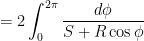

where this last integral is taken over the complex plane on the unit circle, a closed contour oriented counterclockwise. In these formulas, 


This contour integral looks complicated; however, it’s an amazing fact that integrals over closed contours can be easily evaluated by only looking at the poles of the integrand. In recent posts, I established that there was only one pole inside the contour, and the residue at this pole was equal to 
This residue can be used to evaluate the contour integral. Ordinarily, integrals are computed by subtracting the values of the antiderivative at the endpoints. However, there is an alternate way of computing a contour integral using residues. It turns out that the value of the contour integral is 
Therefore,


Next, I use some algebra to simplify the denominator:

![S^2 - R^2 = [(1 + a^2 + b^2) + (1-a^2-b^2)][(1 + a^2 + b^2) - (1 - a^2 -b^2)] - 4a^2](https://s0.wp.com/latex.php?latex=S%5E2+-+R%5E2+%3D+%5B%281+%2B+a%5E2+%2B+b%5E2%29+%2B+%281-a%5E2-b%5E2%29%5D%5B%281+%2B+a%5E2+%2B+b%5E2%29+-+%281+-+a%5E2+-b%5E2%29%5D+-+4a%5E2&bg=ffffff&fg=000000&s=0&c=20201002)
![S^2 - R^2 = 2[2 a^2 + 2b^2] - 4a^2](https://s0.wp.com/latex.php?latex=S%5E2+-+R%5E2+%3D+2%5B2+a%5E2+%2B+2b%5E2%5D+-+4a%5E2&bg=ffffff&fg=000000&s=0&c=20201002)

Therefore,

Once again, this matches the solution found with the previous methods… and I was careful to avoid a common algebraic mistake.
In tomorrow’s post, I’ll discuss an alternative way of computing the residue.
How I Impressed My Wife: Part 4e
Previously in this series, I have used two different techniques to show that
Originally, my wife had asked me to compute this integral by hand because Mathematica 4 and Mathematica 8 gave different answers. At the time, I eventually obtained the solution by multiplying the top and bottom of the integrand by and then employing the substitution (after using trig identities to adjust the limits of integration).
and then employing the substitution (after using trig identities to adjust the limits of integration).But this wasn’t the only method I tried. Indeed, I tried two or three different methods before deciding they were too messy and trying something different. So, for the rest of this series, I’d like to explore different ways that the above integral can be computed.
Here’s my progress so far:
where this last integral is taken over the complex plane on the unit circle, a closed contour oriented counterclockwise. Also,
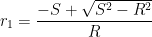
and
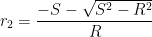
are the two distinct roots of the denominator (as long as 
This contour integral looks complicated; however, it’s an amazing fact that integrals over closed contours can be easily evaluated by only looking at the poles of the integrand. In yesterday’s post, I established that 

The next step of the calculation is finding the residue at

as a power series (technically, a Laurent series) about the point 




![= \displaystyle \frac{-1}{z-r_1} \times \frac{1}{r_2-r_1} \left[ 1 + \left( \displaystyle \frac{z-r_1}{r_2-r_1} \right) + \left( \displaystyle \frac{z-r_1}{r_2-r_1} \right)^2 + \left( \displaystyle \frac{z-r_1}{r_2-r_1} \right)^3 + \dots \right]](https://s0.wp.com/latex.php?latex=%3D+%5Cdisplaystyle+%5Cfrac%7B-1%7D%7Bz-r_1%7D+%5Ctimes+%5Cfrac%7B1%7D%7Br_2-r_1%7D+%5Cleft%5B+1+%2B+%5Cleft%28+%5Cdisplaystyle+%5Cfrac%7Bz-r_1%7D%7Br_2-r_1%7D+%5Cright%29+%2B+%5Cleft%28+%5Cdisplaystyle+%5Cfrac%7Bz-r_1%7D%7Br_2-r_1%7D+%5Cright%29%5E2+%2B+%5Cleft%28+%5Cdisplaystyle+%5Cfrac%7Bz-r_1%7D%7Br_2-r_1%7D+%5Cright%29%5E3+%2B+%5Cdots+%5Cright%5D&bg=ffffff&fg=000000&s=0&c=20201002)

The residue of the function at 
The residue at 
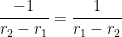
From the definitions of

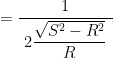

Now that I’ve identified the residue of the only root that lies inside of the contour, we are in position to evaluate the contour integral above. I’ll discuss this in tomorrow’s post.
Fun lecture on geometric series: Index
I’m using the Twelve Days of Christmas (and perhaps a few extra days besides) to do something that I should have done a long time ago: collect past series of posts into a single, easy-to-reference post. The following posts formed my series concerning one of my favorite lectures concerning various applications of geometric series.
Part 1: Introduction to generating functions.
Part 2: Enumeration problems; or counting how many ways $2.00 can be formed using pennies, nickels, dimes, and quarters. (The answer is 1463.)
Part 3: The generating function for the Fibonacci sequence.
Part 4: Using a generating function to find a closed-form expression for the (ahem) Quintanilla sequence, a close but somewhat less famous relative of the Fibonacci sequence.
Part 5: Reproving the formula for the Quintanilla sequence using mathematical induction.
Arithmetic and Geometric Series: Index
I’m using the Twelve Days of Christmas (and perhaps a few extra days besides) to do something that I should have done a long time ago: collect past series of posts into a single, easy-to-reference post. The following posts formed my series on how I remind students about Taylor series. I often use this series in a class like Differential Equations, when Taylor series are needed but my class has simply forgotten about what a Taylor series is and why it’s important.
Part 1: Deriving the formulas for the 
Part 2: Pedagogical thoughts on conceptual barriers that students often face when encountering sequences and series.
Part 3: The story of how young Carl Frederich Gauss, at age 10, figured out how to add the integers from 1 to 100 in his head.
Part 4: Deriving the formula for an arithmetic series.
Part 5: Deriving the formula for an arithmetic series, using mathematical induction. Also, extensions to other series.
Part 6: Deriving the formula for an arithmetic series, using telescoping series. Also, extensions to other series.
Part 7: Pedagogical thoughts on assessing students’ depth of understanding the formula for an arithmetic series.
Part 8: Deriving the formula for a finite geometric series.
Part 9: Infinite geometric series and Xeno’s paradox.
Part 10: Deriving the formula for an infinite geometric series.
Part 11: Applications of infinite geometric series in future mathematics courses.
Part 12: Other commonly-arising infinite series.
2048 and algebra: Index
I’m doing something that I should have done a long time ago: collect past series of posts into a single, easy-to-reference post. The following posts formed my series on using algebra to study the 2048 game… with a special focus on reaching the event horizon of 2048 which cannot be surpassed.
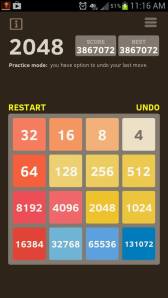 Part 1: Introduction and statement of problem
Part 2: First insight: How points are accumulated in 2048
Part 3: Second insight: The sum of the tiles on the board
Part 4: Algebraic formulation of the two insights
Part 5: Algebraic formulation applied to a more complicated board
Part 6: Algebraic formulation applied to the event horizon of 2048
Part 7: Calculating one of the complicated sums in Part 6 using a finite geometric series
Part 8: Calculating another complicated sum in Part 6 using a finite geometric series
Part 9: Repeating Part 8 by reversing the order of summation in a double sum
Part 10: Estimating the probability of reaching the event horizon in game mode
2048 and algebra (Part 9)
In this series of posts, I consider how algebra can be used to answer a question about the 2048 game: From looking at a screenshot of the final board, can I figure out how many moves were needed to reach the final board? Can I calculate how many new 2-tiles and 4-tiles were introduced to the board throughout the course of this game? In this post, we consider the event horizon of 2048, which I reached after about four weeks of intermittent doodling:

In yesterday’s post, we developed a system of two equations in two unknowns to solve for 


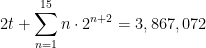
In this post and tomorrow’s post, I consider how the two sums in the above equations can be obtained without directly adding the terms.
In yesterday’s post, we used the formula for the sum of a finite geometric series to calculate the second sum:

In this post, I perform this calculation again, except symbolically and more compactly. The key initial steps are writing the series as a double sum and then interchanging the order of summation (much like reversing the order of integration in a double integral). This is a trick that I’ve used again and again in my own research efforts, but it seems that the students that I teach have never learned this trick. Here we go:

The inner sum is a finite geometric series with 



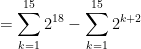
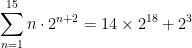
The first sum is merely the sum of a constant. The second sum is another finite geometric series with 15 terms, common ratio of 2, and initial term 



2048 and algebra (Part 8)
In this series of posts, I consider how algebra can be used to answer a question about the 2048 game: From looking at a screenshot of the final board, can I figure out how many moves were needed to reach the final board? Can I calculate how many new 2-tiles and 4-tiles were introduced to the board throughout the course of this game? In this post, we consider the event horizon of 2048, which I reached after about four weeks of intermittent doodling:
In yesterday’s post, we developed a system of two equations in two unknowns to solve for
In this post and tomorrow’s post, I consider how the two sums in the above equations can be obtained without directly adding the terms.
In yesterday’s post, we showed that the formula for the sum of a finite geometric series can be used to calculate the first sum:

Let’s now consider the second (and more complicated) sum, which can be written as

For reasons that will become clear shortly, this sum can be written in expanded form as



Let’s now rearrange the terms of this sum. We will do this by adding along the diagonals instead of along the rows. In this way, the above sum can be rearranged as




Each of these new rows (or the original diagonals) is a geometric series and can be calculated using the formula:




So, thus far in the calculation, we have established that
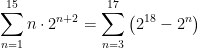
Simplifying,
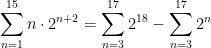
The first sum on the right is the sum of a constant being added to itself 15 times:
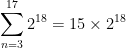
The second sum on the right is yet another geometric series. Indeed, it’s the same geometric series from the first diagonal above:

Therefore,

Not surprisingly, this matches the sum that was found via direct addition.
2048 and algebra (Part 7)
In this series of posts, I consider how algebra can be used to answer a question about the 2048 game: From looking at a screenshot of the final board, can I figure out how many moves were needed to reach the final board? Can I calculate how many new 2-tiles and 4-tiles were introduced to the board throughout the course of this game? In this post, we consider the event horizon of 2048, which I reached after about four weeks of intermittent doodling:
In yesterday’s post, we developed a system of two equations in two unknowns to solve for
In this post and tomorrow’s post, I consider how the two sums in the above equations can be obtained without directly adding the terms.
The first sum is certainly the easiest to handle, as it requires the sum of a finite geometric series:

For the geometric series

there are 16 terms (after all, there are 16 tiles on the board). The first term is 4, and the common ratio is 2. Therefore,
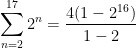
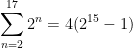

We’ll consider the more complicated sum in tomorrow’s post.
Exponential growth and decay (Part 6): Paying off credit-card debt via recurrence relations
The following problem in differential equations has a very practical application for anyone who has either (1) taken out a loan to buy a house or a car or (2) is trying to pay off credit card debt. To my surprise, most math majors haven’t thought through the obvious applications of exponential functions as a means of engaging their future students, even though it is directly pertinent to their lives (both the students’ and the teachers’).
You have a balance of $2,000 on your credit card. Interest is compounded continuously with a rate of growth of 25% per year. If you pay the minimum amount of $50 per month (or $600 per year), how long will it take for the balance to be paid?
In previous posts, I approached this problem using differential equations. There’s another way to approach this problem that avoids using calculus that, hypothetically, is within the grasp of talented Precalculus students. Instead of treating this problem as a differential equation, we instead treat it as a first-order difference equation (also called a recurrence relation):

The idea is that the amount owed is multiplied by a factor 

Notice that the meaning of the 25% has changed somewhat… it’s no longer the relative rate of growth, as the 25% has been equally divided for the 12 months.

In yesterday’s post, I demonstrated that the solution of this recurrence relation is

Let’s now study when the credit card debt will actually reach $0. To do this, we see 


![0 = r^n \left( P[1-r] + k \right) - k](https://s0.wp.com/latex.php?latex=0+%3D+r%5En+%5Cleft%28+P%5B1-r%5D+%2B+k+%5Cright%29+-+k&bg=ffffff&fg=000000&s=0&c=20201002)
![k = r^n \left( P[1-r] + k \right)](https://s0.wp.com/latex.php?latex=k+%3D+r%5En+%5Cleft%28+P%5B1-r%5D+%2B+k+%5Cright%29&bg=ffffff&fg=000000&s=0&c=20201002)
![\displaystyle \frac{k}{P[1-r] + k} = r^n](https://s0.wp.com/latex.php?latex=%5Cdisplaystyle+%5Cfrac%7Bk%7D%7BP%5B1-r%5D+%2B+k%7D+%3D+r%5En&bg=ffffff&fg=000000&s=0&c=20201002)
![\displaystyle \ln \left( \frac{k}{P[1-r]+k} \right) = n \ln r](https://s0.wp.com/latex.php?latex=%5Cdisplaystyle+%5Cln+%5Cleft%28+%5Cfrac%7Bk%7D%7BP%5B1-r%5D%2Bk%7D+%5Cright%29+%3D+n+%5Cln+r&bg=ffffff&fg=000000&s=0&c=20201002)
![\displaystyle \frac{ \displaystyle \ln \left( \frac{k}{P[1-r]+k} \right) }{ \ln r} = n](https://s0.wp.com/latex.php?latex=%5Cdisplaystyle+%5Cfrac%7B+%5Cdisplaystyle+%5Cln+%5Cleft%28+%5Cfrac%7Bk%7D%7BP%5B1-r%5D%2Bk%7D+%5Cright%29+%7D%7B+%5Cln+r%7D+%3D+n&bg=ffffff&fg=000000&s=0&c=20201002)
That’s certainly a mouthful. However, this calculation should be accessible to a talented student in Precalculus.
Let’s try it out for 


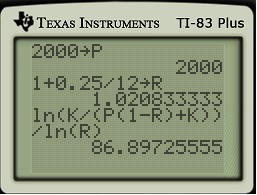
Remembering that each compounding period is one month long, this corresponds to 

 Mean Green Math