Calculators and complex numbers (Part 18)

In this series of posts, I explore properties of complex numbers that explain some surprising answers to exponential and logarithmic problems using a calculator (see video at the bottom of this post). These posts form the basis for a sequence of lectures given to my future secondary teachers.

To begin, we recall that the trigonometric form of a complex number z = a+bi is

z = r(\cos \theta + i \sin \theta) = r e^{i \theta}

where r = |z| = \sqrt{a^2 + b^2} and \tan \theta = b/a, with \theta in the appropriate quadrant. As noted before, this is analogous to converting from rectangular coordinates to polar coordinates.

Definition. If z is a complex number, then we define

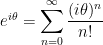
e^z = \displaystyle \sum_{n=0}^{\infty} \frac{z^n}{n!}

This of course matches the Taylor expansion of e^x for real numbers x.

In the last few posts, we proved the following theorem.

Theorem. If z and w are complex numbers, then $e^z e^w = e^{z+w}$.

This theorem allows us to compute e^z without directly plugging into the above infinite series.

Theorem. If z = x + i y, where x and y are real numbers, then

e^z = e^x (\cos y + i \sin y)

Proof. With the machinery that’s been developed over the past few posts, this one is actually a one-liner:

e^z = e^{x+iy} = e^x e^{iy} = e^x (\cos y + i \sin y).

For example,

e^{4+\pi i} = e^4 (\cos \pi + i \sin \pi) = -e^4

Notice that, with complex numbers, it’s perfectly possible to take e to a power and get a negative number. Obviously, this is impossible when using only real numbers.

Another example:

e^{-2+3i} = e^{-2} (\cos 3 +i \sin 3)

In this answer, we have to remember that the angle is 3 radians and not 3 degrees.

green line

For completeness, here’s the movie that I use to engage my students when I begin this sequence of lectures.


Calculators and complex numbers (Part 17)

In this series of posts, I explore properties of complex numbers that explain some surprising answers to exponential and logarithmic problems using a calculator (see video at the bottom of this post). These posts form the basis for a sequence of lectures given to my future secondary teachers.

Definition. If z is a complex number, then we define

e^z = \displaystyle \sum_{n=0}^{\infty} \frac{z^n}{n!}

Even though this isn’t the usual way of defining the exponential function for real numbers, the good news is that one Law of Exponents remains true. (At we saw in an earlier post in this series, we can’t always assume that the usual Laws of Exponents will remain true when we permit the use of complex numbers.)

Theorem. If z and w are complex numbers, then e^z e^w = e^{z+w}.

In yesterday’s post, I gave the idea behind the proof… group terms where the sums of the exponents of z and w are the same. Today, I will formally prove the theorem.

The proof of the theorem relies on a principle that doesn’t seem to be taught very often anymore… rearranging the terms of a double sum. In this case, the double sum is
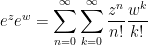
e^z e^w = \displaystyle \sum_{n=0}^{\infty} \sum_{k=0}^{\infty} \frac{z^n}{n!} \frac{w^k}{k!}

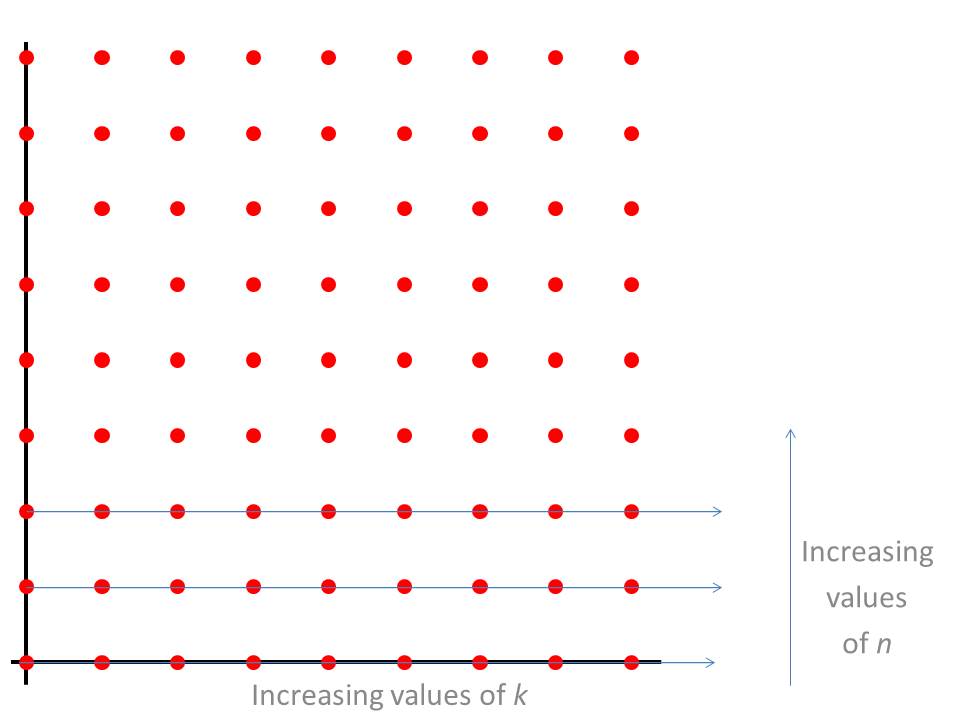
This can be visualized in the picture below, where the x-axis represents the values of k and the y-axis represents the values of n. Each red dot symbolizes a term in the above double sum. For a fixed value of n, the values of k vary from 0 to \infty. In other words, we start with n =0 and add all the terms on the line n = 0 (i.e., the x-axis in the picture). Then we go up to n = 1 and then add all the terms on the next horizontal line. And so on.

double sum 1

I will rearrange the terms as follows: Let j = n+k. Then for a fixed value of j, the values of k will vary from 0 to j. This is perhaps best described in the picture below. The value of j, the sum of the coordinates, is constant along the diagonal lines below. The value of k then changes while moving along a diagonal line.

Even though this is a different way of adding the terms, we clearly see that all of the red circles will be hit regardless of which technique is used for adding the terms.

double sum 2

In this way, the double sum \displaystyle \sum_{n=0}^\infty \sum_{k=0}^\infty gets replaced by \displaystyle \sum_{j=0}^\infty \sum_{k=0}^j. Since n = j-k, we have

e^z e^w = \displaystyle \sum_{j=0}^{\infty} \sum_{k=0}^{j} \frac{z^{j-k}}{(j-k)!} \frac{w^k}{k!}

We now add a couple of j! terms to this expression for reasons that will become clear shortly:

e^z e^w = \displaystyle \sum_{j=0}^{\infty} \sum_{k=0}^{j} \frac{j!}{j!} \frac{1}{k! (j-k)!} w^k z^{j-k}

Since j! does not contain any ks, it can be pulled outside of the inner sum on k. We do this for the j! in the denominator:

= \displaystyle \sum_{j=0}^\infty \frac{1}{j!} \sum_{k=0}^j \frac{j!}{k!(j-k)!} w^k z^{j-k}

We recognize that \displaystyle \frac{j!}{k! (j-k)!} is a binomial coefficent:

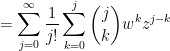
= \displaystyle \sum_{j=0}^\infty \frac{1}{j!} \sum_{k=0}^j {j \choose k} w^k z^{j-k}

The inner sum is recognized as the formula for a binomial expansion:

= \displaystyle \sum_{j=0}^\infty \frac{1}{j!} (w+z)^j

Finally, we recognize this as the definition of e^{w+z}, using the dummy variable j instead of n. This proves that e^z e^w = e^{z+w} even if z and w are complex.

Without a doubt, this theorem was a lot of work. The good news is that, with this result, it will no longer be necessary to explicitly use the summation definition of e^z to actually compute e^z, as we’ll see tomorrow.

green line For completeness, here’s the movie that I use to engage my students when I begin this sequence of lectures.

Calculators and complex numbers (Part 16)

In this series of posts, I explore properties of complex numbers that explain some surprising answers to exponential and logarithmic problems using a calculator (see video at the bottom of this post). These posts form the basis for a sequence of lectures given to my future secondary teachers.

To begin, we recall that the trigonometric form of a complex number z = a+bi is

z = r(\cos \theta + i \sin \theta) = r e^{i \theta}

where r = |z| = \sqrt{a^2 + b^2} and \tan \theta = b/a, with \theta in the appropriate quadrant. As noted before, this is analogous to converting from rectangular coordinates to polar coordinates.

Real mathematicians use the notation e^{i \theta} to represent \cos \theta + i \sin \theta. I say this because I’ve seen textbooks that basically invented the non-standard notation \hbox{cis} \, \theta (pronounced siss), where presumably the c represents \cos and the s represents \sin. I express my contempt for this non-standard notation by saying that this is a sissy way of writing it.

With this shorthand notation of r e^{i \theta}, several of the theorems that we’ve discussed earlier in this series of posts become a lot more memorable.

First, the formula

\left[ r_1 ( \cos \theta_1 + i \sin \theta_1) \right] \cdot \left[ r_2 ( \cos \theta_2 + i \sin \theta_2 ) \right] = r_1 r_2 \left[ \cos( \theta_1 + \theta_2) + i \sin (\theta_1 + \theta_2) \right]

can be rewritten as something that resembles the familiar Law of Exponents:

r_1 e^{i \theta_1} r_2 e^{i \theta_2} = r_1 r_2 e^{i(\theta_1 + \theta_2)}

Similarly, the formula

\displaystyle \frac{ r_1 ( \cos \theta_1 + i \sin \theta_1)}{ r_2 ( \cos \theta_2 + i \sin \theta_2 ) } = \displaystyle \frac{r_1}{ r_2} \left[ \cos( \theta_1 - \theta_2) + i \sin (\theta_1 - \theta_2) \right]

can be rewritten as

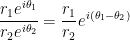
\displaystyle \frac{r_1 e^{i \theta_1}}{ r_2 e^{i \theta_2}} = \displaystyle \frac{r_1 }{r_2} e^{i(\theta_1 - \theta_2)}

Finally, DeMoivre’s Theorem, or

\left[ r (\cos \theta + i \sin \theta) \right]^n = r^n (\cos n \theta + i \sin n \theta)

can be rewritten more comfortably as

\left( r e^{i \theta} \right)^n = r^n e^{i n \theta}

When showing these to students, I stress that these are not the formal proofs of these statements… the formal proofs required trig identites and mathematical induction, as shown in previous posts. That said, now that the proofs have been completed, the e^{i \theta} notation provides a way of remembering these formulas that wasn’t immediately obvious when we began this unit on the trigonometric form of complex numbers.

green line

For completeness, here’s the movie that I use to engage my students when I begin this sequence of lectures.


Calculators and complex numbers (Part 15)

In this series of posts, I explore properties of complex numbers that explain some surprising answers to exponential and logarithmic problems using a calculator (see video at the bottom of this post). These posts form the basis for a sequence of lectures given to my future secondary teachers.

To begin, we recall that the trigonometric form of a complex number z = a+bi is

z = r(\cos \theta + i \sin \theta)

where r = |z| = \sqrt{a^2 + b^2} and \tan \theta = b/a, with \theta in the appropriate quadrant. As noted before, this is analogous to converting from rectangular coordinates to polar coordinates.

There’s a shorthand notation for the right-hand side (r e^{i \theta}) that, at long last, I will explain in today’s post.

Definition. If z is a complex number, then we define

e^z = \displaystyle \sum_{n=0}^{\infty} \frac{z^n}{n!}

This of course matches the Taylor expansion of e^x for real numbers x.

Theorem. If \theta is a real number, then e^{i \theta} = \cos \theta + i \sin \theta.

e^{i \theta} = \displaystyle \sum_{n=0}^{\infty} \frac{(i \theta)^n}{n!}

= \displaystyle 1 + i\theta + \frac{(i\theta)^2}{2!} + \frac{(i\theta)^3}{3!} + \frac{(i\theta)^4}{4!} + \frac{(i\theta)^5}{5!} + \frac{(i\theta)^6}{6!} + \frac{(i\theta)^7}{7!} + \dots

= \displaystyle \left(1 - \frac{\theta^2}{2!} + \frac{\theta^4}{4!} - \frac{\theta^6}{6!} \dots \right) + i \left( \theta - \frac{\theta^3}{3!} + \frac{\theta^5}{5!} - \frac{\theta^7}{7!} \right)

= \cos \theta + i \sin \theta,

using the Taylor expansions for cosine and sine.

This theorem explains one of the calculator’s results:

e^{i \pi} = \cos \pi + i \sin \pi = -1 + 0i = -1.

That said, you can imagine that finding something like e^{4-2i} would be next to impossible by directly plugging into the series and trying to simply the answer. The good news is that there’s an easy way to compute e^z for complex numbers z, which we develop in the next few posts.

green line

For completeness, here’s the movie that I use to engage my students when I begin this sequence of lectures.



Calculators and complex numbers (Part 14)

In this series of posts, I explore properties of complex numbers that explain some surprising answers to exponential and logarithmic problems using a calculator (see video at the bottom of this post). These posts form the basis for a sequence of lectures given to my future secondary teachers.

Definition. If z is a complex number, then we define

e^z = \displaystyle \sum_{n=0}^{\infty} \frac{z^n}{n!}

Even though this isn’t the usual way of defining the exponential function for real numbers, the good news is that one Law of Exponents remains true. (At we saw in an earlier post in this series, we can’t always assume that the usual Laws of Exponents will remain true when we permit the use of complex numbers.)

Theorem. If z and w are complex numbers, then e^z e^w = e^{z+w}.

I will formally prove this in the next post. Today, I want to talk about the idea behind the proof. Notice that

e^z e^w = \displaystyle \left( 1 + z + \frac{z^2}{2!} +\frac{z^3}{3!} + \frac{z^4}{4!} + \dots \right) \left( 1 + w + \frac{w^2}{2!} + \frac{w^3}{3!} + \frac{w^4}{4!} + \dots \right)

Let’s multiply this out (ugh!), but we’ll only worry about terms where the sum of the exponents of z and w is 4 or less. Here we go…

e^z e^w = \displaystyle 1 + z + \frac{z^2}{2!} + \frac{z^3}{3!} + \frac{z^4}{4!} + \dots

+ \displaystyle w + wz + \frac{wz^2}{2!} + \frac{wz^3}{3!} + \dots

+ \displaystyle \frac{w^2}{2!} + \frac{w^2 z}{2!} + \frac{w^2 z^2}{2! \times 2!} + \dots

+ \displaystyle \frac{w^3}{3!} + \frac{w^3 z}{3!} + \dots

+ \displaystyle \frac{w^4}{4!} + \dots

Next, we rearrange the terms according to the sum of the exponents. For example, the terms with z^3, w z^2, w^2 z, and w^3 are placed together because the sum of the exponents for each of these terms is 3.

e^z e^w = 1

+ z + w

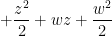
\displaystyle + \frac{z^2}{2} + wz + \frac{w^2}{2}

\displaystyle + \frac{z^3}{6} + \frac{wz^2}{2} + \frac{w^2 z}{2} + \frac{w^3}{6}

\displaystyle + \frac{z^4}{24} + \frac{w z^3}{6} + \frac{w^2 z^2}{4} + \frac{w^3 z}{6} + \frac{w^4}{24} + \dots

For each line, we obtain a common denominator:

e^z e^w = 1

+ z + w

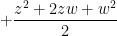
\displaystyle + \frac{z^2 + 2 z w + w^2}{2}

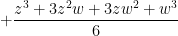
\displaystyle + \frac{z^3 + 3 z^2 w + 3 z w^2 + w^3}{6}

\displaystyle + \frac{z^4+ 4 z^3 w + 6 z^2 w^2 + 4 z w^3 + w^4}{24} + \dots

We recognize the familiar entries of Pascal’s triangle in the coefficients of the numerators, and so it appears that

e^z e^w = 1 + (z+w) + \displaystyle \frac{(z+w)^2}{2!} + \frac{(z+w)^3}{3!} + \frac{(z+w)^4}{4!} + \dots

If the pattern on the right-hand side holds up for exponents greater than 4, this proves that e^z e^w = e^{z+w}.

So that’s the idea of the proof. The formal proof will be presented in the next post.

green line

For completeness, here’s the movie that I use to engage my students when I begin this sequence of lectures.


Calculators and complex numbers (Part 13)

In this series of posts, I explore properties of complex numbers that explain some surprising answers to exponential and logarithmic problems using a calculator (see video at the bottom of this post). These posts form the basis for a sequence of lectures given to my future secondary teachers.

To begin, we recall that the trigonometric form of a complex number z = a+bi is

z = r(\cos \theta + i \sin \theta)

where r = |z| = \sqrt{a^2 + b^2} and \tan \theta = b/a, with \theta in the appropriate quadrant. As noted before, this is analogous to converting from rectangular coordinates to polar coordinates.

There’s a shorthand notation for the right-hand side (r e^{i \theta}) that I’m about to justify.

Definition. If z is a complex number, then we define

e^z = \displaystyle \sum_{n=0}^{\infty} \frac{z^n}{n!}

This of course matches the Taylor expansion of e^x for real numbers x.

For example,

e^i = \displaystyle \sum_{n=0}^{\infty} \frac{i^n}{n!}

= \displaystyle 1 + i + \frac{i^2}{2!} + \frac{i^3}{3!} + \frac{i^4}{4!} + \frac{i^5}{5!} + \frac{i^6}{6!} + \frac{i^7}{7!} + \dots

= \displaystyle \left(1 - \frac{1}{2!} + \frac{1}{4!} - \frac{1}{6!} \dots \right) + i \left( 1 - \frac{1}{3!} + \frac{1}{5!} - \frac{1}{7!} \right)

= \cos 1 + i \sin 1,

using the Taylor expansions for cosine and sine (and remembering that this is 1 radian, not 1 degree).

This was a lot of work, and raising i to successive powers is easy! You can imagine that finding something like e^{4-2i} would be next to impossible by directly plugging into the series and trying to simply the answer.

The good news is that there’s an easy way to compute e^z for complex numbers z, which we develop in the next few posts. Eventually, this will lead to the calculation of e^{\pi i} which is demonstrated in the video below.

green line

For completeness, here’s the movie that I use to engage my students when I begin this sequence of lectures.


Am I Going to Die This Year?

Here’s an unexpected application of exponential growth that I only learned about recently: the Gompertz Law of Human Mortality. It dictates that “your probability of dying in a given year doubles every eight years.”

Here’s the article that I read from NPR: http://www.npr.org/blogs/krulwich/2014/01/08/260463710/am-i-going-to-die-this-year-a-mathematical-puzzle?sc=tw&cc=share.

Engaging students: Solving exponential equations

In my capstone class for future secondary math teachers, I ask my students to come up with ideas for engaging their students with different topics in the secondary mathematics curriculum. In other words, the point of the assignment was not to devise a full-blown lesson plan on this topic. Instead, I asked my students to think about three different ways of getting their students interested in the topic in the first place.

I plan to share some of the best of these ideas on this blog (after asking my students’ permission, of course).

This student submission comes from my former student Elizabeth (Markham) Atkins. Her topic, from Precalculus: solving exponential equations.

green line

A.   APPLICATIONS: What interesting (i.e., uncontrived) word problems using this topic can your students do now?

Exponential equations can be different topics. You can use exponential equations for bacterial growth or decay, population growth or decay, or even a child eating their Halloween candy. Another example would be minimum wage.  A good word problem would be at one point minimum wage was $1.50 an hour. Use A=1.6 e^{rt} to figure out when minimum wage will reach $10.25 an hour. Another good word problem would be Billy Joe gets a dollar on his first day of work. Every day he works his salary for that day doubles. How much money does he have at the end of 30 days? A good money example would also be banking. “Use the equation A=Pe^{rt}. Shawn put $100 in a savings account, which has a rate of 5% per year. How long will it take for his savings to grow to $1000? There are many ways to show exponential growth and decay.

green line

B. CURRICULUM: How can this topic be used in your students’ future courses in mathematics or science?

Exponential equations can be used in science and life for many years from now.  Students will see exponential equations when they begin to study bacteria. They will have to find the decay of growth. Students will also have to see population growth and decay throughout history. They may be asked to find out what the population will be in twenty years. When students take economics, or do their own banking, they will need to calculate interest and principal. Students will also need to do the stock market which uses exponential equations. If students go into field where they are concerned with the population of species that may be becoming extinct then the student would predict when the species would become distinct by using an exponential formula. They could also calculate how long until a certain species may take over the world, such as tree frogs or rabbits. Exponential equations are everywhere in the world and in other subjects, besides mathematics.

green line

E. TECHNOLOGY: How can technology (YouTube, Khan Academy [khanacademy.org], Geometers Sketchpad, graphing calculators, etc.) be used to effectively engage students with this topic?

Exponential equations are used with technology everyday and every which way. Khan Academy has a few examples of exponential growth and exponential decay. Youtube has many great examples of exponential equations. Crewcalc’s exponential rap is an excellent example. They are very creative high school who found a way to express a mathematical concept through music.

Zombie Growth shows another interesting way to portray the mathematical concept of exponential equations. They use the phenomenon of zombies to demonstrate how exponential equations work.

Math project on Youtube showed another way to demonstrate how exponential equations work. They posed a problem and then stated the steps to solve the problem. Students need to use graphing calculators to check whether or not they have the right graph based on information given. They also need calculators to calculate equations and check their equations.

Square roots and logarithms without a calculator (Part 6)

I’m in the middle of a series of posts concerning the elementary operation of computing a square root. This is such an elementary operation because nearly every calculator has a \sqrt{~~} button, and so students today are accustomed to quickly getting an answer without giving much thought to (1) what the answer means or (2) what magic the calculator uses to find square roots. I like to show my future secondary teachers a brief history on this topic… partially to deepen their knowledge about what they likely think is a simple concept, but also to give them a little appreciation for their elders.

In Parts 3-5 of this series, I discussed how log tables were used in previous generations to compute logarithms and antilogarithms.

Today’s topic — log tables — not only applies to square roots but also multiplication, division, and raising numbers to any exponent (not just to the 1/2 power). After showing how log tables were used in the past, I’ll conclude with some thoughts about its effectiveness for teaching students logarithms for the first time.

To begin, let’s again go back to a time before the advent of pocket calculators… say, the 1880s.

Aside from a love of the movies of both Jimmy Stewart and John Wayne, I chose the 1880s on purpose. By the end of that decade, James Buchanan Eads had built a bridge over the Mississippi River and had designed a jetty system that allowed year-round navigation on the Mississippi River. Construction had begun on the Panama Canal. In New York, the Brooklyn Bridge (then the longest suspension bridge in the world) was open for business. And the newly dedicated Statue of Liberty was welcoming American immigrants to Ellis Island.

And these feats of engineering were accomplished without the use of pocket calculators.

Here’s a perfectly respectable way that someone in the 1880s could have computed \sqrt{4213} to reasonably high precision. Let’s write

x = \sqrt{4213}.

Take the base-10 logarithm of both sides.

\log_{10} x = \log_{10} \sqrt{4213} = \log_{10} (4213)^{1/2} = \displaystyle \frac{1}{2} \log_{10} 4213.

Then log tables can be used to compute \log_{10} 4213.

logtables1 logtables2

Step 1. In our case, we’re trying to find \log_{10} 4213. We know that \log_{10} 1000 = 3 and \log_{10} 10,000 = 4, so the answer must be between 3 and 4. More precisely,

\log_{10} 4213 = \log_{10} (1000 \times 4.213) = \log_{10} 1000 + \log_{10} 4.213 = 3 + \log_{10} 4.213.

To find \log_{10} 4.213, we see from the table that

\log_{10} 4.21 \approx 0.6243 and \log_{10} 4.22 = 0.6253

So, to estimate \log_{10} 4.213, we will employ linear interpolation. That’s a fancy way of saying “Find the line connecting (4.21,0.6243) and (4.22,0.6253), and find the point on the line whose x-coordinate is 4.213. Finding this line is a straightforward exercise in the point-slope form of a line:

m = \displaystyle \frac{0.6253-0.6243}{4.22-4.21} = 0.1

y - 0.6243 = 0.1 (x - 4.21)

y = 0.6243 + 0.1 (4.213-4.21)

y = 0.6243 + 0.1(0.003) = 0.6246

So we estimate \log_{10} 4.213 \approx 0.6246. Thus, so far in the calculation, we have

\log_{10} \sqrt{4213} \approx \displaystyle \frac{1}{2} (3 + 0.6246) = 1.8123

Step 2. We then take the antilogarithm of both sides. The term antilogarithm isn’t used much anymore, but the principle is still taught in schools: take 10 to the power of both the left- and right-hand sides. We obtain

\sqrt{4213} \approx 10^{1.8123} = 10^{1 + 0.8123} = 10^1 \times 10^{0.8123}

The first part of the right-hand side is easy: 10^1 = 10. For the second-part, we use the log table again, but in reverse. We try to find the numbers that are closest to 0.8123 in the body of the table. In our case, we find that

\log_{10} 6.49 = 0.8122 and \log_{10} 6.50 = 0.8129.

Once again, we use linear interpolation to find the line connecting (6.49,0.8122) and (6.50,0.8129), except this time the y-coordinate of 0.8123 is known and the x-coordinate is unknown.

m = \displaystyle \frac{0.8129-0.8122}{6.50-6.49} = 0.07

y - 0.8122 = 0.07 (x - 6.49)

0.8123 - 0.8122 = 0.07 (x - 6.49)

x = 6.49 + \displaystyle \frac{0.0001}{0.07} = 6.4914\dots

Since the table is only accurate to four significant digits, we estimate that 10^{0.8123} \approx 6.491. Therefore,

\sqrt{4213} \approx 10^1 \times 10^{0.8123} = 10 \times 6.491 = 64.91

By way of comparison, the answer is \sqrt{4213} \approx 64.9076\dots \approx 64.91, rounding at the hundredths digit. Not bad, for a generation born before the advent of calculators.

With a little practice, one can do the above calculations with relative ease. Also, many log tables of the past had a column called “proportional parts” that essentially replaced the step of linear interpolation, thus speeding the use of the table considerably.

green line

Log tables can be used for calculations more complex than finding a square root. For example, suppose I need to calculate

x = \displaystyle \frac{(34.5)^3}{(912)^{2/5}}

Using the log table, and without using a calculator, I find that

\log_{10} x = 3 \log_{10} 34.5 - \displaystyle \frac{2}{5} \log_{10} 912

\log_{10} x = 3(1.5378) - \displaystyle \frac{2}{5} (2.9600)

\log_{10} x = 3.4294

x = 10^3 \cdot 10^{0.4294} = 1000 \cdot 2.688 = 2688

That’s the correct answer to four significant digits. Using a calculator, we find the answer is 2688.186\dots