Proving theorems and special cases (Part 10): Angles in a convex n-gon

In a recent class with my future secondary math teachers, we had a fascinating discussion concerning how a teacher should respond to the following question from a student:

Is it ever possible to prove a statement or theorem by proving a special case of the statement or theorem?

Usually, the answer is no. In this series of posts, we’ve seen that a conjecture could be true for the first 40 cases or even the first 10^{316} cases yet not always be true. We’ve also explored the computational evidence for various unsolved problems in mathematics, noting that even this very strong computational evidence, by itself, does not provide a proof for all possible cases.

However, there are plenty of examples in mathematics where it is possible to prove a theorem by first proving a special case of the theorem. For the remainder of this series, I’d like to list, in no particular order, some common theorems used in secondary mathematics which are typically proved by first proving a special case.

1. Theorem. The sum of the angles in a convex n-gon is 180(n-2) degrees.

This theorem is typically proven after first proving the following lemma:

Lemma. The sum of the angles in a triangle is 180 degrees.

Clearly the lemma is a special case of the main theorem: for a triangle, n=3 and so 180(n-2) = 180 \times 1 = 180. The proof of the lemma uses alternate interior angles and the convention that the angle of a straight line is 180 degrees.

triangle1Using this, the main theorem follows by using diagonals to divide a convex n-gon into n-2 triangles. (For example, drawing a diagonal divides a quadrilateral into two triangles.) The sum of the angles of the n-gon must equal the sum of the angles of the n-2 triangles.

green line

So it is possible to prove a theorem by proving a special case of the theorem. Using the sum of the angles of a triangle to prove the formula for the sum of the angles of a convex n-gon is qualitatively different than the previous computational examples seen earlier in this series.


Inverse Functions: Arctangent and Angle Between Two Lines (Part 25)

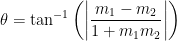
The smallest angle between the non-perpendicular lines y = m_1 x + b_1 and y = m_1 x + b_2 can be found using the formula

\theta = \displaystyle \tan^{-1} \left( \left| \frac{m_1 - m_2}{1 + m_1 m_2} \right| \right).

A generation ago, this formula used to be taught in a typical Precalculus class (or, as it was called back then, analytical geometry). However, I find that analytic geometry has fallen out of favor in modern Precalculus courses.

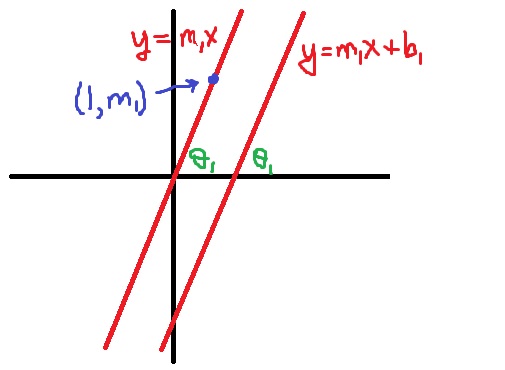
Why does this formula work? Consider the graphs of y = m_1 x and y = m_1 x + b_1, and let’s measure the angle that the line makes with the positive x-axis.

dotproduct5The lines y = m_1 x + b_1 and y = m_1 x are parallel, and the x-axis is a transversal intersecting these two parallel lines. Therefore, the angles that both lines make with the positive x-axis are congruent. In other words, the + b_1 is entirely superfluous to finding the angle \theta_1. The important thing that matters is the slope of the line, not where the line intersects the y-axis.

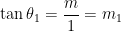
The point (1, m_1) lies on the line y = m_1 x, which also passes through the origin. By definition of tangent, \tan \theta_1 can be found by dividing the y- and x-coordinates:

\tan \theta_1 = \displaystyle \frac{m}{1} = m_1.

green linedotproduct6


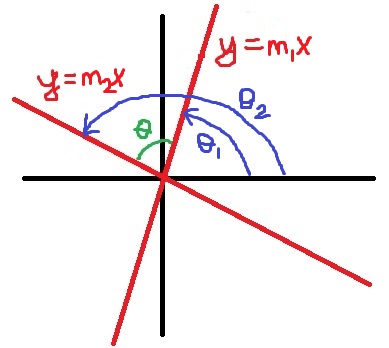
We now turn to the problem of finding the angle between two lines. As noted above, the y-intercepts do not matter, and so we only need to find the smallest angle between the lines y = m_1 x and y = m_2 x.

The angle \theta will either be equal to \theta_1 - \theta_2 or \theta_2 - \theta_1, depending on the values of m_1 and m_2. Let’s now compute both \tan (\theta_1 - \theta_2) and \tan (\theta_2 - \theta_1) using the formula for the difference of two angles:

\tan (\theta_1 - \theta_2) = \displaystyle \frac{\tan \theta_1 - \tan \theta_2}{1 + \tan \theta_1 \tan \theta_2}

\tan (\theta_2 - \theta_1) = \displaystyle \frac{\tan \theta_2 - \tan \theta_1}{1 + \tan \theta_2 \tan \theta_1}

Since the smallest angle \theta must lie between 0 and \pi/2, the value of \tan \theta must be positive (or undefined if \theta = \pi/2… for now, we’ll ignore this special case). Therefore, whichever of the above two lines holds, it must be that

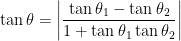
\tan \theta = \displaystyle \left| \frac{\tan \theta_1 - \tan \theta_2}{1 + \tan \theta_1 \tan \theta_2} \right|

We now use the fact that m_1 = \tan \theta_1 and m_2 = \tan \theta_2:

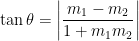
\tan \theta = \displaystyle \left| \frac{m_1 - m_2}{1 + m_1 m_2} \right|

\theta = \tan^{-1} \left( \displaystyle \left| \frac{m_1 - m_2}{1 + m_1 m_2} \right| \right)

green line

The above formula only applies to non-perpendicular lines. However, the perpendicular case may be remembered as almost a special case of the above formula. After all, \tan \theta is undefined at \theta = \pi/2 = 90^\circ, and the right hand side is also undefined if 1 + m_1 m_2 = 0. This matches the theorem that the two lines are perpendicular if and only if m_1 m_2 = -1, or that the slopes of the two lines are negative reciprocals.

Inverse Functions: Arctangent and Angle Between Two Lines (Part 24)

Here’s a straightforward application of arctangent that, a generation ago, used to be taught in a typical Precalculus class (or, as it was called back then, analytical geometry).

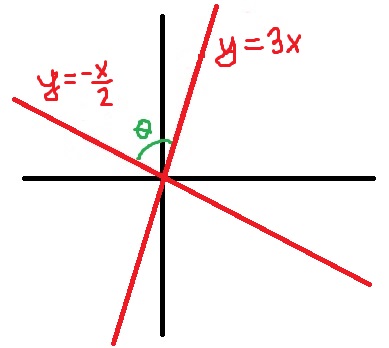
Find the smallest angle between the lines y= 3x and y = -x/2.

dotproduct3

This problem is almost equivalent to finding the angle between the vectors \langle 1,3 \rangle and \langle -2,1 \rangle. I use the caveat almost because the angle between two vectors could be between 0 and \pi, while the smallest angle between two lines must lie between 0 and \pi/2.

This smallest angle can be found using the formula

\theta = \displaystyle \tan^{-1} \left( \left| \frac{m_1 - m_2}{1 + m_1 m_2} \right| \right),

where m_1 and m_2 are the slopes of the two lines. In the present case,

\theta = \tan^{-1} \left( \left| \displaystyle \frac{ 3 - (-1/2) }{1 + (3)(-1/2)} \right| \right)

\theta = \tan^{-1} \left( \left| \displaystyle \frac{7/2}{-1/2} \right| \right)

\theta = \tan^{-1} 7

\theta \approx 81.87^\circ.

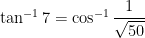
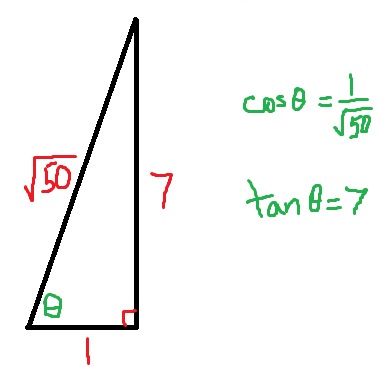
Not surprisingly, we obtain the same answer that we obtained a couple of posts ago using arccosine. The following picture makes clear why \tan^{-1} 7 = \cos^{-1} \displaystyle \frac{1}{\sqrt{50}}.

dotproduct4In tomorrow’s post, I’ll explain why the above formula actually works.


Inverse Functions: Arccosine and Dot Products (Part 23)

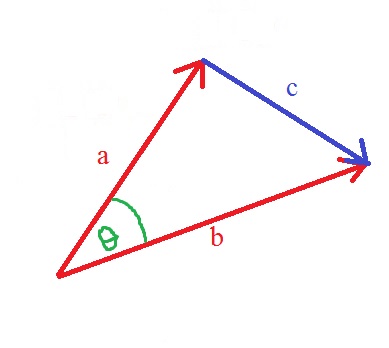
The Law of Cosines can be applied to find the angle between two vectors {\bf a} and {\bf b}. To begin, we draw the vectors {\bf a} and {\bf b}, as well as the vector {\bf c} (to be determined momentarily) that connects the tips of the vectors {\bf a} and {\bf b}.

dotproduct2Using the usual rules for adding vectors, we see that {\bf a} + {\bf c} = {\bf b}, so that {\bf c} = {\bf b} - {\bf a}

We now apply the Law of Cosines to find \theta:

\parallel \! \! {\bf c} \! \! \parallel^2 = \parallel \! \! {\bf a} \! \! \parallel^2 + \parallel \! \! {\bf b} \! \! \parallel^2 - 2 \parallel \! \! {\bf a} \! \! \parallel \parallel \! \! {\bf b} \! \! \parallel \cos \theta

\parallel \! \! {\bf b} - {\bf a} \! \! \parallel^2 = \parallel \! \! {\bf a} \! \! \parallel^2 + \parallel \! \! {\bf b} \! \! \parallel^2 - 2 \parallel \! \! {\bf a} \! \! \parallel \parallel \! \! {\bf b} \! \! \parallel \cos \theta

We now apply the rule \parallel \! \! {\bf a} \! \! \parallel^2 = {\bf a} \cdot {\bf a}, convert the square of the norms into dot products. We then use the distributive and commutative properties of dot products to simplify.

( {\bf b} - {\bf a} ) \cdot ({\bf b} - {\bf a}) = {\bf a} \cdot {\bf a} + {\bf b} \cdot {\bf b} - 2 \parallel \! \! {\bf a} \! \! \parallel \parallel \! \! {\bf b} \! \! \parallel \cos \theta

{\bf b} \cdot ({\bf b} - {\bf a}) - {\bf a} \cdot ({\bf b} - {\bf a}) = {\bf a} \cdot {\bf a} + {\bf b} \cdot {\bf b} - 2 \parallel \! \! {\bf a} \! \! \parallel \parallel \! \! {\bf b} \! \! \parallel \cos \theta

{\bf b} \cdot ({\bf b} - {\bf a}) -{\bf a} \cdot ({\bf b} - {\bf a}) = {\bf a} \cdot {\bf a} + {\bf b} \cdot {\bf b} - 2 \parallel \! \! {\bf a} \! \! \parallel \parallel \! \! {\bf b} \! \! \parallel \cos \theta

{\bf b} \cdot {\bf b} - {\bf a} \cdot {\bf b} - {\bf a} \cdot {\bf b} + {\bf a} \cdot {\bf a} = {\bf a} \cdot {\bf a} + {\bf b} \cdot {\bf b} - 2 \parallel \! \! {\bf a} \! \! \parallel \parallel \! \! {\bf b} \! \! \parallel \cos \theta

{\bf b} \cdot {\bf b} - 2 {\bf a} \cdot {\bf b} + {\bf a} \cdot {\bf a} = {\bf a} \cdot {\bf a} + {\bf b} \cdot {\bf b} - 2 \parallel \! \! {\bf a} \! \! \parallel \parallel \! \! {\bf b} \! \! \parallel \cos \theta

We can now cancel from the left and right sides and solve for \cos \theta:

- 2 {\bf a} \cdot {\bf b} = - 2 \parallel \! \! {\bf a} \! \! \parallel \parallel \! \! {\bf b} \! \! \parallel \cos \theta

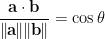
\displaystyle \frac{ {\bf a} \cdot {\bf b} }{ \parallel \! \! {\bf a} \! \! \parallel \parallel \! \! {\bf b} \! \! \parallel } = \cos \theta

Finally, we are guaranteed that the angle between two vectors must lie between 0 and \pi (or, in degrees, between 0^\circ and 180^\circ). Since this is the range of arccosine, we are permitted to use this inverse function to solve for \theta:

\cos^{-1} \left( \displaystyle \frac{ {\bf a} \cdot {\bf b} }{ \parallel \! \! {\bf a} \! \! \parallel \parallel \! \! {\bf b} \! \! \parallel } \right) = \theta

The good news is that there’s nothing special about two dimensions in the above proof, and so this formula may used for vectors in \mathbb{R}^n for any dimension n \ge 2.

In the next post, we’ll consider how this same problem can be solved — but only in two dimensions — using arctangent.

Inverse Functions: Arccosine and Dot Products (Part 22)

Here’s a straightforward application of arccosine, that, as far as I can tell, isn’t taught too often in Precalculus and is not part of the Common Core standards for vectors and matrices.

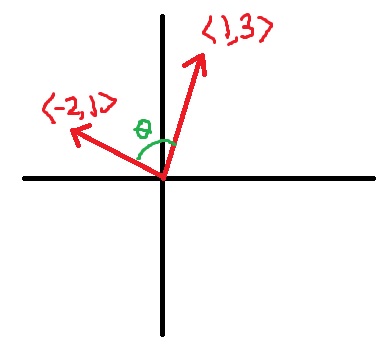
Find the angle between the vectors \langle 1,3 \rangle and \langle -2,1 \rangle.

dotproductThis problem is equivalent to finding the angle between the lines y = 3x and y = -x/2. The angle \theta is not drawn in standard position, which makes measurement of the angle initial daunting.

Fortunately, there is the straightforward formula for the angle between two vectors {\bf a} and {\bf b}:

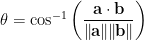
\theta = \cos^{-1} \left( \displaystyle \frac{ {\bf a} \cdot {\bf b} }{ \parallel \!\! {\bf a} \!\! \parallel \parallel \!\! {\bf b} \!\! \parallel } \right)

We recall that {\bf a} \cdot {\bf b} is the dot product (or inner product) of the two vectors {\bf a} and {\bf b}, while \parallel \!\! {\bf a} \!\! \parallel = \sqrt{ {\bf a} \cdot {\bf a} } is the norm (or length) of the vector {\bf a}.

 For this particular example,

\theta = \cos^{-1} \left( \displaystyle \frac{\langle 1,3 \rangle \cdot \langle -2,1 \rangle }{ \parallel \!\!\langle 1,3 \rangle \!\! \parallel \parallel \!\!\langle -2,1 \rangle \!\! \parallel } \right)

\theta = \cos^{-1} \left( \displaystyle \frac{ (1)(-2) + (3)(1) }{ \sqrt{ (1)^2 + (3)^2} \sqrt{ (-2)^2 + 1^2 }} \right)

\theta = \cos^{-1} \displaystyle \frac{1}{\sqrt{50}}

\theta \approx 81.87^\circ

In the next post, we’ll discuss why this actually works. And then we’ll consider how the same problem can be solved more directly using arctangent.

Engaging students: Defining the acute, right, and obtuse

In my capstone class for future secondary math teachers, I ask my students to come up with ideas for engaging their students with different topics in the secondary mathematics curriculum. In other words, the point of the assignment was not to devise a full-blown lesson plan on this topic. Instead, I asked my students to think about three different ways of getting their students interested in the topic in the first place.

I plan to share some of the best of these ideas on this blog (after asking my students’ permission, of course).

This student submission again comes from my former student Randall Hall. His topic, from Geometry: defining the terms acute, right, and obtuse.

green line

D4. What are the contributions of various cultures to this topic?

In ancient times, Euclid adopted the idea of a right angle and defined a right angle to be an angle that was to be congruent to it, an acute angle was denoted by less than a right angle and obtuse angle was denoted to be greater than a right angle. Euclid defined it that way because back then Geometry wasn’t associated with numbers; Geometry was associated with circles, lines, line segments and triangles. Many things we know now such as the Pythagorean Theorem can be explained by what we know now to be a right angle.

The Babylonians were one of the first to use degrees in measurements of astronomy between 5000 and 4000 BC. The Babylonians had an interesting number system in that they used a base-60 counting system while today we use a base-10 system. It is because of them that we have a sixty minutes in an hour and 360 degrees in a circle.

Source: http://math.ucsd.edu/~wgarner/math4c/textbook/chapter5/angles_radians.htm


green line

D5. How have different cultures throughout time used this topic in their society?

The history of the mathematical measurement of angles possibly dates back to 1500BC in Egypt, where measurements were taken of the Sun’s shadow against graduations marked on stone tables, examples of which can be seen in the Egyptian Museum in Berlin. The shadow was cast but a vertical rod (Gnomon) along the length of the markings on a stone tablet, enabling time and seasons to be measured with some degree of accuracy.

The first known instrument for measuring angles was possibly the Egyptian Groma, an instrument used in construction massive objects such as the pyramids. The Groma consisted of four stones hanging by cords from sticks set at right angles; measurements were then taken by the visual alignment of two of the suspended cords and the point to be set out. It was limited due to it was only usable on fairly flat terrain and its accuracy limited by distance. The Groma continued to set out right angles for many Roman constructions, including roads, which were straight lines, set by the Groma.

Source: http://www.fig.net/pub/cairo/papers/wshs_01/wshs01_02_wallis.pdf


green line

E1. How can technology (YouTube, Khan Academy [khanacademy.org], Vi Hart, Geometers Sketchpad, graphing calculators, etc.) be used to effectively engage students with this topic?

The link below contains a great JAVA applet that features an angle within the apple that allows the user to designate what the user wants the angle to be. In addition to showing the angle, the applet will recognize that number and then output the appropriate angle type. For example, if the applet recognizes a 90 in the “degree of angle” box and then outputs ‘Right’. In addition to the JAVA application, a description of an angle is given for each type of angle. The classifications of angles are: acute, right, obtuse, straight, reflux, and full rotation. This is excellent for the student because it provides the student a visual of what each type of angles look like. Visuals, such as this, are good for the student because it encompasses all types of learning style. It is also good for ESL learners because it provides them an alternative method for interpreting what is being discussed.

http://www.cut-the-knot.org/Curriculum/Geometry/Angle.shtml