From a terrific article “Reflections on Mathematics and Democracy” by Lynn Arthur Steen, a past president of the Mathematical Association of America.
So we face three distinct challenges:
– Addressing the many weaknesses evident in mathematical learning;
– Reducing the gulf between the traditional pre-calculus curriculum and the quantitative needs of life, work, and citizenship;
– Teaching mathematics in a way that encourages transfer—for citizenship, for career, and for further study.
I suggest that these three challenges are manifestations of a single problem, and that all three can be addressed in the same way: by organizing the curriculum to pay greater attention to the goal of transferable knowledge and skills.
There are many ways to accomplish this, for example:
– by embedding mathematics in courses focused on applications of mathematics;
– by team-taught cross-disciplinary courses that blend mathematics with other subjects in which mathematical thinking arises (e.g., genetics, personal finance, medical technology);
– by project-focused curricula in which all school subjects are submerged into a class group project (e.g., design a solar powered car).
– by career-focused curricula in which a cohort of students focuses all their school work on particular career areas (e.g., technology, communications, or business).
 , apparently targeted toward mathematicians.
 . A valid answer gets 4 points; the smallest answer in the class will get 5 points.” It was basically free extra credit… any positive number would work, but it was a (hopefully) fun way for students to be a little competitive in coming up with small positive numbers, which is the intuitive meaning of
  or
or  . Except for one particularly gutsy student who wrote, “The probability that Dr. Q gets a date on Friday night.” For sheer nerve, he got the 5 points that year.
 be the smallest answer that anyone else wrote. Then
  .” That was especially clever from a calculus student, as that’s the essence of a fairly common technique when writing proofs in real analysis.
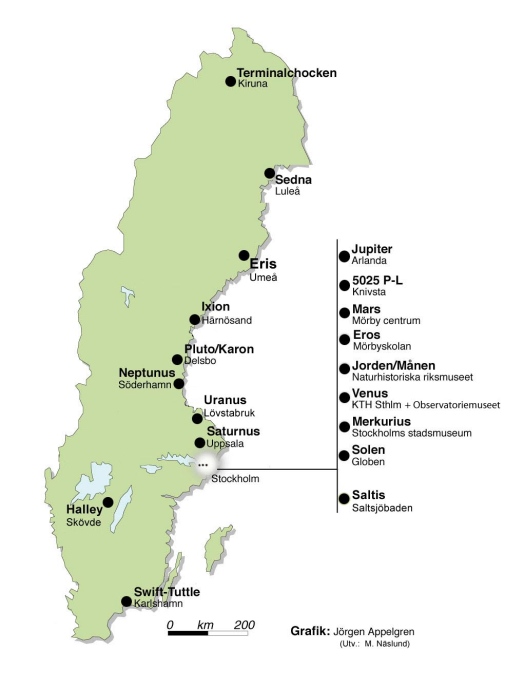
 . The inner planets are in the vicinity of Stockholm, while the outer planets, dwarf planets, and distant objects are spread throughout the country.