Error involving countable numbers in Glencoe Algebra 2 (2014)

Errors in textbooks happened when Pebbles Flintstone and Bamm-Bamm Rubble attended Flintstone Elementary, and they still happen on occasion today. But even with that historical perspective, this howler is a doozy.

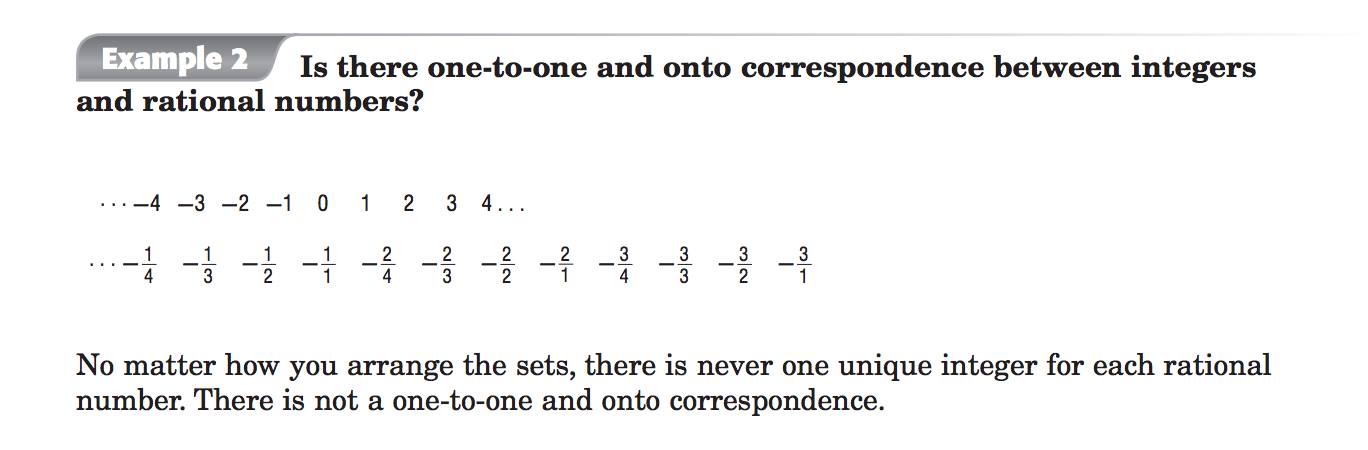
This was sent to me by a former student of mine. It appears in the chapter study guide for Section 2.1 of Glencoe’s Algebra 2 textbook (published in 2014), presumably as an enrichment activity for students learning about the definitions of “one to one functions” and “onto functions.”
countable infinityJust how bad is this mistake?

  • The above “proof” is only a blatant assertion, without any justification, either formal or informal, for why the authors think that the statement is false.
  • The ordering of the rational numbers in the way listed above is actually reasonably close to the listing that actually does produce the one-to-one correspondence between \mathbb{Q} and \mathbb{Z}.
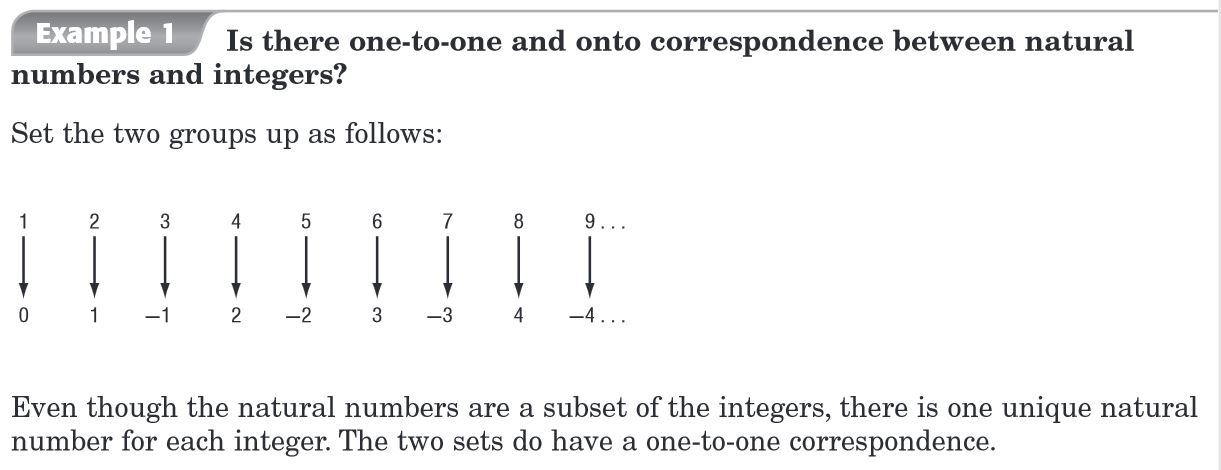
  • Just above Example 2 was Example 1, which gives the correct proof that there’s a one-to-one correspondence between \mathbb{Z} and \mathbb{N}. If the authors had double-checked this proof in any reputable book, they should have also been able to double-check that their Example 2 was completely false.
countable infinity 2

green line

The full chapter study guide can be found here (it’s on the last page): http://nseuntj.weebly.com/uploads/1/8/2/0/18201983/2.1relations_and_functions.pdf

Reactions can be found here: https://www.reddit.com/r/math/comments/3k1qe6/this_is_in_a_high_school_math_textbook_in_texas/

Reference to this can be seen on page 10 of the teacher’s manual here: http://msastete.com/yahoo_site_admin1/assets/docs/Chpte2-1.25882808.pdf


 

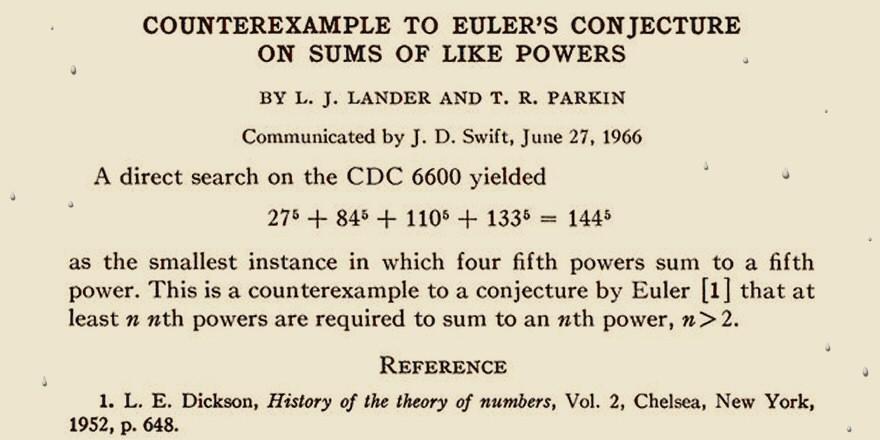
The Shortest Known Paper Published in a Serious Math Journal

Source: http://www.openculture.com/2015/04/shortest-known-paper-in-a-serious-math-journal.html

Euler’s conjecture, a theory proposed by Leonhard Euler in 1769, hung in there for 200 years. Then L.J. Lander and T.R. Parkin came along in 1966, and debunked the conjecture in two swift sentences. Their article — which is now open access and can be downloaded here — appeared in the Bulletin of the American Mathematical Society.


Folding a New Tomorrow: Origami Meets Math and Science

From the YouTube description:

Origami, the art of paper folding, has been practiced in Japan and all over the world for centuries. The past decade, however, has witnessed a surge of interest in using origami for science. Applications in robotics, airbag design, deployment of space structures, and even medicine and bioengineering are appearing in the popular science press. Videos of origami robots folding themselves up and walking away or performing tasks have gone viral in recent years. But if the art of paper folding is so old, why has there been an increase in origami applications now? One answer is because of mathematics. Advances in our understanding of how folding processes work has arisen due to success in modeling origami mathematically. In this presentation we will explore why origami lends itself to mathematical study and see some of the math that has allowed applications to become so fruitful.

Irrational / Everything’s relative

One popular (though maybe apocryphal) story from the history of mathematics involves the discovery of irrational numbers by Pythagoras and his disciples. The following quote is from the book Fermat’s Last Theorem by Simon Singh:

One story claims that a young student by the name of Hippasus was idly toying with the number \sqrt{2}, attempting to find the equivalent fraction. Eventually he came to realize that no such fraction existed, i.e. that \sqrt{2} is an irrational number. Hippasus must have been overjoyed by his discovery, but his master was not. Pythagoras had defined the universe in terms of rational numbers, and the existence of irrational numbers brought his ideal into question. The consequence of Hippasus’ insight should have been a period of discussion and contemplation during which Pythagoras ought to have come to terms with this new source of numbers. However, Pythagoras was unwilling to accept that he was wrong, but at the same time he was unable to destroy Hippasus’ argument by the power of logic. To his eternal shame he sentenced Hippasus to death by drowning.

When I was a boy, the story was told that Pythagoras could not accept irrational (i.e.., cannot be written as the ratio of two integers) numbers because their existence would mean that we live in an irrational (i.e., insane, crazy) world, and so he had the unfortunate discoverer silenced.

When I present this story to my own students, they’re usually incredulous about the story, doubting that someone so smart could act so stupidly (or irrationally). Then I’ll tell them a much more recent story, from less than 100 years ago, about how a scientific principle morphed into a statement of ethics. Einstein’s theories of special relativity and general relativity were developed in the early 1900s; his theory of general relativity explained precession in the orbit of Mercury and predicted the deflection of starlight by the Sun’s gravity, which were both unexplained by Newtonian mechanics.

Writing to a popular audience, Einstein summarized his theory as follows:

The ‘Principle of Relativity’ in its widest sense is contained in the statement: The totality of physical phenomena is of such a character that it gives no basis for the introduction to the concept of “absolute motion”; or, shorter but less precise: There is no absolute motion.

The following sentences from Paul Johnson’s Modern Times summarize the popular reaction to Einstein’s work:

But for most people, to whom Newtonian physics, with their straight lines and right angles, were perfectly comprehensible, relativity never became more than a vague source of unease. It was grasped that absolute time and absolute length had been dethroned; that motion was curvilinear… At the beginning of the 1920s the belief began to circulate, for the first time at a popular level, that there were no longer any absolutes: of time and space, of good and evil, of knowledge, above all of value. Mistakenly, but perhaps inevitably, relativity became confused with relativism.

Indeed, the modern catchphrase “everything’s relative” was spawned shortly after the discovery of special and general relativity, a moral principle that Einstein himself abhorred.

So, after telling the story about Pythagoras and \sqrt{2}, I’ll use this story to hold up a mirror to ourselves, demonstrating that the passage of time has not made us immune from translating mathematical or scientific principles into statements of ethics.

Larger or smaller?

Suppose I write down two different numbers on two slips of paper. You have no idea what the two numbers are. They could be really large or really small, positive or negative, rational or irrational. All you know is that the two numbers are different.Your job is to pick the larger number.

Is there a way for you to guess the larger number with a probability greater than 50%?

The surprising answer is yes.

10 Secret Trig Functions Your Math Teachers Never Taught You

Students in trigonometry are usually taught about six functions:

\sin \theta, \cos \theta, \tan \theta, \cot \theta, \sec \theta, \csc \theta

I really enjoyed this article about trigonometric functions that were used in previous generations but are no longer taught today, like \hbox{versin} \theta and \hbox{havercosin} \theta:

http://blogs.scientificamerican.com/roots-of-unity/10-secret-trig-functions-your-math-teachers-never-taught-you/

Naturally, Math With Bad Drawings had a unique take on this by adding a few more suggested functions to the list. My favorites: