In this series, I’m compiling some of the quips and one-liners that I’ll use with my students to hopefully make my lessons more memorable for them.
I always encourage students to answer occasional questions in class; naturally, this opens the possibility that a student may suggest an answer that is completely wrong or is only partially correct. Naturally, I don’t want to discourage students from participating in class by blunting saying “You’re wrong!” So I need to have a gentle way of pointing out that the proposed answer isn’t quite right.
Thanks to a recent movie, I finally have hit on a one-liner to do this with good humor and cheer: “To quote the trolls in Frozen, I’m afraid your answer is a bit of a fixer-upper. (Laughter) So it’s a bit of a fixer-upper, but this I’m certain of… you can fix this fixer-upper up with a little bit of love.”
If you have no idea about what I’m talking about, here’s the song from the movie (you can hate me for the rest of the day while you sing this song to yourself):
In this series, I’m compiling some of the quips and one-liners that I’ll use with my students to hopefully make my lessons more memorable for them.
When doing a large computation, I’ll often leave plenty of blank space on the board to fill it later. For example, when proving by mathematical induction that
,
the inductive step looks something like
So I explained that, to complete the proof by induction, all we had to do was convert the top line into the bottom line.
As my class swallowed hard as they thought about how to perform this task, I told them, “Yes, this looks really intimidating. Indeed, to quote the great philosopher, ‘You might think that I’m insane. But I’ve got a blank space, baby… so let’s write what remains.’ “
And, just in case you’ve been buried under a rock, here’s the source material for the one-liner (which, at the time of this writing, is the fifth-most watched video on YouTube):
In this series, I’m compiling some of the quips and one-liners that I’ll use with my students to hopefully make my lessons more memorable for them.
One of the most common student mistakes with logarithms is thinking that
.
Whenever students make this mistake, I call it the Third Classic Blunder. The first classic blunder, of course, is getting into a major land war in Asia. The second classic blunder is getting into a battle of wits with a Sicilian when death is on the line. And the third classic blunder is thinking that somehow simplfies as .
Sadly, as the years pass, fewer and fewer students immediately get the cultural reference. On the bright side, it’s also an opportunity to introduce a new generation to one of the great cinematic masterpieces of all time.
One of my colleagues calls this mistake the Universal Distributive Law, where the distributes just as if was being multiplied by a constant. Other mistakes in this vein include and .
Along the same lines, other classic blunders are thinking that
simplifies as
and that
simplifies as .
I’m continually amazed at the number of good students who intellectually know that the above equations are false but panic and use them when solving a problem.
In my capstone class for future secondary math teachers, I ask my students to come up with ideas for engaging their students with different topics in the secondary mathematics curriculum. In other words, the point of the assignment was not to devise a full-blown lesson plan on this topic. Instead, I asked my students to think about three different ways of getting their students interested in the topic in the first place.
I plan to share some of the best of these ideas on this blog (after asking my students’ permission, of course).
This student submission again comes from my former student Daniel Adkins. His topic, from Algebra: adding, subtracting, multiplying, and dividing complex numbers.
How has this topic appeared in pop culture?
Robot chicken aired a television episode in which students were being taught about the imaginary number. Upon the instructor’s completion of his definition of the imaginary number, one student, who understands the definition, immediately has his head explode. One student turns to him and says, “I don’t get it. No wait now I-“, and then his head also explodes.
This video can be used as a humorous introduction that only takes a few seconds. It conveys that these concepts can be difficult in a more light-hearted sense. At the same time it satirically exaggerates the difficulty, and therefore might challenge the students. All the while the video provides the definition as well.
How did people’s conception of this topic change over time?
The first point of contact with imaginary numbers is attributed to Heron of Alexandria around the year 50 A.D. He was attempting to solve the section of a pyramid. The equation he eventually deemed impossible was the sqrt(81-114). Attempts to find a solution for a negative square root wouldn’t reignite till the discovery of negative numbers, and even this would lead to the belief that it was impossible. In the early fifteenth century speculations would rise again as higher degree polynomial equations were being worked out, but for the most part negative square roots would just be avoided. In 1545 Girolamo Cardono writes a book titled Ars Magna. He solves an equation with an imaginary number, but he says, “[imaginary numbers] are as subtle as they would be useless.” About them, and most others agreed with him until 1637. Rene Descartes set a standard form for complex numbers, but he still wasn’t too fond of them. He assumed, “that if they were involved, you couldn’t solve the problem.” And individuals like Isaac Newton agreed with him.
Rafael Bombelli strongly supported the concept of complex numbers, but since he wasn’t able to supply them with a purpose, he went mostly unheard. That is until he came up with the concept of using complex numbers to find real solutions. Over the years, individuals eventually began to hear him out.
One of the major ways that helped aid with people eventually come to terms with imaginary numbers was the concept of placing them on a Cartesian graph as the Y-axis. This concept was first introduced in 1685 by John Wallis, but he was largely ignored. A century later, Caspar Wessel published a paper over the concept, but was also ignored. Euler himself labeled the square root of negative 1 as i, which did help in modernizing the concept. Throughout the 19th century, countless mathematicians aided to the growing concept of complex numbers, until Augustin Louis Cauchy and Niels Henrik Able make a general theory of complex numbers.
This is relevant to students because it shows that mathematicians once found these things impossible, then they found them unbelievable, then they found them trivial, until finally, they found a purpose. It encourages students to work hard even if there doesn’t seem to be a reason behind it just yet, and even if it seems like your head is about to blow.
How has this topic appeared in high culture?
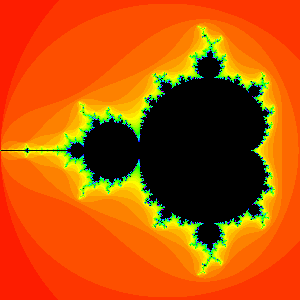
The Mandelbrot set is a beautiful fractal set with highly complex math hidden behind it. However it is extremely complicated, and as Otto von Bismarck put it, “laws are like sausages. Better not to see them being made.”
Like most fractals, the Mandelbrot set begins with a seed to start an iteration. In this case we begin with x2 + c, where c is some real number. This creates an eccentric pattern that grows and grows.
For students, this can show how mathematics can create beautiful patterns that would interest their more artistic senses. Not only would this generate interest in complex numbers, but it might convince students to investigate recurring patterns.
In my capstone class for future secondary math teachers, I ask my students to come up with ideas for engaging their students with different topics in the secondary mathematics curriculum. In other words, the point of the assignment was not to devise a full-blown lesson plan on this topic. Instead, I asked my students to think about three different ways of getting their students interested in the topic in the first place.
I plan to share some of the best of these ideas on this blog (after asking my students’ permission, of course).
This student submission again comes from my former student Matthew Garza. His topic, from Algebra: defining a function of one variable.
How can this topic be used in your students’ future courses in mathematics and science?
Being able to define a function of one variable is necessary for creating a model that describes the most basic phenomenon in math and science. In math, understanding these parent functions is crucial to understanding more complicated functions and, by considering some variables as temporarily fixed, multivariable equations and systems of equations can be easier to understand. In science, we often observe functions of a single variable. In fact, even if there are multiple variables coming into play, a good lab will likely control all but one variable, so that we can understand the relationship with respect to that single variable – a function.
Consider in science, for example, the ideal gas law: PV = nRT, where P is pressure, V is volume, n is the quantity in moles of a gas, R is the gas constant, and T is temperature. This law, taught in high school chemistry, is not taught from scratch. The proportional, single-variable functions that make up the equation are observed individually before the ideal gas law is introduced. Students will probably be taught Boyle’s, Charles’, Gay-Lussac’s, and Avogadro’s laws first. Boyle’s law states pressure and volume are inversely proportional (for a fixed temperature and quantity of gas). This law can be demonstrated in one lab by clamping a pipette with some water and air inside, thus fixing all but two variables. Pressure is applied to the pipette and the volume of air is measured using the length of the air column in the pipette. Students must then evaluate volume V as a function of the single variable pressure P. It should be noted that the length of the air column is measured, while the diameter of the pipette is fixed, thus volume must be calculated as a function of the single variable length. Understanding the single variable, proportional and inversely proportional relationships is crucial to understanding the ideal gas law itself.
How can technology (YouTube, Khan Academy [khanacademy.org], Vi Hart, Geometers Sketchpad, graphing calculators, etc.) be used to effectively engage students with this topic? Note: It’s not enough to say “such-and-such is a great website”; you need to explain in some detail why it’s a great website.
Generally speaking, Khan Academy has great videos to help understand math concepts. Although it’s a little dry, this “Introduction to Functions” video is clear, concise, and touches on several ideas that I was having trouble tying in to every example. This introductory video begins with the basic concept of a function as a mapping from one value to another single value. The first examples it uses are a piece-wise function and a less computational function that returns the next highest number beginning with the same letter. At first I didn’t like that these functions were discontinuous, but this actually gives something else to discuss. The video links back prior knowledge, explaining that the dependent variable y that students are familiar with is actually a function of x, and represents the two in a table. The last couple minutes of the video address the fundamental property that a function must produce unique outputs for each x, or it is a relationship.
How could you as a teacher create an activity or project that involves your topic?
One idea might be to examine any function in which time is the independent variable. Basic concepts of motion in physics can supplement an activity – Have groups evaluate position and speed with respect to time of, say, a marble or hot wheels car rolling down a ramp. Using a stop watch and marking distance on an inclined plane, students could time how long it took to reach certain points and create a graph over time of displacement. This method might result in some students graphing time as a function of displacement, which could lead to an interesting discussion on independence and dependence, and why it might be useful to view change as a function of time.
Technology could supplement such a lesson as to avoid confusion over whether distance is a function of time or vice versa. Using motion sensor devices to collect data, such as the CBR2, students can use less time collecting and plotting data and more time examining it. Different trials resulting in different graphs can lead to discussion on how to model such motion as a function of time – letting an object sit still would result in a constant graph, something rolling down an incline will give a parabolic graph (until the object gets too close to a terminal velocity).
To add variety, students can examine what a graph looks like if they move toward and away from the CBR2 or try to reproduce given position graphs. This may result in the same position at different times, but since an object can be in only one position at a given time, the utility of using position as a function of time can be represented. Sporadic motion, including changes in speed and direction (like moving back and forth and standing still) also allow discussion of piecewise functions, and that functions don’t necessarily have to have a “rule” as long as only one output is assigned per value in the domain.
In my capstone class for future secondary math teachers, I ask my students to come up with ideas for engaging their students with different topics in the secondary mathematics curriculum. In other words, the point of the assignment was not to devise a full-blown lesson plan on this topic. Instead, I asked my students to think about three different ways of getting their students interested in the topic in the first place.
I plan to share some of the best of these ideas on this blog (after asking my students’ permission, of course).
This student submission again comes from my former student Daniel Herfeldt. His topic, from Algebra: multiplying polynomials.
How could you as a teacher create an activity or project that involves your topic?
Activities for multiplying polynomials are endless. An activity that I would do with my students is a game called polynomial dice. To do this, you would first is to get several blank dice and write random polynomials on each side of the dice. Then in class, divide the students into groups of no more than three. Each group will get a pair of dice. Have the students roll the dice and they should have two different polynomials. Once they have rolled, have them multiply the polynomials together. This is best done with groups so that the students can share their work with their partners to see if they both got the same answer. If they did not get the same answer, they can go back through each other’s steps to see where they went wrong. If you want to make the game a bit harder, you can add more dice to make them multiply three polynomials, or maybe even more. This is a great game because it can be used for multiplying polynomials, as well as dividing, adding and subtracting. It could be a great review game before a major test to have students remember how to do each individual property. For example, have the students roll the dice, then with the two polynomials they get, they first add the polynomials, followed by the difference, then the product, and finally the quotient.
How can this topic be used in your students’ future courses in mathematics or science?
Multiplying polynomials is used all over mathematics. It is first introduced in Algebra I and Algebra II. Multiplying polynomials can be very difficult for students and make them not want to do the work. This is due to there being so much work for one problem. Since there is so much work, there is a lot of room for mistakes. This topic is used is Algebra I, Algebra II, Algebra III, Pre-Calculus, Calculus and just about every higher math course. If a student is looking to go into an architecture or engineering field, they will have to apply their knowledge of polynomials. Due to this, the topic is one of the most important topics that students need to understand. Knowing how to multiply polynomials also makes it easier to divide polynomials. If a student is struggling with dividing polynomials, you can go back to showing them how to multiply them. Once a student sees the pattern of multiplying polynomials, they are more likely to get the hang of dividing them.
How can technology (YouTube, Khan Academy [khanacademy.org], Vi Hart, Geometers Sketchpad, graphing calculators, etc.) be used to effectively engage students with this topic?
I believe this video would be a great engage for the students when you, as a teacher, are teaching the students how to multiply polynomials for the first time. This video helps students remember what exactly is a polynomial. Although there is only three types of polynomials in the video (monomial, binomial, and trinomial), it uses the three main types that students will be using in a high school level. Another great thing in the video is that it shows how to tell the degree of the polynomial. Although it seems easy to just say the power of x is the same as the degree, students still might forget how to do it. For example, a student might think that a digit by itself and with no variable has a degree of one, but is really a degree of zero. The final point that is key to this video is that it shows students how to line up the terms. Some students might put 6+x^2+3x, and although that is still correct, it will be better written as x^2+3x+6.
In my capstone class for future secondary math teachers, I ask my students to come up with ideas for engaging their students with different topics in the secondary mathematics curriculum. In other words, the point of the assignment was not to devise a full-blown lesson plan on this topic. Instead, I asked my students to think about three different ways of getting their students interested in the topic in the first place.
I plan to share some of the best of these ideas on this blog (after asking my students’ permission, of course).
This student submission again comes from my former student Brittany Tripp. Her topic, from Algebra: using the point-slope equation of a line.
How can this topic be used in your students’ future courses in mathematics and science?
The point-slope equation of a line can be used in a variety of different ways in mathematics classes that some students may encounter later on. It is used in Calculus when dealing with polynomials. For instance, “key concepts of calculus: limits, continuity, derivatives, and integrals are all relatively trivial for polynomial functions.” It is also seen when dealing with Linear Approximations. “A differentiable function is one for which there is a tangent line at each point on the graph. In an intuitive sense, the tangent to a curve at a point is the line that looks most like the curve at the point of tangency. Assuming that f is differentiable at a, the tangent line to the graph y = f(x) at the point (a,f(a)) is given by the equation.
y – f(a) = f ‘(a)(x – a)
This equation arises from the point-slope formula for the line passing through (a,f(a)) with slope f ‘(a).” In Pre-Calculus with discussing horizontal and vertical shifts you can easily relate back to point-slope equation of a line. You can relate point-slope equation of a line to the definition of derivative where the equation is rewritten with limits to describe the slope as the derivative. This is just a few ways that point-slope pops up in later mathematics courses. It is important to be able to form the point-slope equations of a line, as well as slope-intercept form, and being about to understand it well enough to build off of it when leading into harder concepts.
How has this topic appeared in pop culture (movies, TV, current music, video games, etc.)?
Point-slope equation of a line is used in movies in a huge way that most people probably never even realize. Point-slope equation of a line is used in pinhole cameras. A pinhole camera “is a simple optical imaging device in the shape of a closed box or chamber. In one of its sides is a small hole which, via the rectilinear propagation of light, creates an image of the outside space on the opposite side of the box.” In other words, let’s say we had an object, there is light constantly bouncing off the object. In the case of a pinhole camera, there is a small hole in the nearest wall/barrier which only allows light to pass through the hole. The light that makes it through the hole then hits the far wall, or image plane, creating a projection of the original image. The way point-slope equation of a line is used is first by adding a coordinate plane that has the origin centered at the pinhole. We can imagine that our scene is off to the right of the origin and the image plane is off to the left of the origin. We can choose some point in our scene to be a coordinate point in our coordinate plane. Some of the light bouncing off of that point in our scene will pass through the pinhole and land somewhere on our image plane. One of the ways we can find where it lands in our image plane is by using slope-intercept equation of a line. There is a really cool video on the khan academy website that talks all about the mathematics behind pinhole cameras. There is actually an entire curriculum called Pixar in a Box that goes through a variety of different topics and subject matter that is involved in the making of Pixar movies.
How can technology be used to effectively engage students with this topic?
There are a ton of games online that involve point-slope equation of a line. One website that I found that has a variety of games on it is called Websites for Math. I went and tried out some of these games myself and found them to be fun and entertaining, but somewhat challenging at the same time. The website has links to different games that pertain to slope and equation of a line. You can choose games specifically by what form of an equation of a line you want to practice, among other things. The first game I tried was Algebra Vs. Cockroaches. It pops up with a coordinate plane with a cockroach on it and you have to type in the equation of the line in order to kill the cockroach, but if you take too long the cockroaches start to multiple. I liked this game because it started with just having you identify the y-intercept before leading into harder equations. However, this game focused more on slope-intercept equation of a line than point-slope equation. There were games specifically designed for point-slope equation of a line. One of those games being point-slope jeopardy. If you choose a questions for 300 points you are given a coordinate point and a slope and asked to write the point-slope equation that fits for the given data. If you choose a question for 600 points you are given two coordinate points and asked to write the point-slope equation of the line that fits the given data. Therefore, you must first use the coordinate points to calculate the slope and then plug that into your equation. What I also like about this game is that you can either play by yourself or with a friend. The things I enjoy most about this website is that it has games that don’t only pertain to slope-intercept equation of a line. There are games that focus on slope specifically, graphing equations, slope-intercept form, etc. That way if you are having issues with any of the topics that may have been discussed previously, to point-slope equations of a line, you can find a game that might help refresh your memory.
I’m doing something that I should have done a long time ago: collecting a series of posts into one single post. The links below show the mathematical magic show that I’ll perform from time to time.
And, for the sake of completeness, here’s a recent picture of me just before I performed an abbreviated version of this show for UNT’s Preview Day for high school students thinking about enrolling at my university.
From the category “I Really Don’t Recommend That Anyone Does This But It Sure Makes a Great Story Now”: I recently told my students about the time in Spring 2000 that, in the middle of class, I playfully threw an eraser at a wise-cracking student sitting in the back row…
…and I aimed about three feet above his head so that the eraser would richochet off the back wall…
…but the eraser kind of knuckleballed and inadvertently sailed barely over the head of the student sitting in front of him and then nailed him square in the chest…
…and I somehow kept a straight face as if I really had intended to peg him with a cloud of chalkdust…
…and, the next day, my students gave me a half-dozen new erasers for fresh ammuntion.

 ,
,![1 + 3 + 5 \dots + (2k-1) + (2[k+1]-1) =](https://s0.wp.com/latex.php?latex=1+%2B+3+%2B+5+%5Cdots+%2B+%282k-1%29+%2B+%282%5Bk%2B1%5D-1%29+%3D+&bg=ffffff&fg=000000&s=0&c=20201002)


 .
. somehow simplfies as
  .
. distributes just as if
  was being multiplied by a constant. Other mistakes in this vein include
  and
and  .
. simplifies as
 simplifies as
  .
.

 given
given  if
if  .
.
 Mean Green Math