Engaging students: Finding the equation of a circle

In my capstone class for future secondary math teachers, I ask my students to come up with ideas for engaging their students with different topics in the secondary mathematics curriculum. In other words, the point of the assignment was not to devise a full-blown lesson plan on this topic. Instead, I asked my students to think about three different ways of getting their students interested in the topic in the first place.

I plan to share some of the best of these ideas on this blog (after asking my students’ permission, of course).

This student submission comes from my former student Tiffany Wilhoit. Her topic, from Precalculus: finding the equation of a circle.

green line

How has this topic appeared in pop culture (movies, TV, current music, video games, etc.)? How has this topic appeared in high culture (art, classical music, theatre, etc.)?

Circles are found everywhere! Everyday, multiple times a day, people come across circles. They are found throughout society. The coins students use to buy sodas are circles. On the news, we hear about crop circles and circular patterns in the fields around the world. One of the first examples of a circle was the wheel. Many logos for large companies involve circles, such as Coca-Cola, Google Chrome, and Target. Even the Roman Coliseum is circular in shape. Since circles are found everywhere, students will be able to identify and be comfortable with the shape (more than say a hexagon). A great way to get the students engaged in the topic of circles would be to have the brainstorm different places they see circles on a normal day. Then have each student pick an example and print or bring a picture of it. Then have the student take their circle (say the Ferris Wheel of the state fair), and place in centered at the origin. The students could then find the equation of their circle. They could do another example where their circle is centered at another point as well. This would allow the students to become more aware of circles around them, and would also allow them some freedom in the assignment.


green line

What interesting things can you say about the people who contributed to the discovery and/or the development of this topic?


Circles have been an interesting topic for humans since the beginning. We see the sun as a circle in the sky. The ancient Greeks even believed the circle was the perfect shape. Ancient civilizations built stone circles such as Stonehenge, and circular structures such as the Coliseum. The circle led to the invention of the wheel and gears, as well. The study of geometry is focused largely around the study of circles. The study of circles led to many inventions and ideas. Euclid studied circles, and compared them to other polygons. He found ways to create circles that could circumscribe and inscribe polygons. This created a problem called “squaring a circle”. Ancient Greeks tried to construct a circle and square with the same area using only a compass and straightedge. The problem was never solved, but in 1882 it was proved impossible. However, people still tried to solve the problem and were called “circle squarers”. This became an insult for people who attempted the impossible. Borromean Rings is another puzzle involving circles. Circles have been a part of civilization from the beginning, and it is amazing how much they are still prevalent today.

green line

How can technology (YouTube, Khan Academy [khanacademy.org], Vi Hart, Geometers Sketchpad, graphing calculators, etc.) be used to effectively engage students with this topic?


The website on www.mathopenref.com/coordgeneralcircle.html is a good site to use when learning to find the equation of a circle. The page contains an applet where the students are able to work with a circle. The circle can be moved so the center is at any point, and the radius can be changed to various sizes. At the top, it shows the equation of the circle shown. This website would allow the students to see how the equation of a circle changes depending on the center and size. This is a good tool to use for the students to explore circles and their equations or to review them before the test. The website also contains some information for the students to read to understand the concept, and there is even an example to try. The website is easy to use, and would not be difficult for students to understand.


Resources:

http://www-history.mcs.st-and.ac.uk/Curves/Circle.html

http://nrich.maths.org/2561

www.mathopenref.com/coordgeneralcircle.html

https://circlesonly.wordpress.com/category/history-of-circles/


Engaging students: Introducing the number e

In my capstone class for future secondary math teachers, I ask my students to come up with ideas for engaging their students with different topics in the secondary mathematics curriculum. In other words, the point of the assignment was not to devise a full-blown lesson plan on this topic. Instead, I asked my students to think about three different ways of getting their students interested in the topic in the first place.

I plan to share some of the best of these ideas on this blog (after asking my students’ permission, of course).

This student submission comes from my former student Nada Al-Ghussain. Her topic, from Precalculus: introducing the number e.

green line

How can this topic be used in your students’ future courses in mathematics or science?


Not every student loves math, but almost all students use math in his or her advanced courses. Students in microbiology will use the number e, to calculate the number of bacteria that will grow on a plate during a specific time. Biology or pharmacology students hoping to go into the health field will be able to find the time it takes a drug to lose one-half of its pharmacologic activity. By knowing this they will be able to know when a drug expires. Students going into business and finance will take math classes that rely greatly on the number e. It will help them understand and be able to calculate continuous compound interest when needed. Students who do love the math will get to explore the relation of logarithms and exponentials and how they interrelate. As students move into calculus, they are introduced to derivatives and integrals. The number e is unique, since when the area of a region bounded by a hyperbola y= 1/x, the x-axis, and the vertical lines x=1 and x= e is 1. So a quick introduction to e in any level of studies, reminds the students that it is there to simplify our life!


green line

What interesting things can you say about the people who contributed to the discovery and/or the development of this topic?


In the late 16th century, a Scottish mathematician named John Napier was a great mind that introduced to the world decimal point and Napier’s bones, which simplified calculating large numbers. Napier by the early 17th century was finishing 20 years of developing logarithm theory and tables with base 1/e and constant 10^7. In doing this, multiplication computational time was cut tremendously in astronomy and navigation. Other mathematicians built on this to make lives easier (at least mathematically speaking!) and help develop the logarithmic system we use today.

Henry Briggs, an English mathematician saw the benefit of using base 10 instead of Napier’s base 1/e. Together Briggs and Napier revised the system to base 10, were Briggs published 30,000 natural numbers to 14 places [those from 1 to 20,000 and from 90,000 to 100,000]! Napier’s became known as the “natural logarithm” and Briggs as the “common logarithm”. This convinced Johann Kepler of the advantages of logarithms, which led him to discovery of the laws of planetary motions. Kepler’s reputation was instrumental in spreading the use of logarithms throughout Europe. Then no other than Isaac Newton used Kepler’s laws in discovering the law of gravity.

In the 18th century Swiss mathematician, Leonhard Euler, figured he would have less distraction after becoming blind. Euler’s interest in e stemmed from the need to calculate compounded interest on a sum of money. The limit for compounding interest is expressed by the constant e. So if you invest $1 at a rate of interest of 100% a year and in interest is compounded continually, then you will have $2.71828… at the end of the year. Euler helped show us many ways e can be used and in return published the constant e. It didn’t stop there but other mathematical symbols we use today like i, f(x), Σ, and the generalized acceptance of π are thanks to Euler.


green line

How can technology be used to effectively engage students with this topic?


Statistics and math used in the same sentence will make most students back hairs stand up! I would engage the students and ask them if they started a new job for one month only, would they rather get 1 million dollars or 1 penny doubled every day for a month? I would give the students a few minutes to contemplate the question, without using any calculators. Then I would take a toll of the number of the students’ choices for each one. I would show them a video regarding the question and idea of compound interest. Students will see how quickly a penny gets transformed into millions of dollars in a short time. Money and short time used in the same sentence will make students fully alert! I would then ask them another question, how many times do you need to fold a newspaper to get to the moon? As a class we would decide that the thickness is 0.001cm and the distance from the Earth to the moon would be given. I would give them some time to formulate a number and then take votes around the class, which should be correct. The video is then played which shows how high folding paper can go! This one helps them see the growth and compare it to the world around them. After the engaged, students are introduced to the number e and its roll in mathematics.


Money: watch until 2:35:

Paper:


References:


http://mathworld.wolfram.com/e.html

http://betterexplained.com/articles/demystifying-the-natural-logarithm-ln/

http://www.math.wichita.edu/history/men/euler.html

http://www.maa.org/publications/periodicals/convergence/john-napier-his-life-his-logs-and-his-bones-introduction

http://math.about.com/library/weekly/blbionapier.htm

http://www.purplemath.com/modules/expofcns5.htm

http://ualr.edu/lasmoller/efacts.html


Engaging students: Graphing an ellipse

In my capstone class for future secondary math teachers, I ask my students to come up with ideas for engaging their students with different topics in the secondary mathematics curriculum. In other words, the point of the assignment was not to devise a full-blown lesson plan on this topic. Instead, I asked my students to think about three different ways of getting their students interested in the topic in the first place.

I plan to share some of the best of these ideas on this blog (after asking my students’ permission, of course).

This student submission comes from my former student Kristin Ambrose. Her topic, from Precalculus: finding the foci of an ellipse.

green line

How can you as a teacher create an activity or project that involves your topic?


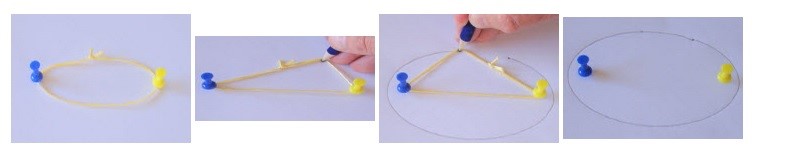
In order to help my students visualize what foci are and the role they play in ellipses, I could do an activity that involves my students constructing ellipses given the foci. This can be done with two thumbtacks, string (tied into a loop), paper, and a pencil. What you do is place a piece of paper on top of a cork board, then stick two thumbtacks into the board and put a loop of string around them. Then take a pencil and pull the string tight, so that it makes a triangle. Then draw an ellipse by moving the pencil around the two thumbtacks, while keeping the string pulled tight to make a triangle shape. The picture below depicts how the activity should work.

ellipse3

I would give my students time to change the distance between the thumbtacks and create other ellipses, so that they could see how the distance between the two thumbtacks affects the shape of the ellipse. In keeping with the style of ‘discovery’ based learning, only after my students had created a few different ellipses would I explain that the thumbtacks are actually the ‘foci’ of the ellipse. I think this activity would help my students have a better visual of what foci actually are and how they affect the shape of ellipses. It would also help my students to understand why the sum of the distance between each foci and any point on the ellipse is always constant. I believe this would be a good segue into discussing how to find the foci of an ellipse.


green line

How can this topic be used in your students’ future courses in mathematics and science?


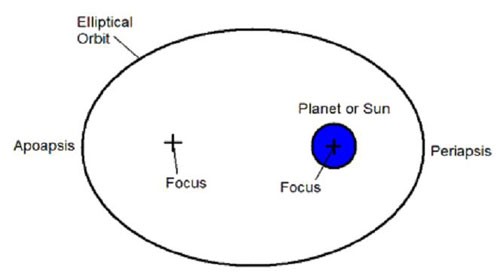
Ellipses tend to come up in topics like Physics and Astronomy. Specifically in Astronomy, ellipses become important when learning about orbits. An orbiting satellite follows an elliptical shape around an object called the primary. The primary simply means the body being orbited and is typically located at one of the two foci of an ellipse. A good website that describes this phenomenon is http://www.braeunig.us/space/orbmech.htm. This website explains different types of orbits and how they relate to different conic sections, ellipses being one of them. In our solar system, the Earth orbits the sun, with the sun lying at one of the foci on the ellipse. In elliptical orbits, the center of mass is located at a focus of the ellipse, but since the sun contains most of the mass in our solar system, the center of mass is located almost at the sun; therefore the planets orbit the sun. Below is an illustration of this concept.

ellipse4


green line

How can technology be used to effectively engage students with this topic?


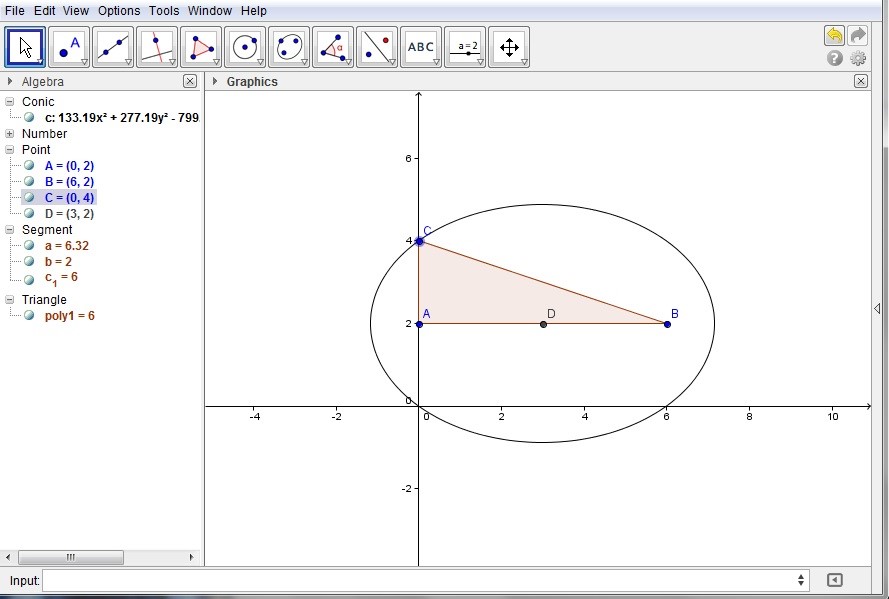
A really neat tool to use in mathematics is a computer application called GeoGebra. It is free to download and useful for a lot of mathematical topics. For the topic of foci and ellipses, I would have students create an ellipse in GeoGebra using the ellipse tool. Once the ellipse is created, students can grab the foci points and pull them around to change the shape of the ellipse. Students can also grab the point ‘C’ and move it around to change the shape of the ellipse. The nice thing about GeoGebra is that not only does it show the shapes and points on the graph it also states the coordinates of the points in the ‘Algebra’ section. As students are exploring the different ways they can change the shape of the ellipse, they can also see how the coordinates change. On my GeoGebra ellipse, I also added a point ‘D’ which is the center of the ellipse. I created this point by typing D = (A+B)/2 in the ‘input’ section. Once ‘D’ is created, as students move the foci around, the location of ‘D’ will change as well, so students can see how the center of the ellipse and the location of the foci are interconnected. I think this tool would be a great way to get started on the topic of how to find foci, and it helps students to visualize how the shape of the ellipse, the foci, and the center of the ellipse are all interconnected. Below are some pictures of different ellipses I created in GeoGebra.

ellipse5 ellipse6

Engaging students: Solving logarithmic equations

In my capstone class for future secondary math teachers, I ask my students to come up with ideas for engaging their students with different topics in the secondary mathematics curriculum. In other words, the point of the assignment was not to devise a full-blown lesson plan on this topic. Instead, I asked my students to think about three different ways of getting their students interested in the topic in the first place.

I plan to share some of the best of these ideas on this blog (after asking my students’ permission, of course).

This student submission again comes from my former student Kelley Nguyen. Her topic: how to engage Algebra II or Precalculus students when solving logarithmic equations.

green line

How could you as a teacher create an activity or project that involves your topic? (Flashcard/Match Game)


Because the rules behind logarithms can be mastered with practice, I believe an activity would help the students understand and master the concept. For an activity, I would create a matching game. It will include multiple cards that have logarithmic equations, as well as a match card with its solution or rewritten equation. For example:

logarithm1

The students would be in groups of 2-4 players. The deck of cards will be well-shuffled and laid out face down. Player 1 will turn over two cards and determine if they’re a match. If they’re a matching pair, the student will keep the two cards. If they are not, the player will turn the cards face down again and now it’s Player 2’s turn. If the Player 1 found a match, he/she will go again, following their first attempt. The other players should be observing and checking each other’s pairs to ensure that they are correct matches. They can also help each other in the process, i.e. coaching.


Another activity can also be done with logarithmic equation and solution cards. In this activity, there are 2-4 players in each group. Each player will receive five cards from the deck and the rest of the deck will be placed in the middle of the players in one stack and face down. The players are able to look at their cards and think of the solutions to them. Player 1 will turn the top card in the deck face up. If Player 1 has a matching card, he/she will take the card and start a stack of his/her matching pairs then draw a card from the deck. [Note: players will have five cards at all times.] If Player 1 does not have a match, each player will take a turn. If there is no match, Player 2 will then flip the second card and repeat the process. When all cards in the deck have been flipped over, turn the entire deck face down again and continue. The game will go on until all cards are match up. Whoever has the most matched pairs wins the game.


green line

How can this topic be used in your students’ future courses in mathematics or science?


Logarithms are used frequently in chemistry when learning about acidity. In particular, the following equation describes a derivation of pH as the measure of acidity, as well as estimating the pH of a buffer solution and finding pH at equilibrium in acid-base reactions.

 pH = pK_\alpha + \log_{10} \left( \displaystyle \frac{ [A^-]}{[HA]} \right)

There is also a time when logarithms are used in physics when working with the Beer-Lambert Law. The intensity of a light Io passing through a length of size l of a solution of concentration c is given as follows:

 \log (I_0 ll) = \epsilon c l,

where \epsilon is the absorption coefficient.

Another way logarithms are utilized is in science courses when students are to make predictions on the spread of disease in the world. This issue is greatly seen as the population grows dramatically, and using a logarithmic approach will allow the student to make a reasonable guesstimate.


Because students are introduced to logarithms at the end of Algebra II, they will work with them a lot in pre-calculus, as well as into calculus when dealing with trigonometric equations where there is a variable in the base and in the exponent.


green line

How can technology be used to effectively engage students with this topic? (graphing calculator)


Although I think it’s easier to punch logarithmic equations into a calculator to get an answer, I still think that the students should conceptually learn why we come up with the answer. So, before allowing students to use calculators, make sure they know how we came up with the solutions. Once the students have mastered that concept, let them explore with their graphing calculators.

First, have the students put in the basic log function in Y1, then give them a log function with a transformation, whether it be a vertical shift, horizontal shift, or expansion, and store it into Y2. Ask the students to describe what they see.

Another way to utilize calculators with this topic is showing that the properties of logs are true, such as the addition rules of logarithmic equations being the log of the product of the arguments. You can also show the students how to change the base of a logarithmic equation on their calculators, since the standard log key is programmed at log10. That can be found when you click MATH and choice A in the first drop-down list.


References


Engaging students: Mathematical induction

In my capstone class for future secondary math teachers, I ask my students to come up with ideas for engaging their students with different topics in the secondary mathematics curriculum. In other words, the point of the assignment was not to devise a full-blown lesson plan on this topic. Instead, I asked my students to think about three different ways of getting their students interested in the topic in the first place.

I plan to share some of the best of these ideas on this blog (after asking my students’ permission, of course).

This student submission comes from my former student Emily Bruce. Her topic, from Precalculus: mathematical induction.

green line

How could you as a teacher create an activity or project that involves your topic?

In order to help students understand how induction works, I would either use the domino example or the idea behind an assembly line. Using dominos, students would make a domino train by standing them on their ends close to each other. Students should be able to see that we only have to knock down the first one in order to guarantee that all of them fall over because we know that any one tile falling over will knock over the next one. The assembly line analogy uses the idea that as long as an object begins down the assembly line and each person does their job and passes it on, the object will be made correctly. Like induction, these examples only require us to have the first step succeed and guarantee that it passes from one step to the next, in order to guarantee that it will work for every step.


green line

How can this topic be used in your students’ future courses in mathematics or science?

Induction is a basic proof method that is very useful when proving statements that involve all natural numbers. It is used in pre-calculus, as well as more advanced calculus courses and other upper level college courses. It is an extremely helpful tool when dealing with the natural numbers. Using induction, we can prove conjectures about different series or summations. Knowing and understanding different patterns of with the natural numbers is particularly important in later calculus classes when they focus on the possible convergence of different series and summations.


green line

How has this topic appeared in pop culture?

The movie Titanic is a classic movie about a sinking cruise ship. The question to be posed is “How did they know the whole ship would sink from one hole?” The answer involves induction. The captain would have known that the bulkhead that had a hole would flood completely from the hole. He also would have known that as soon as any one bulkhead was full, another adjacent bulkhead would begin filling up. This is the concept of induction. Using just those two pieces of information, the captain was able to induce that the boat would continue to fill with water until it sank. This is why the captain immediately began evacuating the boat. It was only a matter of time before the ship went down, with everything in it. He knew all of this just form knowing that the first bulkhead would fill and once any one was full, the next would begin to fill as well. The knowledge and quick thinking of the captain saved many lives from the Titanic.


Received from:

http://math.stackexchange.com/questions/423513/how-to-teach-mathematical-induction

Engaging students: Graphing an ellipse

In my capstone class for future secondary math teachers, I ask my students to come up with ideas for engaging their students with different topics in the secondary mathematics curriculum. In other words, the point of the assignment was not to devise a full-blown lesson plan on this topic. Instead, I asked my students to think about three different ways of getting their students interested in the topic in the first place.

I plan to share some of the best of these ideas on this blog (after asking my students’ permission, of course).

This student submission comes from my former student Donna House. Her topic, from Precalculus: graphing an ellipse.

green line

How could you as a teacher create an activity or project that involves your topic?

A great hands-on activity for learning about an ellipse is created with some cardboard, a string, some tape, a yarn needle (or something to make a hole in the cardboard), and a marker.

To create the “ellipse boards,” take a piece of cardboard about one foot by one foot. You do not have to use a square piece and it can be larger or smaller. Just make certain the cardboard is large enough for the graph to be clearly seen. (I prefer white cardboard because it is easier to see the marks, but regular cardboard will also work if you use dark markers.)

Next, using the marker, make two marks for the foci. Thread the string (or yarn) through the yarn needle and poke a hole through one of the foci, pulling the string to the back side of the cardboard. Tie a knot in the string and tape it to the back of the board.

Now, thread the other end of the string through the yarn needle and poke a hole through the other focus. Decide how long the string needs to be to create a nice ellipse. (Remember the string must be 2a long – whatever length that is. Unless you really want the ellipse to be a certain size, the length of the string can vary. The farther apart the foci are, the more elongated the ellipse will be. This can also lead to a discussion about what happens to the shape of the ellipse as the foci get very close to each other!) Make certain the drawing will not fall off the edge of the board. Then tie a knot in this end of the string and tape it down. Each ellipse board will have a different sized ellipse unless you VERY carefully measure the foci and the string. I think having different sizes is better (and much easier to do) and shows the students that the formula for an ellipse works. Now the boards are ready for the students! (The students can put together their ellipse boards in class or you can have them pre-made to save time.)

The fun part is the actual drawing of the ellipse. This, however, is not as easy as it looks! To draw the ellipse, use the marker to stretch the string taut and let the string guide your drawing. Be sure to draw one before class so you will be able to give the students suggestions as they draw their own ellipses.

On their boards, the students can find the center, draw the major and minor axes, can find the vertices, and can easily see that the foci are on the major axis. Using the string, you can prove that the sum of the distances from any point on the ellipse to each of the foci is always 2a, and, using the Pythagorean Theorem, the students can see how to find the foci.

ellipse1

green line

How could you as a teacher create an activity or project that involves your topic?

            Since an ellipse is created when a cylinder is cut at an angle, ellipses are commonly encountered in construction. An example is creating a right angle while joining two pipes to build the corner of a fence. One joining method is to cut each pipe at a 45° angle then weld them together. Students could be asked to determine the length of the major and minor axes of the resulting ellipse when a 2” diameter pipe is cut at a 45° angle.

This same idea is used to make holes in walls or tile for some light fixtures, plumbing fixtures (like shower heads), vent pipes, etc.

I also found the following class project. This could be done in small groups by giving each group the main problem and letting them brainstorm to come up with the solution. I think this would be wonderful to stimulate creativity in the classroom.

http://www.pleacher.com/mp/mlessons/calculus/appellip.html
green line

How can technology be used to effectively engage students with this topic?

To engage the students, begin by showing the first 3 1/2 minutes or so of this video from YouTube:

https://www.youtube.com/watch?v=Yl8Qy79aLk0

Note that the doctor actually touches the peppermint while the sound waves are on!

But what does this have to do with an ellipse?

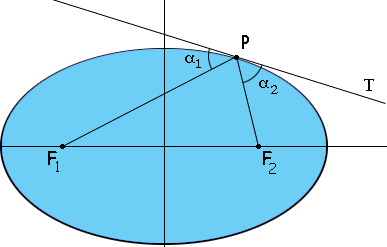
A unique characteristic of the ellipse is that shockwaves emitted from one focus will
reflect off the ellipse and go through the other focus. Using this characteristic, medical engineers have created a device called a lithotripter (as shown in the video) which can break up kidney and gall stones with minimal damage to the surrounding tissue. This eliminates the need for traditional surgery. Mathematics continues to make life easier!

ellipse2

As illustrated in the diagram above, when an energy ray reflects off a surface, the angle of incidence is equal to the angle of reflection.

Here is a short article explaining how the medical device works. (The above illustration comes from this article.) Using the computer, project the article onto the screen to show to the class.

http://mathcentral.uregina.ca/beyond/articles/Lithotripsy/lithotripsy1.html

This not only shows how technology can be used to engage students, it also shows how this topic is used in technology!

Engaging students: Computing trigonometric functions using a unit circle

In my capstone class for future secondary math teachers, I ask my students to come up with ideas for engaging their students with different topics in the secondary mathematics curriculum. In other words, the point of the assignment was not to devise a full-blown lesson plan on this topic. Instead, I asked my students to think about three different ways of getting their students interested in the topic in the first place.

I plan to share some of the best of these ideas on this blog (after asking my students’ permission, of course).

This student submission comes from my former student Delaina Bazaldua. Her topic, from Precalculus: computing trigonometric functions using a unit circle.

green line

How could you as a teacher create an activity or project that involves your topic?

When I first picked my topic, I was searching through topics that I could choose while playing the game Headbandz with my coworkers. That is when my idea hit me: Trigonometry Headbandz. Instead of asking the traditional questions like: “Am I an animal?” “Do I move?” “Am I famous?” or whatnot, the person guessing would have either a degree value, radian value, or the x-y coordinate on their headband and would ask questions like: “Is my measure in radians?” “Is my measure in quadrant I?” “Does my measure have a radical in it?” For the first few minutes, students would be allowed to use a premade unit circle to help them in guessing. However, after that they would need to guess solely based on memorization of the circle. I think this is a good engage because it is a familiar game that students will enjoy and it’s also educational in that they are subconsciously memorizing the unit circle that will carry them through the remaining months of high school, college, and perhaps, everyday life.


green line

How does this topic extend what your students should have learned in previous courses?

When I was in EDSE 3500 with Dr. Pratt, I truly learned how the unit circle worked for the first time in my life. In high school, it was more taught as: “learn this so you can use it for a really long, hard word that is supposedly math (trigonometry.)” In Dr. Pratt’s class, she gave every student the two special right triangles (30-60-90 and (45-45-90) and an empty circle that had the x-y coordinate plane on it. She asked us to recall what we learned in geometry in high school so that we can figure out the side lengths of the triangle. After that, we formed the unit circle using the two right triangles that she gave us by using the degree measure and the side lengths. It was so neat and so surprising that I have never learned how the unit circle is formed—especially as a math major. I definitely want to implement this in my teaching because it forces students to recall what they used in geometry and it also teaches where the unit circle comes from. In addition, it will also be easier for them to construct it in the future if they were to ever forget it.


green line

How could you as a teacher create an activity or project that involves your topic?

I just love this topic and activities that go hand-in-hand with it, so I decided to do it again. I was in the mood to procrastinate, so naturally I log onto Pinterest. I came across a board game dealing with the unit circle: http://cheesemonkeysf.blogspot.com/2014/07/life-on-unit-circle-board-game-for-trig.html?spref=pi. It is based on the game Life on a Number Line. It caught my attention because it tests the students’ knowledge of the unit circle in a fun way. The game involves game pieces, 3 die (a standard one and two positive-negative dice), a semi-blank unit circle, and flash cards of the trigonometric functions. When a student lands on the radian, they are to name the sine and cosine measurement in order to get credit. This game can also be played on a much larger scale with the entire class competing for extra credit. The whole point of the game is to, as the blog says, “used to living on the unit circle” in a fun and educational way. Like the first activity, Trigonometry Headbandz, it inevitably forces students to learn the unit circle. This way, it’s much more engaging and fun than staring at a piece of paper in hopes of memorizing it.

References:

http://cheesemonkeysf.blogspot.com/2014/07/life-on-unit-circle-board-game-for-trig.html?spref=pi

Dr. Pratt EDSE 3500 class


Engaging students: Exponential Growth and Decay

In my capstone class for future secondary math teachers, I ask my students to come up with ideas for engaging their students with different topics in the secondary mathematics curriculum. In other words, the point of the assignment was not to devise a full-blown lesson plan on this topic. Instead, I asked my students to think about three different ways of getting their students interested in the topic in the first place.

I plan to share some of the best of these ideas on this blog (after asking my students’ permission, of course).

This student submission comes from my former student Chais Price. His topic, from Precalculus: exponential growth and decay.

green line

How does this topic extend what your students should have learned in previous courses?

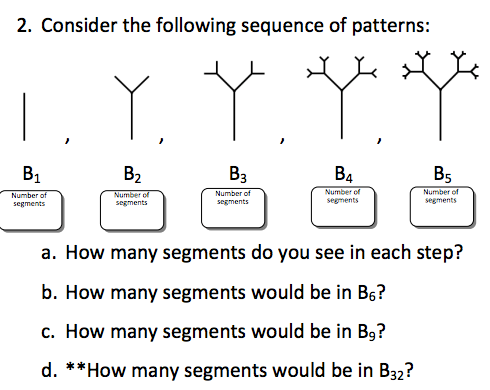
Every year in elementary through high school it seemed like I had some form of standardized test. These test typically consist of various problems, which include patterns and sequences of patters style of problems. I always found it more helpful when being introduced to more complex and intimidating concepts, to relate the general idea to something much more simplistic. When teaching a lesson on exponential growth and/or decay I plan on starting off the lesson with problems like:

exponential1 exponential2

These two patterns are pretty basic and finding the next one in the sequence shouldn’t be to difficult. This begs the question what if I wanted to find some enormous value for n. For questions d, a student can answer the question by drawing or counting but it will take some time. Or the student could find an equation that models the sequence of patterns. The equation would obviously be an exponential. From this point the teacher could discuss how these functions appear on the graph by simply observing what is happening in the sequence. In the first picture alone with the triangles, we only have 4 triangles shown and the first triangle is solid black. If we continue on, the next one in the sequence would represent basically our x values on a graph and the amount of triangles growing exponentially represents the y values. By using this previous knowledge the teacher was capable of relating a new concept with a much simpler approach.

green line

How could you as a teacher create an activity or project that involves your topic?

Has anyone ever asked you if you would rather have a million dollars, or a penny that doubles everyday for an entire month? I heard this question probably when I was in high school. I am pretty sure that I picked a penny that doubled everyday for a month only because it was the least obvious and it seemed like a trick question. However this is an example of how only 31 days explode into a fortune. After the first week of doubling you only have a little over a dollar. In fact you really don’t start making any real money until about the middle of the 3rd week if you chose to have a penny double everyday for a month. It turns out that by the last day of the month you end up with over 21 million dollars. This is once again because the function is growing exponentially. The link at the bottom of the page has a story that uses this same idea about a raja from India who made a young girls request to have a grain of rice double everyday for a month. This story can be fun to read and engaging for the students as well. After the story is read, there is a calendar where the students will fill in each day the amount of rice given to Rani, the young girl in the story. This calendar has a few random days filled in so the students know if they are on the right track. This activity serves as an engage/ explore for more of an introduction to exponential growth. The students could graph this function of type some points into the calculator to see the function explode. Let x represent days and y represent the grain of rice each day.


green line

How can technology be used to effectively engage students with this topic?

Dan Myers is a teacher who developed a style of teaching called the 3 act lessons, which incorporates multiple technology applications such as video recording, as well as imaging and photo editing. Each act is designed to teach a lesson like a movie divided up into parts. I came across this lesson of his which I think is awesome. In act 1, there is a 24 second video with these words at the beginning: “ a smaller domino can topple a domino that is up to 1.5 times larger in every dimension. “ The guy on the video explains that the smallest domino is 5 mm high and 1mm thick. This is all you are given. Then the teacher asks something to the class along the lines of “ If you wanted to topple over a domino the size of a sky scraper, how many dominoes would you need? “ This opens the door for students to both question and reason. Make a prediction and write it down. Have the students write down an answer they know is too high and one they know is too low. That is the end of act one. As we get into act to we need more information just like in a movie. Act 2 answers the question how many dominoes are present in the video. It also provides a data sheet that has the heights f several sky scrappers. This is a very discussion style lesson so in act 2 we would continue to promote discussion and questions. Then finally in act three we come to the conclusion. The man in the video had 13 dominoes and the biggest one was barely up to his waste. It turns out that if we were to keep adding dominoes that grew 1.5 times more than the previous one, the 29th domino would be as tall as the Empire State Building. That is exponential growth at its finest.


Engaging students: Parabolas

In my capstone class for future secondary math teachers, I ask my students to come up with ideas for engaging their students with different topics in the secondary mathematics curriculum. In other words, the point of the assignment was not to devise a full-blown lesson plan on this topic. Instead, I asked my students to think about three different ways of getting their students interested in the topic in the first place.

I plan to share some of the best of these ideas on this blog (after asking my students’ permission, of course).

This student submission comes from my former student Banner Tuerck. His topic, from Precalculus: finding the equation of a parabola from the focus and directrix.

green line

An interesting way to present the mathematics behind parabolas and their focus points is through the applications it has in science present in our everyday lives. http://spacemath.gsfc.nasa.gov/IRAD/IRAD-4.pdf

The above link includes a great engagement activity for students to do as a group activity. The first exercise presented involves the students in the design of a parabolic dish after observing the properties of a satellite dish with a radio receiver (located at the focus). Once the students have completed the design of the parabolic dish the instructor could then use the second half of the pdf from the link as an elaboration activity. The instructor could either keep the students in the groups or have them work the problems individually. Nevertheless, the second activity would be for the students to work problems one and two, which deal with aiding a bird watcher and a hobbiest in determining the focus points in order to design their parabolically shaped tools. The last problems are excellent real world examples of why one would need to know and apply the mathematics for parabolas. This will encourage students to view everyday objects with a more mathematical respect.


green line

The understanding of the relationship between the focus point and the directrix of a standard parabola is fundamental when students extend their mathematical and science education in post-secondary courses. For example, when students reach multivariable calculus they will graph and study the properties of conic sections on a three dimensional scale. With respect to this topic the students can apply their preexisting knowledge of two-dimensional parabolas to the paraboloids presented in this course. Furthermore, if students from a pre-calculus high school course were to not keep with the theoretical study of mathematics they could benefit greatly from this topic in careers such as architecture, art, or graphic design.


green line

As an instructor of a pre-calculus course one has many technological resources to use in order to construct an elaborate lesson on the directrix and focus of a parabola. For example, modern graphing calculators allow instructors to link their calculator to a projector and show the entire class various parabolas in order to further visualize the changing distances to these specific points. Furthermore, I believe a unique homework assignment would be for students to graph given quadratic equations with an online resource such as http://www.wolframalpha.com/. This assignment would also be a great review of how to apply the distance formula. I recommend having the students check that the points on the parabola are equidistant apart from the focus and the directrix they have already found after graphing and computing. Another idea is requesting (for full credit of the assignment) the students use the following link: https://www.khanacademy.org/math/algebra2/conics_precalc/parabolas_precalc/v/parabola-focus-and-directrix-1

to facilitate their understanding of the definition of a parabola as well as the importance of the focus point and directrix line. This is a way to involve technology while simultaneously ensuring that students review key aspects of the lesson after it was given by the instructor during class time.

References

http://spacemath.gsfc.nasa.gov/IRAD/IRAD-4.pdf

http://www.wolframalpha.com/.

https://www.khanacademy.org/math/algebra2/conics_precalc/parabolas_precalc/v/parabola-focus-and-directrix-1


Engaging students: Compound interest

In my capstone class for future secondary math teachers, I ask my students to come up with ideas for engaging their students with different topics in the secondary mathematics curriculum. In other words, the point of the assignment was not to devise a full-blown lesson plan on this topic. Instead, I asked my students to think about three different ways of getting their students interested in the topic in the first place.

I plan to share some of the best of these ideas on this blog (after asking my students’ permission, of course).

This student submission comes from my former student Andy Nabors. His topic, from Precalculus: compound interest.

green line

What interesting (i.e., uncontrived) word problems using this topic can your students do now?

I would give the students a problem to find out where they should invest their money. They would be given several options with pros and cons and need to choose the best option for them and explain their reasoning. The problem would go something like this:

You are looking to put your graduation money, a total of $2,498, into a savings account. You have gone to several banks and found the interest rates and start-up fees for making an account there. Which bank is offering you the best deal? Which would you choose and why?

Bank Interest Rate Compounded Start-Up Fee
Bank of America 2.5% daily $65
CitiBank 5% monthly $100
Comerica 3% weekly $50
JP Morgan 1.7% continuously $50
Wells Fargo 3.3% bi-annually $0


This material is Pre-Cal, so I assume the students are either juniors or seniors, so they may be looking at having to open a bank account of their own in their near future. Then this would be a relevant question for them to look into and figure out what exactly gives them the best option.


green line

How could you as a teacher create an activity or project that involves your topic?

This activity would be similar to one we did in 4050. At the time of this activity, they would not know the formula for compound interest. I would put the students in pairs and pose the question “Suppose you have $1000 that earns 8% interest. How much would you have at the end of 2 years if the interest was compounded: a.)annually b.) biannually c.)quarterly d.)daily”. Then the students would work in pairs to figure out the answers and I would instruct the students to find a pattern as they worked to make it easier. The students would eventually discover the formula for compound interest compounded for any number. They would then be asked how many times the money would have to be compounded to put out the highest total. The students would discover that the higher number, the more total, but as the compounded numbers increased, the difference between the outputs would decrease. So we could then say that there is a limit to how much the output could be, and that limit would be compounded infinitely. Then we could take the limit and find out what the formula is for finding compound interest compounded continuously.


green line

How can technology be used to effectively engage students with this topic?

Students need to know how to do their own research in their future for things like buying a house or car, choosing whether or not to rent or buy, or other things where they are having to find the best deal and fit for them. This activity would have students researching different banks. They would be asked to find out the details on certain banks’ interest rates. They would need to find out about fees and how many times the interest is compounded. They would need information about at least three banks, and then would need to research on independent sites which bank would be the best to start an account with from the banks they chose. Then they would choose a bank for them based on their own findings and calculations, and would choose a bank based on what an online article said. This would let students form their own opinions based on data they found, and weigh that data against the opinions of others. Their findings and opinions may not match up, and that’s why this activity would benefit them. It’s important that students learn to not take the opinions of others as fact, but do their own research to find the best deal.