My Favorite One-Liners: Part 40

In this series, I’m compiling some of the quips and one-liners that I’ll use with my students to hopefully make my lessons more memorable for them.

In some classes, the Greek letter \phi or \Phi naturally appears. Sometimes, it’s an angle in a triangle or a displacement when graphing a sinusoidal function. Other times, it represents the cumulative distribution function of a standard normal distribution.

Which begs the question, how should a student pronounce this symbol?

I tell my students that this is the Greek letter “phi,” pronounced “fee”. However, other mathematicians may pronounce it as “fie,” rhyming with “high”. Continuing,

Other mathematicians pronounce it as “foe.” Others, as “fum.”

My Favorite One-Liners: Part 32

In this series, I’m compiling some of the quips and one-liners that I’ll use with my students to hopefully make my lessons more memorable for them. Today’s story is a continuation of yesterday’s post. I call today’s one-liner “Method #1… Method #2.”

Every once in a while, I want my students to figure out that there’s a clever way to do a problem that will save them a lot of time, and they need to think of it.

For example, in Algebra II, Precalculus, or Probability, I might introduce the binomial coefficients to my students, show them the formula for computing them and how they’re related to combinatorics and to Pascal’s triangle, and then ask them to compute \displaystyle {100 \choose 3}. We write down

\displaystyle {100 \choose 3} = \displaystyle \frac{100!}{3!(100-3)!} = \displaystyle \frac{100!}{3! \times 97!}

So this fraction needs to be simplified. So I’ll dramatically announce:

Method #1: Multiply out the top and the bottom.

This produces the desired groans from my students. If possible, then I list other available but undesirable ways of solving the problem.

Method #2: Figure out the 100th row of Pascal’s triangle.

Method #3: List out all of the ways of getting 3 successes in 100 trials.

All of this gets the point across: there’s got to be an easier way to do this. So, finally, I’ll get to what I really want my students to do:

Method #4: Write 100! = 100 \times 99 \times 98 \times  97!, and cancel.

The point of this bit of showman’s patter is to get my students to think about what they should do next as opposed to blindly embarking in a laborious calculation.

green line

As another example, consider the following problem from Algebra II/Precalculus: “Show that x-1 is a factor of f(x)=x^{78} - 4 x^{37} + 2 x^{15} + 1.”

As I’m writing down the problem on the board, someone will usually call out nervously, “Are you sure you mean x^{78}?” Yes, I’m sure.

“So,” I announce, “how are we going to solve the problem?”

Method #1: Use synthetic division.

Then I’ll make a point of what it would take to write down the procedure of synthetic division for this polynomial of degree 78.

Method #2: (As my students anticipate the real way of doing the problem) Use long division.

Understanding laughter ensures. Eventually, I tell my students — or, sometimes, my students will tell me:

Method #3: Calculate f(1).


My Favorite One-Liners: Part 28

In this series, I’m compiling some of the quips and one-liners that I’ll use with my students to hopefully make my lessons more memorable for them. Today’s quip is one that I’ll use when simple techniques get used in a complicated way.

Consider the solution of the linear recurrence relation

Q_n = Q_{n-1} + 2 Q_{n-2},

where F_0 = 1 and F_1 = 1. With no modesty, I call this one the Quintanilla sequence when I teach my students — the forgotten little brother of the Fibonacci sequence.

To find the solution of this linear recurrence relation, the standard technique — which is a pretty long procedure — is to first solve the characteristic equation, from Q_n - Q_{n-1} - 2 Q_{n-2} = 0, we obtain the characteristic equation

r^2 - r - 2 = 0

This can be solved by any standard technique at a student’s disposal. If necessary, the quadratic equation can be used. However, for this one, the left-hand side simply factors:

(r-2)(r+1) = 0

r=2 \qquad \hbox{or} \qquad r = -1

(Indeed, I “developed” the Quintanilla equation on purpose, for pedagogical reasons, because its characteristic equation has two fairly simple roots — unlike the characteristic equation for the Fibonacci sequence.)

From these two roots, we can write down the general solution for the linear recurrence relation:

Q_n = \alpha_1 \times 2^n + \alpha_2 \times (-1)^n,

where \alpha_1 and \alpha_2 are constants to be determined. To find these constants, we plug in n =0:

Q_0 = \alpha_1 \times 2^0 + \alpha_2 \times (-1)^0.

To find these constants, we plug in n =0:

Q_0 = \alpha_1 \times 2^0 + \alpha_2 \times (-1)^0.

We then plug in n =1:

Q_1 = \alpha_1 \times 2^1 + \alpha_2 \times (-1)^1.

Using the initial conditions gives

1 = \alpha_1 + \alpha_2

1 = 2 \alpha_1 - \alpha_2

This is a system of two equations in two unknowns, which can then be solved using any standard technique at the student’s disposal. Students should quickly find that \alpha_1 = 2/3 and \alpha_2 = 1/3, so that

Q_n = \displaystyle \frac{2}{3} \times 2^n + \frac{1}{3} \times (-1)^n = \frac{2^{n+1} + (-1)^n}{3},

which is the final answer.

Although this is a long procedure, the key steps are actually first taught in Algebra I: solving a quadratic equation and solving a system of two linear equations in two unknowns. So here’s my one-liner to describe this procedure:

This is just an algebra problem on steroids.

Yes, it’s only high school algebra, but used in a creative way that isn’t ordinarily taught when students first learn algebra.

I’ll use this “on steroids” line in any class when a simple technique is used in an unusual — and usually laborious — way to solve a new problem at the post-secondary level.


My Favorite One-Liners: Part 27

In this series, I’m compiling some of the quips and one-liners that I’ll use with my students to hopefully make my lessons more memorable for them.

Here’s an anecdote that I’ll share when teaching students about factorials:

1! = 1

2! = 1 \times 2 = 2

3! = 1 \times 2 \times 3 = 6

4! = 1 \times 2 \times 3 \times 4 = 24

5! = 1 \times 2 \times 3 \times 4 \times 5 = 120

The obvious observation is that the factorials get big very, very quickly.

Here’s my anecdote:

Many years ago, I was writing lesson plans while the TV show “Wheel of Fortune” was on in the background. And the contestant solved the puzzle at the end, and Pat Sajak declared, “You have just won $40,320 in cash in prizes.

So I immediately thought to myself, “Ah, 8 factorial.”

Then I thought, ugh [while slapping myself in the forehead, grimacing, and shaking my head, pretending that I can’t believe that that was the first thought that immediately came to mind].

[Finishing the story:] Not surprisingly, I was still single when this happened.

My Favorite One-Liners: Part 20

In this series, I’m compiling some of the quips and one-liners that I’ll use with my students to hopefully make my lessons more memorable for them.

Perhaps the world’s most famous infinite series is

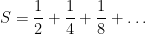
S = \displaystyle \frac{1}{2} + \frac{1}{4} + \frac{1}{8} + \dots

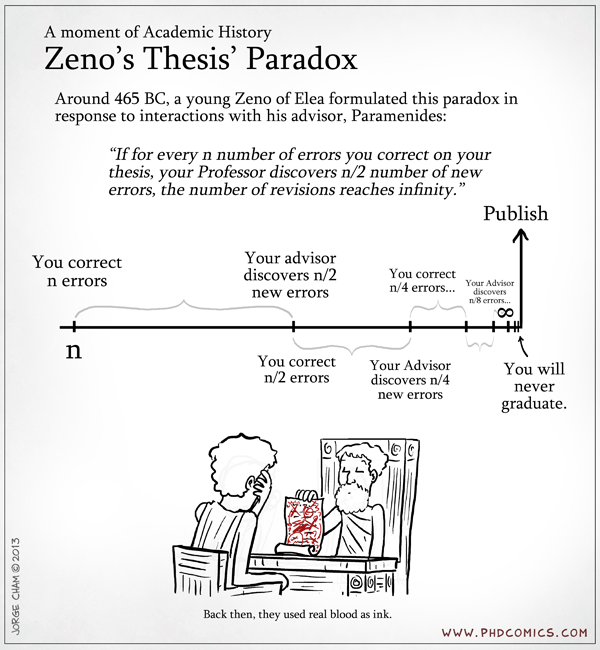
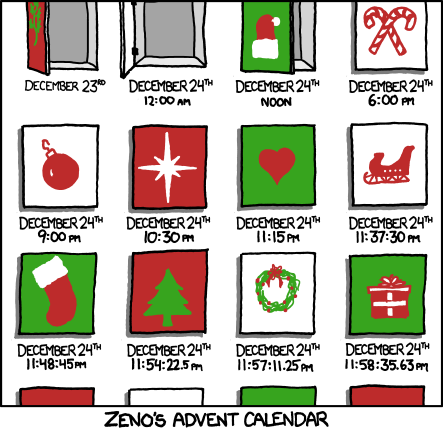
as this is the subject of Zeno’s paradox. When I teach infinite series in class, I often engage the students by reminding students about Zeno’s paradox and then show them this clip from the 1994 movie I.Q.

This clip is almost always a big hit with my students. After showing this clip, I’ll conclude, “When I was single, this was part of my repertoire of pick-up lines… but it never worked.”

Even after showing this clip, some students resist the idea that an infinite series can have a finite answer. For such students, I use a physical demonstration: I walk half-way across the classroom, then a quarter, and so on… until I walk head-first into a walk at full walking speed. The resulting loud thud usually confirms for students that an infinite sum can indeed have a finite answer.

For further reading, see my series on arithmetic and geometric series.


My Favorite One-Liners: Part 17

In this series, I’m compiling some of the quips and one-liners that I’ll use with my students to hopefully make my lessons more memorable for them.

Sometimes it’s pretty easy for students to push through a proof from beginning to end. For example, in my experience, math majors have little trouble with each step of the proof of the following theorem.

Theorem. If z, w \in \mathbb{C}, then \overline{z+w} = \overline{z} + \overline{w}.

Proof. Let z = a + bi, where a, b \in \mathbb{R}, and let w = c + di, where c, d \in \mathbb{R}. Then

\overline{z + w} = \overline{(a + bi) + (c + di)}

= \overline{(a+c) + (b+d) i}

= (a+c) - (b+d) i

= (a - bi) + (c - di)

= \overline{z} + \overline{w}

\square

For other theorems, it’s not so easy for students to start with the left-hand side and end with the right-hand side. For example:

Theorem. If z, w \in \mathbb{C}, then \overline{z \cdot w} = \overline{z} \cdot \overline{w}.

Proof. Let z = a + bi, where a, b \in \mathbb{R}, and let w = c + di, where c, d \in \mathbb{R}. Then

\overline{z \cdot w} = \overline{(a + bi) (c + di)}

= \overline{ac + adi + bci + bdi^2}

= \overline{ac - bd + (ad + bc)i}

= ac - bd - (ad + bc)i

= ac - bd - adi - bci.

A sharp math major can then provide the next few steps of the proof from here; however, it’s not uncommon for a student new to proofs to get stuck at this point. Inevitably, somebody asks if we can do the same thing to the right-hand side to get the same thing. I’ll say, “Sure, let’s try it”:

\overline{z} \cdot \overline{w} = \overline{(a + bi)} \cdot \overline{(c + di)}

= (a-bi)(c-di)

= ac -adi - bci + bdi^2

= ac - bd - adi - bci.

\square

I call working with both the left and right sides to end up at the same spot the Diamond Rio approach to proofs: “I’ll start walking your way; you start walking mine; we meet in the middle ‘neath that old Georgia pine.” Not surprisingly, labeling this with a catchy country song helps the idea stick in my students’ heads.

Though not the most elegant presentation, this is logically correct because the steps for the right-hand side can be reversed and appended to the steps for the left-hand side:

Proof (more elegant). Let z = a + bi, where a, b \in \mathbb{R}, and let w = c + di, where c, d \in \mathbb{R}. Then

\overline{z \cdot w} = \overline{(a + bi) (c + di)}

= \overline{ac + adi + bci + bdi^2}

= \overline{ac - bd + (ad + bc)i}

= ac - bd - (ad + bc)i

= ac - bd - adi - bci

= ac -adi - bci + bdi^2

= (a-bi)(c-di)

= \overline{(a + bi)} \cdot \overline{(c + di)}

\overline{z} \cdot \overline{w}.

\square

 For further reading, here’s my series on complex numbers.

My Favorite One-Liners: Part 16

In this series, I’m compiling some of the quips and one-liners that I’ll use with my students to hopefully make my lessons more memorable for them.

One of the basic notions of functions that’s taught in Precalculus and in Discrete Mathematics is the notion of an inverse function: if f: A \to B is a one-to-one and onto function, then there is an inverse function f^{-1}: B \to A so that

f^{-1}(f(a)) = a for all a \in A and

f(f^{-1}(b)) = b for all b \in B.

If A = B = \mathbb{R}, this is commonly taught in high school as a function that satisfies the horizontal line test.

In other words, if the function f is applied to a, the result is f(a). When the inverse function is applied to that, the answer is the original number a. Therefore, I’ll tell my class, “By applying the function f^{-1}, we uh-uh-uh-uh-uh-uh-uh-undo it.”

If I have a few country music fans in the class, this always generates a bit of a laugh.

See also the amazing duet with Carrie Underwood and Steven Tyler at the 2011 ACM awards:

My Favorite One-Liners: Part 12

In this series, I’m compiling some of the quips and one-liners that I’ll use with my students to hopefully make my lessons more memorable for them.

Often in mathematics, one proof is quite similar to another proof. For example, in Precalculus or Discrete Mathematics, students encounter the theorem

\sum_{k=1}^n (a_k + b_k) = \sum_{k=1}^n a_k + \sum_{k=1}^n b_k.

The formal proof requires mathematical induction, but the “good enough” proof is usually convincing enough for most students, as it’s just the repeated use of the commutative and associative properties to rearrange the terms in the sum:

\sum_{k=1}^n (a_k + b_k)= (a_1 + b_1) + (a_2 + b_2) + \dots + (a_n + b_n)

= (a_1 + a_2 + \dots + a_n) + (b_1 + b_2 + \dots + b_n)

= \sum_{k=1}^n a_k + \sum_{k=1}^n b_k.

Next, I’ll often present the new but closely related theorem

\sum_{k=1}^n (a_k - b_k) = \sum_{k=1}^n a_k -\sum_{k=1}^n b_k.

The proof of this would take roughly the same amount of time as the first proof, but there’s often little pedagogical value in doing all the steps over again in class. So here’s the line I’ll use: “At this point, I invoke the second-most powerful word in mathematics…” and then let them guess what this mysterious word is.

After a few seconds, I tell them the answer: “Similar.” The proof of the second theorem exactly parallels the proof of the first except for some sign changes. So I’ll tell them that mathematicians often use this word in mathematical proofs when it’s dead obvious that the proof can be virtually copied-and-pasted from a previous proof.

Eventually, students will catch on to my deliberate choice of words and ask, “What the most powerful word in mathematics?” As any mathematician knows, the most powerful word in mathematics is “Trivial”… the proof is so easy that it’s not necessary to write the proof down. But I warn my students that they’re not allowed to use this word when answering exam questions.

The third most powerful phrase in mathematics is “It is left for the student,” thus saving the professor from writing down the proof in class and encouraging students to figure out the details on their own.


My Favorite One-Liners: Part 11

In this series, I’m compiling some of the quips and one-liners that I’ll use with my students to hopefully make my lessons more memorable for them.

Every once in a while, I’ll cover a theorem in class that looks utterly surprising to students at first glance. For example, in trigonometry, I might state that

\sin^{-1} \left( \sin \pi \right) \ne \pi,

so that the inverse function doesn’t quite behave like it’s supposed to (because of the restricted domain used to define inverse sine.)

Before explaining why \sin^{-1} \left( \sin \pi \right) isn’t equal to \pi, I’ll get the discussion started by saying, “Don’t believe me? Just watch.”… a tip of the cap to this recent hit song (at the time of this writing, the third-most watched video on YouTube).

While on this topic, I have to tip my cap to Kelli Hauser, a sixth-grade teacher in my city who made the following motivational video for students about to take their end-of-year high-stakes test (called, here in Texas, the STAAR exam).

One more parody concerning a recent spacecraft that visited Pluto:

For further reading, here’s my series on inverse functions.

My Favorite One-Liners: Part 9

In this series, I’m compiling some of the quips and one-liners that I’ll use with my students to hopefully make my lessons more memorable for them.

Today, I’d like to discuss a common mistake students make in trigonometry… as well as the one-liner that I use to (hopefully) help students not make this mistake in the future.

Question. Find all solutions (rounded to the nearest tenth of a degree) of \sin x = 0.8.

Erroneous Solution. Plugging into a calculator, we find that x \approx 53.1^o.

arcsine1

The student correctly found the unique angle x between -90^o and 90^o so that \sin x = 0.8. That’s the definition of the arcsine function. However, there are plenty of other angles whose sine is equal to 0.7. This can happen in two ways.

First, if $\sin x > 0$, then the angle x could be in either the first quadrant or the second quadrant (thanks to the mnemonic All Scholars Take Calculus). So x could be (accurate to one decimal place) equal to either 53.1^o or else 180^o - 53.1^o = 126.9^o. Students can visualize this by drawing a picture, talking through each step of its construction (first black, then red, then brown, then green, then blue).arcsin45

However, most students don’t really believe that there’s a second angle that works until they see the results of a calculator.

TIarcsin45

Second, any angle that’s coterminal with either of these two angles also works. This can be drawn into the above picture and, as before, confirmed with a calculator.

So the complete answer (again, approximate to one decimal place) should be 53.1^{\circ} + 360n^o and 126.9 + 360n^{\circ}, where n is an integer. Since integers can be negative, there’s no need to write \pm in the solution.

Therefore, the student who simply answers 53.1^o has missed infinitely many solutions. The student has missed every nontrivial angle that’s coterminal with 53.1^o and also every angle in the second quadrant that also works.

green line

Here’s my one-liner — which never fails to get an embarrassed laugh — that hopefully helps students remember that merely using the arcsine function is not enough for solving problems such as this one.

You’ve forgotten infinitely many solutions. So how many points should I take off?

For further reading, here’s my series on inverse functions.