Visualizing Vectors

From the Math Values blog of the Mathematical Association of America:

Anyone who has taught linear algebra knows how easy it is for students to get absorbed in performing matrix computations and memorizing theorems, losing the beauty of the structures in this foundational subject. James Factor and Susan Pustejovsky of Alverno College in Milwaukee, WI, bring back the visual beauty of linear algebra through their NSF-funded project Transforming Linear Algebra Education with GeoGebra Applets.

The applets are freely available in the GeoGebra book Transforming Linear Algebra Education https://www.geogebra.org/m/XnfUWvvp. Each topic is packaged with a video to show how the applets work, the applet, and learning activities.

Read more about it here: https://www.mathvalues.org/masterblog/visualizing-vectors

Left-Hand Rule?

Misleading pictures in math textbooks always send 10,000 volts of electricity down my spine. Thanks to the right-hand rule, the cross product should be pointing down, not up. This comes from the 2007 edition of Glencoe’s “Advanced Mathematical Topics,” a high-school Precalculus book.

For what it’s worth, this is the same line of textbooks that, in a supplementary publication, said that the rational numbers are not countable.

Slightly Incorrect Ugly Mathematical Christmas T-Shirts: Index

I’m doing something that I should have done a long time ago: collecting a series of posts into one single post. The following links comprised my series on slightly incorrect ugly mathematical Christmas T-shirts.

Part 1: Missing digits in the expansion of \pi.

Part 2: Incorrect computation of Pascal’s triangle.

Part 3: Incorrect name of Pascal’s triangle.


The IRS Uses Geometric Series?

I recently read the delightful article “The IRS Uses Geometric Series?” by Michelle Ghrist in the August/September 2019 issue of MAA FOCUS. The article concerns a church raffle for a $4000 ATV in which the church would pay for the tax bill of the winner. This turned out to be an unexpected real-world application of an infinite geometric series. A few key quotes: According to the IRS rules at the time,

…winnings below a certain level [were] subject to a 25% regular gambling withholding tax…

My initial thought was that the church would need to pay 0.25 \times \$4000 = \$1000 to the IRS. However, I then wondered if this extra \$1000 payment would then be considered part of the prize and therefore also subject to 25% withholding, requiring the church to give 0.25 \times \$1000 = \$250 more to the IRS. But then this \$250 would also be part of the prize and subject to withholding, with this process continuing forever.

I got quite excited about the possibility of an infinite geometric series being necessary to implement IRS tax code. By my calculations… [gave] an effective tax rate of 33-1/3%.

I then read more of the instructions, which clarified if the payer pays the withholding tax rate for the payee, “the withholding is 33.33% of the FMV [Fair Market Value] of the noncash payment minus the amount of the wager.” It was satisfying to discover the behind-the-scenes math leading to that number…

In any event, I am glad to know that the IRS can properly apply geometric series.”

Here’s a link to the whole article: http://digitaleditions.walsworthprintgroup.com/publication/?m=7656&l=1#{%22issue_id%22:606088,%22page%22:%2214%22}

Note: The authors notes that, in January 2018, the IRS dropped the two above rates to 24% and 31.58%.

Decimal Approximations of Logarithms: Index

I’m doing something that I should have done a long time ago: collecting a series of posts into one single post. The following links comprised my series on the decimal expansions of logarithms.

Part 1: Pedagogical motivation: how can students develop a better understanding for the apparently random jumble of digits in irrational logarithms?

Part 2: Idea: use large powers.

Part 3: Further idea: use very large powers.

Part 4: Connect to continued fractions and convergents.

Part 5: Tips for students to find these very large powers.


Another Poorly Written Word Problem: Index

I’m doing something that I should have done a long time ago: collecting a series of posts into one single post. The following links comprised my series poorly written word problem, taken directly from textbooks and other materials from textbook publishers.

Part 1: Addition and estimation.

Part 2: Estimation and rounding.

Part 3: Probability.

Part 4: Subtraction and estimation.

Part 5: Algebra and inequality.

Part 6: Domain and range of a function.

Part 7: Algebra and inequality.

Part 8: Algebra and inequality.

Part 9: Geometric series.

Part 10: Currently infeasible track and field problem.

Part 11: Another currently infeasible track and field problem.


Engaging students: Geometric sequences

In my capstone class for future secondary math teachers, I ask my students to come up with ideas for engaging their students with different topics in the secondary mathematics curriculum. In other words, the point of the assignment was not to devise a full-blown lesson plan on this topic. Instead, I asked my students to think about three different ways of getting their students interested in the topic in the first place.

I plan to share some of the best of these ideas on this blog (after asking my students’ permission, of course).

This student submission comes from my former student Victor Acevedo. His topic, from Precalculus: geometric sequences.

green line

How has this topic appeared in pop culture (movies, TV, current music, video games, etc.)?

2048 is a fun game on mobile phones and online that can help introduce the concept of geometric sequences to students. The game is based on the powers of 2 and trying to reach 2^11 (or 2048). Each time two matching tiles are combined it creates the next power of 2. At first glance, it may seem that you are just adding the two tiles, so it doesn’t look like a geometric sequence. The geometric sequence shows up when you look at the terms in the sequence being each new tile that is introduced. For example, the 8 tile comes from two 4 tiles, and each 4 tile comes from two 2 tiles, but the 8 tile is still the third new tile making it the third term in the sequence. There can be a discussion about how many tiles are needed to create the first several terms in the sequence up until 2048.

https://play2048.co/

green line

What interesting (i.e., uncontrived) word problems using this topic can your students do now?

A fun problem that involves geometric sequences is the doubling penny problem. You are asked to decide whether you would rather have lump sum of $1,000,000 given to you upfront or take an offer that involves doubling pennies for the next 30 days. The second offer would involve you taking a single penny on the first day, then doubling that amount each day until the 30th day. At first it seems like a reasonable choice to take the lump sum of $1,000,000, but you have to remember that we are dealing with and exponential or geometric growth in the second offer. On the 30th day you would receive 2^30 pennies which would be $107,374,182.40. That number doesn’t even include the sum of all the other days you were receiving pennies. This would be a great way to explore that difference between linear (or arithmetic) and exponential (or geometric) growth.

green line

How have different cultures throughout time used this topic in their society?

The paradox of Achilles and the tortoise is an example where geometric sequences are applied with philosophical thought. Achilles is racing a tortoise.  Achilles gives the tortoise a lead because he believes that he is much faster than the tortoise. The paradox arises from the fact that Achilles will have to try and close the gap between him and tortoise while the tortoise keeps moving forward. By having to always get to where the tortoise has been, Achilles can’t catch up. A simplified way of seeing this is by imagining the tortoise already being at the finish line and Achilles just having to close the gap in between him and the tortoise. He does so in a way that cuts the distance between him and the tortoise in half every minute. By doing so, Achilles will never actually catch up since there is always more distance to travel. In this case the common ratio for the geometric sequence would ½ and the end goal would be 0 but it could never be attained.

Engaging students: Introducing the number e

In my capstone class for future secondary math teachers, I ask my students to come up with ideas for engaging their students with different topics in the secondary mathematics curriculum. In other words, the point of the assignment was not to devise a full-blown lesson plan on this topic. Instead, I asked my students to think about three different ways of getting their students interested in the topic in the first place.

I plan to share some of the best of these ideas on this blog (after asking my students’ permission, of course).

This student submission comes from my former student Julie Thompson. Her topic, from Precalculus: introducing the number e.

green line

What interesting word problems using this topic can your students do now?


I found a very interesting word problem involving the number e and derangements. A derangement is a permutation of a set in which no element is in its original place. The word problem I found is as follows:

“At the bohemian jazz parties frequented by aficionados of the number e, the espresso flows freely, and at the end of the evening, party-goers are just as likely to go home in someone else’s overcoat as they are in their own. After such a party, what are the chances that at least one person goes home wearing the right coat?”

To start off, we need to find out how many permutations, or how many combinations of ways the coats can be put on at random when guests leave the party. The problem asks us to identify the chance that at least one person IS wearing the right coat. In other words, we need to delete all the combinations in which nobody grabbed the correct coat. These are the derangements. Interestingly, when you divide the number of permutations by the number of derangements, you get a number extremely close to the value of e. And the ratio is always so.

Looking at a numerical example with 10 guests, the number of ways 10 people can pick up 10 coats (permutations) is 3628800, and the number of ways nobody would pick up the right coat is 1334961. Dividing, 3628800/1334961= 2.71828, which is extremely close to e. Therefore, the chance of nobody getting the right coat is about 1 in e. How interesting. I feel like this word problem would really interest students!


green line

How was this topic adopted by the mathematical community?

The number e was not discovered as ‘naturally’ as you may think. Mathematicians came close to discovering e in their calculations many times in the 17th century but thought it was just a random number without any real significance. The first person to calculate e is not documented, but historians believe it to not even be a mathematician, but a banker or trader. Why is this?

The number e is very fundamental to a financial process that took off in the 17th century. “The number e lies at the foundations of one of the most fundamental processes of finance: compound interest.” Mathematicians, including Jacob Bernoulli, would later go on to define:

            . e = \displaystyle \lim_{x \to \infty} \left(1 + \frac{1}{x} \right)^x
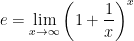
            “This is why the number e appears so often in modeling the exponential growth or decay of everything from bacteria to radioactivity.” This fact was adopted by the mathematical community and many mathematicians started collaborating and making many more discoveries on the number e, such as Euler, who estimated e correctly to 18 decimal places, gave the continued fraction expansion of e, and made a connection between e and the sine and cosine functions. The number e is one of the most beautiful and powerful number in all of mathematics and the use of it was adopted into mathematics most likely by a banker…how interesting.


green line

How can technology be used to effectively engage students with this topic?


Any graphing technology, such as a TI calculator, Mathematica, MatLab, Desmos, etc., are great tools to use in order to engage students when discovering the number e. For instance, to convince students that the above limit is true,

e = \displaystyle \lim_{x \to \infty} \left(1 + \frac{1}{x} \right)^x,

 I can have them graph the function for themselves and actually see that the function approaches the number e as x gets very large. Similarly, I can simulate numbers of e on a computer program with the expansion  1 + 1/1! + 1/2! + 1/3! + … to show the sum getting closer and closer to the value of e the more terms I add. I believe this will be really engaging because the expansion for the number e and the limit for e look like they have nothing to do with e at first glance. To make the connection between them graphically would be somewhat magical to students and hopefully make them curious for more.


References:

http://wmueller.com/precalculus/e/e6.html (this is word problem from A1)

https://brilliant.org/wiki/the-discovery-of-the-number-e/

http://mathworld.wolfram.com/e.html

http://www-history.mcs.st-and.ac.uk/HistTopics/e.html


Engaging students: Compound interest

In my capstone class for future secondary math teachers, I ask my students to come up with ideas for engaging their students with different topics in the secondary mathematics curriculum. In other words, the point of the assignment was not to devise a full-blown lesson plan on this topic. Instead, I asked my students to think about three different ways of getting their students interested in the topic in the first place.

I plan to share some of the best of these ideas on this blog (after asking my students’ permission, of course).

This student submission comes from my former student J. R. Calvillo. His topic, from Precalculus: compound interest.

green line

How was this topic adopted by the mathematical community?


The mathematical community adopted the concept of compound interest very well. Albert Einstein was one of if not the biggest mathematician who adopted this policy of compound interest very well. His most notable quote on the topic is, “Compound interest is the eighth wonder of the world. He who understand it, earns it… He who doesn’t… pays it.” (Albert Einstein) Compound interest has expanded even from the mathematical community and spread to banks, and how they decide to give out interest on deposits or loans. The concept of compound interest has truly been one of the most well received concepts in the mathematical community, so much so that it even spread outside of that community into the business world. Where it then changed how businesses and banks looked at interest.

green line

How could you as a teacher create an activity or project that involves your topic?


Compound interest is a very important and very relatable topic for teachers to be able to relate real world examples to.  With that, I believe it is very important to make compound interest relatable to the real world uses that students’ will one day see when they get older. To begin the activity, each student will receive $2,000. That $2,000 will be put in the bank and the bank has agreed to add interest. The bank decided to give them the option on how they want that interest compounded; daily, monthly, quarterly or yearly. At the end we will group together the students’ who wanted to compound their interest similarly. Each group will get to explain why they chose how often it will be compounded, then will get the opportunity to solve how much it will grow after 2 years, 4 years and 20 years. This will then allow the students to see the differences and similarities between the different options that the bank provided, and which option will earn you the most money.

green line

How can this topic be used in your students’ future courses in mathematics or science?


Compound interest is a topic that will originally get introduced in a pre-calculus class, however, if any students’ go onto take classes such as statistics or any other business related math, it will contain material on compound interest. It is used as such a big role in the business world that getting a true understanding how it works and the reasoning behind why it works is crucial from the earliest class that we see it in.  In later classes it can be touched on more so, especially reaching the ways that it is beneficial to use it or the ways that it may hurt to use it. Either way it is a concept that will come up again whether you see it in the classroom, or in real life. Compound interest is one of if not the most relatable topic to the outside world with all of its applications to loans and how it is used in banks. Getting the fundamental concepts early is a crucial aspect to understanding its deeper usage in other courses.


Resources:

Compound interest – Albert Einstein. (n.d.). Retrieved from https://quotesonfinance.com/quote/79/albert-einstein-compound-interest
