Engaging students: Expressing probability as a fraction and as a percentage

In my capstone class for future secondary math teachers, I ask my students to come up with ideas for engaging their students with different topics in the secondary mathematics curriculum. In other words, the point of the assignment was not to devise a full-blown lesson plan on this topic. Instead, I asked my students to think about three different ways of getting their students interested in the topic in the first place.

I plan to share some of the best of these ideas on this blog (after asking my students’ permission, of course).

This student submission again comes from my former student Zacquiri Rutledge. His topic, from probability: expressing a probability as a fraction and as a percentage.

green line

Probability involves any kind of situation where the outcomes are known, but are not 100% certain. Examples of this could be things as simple as flipping a coin, to trying to predict the next card while playing blackjack. However, for a student who is just beginning to understand probability, I thought a word problem involving the rolling of a die would be just challenging enough. “You and your best friend have been playing Monopoly for hours. After several times around the board, you own a large amount of the properties and your friend is nearly bankrupt. In fact, your friend does not have enough money to survive landing on your Boardwalk property in the corner of the board. In order for your friend to land on this space, he/she would need to roll a 12. First, calculate the odds that one die will roll a 6 and express it both as a fraction and as a percentage. Then, calculate the odds that both dice will roll a 6 and express it both as a fraction and as a percentage.”

green line

After learning the basics of probability as fractions and percentages, students can then begin to learn about how to change them into “odds”, or the probability of a series of actions. Since probability is simply the ratio between the desired number of outcomes and the total number of outcomes, only knowing how to write ratios will not help the student in calculating odds. By changing the probability ratio into a fraction, this will allow the student to easily apply the multiplication principle to a series of actions to find the larger probability ratio. From there the student will be able use previous experience of changing probability into a percentage to state how likely or unlikely a situation is.


green line

Probability is found in many areas of culture and science. However, one of the most widely known forms of probability is in gambling. People all over the world gamble for money, for fun, and sometimes even for sport. A few of the common games people play in casinos are Roulette, Blackjack, and Texas Hold’em. Each one of these games has its own way in which it uses probability to make it more difficult for a player to make money.

To play a game of Roulette, all a player has to do is bet on which number, color, or set of numbers they think might win. On the table are the numbers 00, 0, and 1 through 36. 00 and 0 are both their own color, but 1 through 36 alternate between red and black. After the player bets, the rest of the game is controlled by “The House” or the casino. A ball is placed on a rotating circle that has all of the numbers listed one time on it with a slot in the middle for each one. As the ball rolls, it slows down and drops into one of these holes. This is where probability comes into play. Depending on the player’s bet, they have an x/38 chance of winning. If they select one number, it gives 1/38 or 2.6% chance; for 1-12 its 6/19 or 31.5%. By using a combination of bets, a player can increase their probability of winning by selecting more than one number. Due to Roulettes simplicity, it would make a good beginning topic for a student who is beginning to learn about probability.

Blackjack is game that uses cards to determine who wins or loses, instead of a ball and a wheel. The object of this game is to get as close to 21 as possible without going over, as well as attempting to beat the hand “The House” is holding. While there are a lot of calculations that must go in when calculating probability in a game of blackjack, it is possible to do it on a smaller scale. To do so, a player would have to look at what cards had come up in the past and then look to see what card it is that they need. Since there are only 4 of each card in the deck, assuming the player nor “The House” is holding the card he/she needs, the probability would be 4/(52 – y), where y is the number of cards that have already been shown and are not the card the player needs. Texas Hold’em uses this same kind of idea, but instead is used when playing against other people rather than against “The House”. This version of poker has become so well known, it is featured on an ESPN sports channel, where people play in a live tournament and compete for millions of dollars. What is significant about this channel is that they show what cards each of the players are holding as well as what cards are on the table. Then, once every player’s cards are seen, the channel shows on one side of the screen a player’s percent chance of winning. This percent is calculated by an analysis of what cards are in the player’s hand, what cards are in everyone else’s hands, and what cards are on the board. After analyzing the cards, it is then calculated what the probability is that the best possible cards the player needs are going to come up. Even though only basic probability is being used here, this is still on a much higher difficulty due to the amount of numbers that must be processed. However, given its complexity and how the probability can change by the turn of a card can make both Blackjack and Texas Hold’em an interesting topic for a student of probability.


Engaging students: Square roots

In my capstone class for future secondary math teachers, I ask my students to come up with ideas for engaging their students with different topics in the secondary mathematics curriculum. In other words, the point of the assignment was not to devise a full-blown lesson plan on this topic. Instead, I asked my students to think about three different ways of getting their students interested in the topic in the first place.

I plan to share some of the best of these ideas on this blog (after asking my students’ permission, of course).

This student submission again comes from my former student Tiffany Jones. Her topic, from Algebra: square roots.

green line

B.1 How can this topic be used in your students’ future courses in mathematics or science?


One area of mathematics I wish I had more practice with in grade school is numerical reasoning. I feel that, as a student, I was allowed to use my calculator too much and am struggling to remove my calculator crutch. I hope to encourage my students to sharpen their numerical reasoning skills and to not rely on their calculator. Does this number make sense? Is it too high, too low? Is a negative result valid given the scenario of the problem? The following video introduces a method to estimate the square root of non-perfect squares to the nearest tenth by hand:

“Estimating Square Roots To the Nearest Tenth by Hand” by Fort Bend Tutoring

It gives the students another tool for their toolbox of numerical reasoning, practice using formulas, reviews long division by hand, and strongly encourages students to remember the perfect squares.

I think that introducing this idea as an engage could intrigue student to wonder why the formula works and to wonder what else they are able to do quickly by hand.

Fort Bend Tutoring’s YouTube channel offers videos on a wide verity of high school mathematics topics and courses. The videos cover several examples. They are engaging, not dry and there is also a “theme song” to the videos. I feel that these videos can sever as a great addition to lessons as extra help to the students.

green line

D.1 What interesting things can you say about the people who contributed to the discovery and/or the development of this topic?


The following story was first told to me in a calculus one course. While the telling of the story was to serve as amusement and did not directly relate to the topic of the day, it stuck with me. It comes to mind frequently when working with the Pythagorean theorem and with irrational squares. And when given this assignment, I saw square roots as an option, this story again came to mind. I think having an interesting story cross my mind makes a problem overall more fun. I would want to give that to my students. The article “The Dangerous Ratio” by Brain Clegg does a wonderful job of telling the story, its implications, and gives a mock dialogue so reads can work through the logic. At the end of the article, there is a link to an activity about the proof that the square root of 2 is irrational.


green line

E.1

How can technology be used to effectively engage students with this topic?


I really like the idea of a flipped classroom and hope to be able to practice it in my classroom. While a completely flipped classroom will take some time to implement, videos such as Math Antics’ “Exponents & Square Roots” will be a great place to start.

This particular video address a previously learned topic, namely exponents and relates it to the new topic. It provides definitions and visuals to remember how the terms relate to each other and how to read the symbols. It goes through several examples of varying level and shows the viewer how to use technology such as calculators to solve hard problems. In addition, the video addresses some common misconceptions such as mistaking the root sign and the division sign. Moreover, it ties everything together with a quick review at the end.

One of my favorite aspects so of flipped classrooms, is that the student can review the video over and over. Math Antics does an excellent job of talking the math out to the viewer. The animations are amusing yet helpful. While a lot of information is covered, the video is not dry.


Resources:

“Estimating Square Roots To the Nearest Tenth by Hand” by Fort Bend Tutoring – https://www.youtube.com/watch?v=bUh7Hj-3dkw

“The Dangerous Ratio” by Brian Clegg – http://nrich.maths.org/2671

“Exponents & Square Roots” by Math Antics –https://www.youtube.com/watch?v=C_iKTTI1E34


Engaging students: Combinations

In my capstone class for future secondary math teachers, I ask my students to come up with ideas for engaging their students with different topics in the secondary mathematics curriculum. In other words, the point of the assignment was not to devise a full-blown lesson plan on this topic. Instead, I asked my students to think about three different ways of getting their students interested in the topic in the first place.

I plan to share some of the best of these ideas on this blog (after asking my students’ permission, of course).

This student submission again comes from my former student Taylor Vaughn. Her topic, from probability: combinations.

green line

How could you as a teacher create an activity or project that involves your topic?

One interesting way that I thought about introducing combinations is bringing in combinations that students do often, but do not really think about. When it is known that the family is going on vacation, as a girl, the first thought is “what am I going to wear?” Being a girl, I was always told that I cant pack as much as I wanted to because I also wanted to bring extra clothes just in case I didn’t want to wear what I had planned for that day. One activity I thought bout is actually bring in a suitcase to class with clothes and try and plan a 3 day vacation and figure out how we, as a class, was going to pack this suitcase. I could include different scenarios such as, if the hotel has a laundry room, and how would being able to wash clothes and put them back in the suitcase change how we pack. Also, what happens if we add shoes and socks? How would this change affect the number of combinations we can have? I think it would be really cool for students to touch and play and bring in ideas that they don’t necessarily think has anything to do with math.

green line

How has this topic appeared in pop culture (movies, TV, current music, video games, etc.)?

Everyone listens to music, but there are so many different types of genres, artists, and songs. Have you ever thought, “Will we ever run out of new music?” Well someone by the name of Michael has. He has done the research of what others say about the math of the order of the notes and how many combinations of these notes can we get that will create a new song

One activity that could be done after the video is given 8 notes, how many different measures could students in the class come up with. Then the whole class could see how many people got the same measure or did everyone get something completely different. Then you could also ask “Did we cover all the possibilities? How do we know? How can we show this mathematically?” Lastly, if there are so many possibilities, why are there so many songs with the melodies? There is a video that has one melody and sings a lot of songs to that one melody. (PG-13 Warning: gratuitous cursing near the end of the video.)

The one thing I didn’t like about the first video is the length and he makes connections about songs that are really outdated. SO this video has songs that will relate closer to this generation of students.


green line

How can this topic be used in your students’ future courses in mathematics or science?      In school, students that didn’t like math the way I did always asked, “Well when will we ever use this again?” Well even though we use combinations more than we think, it can also be used in later math classes. Ever thought that combinations had anything to do with Pascal’s triangle? What is Pascal’s triangle, you may ask? Well according to Math Is Fun, it is a pattern of numbers where the starting number is 1 and “each number is the two numbers above it added together (except for the edges, which are all “1”).” Well what if you are asked to find entry 20 of the triangle. The one thing I would do would keep the pattern of the triangle and write out all the entries until I got to that number, but using combinations you can get any entry you would like without writing all the entries out. The formula is where n is the row and k is where it is in the nth row.

\displaystyle {n \choose k} = \frac{n!}{k! (n-k)!}

While teaching this, I would definitely talk about factorial and how it relates to the lesson.
References

Stevens, Michael. “Will We Ever Run Out of New Music?” YouTube. YouTube, 20 Nov. 2012. Web. 02 Sept. 2015.

The Axis of Awesome. “4 Chords.” YouTube. YouTube, 20 July 2011. Web. 02 Sept. 2015.

Pierce, Rod. “Pascal’s Triangle” Math Is Fun. Ed. Rod Pierce. 30 Mar 2014. 3 Sep 2015 http://www.mathsisfun.com/pascals-triangle.html


Engaging students: Fractions and decimals

In my capstone class for future secondary math teachers, I ask my students to come up with ideas for engaging their students with different topics in the secondary mathematics curriculum. In other words, the point of the assignment was not to devise a full-blown lesson plan on this topic. Instead, I asked my students to think about three different ways of getting their students interested in the topic in the first place.

I plan to share some of the best of these ideas on this blog (after asking my students’ permission, of course).

This student submission again comes from my former student Samantha Offutt. Her topic, from Algebra: fractions and decimals.

green line

How can this topic be used in your students’ future courses in mathematics or science?

Students will use/convert fractions and decimals in a number of ways in future courses in mathematics and science. The best example is percentages. In a probability/statistics class, percentages are a major component for answering many types of problems. For example, in the college course Math 3680, percentages are used frequently. So in a large set of data, one is asked to record the frequency of a certain number, take the frequency and divide it by the total number of entries, and one is almost always ask for them to be written as decimals to the 4th number. After determining the relative frequency, you can tell what proportions of the data are between certain stipulations. For example, if there were 50 numbers that are between 1 and 20, one can be asked, “What proportion of the numbers are between 7 and 13.” So even to this day in college, students still use this pre-algebra topic.


green line

How could you as a teacher create an activity or project that involves your topic?

I found this awesome project on a teachers blog: http://teachinginroom6.blogspot.com/2012/02/math-social-studies-awesomeness.html, This certain teacher did a social studies spin on colonial era quilts. I think it was awesome. “I then had the students create a 20 cm x 20 cm square (we have cm graph paper available at school).  Choosing either 2, 4, or 5 colors, the students created a square that had at least one triangle, quadrilateral, was bright, and symmetrical (Stephanie).” Then the students created fractions by counting how many squares, of the 400 squares, took up each color. Later found the decimal of those fractions, and finally determined the percentage each color owned on their square. The teacher took each square and made a quilt. I’m in love with this project and I think it’d look fantastic in the classroom. Students get to practice multiple skills and are given the opportunity to have their work displayed in the classroom.

green line

How can technology (YouTube, Khan Academy [khanacademy.org], Vi Hart, Geometers Sketchpad, graphing calculators, etc.) be used to effectively engage students with this topic?

Technology is a very useful tool for students. Instead of a teacher lecturing, they can find videos of all sorts on the Internet. If a teacher simply wanted to let Khan Academy engage students and do examples for the kids in a short 8 minutes, then they could use this very helpful video (that the students can reference later at home if they have any questions):

Students get to dive right into the topic and see how it is done, but later when they are at home and have forgotten some things, they have access to the exact video. Technology is very useful both in the classroom and at home. Also this video shows more than just one, simple example. I think it’s great the video shows problems of different levels of difficulty.

References

Khan Academy. “Converting Fractions to Decimals | Decimals | Pre-Algebra | Khan Academy.” YouTube. YouTube, 8 Apr. 2007. Web. 04 Sept. 2015.

Stephanie. “Teaching in Room 6: Math + Social Studies = Awesomeness.”Teaching in Room 6: Math + Social Studies = Awesomeness. 3AM Teacher, 5 Feb. 2012. Web. 05 Sept. 2015.


Engaging students: Fractions, decimals, and percents

In my capstone class for future secondary math teachers, I ask my students to come up with ideas for engaging their students with different topics in the secondary mathematics curriculum. In other words, the point of the assignment was not to devise a full-blown lesson plan on this topic. Instead, I asked my students to think about three different ways of getting their students interested in the topic in the first place.

I plan to share some of the best of these ideas on this blog (after asking my students’ permission, of course).

This student submission again comes from my former student Perla Perez. Her topic, from Algebra: fractions, decimals, and percents.

green line

A2. How could you as a teacher create an activity or project that involves your topic?

This past summer when I worked as a program assistant for TexPrep, we had the opportunity to have a pizza party. How fun! Well it took longer than we thought to pick out a place and figure out how much we all had to pay. I got to thinking about how this could be a great engaging activity for students to get excited about decimals, fractions, and percents.

The activity will go as follows:

Students are split up into groups of four with each group given a pizza place. Every person has one of the following roles: the researcher, the recorder, the calculator, and the presenter (to compare with other groups). Their goal is to find the pizza place that is the cheapest, gives the most pizza, and figure out how much each individual would have to pay. By comparing each other’s work during presentations, students get to compare, contrast, and see the different methods used to solve the problems. This also gives the teacher an opportunity to understand their comprehension level of the subject and see if converting a percentage is difficult for them or not. When all the groups are finished gathering their information they will present. Afterwards (if allowed), we will reward ourselves with eating pizza! Through this activity students will have to come up their own way to solve these problems. It leads them to work with: Decimals, since they must include every penny (including tax); Fractions, when it comes to figuring out how much each individual owes; and Precents, when asked to compare prices between pizza places.

green line

C3. How has this topic appeared in the news?

Decimals, fractions, and percent are used in media to represent a variety of concepts from the percent of the candidate poll elections to percent chance of rain. Now some of these topics might not sound interesting to most students, but current events such as the movement to raise minimum wage to $15.00 can grab their attention. Students can then be given questions such as: How does that affect the regular worker financially? Are employees working the same hours? Do employees get fewer hours and more pay, or do they keep their regular hours? In the Time article “Here’s Every City in America Getting a $15 Minimum Wage”, it mentions how some restaurants are increasing their prices from 4% to 21% which begs to question, is everything in the market going to increase as well? All the answers to these questions can be found in the news and prompt their interest in actually doing the math to find out the answers. The news also gives them the real world application student’s consistently are trying to find. Engaging students about the news and simply prompting them before the lesson allows students to continue thinking about it as they go forth in the lesson.

Helpful links:

green line

E1. How can technology (YouTube, Khan Academy [khanacademy.org], Vi Hart, Geometers Sketchpad, graphing calculators, etc.) be used to effectively engage students with this topic?

As we continue to advance in technology, we begin to see how there are many ways a student can learn. The internet is full of different educational games, activities, calculators, and above all videos that are useful to educators. There are videos basically for everything. So what better way to engage students than with a video that knows exactly how they feel like in this one: https://www.youtube.com/watch?v=cGqQOQavbls. The video is a great representation of how a unique activity such as magic can be used to stimulate students in understanding the idea of how fractions, decimals, and percentages relate to one another. Aside from funny videos students also like to interact in games like: http://www.math-play.com/Fractions-Decimals-Percents-Jeopardy/fractions-decimals-percents-jeopardy.html and http://www.topmarks.co.uk/maths-games/7-11-years/fractions-and-decimals. The first game allows students to practice converting fractions, decimals, and fractions from one to another and shows them how they are related. The last website gives teachers a variety of tools to choose from, all of which can help a lot in the classroom.

References:


My Mathematical Magic Show: Index

I’m doing something that I should have done a long time ago: collecting a series of posts into one single post. The links below show the mathematical magic show that I’ll perform from time to time.

Part 1: Introduction.

Part 2a, Part 2b, and Part 2c: The 1089 trick.

Part 3a, Part 3b, and Part 3c: A geometric magic trick.

Part 4a: Part 4b, Part 4c, and Part 4d: A trick using binary numbers.

Part 5a, Part 5b, Part 5c, and Part 5d: A trick using the rule for checking if a number is a multiple of 9.

Part 7: The Fitch-Cheney card trick, which is perhaps the slickest mathematical card trick ever devised.

Part 8a, Part 8b, and Part 8c: A trick using Pascal’s triangle.

Part 6: The Grand Finale.

And, for the sake of completeness, here’s a recent picture of me just before I performed an abbreviated version of this show for UNT’s Preview Day for high school students thinking about enrolling at my university.

magician


Engaging students: Solving one-step algebra problems

In my capstone class for future secondary math teachers, I ask my students to come up with ideas for engaging their students with different topics in the secondary mathematics curriculum. In other words, the point of the assignment was not to devise a full-blown lesson plan on this topic. Instead, I asked my students to think about three different ways of getting their students interested in the topic in the first place.

I plan to share some of the best of these ideas on this blog (after asking my students’ permission, of course).

This student submission again comes from my former student Jason Trejo. His topic, from Algebra: solving one-step algebra problems.

green line

A2) How could you as a teacher create an activity or project that involves this topic?

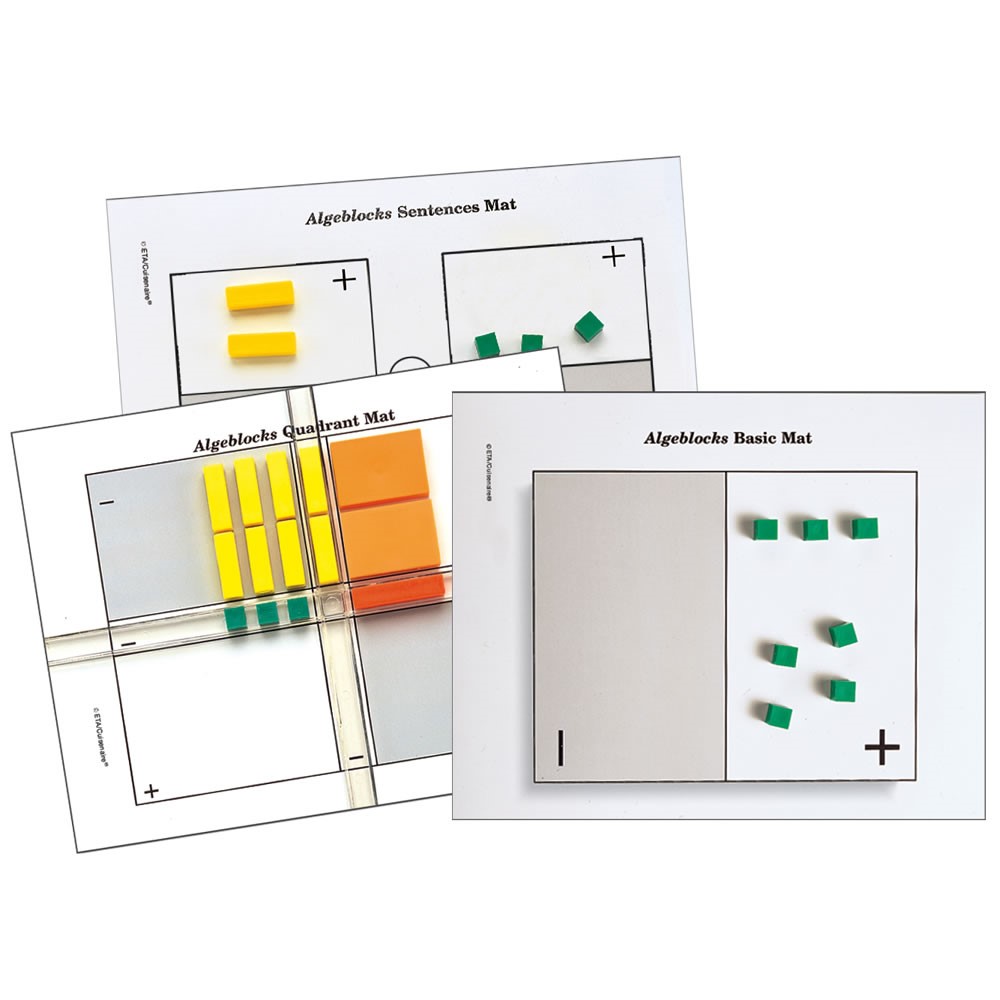
How can I engage my students with solving for a variable? Off the top of my head, I came up with 3 tried and true surefire ways that would not only further my students understanding but also be a ton of fun for them: Algeblocks with accompanying interactive whiteboard, using a balance and counters, and possibly using snacks (e.g. cookies, chips, candies, etc.)

First things first, the Algeblocks:
algeblocks

Essentially, Algeblocks are made of a variety of cubes and rectangles that represent ones, tens hundreds, thousands, and even the variables x and x2. Although obscured in the picture, the Algeblocks mat in the back represents a balance where the fulcrum is “=” and each end of the balance represent both sides of the equation. There is even a place that represents negative numbers! Using the problem “x+4=8”, students would have 8 green blocks to the left of the fulcrum and 4 green blocks with an x block. Students would then add or take away tiles to solve the equation. As for problems such as “4x=16”, the students would display the problem using the blocks and then group the green blocks with the x’s to find there answer. Now that I think of it, I would essentially do the same thing but use either a real balance with any type of manipulative.


green line

B1) How can this topic be used in you students’ future courses in mathematics or science?

Being able to solve single step algebraic problems is a foundation to algebra in general, correct? This means that this will continue to pop up regardless of what math class (and even science classes like chemistry). There will always be problems given to students where they will need to solve for a variable and the final step of even the most excruciatingly, horrific looking algebra problems is usually adding, subtracting, multiplying, dividing, etc. to get the “x” all alone. In reality, solving an initial value problem (like I currently do in my Differential Equations class) boils down to one step algebraic solutions.


green line

E1) How can technology (YouTube, Khan Academy [khanacademy.org], Vi Hart, Geometers Sketchpad, graphing calculators, etc.) be used to effectively engage students with this topic?

Interestingly enough, I have the perfect example that ties both Khan Academy and the “use of a balance” activity I mentioned earlier. A quick Google search for “one-step equations” gives a link to Khan Academy that allows for a digital balance and you are to solve the equation given with the balance. This would be an amazing tool for teachers to use when they don’t have actual balances for their class or even have their students create a profile on Khan Academy and use it to be able to track extra problems the students can do. Besides Khan Academy, there are even some cheesy yet fun games (like “Equations Pong” off the XP Math website) that would give the students more practice with these equations while feeling like a reward since they are playing a game. Plus, students can go head-to-head in “Equations Pong” and a vast majority of students like to best their friends in anything and everything.


References:

Information on Algeblocks: http://www.hand2mind.com/brands/algeblocks

Image of Algeblock Mats: https://cdn.hand2mind.com/productimages/76986_Algeblocks_Mats_BQS-web.jpg

Khan Academy use for subject: https://www.khanacademy.org/math/algebra/solving-linear-equations-and-inequalities/why-of-algebra/e/one_step_equation_intuition

Equations Pong Game: http://www.xpmath.com/forums/arcade.php?do=play&gameid=105


Engaging students: Factoring polynomials

In my capstone class for future secondary math teachers, I ask my students to come up with ideas for engaging their students with different topics in the secondary mathematics curriculum. In other words, the point of the assignment was not to devise a full-blown lesson plan on this topic. Instead, I asked my students to think about three different ways of getting their students interested in the topic in the first place.

I plan to share some of the best of these ideas on this blog (after asking my students’ permission, of course).

This student submission again comes from my former student Irene Ogeto. Her topic, from probability: Venn diagrams.

green line

A2. How could you as a teacher create an activity or project that involves your topic?


As a warm up activity to a lesson on Venn diagrams, I could set up a model Venn diagram made out of tape on the classroom floor or in the hallway outside of the class. The topic for the activity would be comparing the number of students who prefer to play indoor sports versus the number of students who prefer to play outdoor sports. I would ask the students who prefer to play outdoor sports such as soccer, baseball, football or field hockey to stand in the circle that represents outdoor sports. Then I would ask the students who prefer to play indoor sports such as bowling or table tennis to stand in the other circle. Next, I would ask the students who prefer to play both indoor and outdoor sports such as basketball, volleyball or badminton to stand where the circles intersect. Lastly, I would ask the students who don’t prefer to play any sports to stand outside the two circles.


With this activity we can explore these questions:

  • How many students prefer to play indoor sports?
  • What is the percentage of students in our class prefer to play indoor sports?
  • How many students prefer to play both indoor and outdoor sports?
  • What percentage of students in our class prefer play both indoor and outdoor sports?
  • What percentage of the students in our class prefer to play sports?

green line

C1. How has this topic appeared in pop culture (movies, TV, current music, video games, etc.)?


Venn diagrams have appeared in children’s TV shows such as Cyberspace. In this episode of Cyberspace which is was aired on PBS in Season 1, the Cyberspace squad uses a Venn diagram to rescue the Lucky Charms. The squad uses the terms “or” and “and” with respect to sets to find the Lucky Charms. Motherboard tells them that the Lucky Charms is both blue and tall. One circle represents the blue bunnies and the other circle represents the bunnies of another color. The area where the two circles intersect represents the area where the tall and blue bunnies are. The squad works together to find the Lucky Charms using applications of Venn diagrams. Venn diagrams can be used to explore possibilities and combinations of things. This video can serve as an introduction to a lesson on Venn diagrams. It enables students to see how math is part of culture, as it is found in television shows.


Episode 112: “Of All the Luck” http://www.pbs.org/parents/cyberchase/episodes/season-1/


green line

D1. What interesting things can you say about the people who contributed to the discovery and/or the development of this topic?


John Venn (1834-1923) the famous mathematician, devised a way to picture sets by creating what is now known as Venn diagrams in 1881. John Venn was born in Hull, New England, United Kingdom. He was a lecturer, president of a college, and a priest for some of the years in his life. Venn wanted to show how different groups of things could be represented visually. John Venn called Venn diagrams Eulerian circles because they were similar to the Euler circles created by Leonhard Euler. While they share similarities, Euler circles and Venn diagrams are different. Venn diagrams are more sophisticated and are used to represent all possible combinations of classes. Euler circles differ in the sense that the circles do not always have to intersect and do not always represent all possible combinations. Some people still refer to Venn diagrams as Eulerian circles to this day and often some people use the two terms interchangeably. Despite the differences, both diagrams are used in math every day.


References:

http://www.venndiagram.net/the-history-behind-the-venn-diagram.html

http://www.mathresources.com/products/mathresource/maa/venn_diagram.html

http://www.pbs.org/parents/cyberchase/episodes/season-1/


Engaging students: Rational and irrational numbers

In my capstone class for future secondary math teachers, I ask my students to come up with ideas for engaging their students with different topics in the secondary mathematics curriculum. In other words, the point of the assignment was not to devise a full-blown lesson plan on this topic. Instead, I asked my students to think about three different ways of getting their students interested in the topic in the first place.

I plan to share some of the best of these ideas on this blog (after asking my students’ permission, of course).

This student submission again comes from my former student Emma Sivado. Her topic, from Algebra: rational and irrational numbers.

green line

D.1: What interesting things can you say about the people who contributed to the discovery and/or the development of this topic?

The famous story on the first discovery of irrational numbers is one of violence. We all know the Pythagorean theorem, a2+b2=c2 , but what happens if we have a right triangle with height 1 and base 1? The hypotenuse becomes √2. So, √2, what’s the big deal? Well this is where we turn to history for the answer. Hippassus was an ancient greek philosopher who belonged to the Pythagorean school of thought. Now the Pythagorean’s had a saying, “All is number.” What do we think this means? What Pythagoras meant was that everything in the universe had a numerical attribute. For example, one is the number of reason, five is the number of marriage. So one day when Hippassus was playing with the length of the diagonal of the unit square, or the hypotenuse of a right triangle with base 1 and height 1, he discovered the number √2. Hippassus tried to write √2 as a fraction, or rational number, and found it to be impossible. Therefore, √2 is what we call an irrational number. Well this is where the history turns violent. There are numerous stories to explain the death of Hippassus, but all of them point to his ultimate cause of death being the discovery of these irrational numbers. Irrational numbers were so against Pythagoras and the Pythagorean school of thought that they had this man killed!

https://brilliant.org/discussions/thread/discovery-of-irrational-numbers/

http://www.math.tamu.edu/~dallen/history/pythag/pythag.html


green line

B.1: How can this topic be used in your students’ future courses in mathematics and science?

I believe that the irrational number would be a great place to introduce a simple proof. Students will have to do proofs in multiple math classes in the future and to give them an example with an interesting story might be a good place to start. For example, after telling the story of the discovery of irrational numbers ask the students how Hippassus might have proven that this was true; possibly his dying words. Then give them an outline or fill in the black of the proof that √2 is irrational. This example I found on homeschoolmath.net is given in good language and gives good explanations of why everything is done in the order it is:

Let’s suppose √2 is a rational number. Then we can write it √2  = a/b where a, b are whole numbers, b not zero.

We additionally assume that this a/b is simplified to lowest terms, since that can obviously be done with any fraction.

From the equality √2  = a/b it follows that 2 = a2/b2,  or  a2 = 2 · b2.  So the square of a is an even number since it is two times something.

From this we know that a itself is also an even number. Why? Because it can’t be odd; if a itself was odd, then a · a would be odd too. Odd number times odd number is always odd.

Okay, if a itself is an even number, then a is 2 times some other whole number. In symbols, a = 2k where k is this other number. We don’t need to know what k is; it won’t matter. Soon comes the contradiction.

If we substitute a = 2k into the original equation 2 = a2/b2, this is what we get:

2 = (2k)2/b2
2 = 4k2/b2
2*b2 = 4k2
b2 = 2k2

This means that b2 is even, from which follows again that b itself is even. And that is a contradiction!!!

WHY is that a contradiction? Because we started the whole process assuming that a/b was simplified to lowest terms, and now it turns out that a and b both would be even. We ended at a contradiction; thus our original assumption (that √2 is rational) is not correct. Therefore √2 is rational.


Obviously this would have to be presented slowly, but I believe that the students could do this and understand it.

http://www.homeschoolmath.net/teaching/proof_square_root_2_irrational.php


green line

I would begin by showing the movie clip from Life of Pi when Pi is reciting all the digits of Pi that he knows, or another video of someone reciting a ridiculous number of digits of pi. Then I would ask the students how many digits of Pi there are? When no one could tell me an exact answer I would introduce the irrational number and explain how the decimals will go on forever because this number cannot be written as a fraction like a rational number. At the end of class you could show the kids the Princeton University Pi Day celebration complete with Einstein look alike contests, and pi reciting competitions to win $314.15!

http://www.pidayprinceton.com/


References:


Engaging students: Adding and subtracting a mixture of positive and negative integers

In my capstone class for future secondary math teachers, I ask my students to come up with ideas for engaging their students with different topics in the secondary mathematics curriculum. In other words, the point of the assignment was not to devise a full-blown lesson plan on this topic. Instead, I asked my students to think about three different ways of getting their students interested in the topic in the first place.

I plan to share some of the best of these ideas on this blog (after asking my students’ permission, of course).

This student submission again comes from my former student Diana A’Lyssa Rodriguez. Her topic, from Algebra: adding and subtracting a mixture of positive and negative integers.

green line

A2. How could you as a teacher create an activity or project that involves your topic?

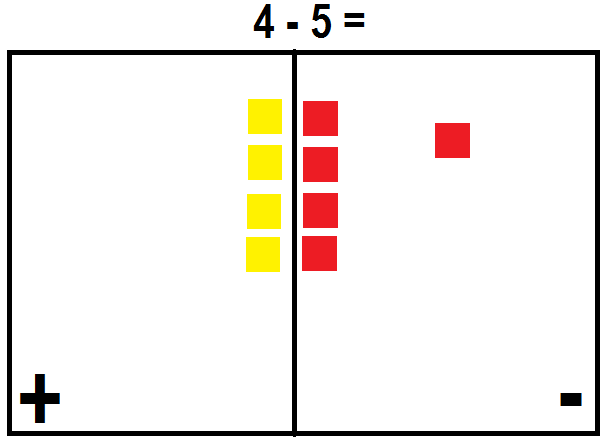
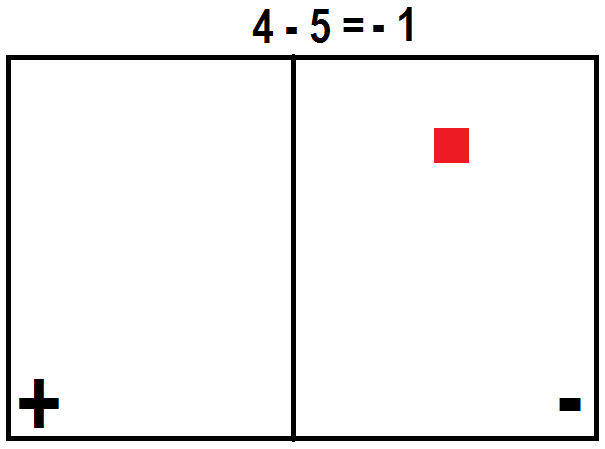
Algebra tiles are a fun, hands-on way to help students understand how to add or subtract positive and negative integers. Using a mat with a positive and negative side, students can manipulate the 1-tiles. Using the yellow side of the tile for the positive numbers and the red side for the negative numbers, students pair together opposing colors and take those away. The tiles leftover is the answer to the problem. Here is an example:

Step 1:

algebratile1

Step 2:

algebratile2

Step 3:

algebratile3

green line

B1. How can this topic be used in your students’ future courses in mathematics or science?

Adding and subtracting positive and negative integers is a one of the most crucial foundation skills that students must learn. This concept is demonstrated and needed in almost every math scenario. In its simplest form, students begin to learn this concept around the first grade, 1+1=2. This process is carried over into third grade with multiplication. Then negative numbers are introduced while in sixth grade. Adding and subtracting opposing integers is a continuous concept that consistently builds upon itself, even through algebra, geometry, calculus, or most especially the real world. There is not just one future math course students will use this in; they will use it for the rest of their lives, even if they do not realize it.


green line

E1. How can technology (YouTube, Khan Academy [khanacademy.org], Vi Hart, Geometers Sketchpad, graphing calculators, etc.) be used to effectively engage students with this topic?

YouTube is always a great resource when trying to engage students. The video below explains how positive and negative numbers work when adding and subtracting them.

A lot of the time students struggle with numbers in general, which makes it harder for them to understand why a concept in math works. This video explains how positive and negative numbers work in relation to each other by using characters from Batman instead of numbers. Using the balance and watching the arrow move in either direction, depending on the type of character that was added into or taken out, allows students to see why positive and negative numbers work the way they do. Once they understand this, it makes working with numbers a whole lot easier. This video also does a wonderful job of maintaining the students’ interest by keeping it related to popular culture by incorporating Batman and the Matrix.