Engaging students: Measures of the angles in a triangle add to 180 degrees

In my capstone class for future secondary math teachers, I ask my students to come up with ideas for engaging their students with different topics in the secondary mathematics curriculum. In other words, the point of the assignment was not to devise a full-blown lesson plan on this topic. Instead, I asked my students to think about three different ways of getting their students interested in the topic in the first place.

I plan to share some of the best of these ideas on this blog (after asking my students’ permission, of course).

This student submission comes from my former student Claire McMahon. Her topic, from Geometry: the proof that the measures of the angles in a triangle add to 180^o.

green line

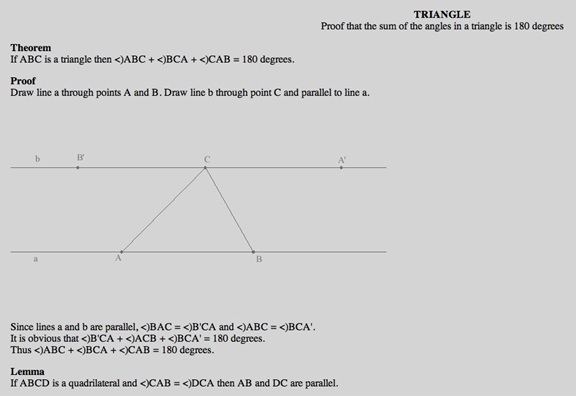
One of the hardest concepts in math is learning how to prove something that is already considered to be correct.  One of the more difficult concepts to teach could also be said on how to prove things that you had already believed and accepted in the first place.  One of these concepts happens to be that a triangle’s angles are always going to add up to 180 degrees.  Here is one of the proofs that I found that is absolutely simplistic and most kids will agree with you on it:

triangle1

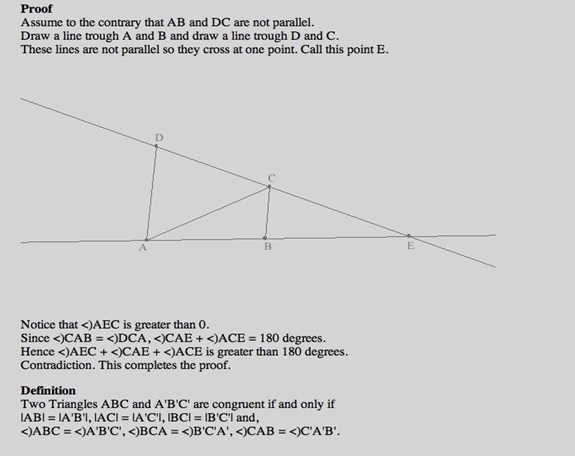
This particular proof is from the website http://www.mathisfun.com.  This is a great website to simply explain most math concepts and give exercises to practice those math facts.  For the more skeptical student, you can use a form of Euclidean and modern fact base to prove this more in depth.  I found this proof on http://www.apronus.com/geometry/triangle.htm.  Here you will see that there is no question as to why the proof above works and how it doesn’t work when you do a proof by contradiction.

triangle3 triangle2

green line

I stumbled across this awesome website that very simply put into context how easy it would be to prove that a triangle’s angles will always add up to 180 degrees.  In this activity you take the same triangle 3 times and then have them place all three of the angles on a straight line.  This proves that the angles in a triangle will always equal 180 degrees, which is a concept that should have already been taught as a straight line having an “angle” measure of 180. The website for this can be found here: http://www.regentsprep.org/Regents/math/geometry/GP5/TRTri.htm.

green line

The triangle is the basis for a lot of math.  There is one very important person that really started playing with the idea of a triangle and how 3 straight lines that close to form a figure has a certain amount of properties and similarities to parallels and other figures like it.  We base a whole unit on special right triangles in geometry in high school and never know exactly where the term right angle is derived.  This man that made the right angle so important in math is none other than Euclid himself.  While Euclid never introduced angle measures, he made it very apparent that 2 right angles are always going to be equal to the interior angles of a triangle.  Not only did Euclid prove this but he did so in a way that relates to all types of triangles and their similar counterparts using only a straight edge and a compass, pretty impressive!!

Continued fractions and pi

I suggest the following activity for bright middle-school students who think that they know everything that there is to know about fractions.

The approximation to \pi that is most commonly taught to students is \displaystyle \frac{22}{7}. As I’ll discuss, this is the closest rational number to \pi using a denominator less than 100. However, it is possible to obtain closer rational approximations to \pi using larger numbers. Indeed, the ancient Chinese mathematicians were superior to the ancient Greeks in this regard, as they developed the approximation

\pi \approx \displaystyle \frac{355}{133}

It turns out that this is the best rational approximation to \pi using a denominator less than 16,000. In other words, \displaystyle \frac{355}{133} is the best approximation to \pi using a reasonably simple rational number.

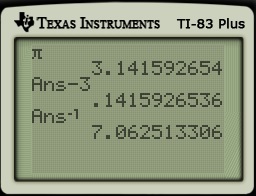
Step 1. To begin, let’s find \pi with a calculator. Then let’s now subtract 3 and then find the inverse.

TIpi1

This calculation has shown that

\pi = \displaystyle 3 + \frac{1}{7.0625133\dots}

If we ignore the 0.0625133, we obtain the usual approximation

\pi \approx \displaystyle 3 + \frac{1}{7} = \frac{22}{7}

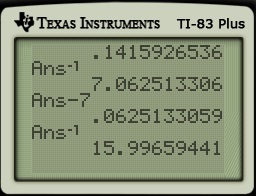
Step 2. However, there’s no reason to stop with one reciprocal, and this might give us some even better approximations. Let’s subtract 7 from the current denominator and find the reciprocal of the difference.

TIpi2

At this point, we have shown that

\pi = \displaystyle 3 + \frac{1}{7 + \displaystyle\frac{1}{15.9965944\dots}}

If we round the final denominator down to 15, we obtain the approximation

\pi \approx \displaystyle 3 + \frac{1}{7 + \displaystyle\frac{1}{15}}

\pi \approx \displaystyle 3 + \frac{1}{~~~\displaystyle \frac{106}{15}~~~}

\pi \approx \displaystyle 3 + \frac{15}{106}

\pi \approx \displaystyle \frac{333}{106}

Step 3. Continuing with the next denominator, we subtract 15 and take the reciprocal again.

TIpi3

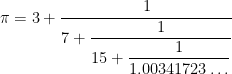
At this point, we have shown that

\pi = \displaystyle 3 + \frac{1}{7 + \displaystyle\frac{1}{15 + \displaystyle \frac{1}{1.00341723\dots}}}

If we round the final denominator down to 1, we obtain the approximation

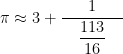
\pi \approx \displaystyle 3 + \frac{1}{7 + \displaystyle\frac{1}{16}}

\pi \approx \displaystyle 3 + \frac{1}{~~~\displaystyle \frac{113}{16}~~~}

\pi \approx \displaystyle 3 + \frac{16}{113}

\pi \approx \displaystyle \frac{355}{113}

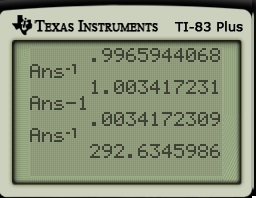
Step 4. Let me show one more step.TIpi4

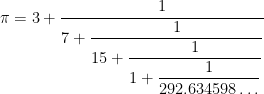
At this point, we have shown that

\pi = \displaystyle 3 + \frac{1}{7 + \displaystyle\frac{1}{15 + \displaystyle \frac{1}{1 + \displaystyle \frac{1}{292.634598\dots}}}}

If we round the final denominator down to 292, we (eventually) obtain the approximation

\pi \approx \displaystyle \frac{52163}{16604}

green lineThe calculations above are the initial steps in finding the continued fraction representation of \pi. A full treatment of continued fractions is well outside the scope of a single blog post. Instead, I’ll refer the interested reader to the good write-ups at MathWorld (http://mathworld.wolfram.com/ContinuedFraction.html) and Wikipedia (http://en.wikipedia.org/wiki/Continued_fraction) as well as the references therein.

But I would like to point out one important property of the convergents that we found above, which were

\displaystyle \frac{22}{7}, \frac{333}{106}, \frac{355}{113}, ~ \hbox{and} ~ \frac{52163}{16604}

All of these fractions are pretty close to \pi, as shown below. (The first decimal below is the result for 22/7.)

TIpi5

In fact, these are the first terms in a sequence of best possible rational approximations to $\pi$ up to the given denominator. In other words:

  • \displaystyle \frac{22}{7} is the best rational approximation to \pi using a denominator less than $106$. In other words, no integer over 8 will be any closer to \pi than \displaystyle \frac{22}{7}.  No integer over 9 will be any closer to \pi than \displaystyle \frac{22}{7}. And so on, all the way up to denominators of 105. Small wonder that we usually teach children the approximation \pi \approx \displaystyle \frac{22}{7}.
  • Once we reach 106, the fraction \displaystyle \frac{323}{106} is the best rational approximation to \pi using a denominator less than 113.
  • Then \displaystyle \frac{355}{113} is the best rational approximation to \pi using a denominator less than 16604.

As noted above, the ancient Chinese mathematicians were superior to the ancient Greeks in this regard, as they were able to develop the approximation \pi \approx \displaystyle \frac{355}{113}. For example, Archimedes was able to establish that

3\frac{10}{71} < \pi < 3\frac{1}{7}

Engaging students: Deriving the Pythagorean theorem

In my capstone class for future secondary math teachers, I ask my students to come up with ideas for engaging their students with different topics in the secondary mathematics curriculum. In other words, the point of the assignment was not to devise a full-blown lesson plan on this topic. Instead, I asked my students to think about three different ways of getting their students interested in the topic in the first place.

I plan to share some of the best of these ideas on this blog (after asking my students’ permission, of course).

This student submission again comes from my former student Maranda Edmonson. Her topic, from Geometry: deriving the Pythagorean theorem.

green line

D. History: What are the contributions of various cultures to this topic?

Legend has it that Pythagoras was so happy about the discovery of his most famous theorem that he offered a sacrifice of oxen. His theorem states that “the area of the square built upon the hypotenuse of a right triangle is equal to the sum of the areas of the squares upon the remaining sides.” It is likely, though, that the ancient Babylonians and Egyptians knew the result much earlier than Pythagoras, but it is uncertain how they originally demonstrated the proof. As for the Greeks, it is likely that methods similar to Euclid’s Elements were used. Also, though there are many proofs of the Pythagorean Theorem, one came from the contemporary Chinese civilization found in the Arithmetic Classic of the Gnoman and the Circular Paths of Heaven, a Chinese text containing formal mathematical theories.

http://jwilson.coe.uga.edu/emt669/student.folders/morris.stephanie/emt.669/essay.1/pythagorean.html

green line

E. Technology: How can technology be used to effectively engage students with this topic?

The following link is for a video that not only engages students from the very beginning by playing the Mission: Impossible theme and giving students a mission – “should they choose to accept it” – but that has great information. It begins with a short engagement, as stated before, and goes into a little bit of history about Pythagoras and the Pythagoreans. It then briefly describes what the Pythagorean Theorem is before the commentator says, “Does it have applications in our lives today?” At this point (2:43 in the video), it would be beneficial to stop the video and let students discuss where they could use the theorem. The rest of the video simply shows some examples of how the Pythagorean Theorem is used on sailboats, inclined planes, and televisions. It would be up to the teacher whether or not to show the last five minutes of the video to show students these examples, but they could take notes on these examples as they are worked out on the screen.

http://digitalstorytelling.coe.uh.edu/movie_mathematics_02.html

green line

B. Applications: How can this topic be used in your students’ future courses in mathematics or science?

After students learn the Pythagorean Theorem in their Geometry classes, they will use it throughout their mathematical careers. They will use it specifically in Pre-Calculus when they are learning about the unit circle. The theorem is fundamental to proving the basic identities in Trigonometry. It is also used in some of the trigonometric identities, aptly named the Pythagorean Identities based on the nature of their derivation.

In Physics, the kinetic energy of an object is

\displaystyle \frac{1}{2} (\hbox{mass})(\hbox{velocity})^2.

But, in terms of energy, energy at 500 mph = energy at 300 mph + energy at 400 mph. This equation means that, with the energy used to accelerate something at 500 mph, two other objects could use that same energy to be accelerated to 300 mph and 400 mph. Looks like a Pythagorean triple, right? The theorem is also used in Computer Science with processing time. Other examples are found in the link below.

http://betterexplained.com/articles/surprising-uses-of-the-pythagorean-theorem/

Collaborative Mathematics: Challenge 05

My colleague Jason Ermer is back from summer hiatus and has posted his fifth challenge video, shown below.

Video responses can be posted to his website, http://www.collaborativemathematics.org. In the words of his website, this is a unique forum for connecting a worldwide community of mathematical problem-solvers, and I think these unorthodox but simply stated problems are a fun way for engaging students with the mathematical curriculum.

Full lesson plan: Platonic solids

Over the summer, I occasionally teach a small summer math class for my daughter and her friends around my dining room table. Mostly to preserve the memory for future years… and to provide a resource to my friends who wonder what their children are learning… I’ll write up the best of these lesson plans in full detail.

This was the first lesson that I taught to this audience: constructing the five regular polyhedra and inductively deriving Euler’s formula. This lesson plan is written in a 5E format — engage, explore, explain, elaborate, evaluate — which promotes inquiry-based learning and fosters student engagement.

Platonic Solids Lesson

Post Assessment 1

Post Assessment 2

V-E-F Chart

Vocabulary Sheet

Engaging students: Distinguishing between inductive and deductive reasoning

In my capstone class for future secondary math teachers, I ask my students to come up with ideas for engaging their students with different topics in the secondary mathematics curriculum. In other words, the point of the assignment was not to devise a full-blown lesson plan on this topic. Instead, I asked my students to think about three different ways of getting their students interested in the topic in the first place.

I plan to share some of the best of these ideas on this blog (after asking my students’ permission, of course).

This student submission again comes from my former student Caitlin Kirk. Her topic, from Geometry (and proof writing): distinguishing between inductive and deductive reasoning.

green line

C. Culture: How has this topic appeared in pop culture (movies, TV, current music, video games, etc.)?

Inductive and deductive reasoning are often used on TV, radio, or in print in the form of advertising.

Deductive Reasoning

Man: What’s better, faster or slower?

All kids: Faster!

Man: And what’s fast?

Boy: My mom’s car and a cheetah.

Girl: A space ship.

Man: And what’s slow?

Boy: My grandma’s slow.

Man: Would you like her better if she was fast?

Boy: I bet she would like it if she was fast.

Man: Hmm, maybe give her some turbo boosters?

Boy: Or tape a cheetah to her back.

Man: Tape a cheetah to her back, it seems like you’ve thought about this before.

Narrator: It’s not complicated, faster is better. And iPhone 5 downloads fastest on AT&T 4G.

Deductive reasoning, which applies a general rule to specific examples, can be seen in advertisements like the AT&T commercial above. The kids establish in their conversation that faster things are better. The narrator says that iPhone 5 downloads fastest on AT&T 4G. Thus the viewer is left with the conclusion that AT&T 4G is better. This commercial’s deduction can be summed up as follows:

Faster things are better.

AT&T 4G is faster.

AT&T 4G is better. (conclusion)

Inductive Reasoning

Hotch: Sprees usually end in suicide. If he’s got nothing to live for, why wouldn’t he end it?

Reid: Because he’s not finished yet.

Reid: He’s obviously got displaced anger and took it out on his first victim.

Hotch: The stock boy represented someone. We need to know who. What about the other victims.

Reid: Defensive.

Hotch: Was he military?

Garcia: Negative.

Hotch: He’s lashing out. There’s got to be a reason. Rossi and Prentiss, dig through his house. Reid and JJ, get to the station. Morgan and I will take the crime scene. This guy’s got anger, endless targets and a gun. And from the looks of it, he just got started.

Inductive reasoning, which uses specific examples to make a general rule, can be seen frequently in episodes of TV shows or movies that involve crime scene investigation. The show Criminal Minds features a special unit of the FBI that profiles criminals. They do this by interviewing criminals who have already been caught and then inducing general rules about all criminals in order to catch the one they are looking for. Conversations among the profilers, like the one above, lead to inductive reasoning that can be summed up as follows:

He has nothing to live for.

He doesn’t want to commit suicide.

He wasn’t in the military.

He has displaced anger.

He has endless targets.

He has a gun.

He is a dangerous man who will hurt more people. (conclusion)

green line

C. Culture: How has this topic appeared in high culture (art, classical music, theatre, etc.)?

 When in the Course of human events, it becomes necessary for one people to dissolve the political bands which have connected them with another, and to assume among the powers of the earth, the separate and equal station to which the Laws of Nature and of Nature’s God entitle them, a decent respect to the opinions of mankind requires that they should declare the causes which impel them to the separation.

 We hold these truths to be self-evident, that all men are created equal, that they are endowed by their Creator with certain unalienable rights, that among these are Life, Liberty, and the pursuit of Happiness. That to secure these rights, Governments are instituted among Men, deriving their just powers from the consent of the governed. That whenever any Form of Government becomes destructive of these ends, it is the Right of the People to alter or to abolish it, and to institute new Government, laying its foundation on such principles and organizing its powers in such form, as to them shall seem most likely to effect their Safety and Happiness.

-The Declaration of Independence

July, 4, 1776

The Declaration of Independence was drafted as a deductive argument as to why the United States can and should be a country independent of Great Britain. Thomas Jefferson drafted the declaration with a series of premises leading to four different conclusions.

  1. George III is a tyrant
  2. The colonies have a right to be free and independent states
  3. All political connections between Britain and the colonies should be dissolved
  4. The “united states” have the right to do all things that free nations do

These four conclusions then serve as premises for the final conclusion that the United States is now an independent country. The declaration is a great example of deductive reasoning because it takes specific examples, such as the 27 grievances against the monarch, and makes logical conclusions, such as “George III is a tyrant,” from the examples. Its deduction can be plainly seen.

The Declaration of Independence is a great example of high culture to use in the classroom because every student who is educated in the United States will have some knowledge of this document. Therefore learning to analyze it “mathematically” in terms of deductive versus inductive reasoning, is a great engagement tool.

green line

E. Technology: How can technology be used to effectively engage students with this topic?

Crime Scene Games & Deductive Reasoning: https://sites.google.com/a/wcsga.net/mock-trial/crime-scene-games-deductive-reasoning

This website contains links to several crime scene investigation games. Several of the games require students to collect clues, compare evidence, and then determine who is responsible for committing a given crime. These games are great for having students use their deductive skills. A couple of the other games require students to review given qualities of a criminal and inductively decide who the criminal in a scenario is based on these broad statements.

This website could be used to engage students easily. Having students play a game, especially one like these where they cannot pick out the mathematical skill they are using, is a great way to get students to abandon their potential distaste for a topic and be involved. After the students have completed a game and solved their crime, the teacher can smoothly transition into a geometrical lesson on inductive and deductive reasoning. The teacher will have activated the students’ knowledge of reasoning through a fun game. They will then be in a better position to learn a new, mathematical application of the reasoning they just used.

Engaging students: Finding the area of a square or rectangle

In my capstone class for future secondary math teachers, I ask my students to come up with ideas for engaging their students with different topics in the secondary mathematics curriculum. In other words, the point of the assignment was not to devise a full-blown lesson plan on this topic. Instead, I asked my students to think about three different ways of getting their students interested in the topic in the first place.

I plan to share some of the best of these ideas on this blog (after asking my students’ permission, of course).

This student submission comes from my former student Alyssa Dalling. Her topic, from Geometry: finding the area of a square or rectangle.

green line

D. How have different cultures throughout time used this topic in their society?

Giza

  • For three thousand years, the Great Pyramid of Giza was the world’s tallest man-made structure. It is also the oldest structure of the Seven Wonders of the Ancient World. It was built by cutting huge stones into rectangles then placing each stone into place to create the base. It is believed by many that the pharaoh Khufu had his vizier Hemon create the design for the great Pyramids. What is amazing about the design of the Pyramid of Giza is that each of the four sides of the base has an average error of only 58 millimeters in length. Meaning the base is almost a perfect square!
  • It would be fun to start the engage with introducing the Pyramid of Giza and explaining the facts above. Then students would be given the dimensions of other pyramids where they would have to find the area of the base to see whether they created a square or rectangular pyramid. This would get them excited about this topic because students would be exploring math that has actually been used in real life.

Castillo

  • The Mesoamericans also built pyramids with square and rectangular bases. The picture above is in a city known as Chechen Itza which is located in the Mexican state of Yucatan. It is called El Castillo, and also known as the Temple of Kukulkan. Unlike the Egyptian pyramids though, the Mayan pyramids were usually meant as steps to get to a temple on top. The pyramids consisted of several square bases stacked onto each other with steps up each side. El Castillo consists of nine square terraces each about 8.4 feet tall. The main base of the pyramid is approximately 55.3 meters (181 feet).
  • What would be fun to do is have students find the area of each level and compare it to all the levels on the pyramid. I feel students would have fun seeing just how big this type of structure is and understanding the planning it took to create the different levels in this pyramid.

Sources: http://en.wikipedia.org/wiki/Great_Pyramid_of_Giza and http://en.wikipedia.org/wiki/Pyramids#Nigeria

green line

B. How can this topic be used in your students’ future courses in mathematics or science?

  • Finding the area of squares and rectangles will be used a lot in Algebra and Algebra II. One example in Algebra is when students start solving for unknown variables. A student would be asked to find the area of a square when they have two unknown sides.
  • The following is an example engage problem students would use the finding the area of a square or rectangle to solve.

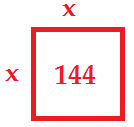
Principal Smith has decided the school needs a new practice basketball court. The current practice court is a square with an area of 144 square feet. She wants the new court to be a rectangle twice as long as it is wide. Find the length of all the sides of both the old court and the new court and find the area of the new court.

rect1rect2

x^2 = 144

So x = 12

Then x(2x) = 2x^2 = 2(12)^2 = 288

The square court has sides of 12.

The rectangular court has sides of 12×24 and an area of 288 square feet.

Engaging students: Defining the words acute, right, and obtuse

In my capstone class for future secondary math teachers, I ask my students to come up with ideas for engaging their students with different topics in the secondary mathematics curriculum. In other words, the point of the assignment was not to devise a full-blown lesson plan on this topic. Instead, I asked my students to think about three different ways of getting their students interested in the topic in the first place.

I plan to share some of the best of these ideas on this blog (after asking my students’ permission, of course).

This student submission again comes from my former student Jesse Faltys. Her topic: how to engage geometry students when defining the words acute, right, and obtuse.

green line

E. TECHNOLOGY: How can technology be used to effectively engage students with this topic?

ACUTE, OBTUSE, and RIGHT Angles Song

This is a great video for the end of the lesson when first introducing acute, right, and obtuse angles.  A little corny but it’s always helpful to link new knowledge to a song.  Music brings back memories or in this situation recognition.  By using creative things, you are helping the students reinforce new ideas.  Just hearing words will not help us retain the information, but adding the words to a song help reinforce the reminder for the information.  We can remember anything if we just put our minds to it.  The kids in the video are singing lyrics about right, obtuse and acute angles to the song Old McDonald Had a Farm.  The video helps the students to summarize their understanding of the three new terms and a way to retain it for future use.

http://www.watchknowlearn.org/Video.aspx?VideoID=2446

green line

D. HISTORY: How have different cultures throughout time used this topic in their society?

In Egypt as far back as 1500BC, measurements were taken of the Sun’s shadow against graduations marked on stone tables. These measurements are just different angles used to show time with some degree of accuracy.  Gromas were used for the purpose of construction in ancient Egypt.  Gromas were right-angle devices that the ancient Egyptians used when they began construction project by surveying an area. They could sketch out long lines at right angles.  The Romans will actually use the same tool to sketch out their roads.  1,713 years ago they were using right angles.  This might be important.

http://www.fig.net/pub/cairo/papers/wshs_01/wshs01_02_wallis.pdf

angles

green line

C. Culture: How has this topic appeared in pop culture (movies, TV, current music, video games, etc.)?

Angry-Birds: “Use the unique powers of the Angry Birds to destroy the greedy pigs’ fortresses!“ Angry-Birds is an app that is played by a large percentage of children on a daily basis.  Birds are positioned on a slingshot and launched at pigs that are resting on different structures.  We create a zero plane from the bird sitting in the slingshot, releasing the bird, and mark the maximum height reached. We now have an angle. The bird has created an angle with its path.  Can we classify the majority of these angles as acute, right or obtuse?

angrybirds

Bubble Shooter:  A Puzzle game that will help you stay busy for a while!

The point of the game is to remove all the spheres by matching like colors.  The “cannon” at the bottom of the page is your tool to directing the sphere were you want it to go.  You can directly shot the sphere or you can bounce off the edge of the wall.  Here is the trick, what kind of angle do you need to deliver your sphere.  One of the helpful hints from the website, “you can use the left and right border to bounce new balls in more advanced angles.” These advanced angles can be denoted as acute, right or obtuse.

http://www.shooter-bubble.com/

Geometric magic trick

This is a magic trick that my math teacher taught me when I was about 13 or 14. I’ve found that it’s a big hit when performed for grade-school children.

Magician: Tell me a number between 3 and 10.

Child: (gives a number, call it x)

Magician: On a piece of paper, draw a shape with x corners.

Child: (draws a figure; an example for x=6 is shown)

geom_magic1Important Note: For this trick to work, the original shape has to be convex… something shaped like an L or M won’t work. Also, I chose a maximum of 10 mostly for ease of drawing and counting (and, for later, calculating).

Magician: Tell me another number between 3 and 10.

Child: (gives a number, call it y)

Magician: Now draw that many dots inside of your shape.

Child: (starts drawing y dots inside the figure; an example for y = 7While the child does this, the Magician calculates 2y + x - 2, writes the answer on a piece of paper, and turns the answer face down.

geom_magic2Magician: Now connect the dots with lines until you get all triangles. Just be sure that no two lines cross each other.

Child: (connects the dots until the shape is divided into triangles; an example is shown)

geom_magic3Magician: Now count the number of triangles.

Child: (counts the triangles)

Magician: Was your answer… (and turns the answer over)?

The reason this magic trick works so well is that it’s so counter-intuitive. No matter what convex x-gon is drawn, no matter where the y points are located, and no matter how lines are drawn to create triangles, there will always be 2y + x - 2 triangles. For the example above, 2y+x-2 = 2\times 7 + 6 - 2 = 18, and there are indeed 18 triangles in the figure.

Why does this magic trick work? I offer a thought bubble if you’d like to think about it before scrolling down to see the answer.

green_speech_bubbleThis trick works by counting the measures of all the angles in two different ways.

Method #1: If there are T triangles created, then the sum of the measures of the angles in each triangle is 180 degrees. So the sum of the measures of all of the angles must be 180 T degrees.

geom_magic4Method #2: The sum of the measures of the angles around each interior point is 360 degrees. Since there are y interior points, the sum of these angles is 360y degrees.

geom_magic5The measures of the remaining angles add up to the sum of the measures of the interior angles of a convex polygon with x sides. So the sum of these measures is 180(x-2) degrees.

geom_magic6In other words, it must be the case that

180T = 360y + 180(x-2), or T = 2y + x - 2.