My Mathematical Magic Show: Part 3c

Last March, on Pi Day (March 14, 2015), I put together a mathematical magic show for the Pi Day festivities at our local library, compiling various tricks that I teach to our future secondary teachers. I was expecting an audience of junior-high and high school students but ended up with an audience of elementary school students (and their parents). Still, I thought that this might be of general interest, and so I’ll present these tricks as well as the explanations for these tricks in this series. From start to finish, this mathematical magic show took me about 50-55 minutes to complete. None of the tricks in this routine are original to me; I learned each of these tricks from somebody else.

green line

In the last couple of posts, I discussed a trick for predicting the number of triangles that appear when a convex x-gon with y points in the middle is tesselated. Though I probably wouldn’t do the following in a magic show (for the sake of time), this is a natural inquiry-based activity to do with pre-algebra students in a classroom setting (as opposed to an entertainment setting) to develop algebraic thinking. I’d begin by giving the students a sheet of paper like this:

trianglechart

Then I’ll ask them to start on the left box. I’ll tell them to draw a triangle in the box and place one point inside, and then subdivide into smaller triangles. Naturally, they all get 3 triangles.

Then I ask them to repeat if there are two points inside. Everyone will get 5 triangles.

Then I ask them to repeat until they can figure out a pattern. When they figure out the pattern, then they can make a prediction about what the rest of the chart will be.

Then I’ll ask them what the answer would be if there were 100 points inside of the triangle. This usually requires some thought. Eventually, the students will get the pattern T = 2P+1 for the number of triangles if the initial figure is a triangle.

Then I’ll repeat for a quadrilateral (with four sides instead of three). After some drawing and guessing, the students can usually guess the pattern T=2P+2.

Then I’ll repeat for a pentagon. After some drawing and guessing, the students can usually guess the pattern T=2P+3.

Then I’ll have them guess the pattern for the hexagon without drawing anything. They’ll usually predict the correct answer, T = 2P+4.

What about if the outside figure has 100 sides? They’ll usually predict the correct answer, T = 2P+98.

What if the outside figure has N sides? By now, they should get the correct answer, T = 2P + N - 2.

This activity fosters algebraic thinking, developing intuition from simple cases to get a pretty complicated general expression. However, this activity is completely tractable since it only involves drawing a bunch of figures on a piece of paper.

My Mathematical Magic Show: Part 3b

Last March, on Pi Day (March 14, 2015), I put together a mathematical magic show for the Pi Day festivities at our local library, compiling various tricks that I teach to our future secondary teachers. I was expecting an audience of junior-high and high school students but ended up with an audience of elementary school students (and their parents). Still, I thought that this might be of general interest, and so I’ll present these tricks as well as the explanations for these tricks in this series. From start to finish, this mathematical magic show took me about 50-55 minutes to complete. None of the tricks in this routine are original to me; I learned each of these tricks from somebody else.

green line

This is a magic trick that my math teacher taught me when I was about 13 or 14. I’ve found that it’s a big hit when performed for grade-school children. Here’s the patter:

Magician: Tell me a number between 5 and 10.

Child: (gives a number, call it x)

Magician: On a piece of paper, draw a shape with x corners.

Child: (draws a figure; an example for x=6 is shown)

geom_magic1Important Note: For this trick to work, the original shape has to be convex… something shaped like an L or M won’t work. Also, I chose a maximum of 10 mostly for ease of drawing and counting (and, for later, calculating).

Magician: Tell me another number between 5 and 10.

Child: (gives a number, call it y)

Magician: Now draw that many dots inside of your shape.

Child: (starts drawing y dots inside the figure; an example for y = 7While the child does this, the Magician calculates 2y + x - 2, writes the answer on a piece of paper, and turns the answer face down.

geom_magic2Magician: Now connect the dots with lines until you get all triangles. Just be sure that no two lines cross each other.

Child: (connects the dots until the shape is divided into triangles; an example is shown)

geom_magic3Magician: Now count the number of triangles.

Child: (counts the triangles)

Magician: Was your answer… (and turns the answer over)?

The reason this magic trick works so well is that it’s so counter-intuitive. No matter what convex x-gon is drawn, no matter where the y points are located, and no matter how lines are drawn to create triangles, there will always be 2y + x - 2 triangles. For the example above, 2y+x-2 = 2\times 7 + 6 - 2 = 18, and there are indeed 18 triangles in the figure.

This trick works by counting the measures of all the angles in two different ways.

Method #1: If there are T triangles created, then the sum of the measures of the angles in each triangle is 180 degrees. So the sum of the measures of all of the angles must be 180 T degrees.

geom_magic4Method #2: The sum of the measures of the angles around each interior point is 360 degrees. Since there are y interior points, the sum of these angles is 360y degrees.

geom_magic5The measures of the remaining angles add up to the sum of the measures of the interior angles of a convex polygon with x sides. So the sum of these measures is 180(x-2) degrees.

geom_magic6These two different ways of adding the angles must be the same. In other words, it must be the case that

180T = 360y + 180(x-2),

or

T = 2y + x - 2.

green lineI’m often asked why it was important to choose a number between 5 and 10. The answer is, it’s not important. The trick will work for any numbers as long as there are at least three sides of the polygon. However, in a practical sense, it’s a good idea to make sure that the number of sides and the number of points aren’t too large so that the number of triangles can be counted reasonably quickly.

After explaining how the trick works, I’ll again ask a child to stand up and play the magician, repeating the trick that I just did, before I move on to the next trick.

My Mathematical Magic Show: Part 3a

Last March, on Pi Day (March 14, 2015), I put together a mathematical magic show for the Pi Day festivities at our local library, compiling various tricks that I teach to our future secondary teachers. I was expecting an audience of junior-high and high school students but ended up with an audience of elementary school students (and their parents). Still, I thought that this might be of general interest, and so I’ll present these tricks as well as the explanations for these tricks in this series. From start to finish, this mathematical magic show took me about 50-55 minutes to complete. None of the tricks in this routine are original to me; I learned each of these tricks from somebody else.

green line

For my second trick, I’ll show something that my math teacher taught me when I was about 13 or 14. Everyone in the audience has a piece of paper and a pen or pencil. Here’s the patter:

Magician: Tell me a number between 5 and 10.

Child #1: (gives a number, call it x)

Magician: On a piece of paper, draw a shape with x corners. Don’t draw something really, really tiny… make sure it’s big enough to see well.

Audience: (draws a figure; an example for x=6 is shown) The Magician also draws this figure on the board.

geom_magic1Important Note: For this trick to work, the original shape has to be convex… something shaped like an L or M won’t work. Also, I chose a maximum of 10 mostly for ease of drawing and counting (and, for later, calculating).

Magician: Tell me another number between 5 and 10.

Child #2: (gives a number, call it y)

Magician: Now draw that many dots inside of your shape.The Magician also draws y dots inside the figure on the board, an example for y = 7 is shown.

geom_magic2Audience: (starts drawing y dots inside the figure) The Magician also calculates 2y + x - 2 and says, “Now while you’re doing that, I’m going to write a secret number on the board,” discreetly writes the answer on the board, and then covers up the answer with a piece of paper and some adhesive tape.

Magician: Now connect the dots with lines until you get all triangles. Just be sure that no two lines cross each other. For example, your figure could look like this:

geom_magic3

Audience: (quietly connects the dots until the shape is divided into triangles)

Magician: Now count the number of triangles.

Audience: (counts the triangles)

Magician: Was your answer… (removes the adhesive tape and displays the answer)?

The reason this magic trick works so well is that it’s so counter-intuitive. No matter what convex x-gon is drawn, no matter where the y points are located, and no matter how lines are drawn to create triangles, there will always be 2y + x - 2 triangles. For the example above, 2y+x-2 = 2\times 7 + 6 - 2 = 18, and there are indeed 18 triangles in the figure.

In tomorrow’s post, I’ll explain why this trick works.


Langley’s Adventitious Angles (Part 2)

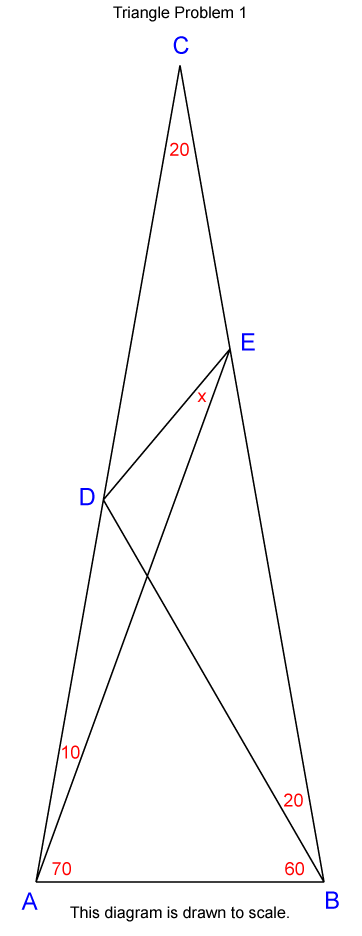
As a follow-up to yesterday’s triangle problem, here’s another one in the same equivalence class that I found at http://thinkzone.wlonk.com/MathFun/Triangle.htm (via the comments at Math With Bad Drawings). The author of this webpage tantalizingly calls this the World’s Hardest Easy Geometry Problem: solve for x in the figure below.


This figure is similar to the figure in yesterday’s post, except the values of m\angle BAE and m\angle DAE have changed.

So as to not ruin the fun, I won’t give the answer here. Instead, I’ll leave a thought bubble so you can think about the answer. In case you’re wondering: yes, I did figure this out for myself without using the Laws of Sines and Cosines. But I needed over an hour to solve this problem , and that’s after I had time to read and reflect upon the solution to the problem I posed in yesterday’s post.

green_speech_bubble

Langley’s Adventitious Angles (Part 1)

Math With Bad Drawings had an interesting post about solving for x in the following picture (this picture is taken from http://thinkzone.wlonk.com/MathFun/Triangle.htm):

I had never heard of this problem before, but it’s apparently well known and is called Langley’s Adventitious Angles. See Math With Bad Drawings, Wikipedia, and Math Pages for more information about the solution of this problem. Math Pages has a nice discussion about mathematical aspects of this problem, including connections to the Laws of Sines and Cosines and to various trig identities.

I’d encourage you to try to solve for x without clicking on any of these links… a certain trick out of the patented Bag of Tricks is required to solve this problem using only geometry (as opposed to the Law of Cosines and the Law of Sines). I have a story that I tell my students about the patented Bag of Tricks: Socrates gave the Bag of Tricks to Plato, Plato gave it to Aristotle, it passed down the generations, my teacher taught the Bag of Tricks to me, and I teach it to my students. In the same post, Math With Bad Drawings has a nice discussion about pedagogical aspects of this problem concerning when a “trick” becomes a “technique”.

I recommend this problem for advanced geometry students who need to be challenged; even bright students will be stumped concerning coming up with the requisite trick on their own. Indeed, the problem still remains quite challenging even after the trick is shown.

Engaging students: Deriving the Pythagorean theorem

In my capstone class for future secondary math teachers, I ask my students to come up with ideas for engaging their students with different topics in the secondary mathematics curriculum. In other words, the point of the assignment was not to devise a full-blown lesson plan on this topic. Instead, I asked my students to think about three different ways of getting their students interested in the topic in the first place.

I plan to share some of the best of these ideas on this blog (after asking my students’ permission, of course).

This student submission comes from my former student Belle Duran. Her topic, from Geometry: deriving the Pythagorean theorem.

green line

How can technology be used to effectively engage students with this topic?

Using the video in which the scarecrow from The Wizard of Oz “explains” the Pythagorean theorem, I can get the students to review what the definition of it is. Since the scarecrow’s definition was wrong, I can ask the students what was wrong with his phrasing (he said isosceles, when the Pythagorean theorem pertains to right triangles). Thus, I can ask why it only relates to right triangles, starting the proof for the Pythagorean theorem.

green line

What interesting things can you say about the people who contributed to the discovery and/or the development of this topic?

While Pythagoras is an important figure in the development of mathematics, little is truly known about him since he was the leader of a half religious, half scientific cult-like society who followed a code of secrecy and often presented Pythagoras as a god-like figure. These Pythagoreans believed that “number rules the universe” and thus gave numerical values to many objects and ideas; these numerical values were endowed with mystical and spiritual qualities. Numbers were an obsession for these people, so much so that they put to death a member of the cult who founded the idea of irrational numbers through finding that if we take the legs of measure 1 of an isosceles right triangle, then the hypotenuse would be equal to sqrt(2). The most interesting of all, is the manner in which Pythagoras died. It all roots back to Pythagoras’ vegetarian diet. He had a strong belief in the transmigration of souls after death, so he obliged to become a vegetarian to avoid the chance of eating a relative or a friend. However, not only did he abstain from eating meat, but also beans since he believed that humans and beans were spawned from the same source, hence the human fetal shape of the bean. In a nutshell, he refused access to the Pythagorean Brotherhood to a wealthy man who grew vengeful and thus, unleashed a mob to go after the Brotherhood. Most of the members were killed, save for a few including Pythagoras (his followers created a human bridge to help him out of a burning building). He was meters ahead from the mob, and was about to run into safety when he froze, for before him stretched a vast bean field. Refusing to trample over a single bean, his pursuers caught up and immediately ended his life.


green line

How has this topic appeared in the news?

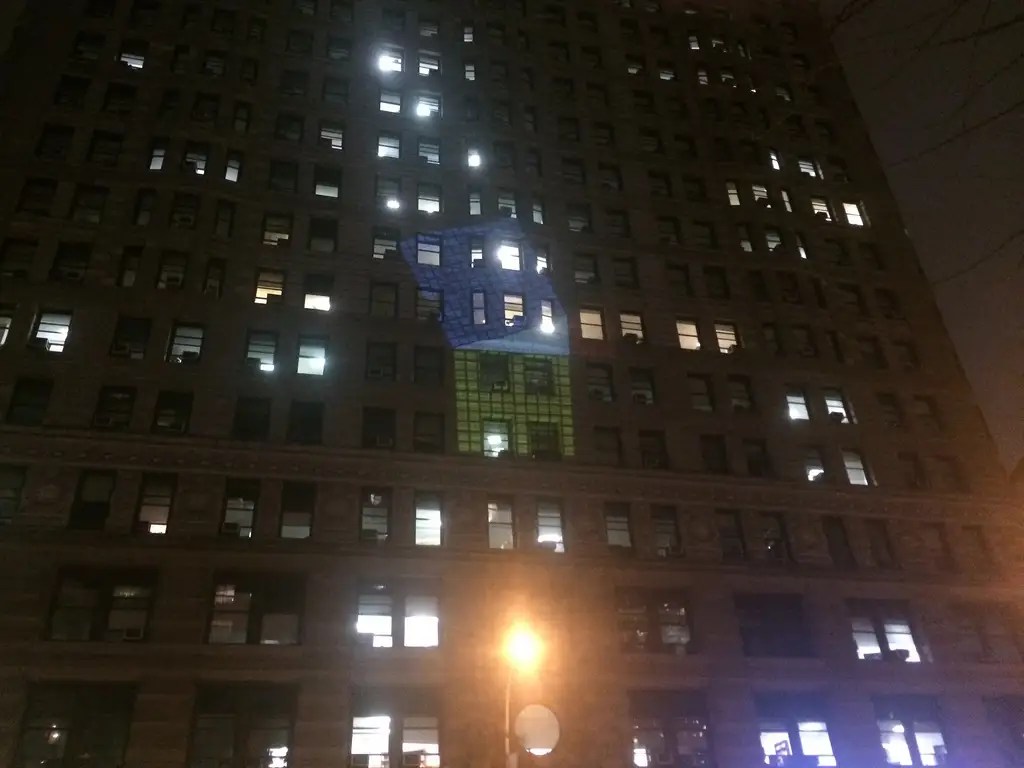
Dallas Cowboys coach, Jason Garrett recently made it mandatory for his players to know the Pythagorean theorem. He wants his players to understand that “’if you’re running straight from the line of scrimmage, six yards deep…it takes you a certain amount of time…If you’re doing it from ten yards inside and running to that same six yards, that’s the hypotenuse of the right triangle’” (NBC Sports). Also, recently the Museum of Mathematics (MoMath) and about 500 participants recently proved that New York’s iconic Flatiron building is indeed a right triangle. They measured the sides of the building by first handing out glow sticks for the participants to hold from end to end, then by counting while handing out the glow sticks, MoMath was able to estimate the length of the building in terms of glow sticks.

The lengths came out to be 75^2 + 180^2 = 38,025. After showing their Pythagorean relationship, MoMath projected geometric proofs on the side of the Flatiron building.


References

http://www.youtube.com/watch?v=DUCZXn9RZ9s

http://www.youtube.com/watch?v=X1E7I7_r3Cw

http://www.geom.uiuc.edu/~demo5337/Group3/hist.html

http://profootballtalk.nbcsports.com/2013/07/24/jason-garrett-wants-the-cowboys-to-know-the-pythagorean-theorem/

http://www.businessinsider.com/500-math-enthusiasts-prove-the-flatiron-building-is-a-right-triangle-2013-12

Different ways of computing a limit (Part 5)

One of my colleagues placed the following problem on an exam for his Calculus II course…

\displaystyle \lim_{x \to \infty} \frac{\sqrt{x^2+1}}{x}

and was impressed by the variety of correct responses that he received. I thought it would be fun to discuss some of the different ways that this limit can be computed.

Method #5. Another geometric approach. The numbers x and \sqrt{x^2+1} can be viewed as two sides of a right triangle with legs 1 and x and hypotenuse \sqrt{x^2+1}. Therefore, the length of the hypotenuse must be larger than the length of one leg but less than the sum of the lengths of the two legs. In other words,

x < \sqrt{x^2+1} < x+1,

or

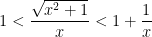
1 < \displaystyle \frac{\sqrt{x^2+1}}{x} < \displaystyle 1+\frac{1}{x}.

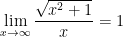
 Clearly \displaystyle \lim_{x \to \infty} 1 = 1 and \displaystyle \lim_{x \to \infty} \left( 1 + \frac{1}{x} \right) = 1. Therefore, by the Sandwich Theorem, we can conclude that \displaystyle \lim_{x \to \infty} \frac{\sqrt{x^2+1}}{x} = 1.
Different ways of computing a limit (Part 4)

One of my colleagues placed the following problem on an exam for his Calculus II course…

\displaystyle \lim_{x \to \infty} \frac{\sqrt{x^2+1}}{x}

and was impressed by the variety of correct responses that he received. I thought it would be fun to discuss some of the different ways that this limit can be computed.

Method #4. The geometric approach. The numbers x and \sqrt{x^2+1} can be viewed as two sides of a right triangle with legs 1 and x and hypotenuse \sqrt{x^2+1}. So as x gets larger and larger, the longer leg x will get closer and closer in length to the length of the hypotenuse. Therefore, the ratio of the length of the hypotenuse to the length of the longer leg must be 1.