Solving a Math Competition Problem: Part 7

This series of posts concerns solving the following problem from the 2016 University of Maryland High School Mathematics Competition.

A sphere is divided into regions by 9 planes that are passing through its center. What is the largest possible number of regions that are created on its surface?

a. 2^8

b. 2^9

c. 81

d. 76

e. 74

This series was actually written by my friend Jeff Cagle, department head for mathematics at Chapelgate Christian Academy, as he tried technique after technique to solve this problem. I thought that his resolution to the problem was an excellent example of the process of mathematical problem-solving, and (with his permission) I am posting the process of his solution here. (For the record, I have no doubt that I would not have been able to solve this problem.)

OK, so I wanted to prove that each region would be a triangle. So I decided to project the sphere onto a plane.

The projection of four planes:

After a while, I had a chart for max possible regions.

  • 1 plane: Max regions = 2
  • 2 planes: Max regions = 4
  • 3 planes: Max regions = 8 (exponential?)
  • 4 planes: Max regions = 14 (nope!)
  • 5 planes: Max regions = 22 (huh?)

Then, really because I had no other ideas, I tried counting intersection points AND max regions
(remembering that one intersection point is “at infinity” – that is, the north pole).

  • 1 plane: Intersection Points = 0, Max regions = 2
  • 2 planes: Intersection Points = 2, Max regions = 4
  • 3 planes: Intersection Points = 6, Max regions = 8
  • 4 planes: Intersection Points = 12, Max regions = 14
  • 5 planes: Intersection Points  20, Max regions = 22

Oh. My. Goodness. The max regions are simply the number of intersection points plus 2. Could it really REALLY be that simple?
Solving a Math Competition Problem: Part 6

This series of posts concerns solving the following problem from the 2016 University of Maryland High School Mathematics Competition.

A sphere is divided into regions by 9 planes that are passing through its center. What is the largest possible number of regions that are created on its surface?

a. 2^8

b. 2^9

c. 81

d. 76

e. 74

This series was actually written by my friend Jeff Cagle, department head for mathematics at Chapelgate Christian Academy, as he tried technique after technique to solve this problem. I thought that his resolution to the problem was an excellent example of the process of mathematical problem-solving, and (with his permission) I am posting the process of his solution here. (For the record, I have no doubt that I would not have been able to solve this problem.)

OK, so I wanted to prove that each region would be a triangle. So I decided to project the sphere onto a plane.

The projection of four planes:

After a while, I had a chart for max possible regions.

  • 1 plane: Max regions = 2
  • 2 planes: Max regions = 4
  • 3 planes: Max regions = 8 (exponential?)
  • 4 planes: Max regions = 14 (nope!)
  • 5 planes: Max regions = 22 (huh?)

Solving a Math Competition Problem: Part 5

This series of posts concerns solving the following problem from the 2016 University of Maryland High School Mathematics Competition.

A sphere is divided into regions by 9 planes that are passing through its center. What is the largest possible number of regions that are created on its surface?

a. 2^8

b. 2^9

c. 81

d. 76

e. 74

This series was actually written by my friend Jeff Cagle, department head for mathematics at Chapelgate Christian Academy, as he tried technique after technique to solve this problem. I thought that his resolution to the problem was an excellent example of the process of mathematical problem-solving, and (with his permission) I am posting the process of his solution here. (For the record, I have no doubt that I would not have been able to solve this problem.)

OK, so I wanted to prove that each region would be a triangle. So I decided to project the sphere onto a plane.

For a while, I toyed with the situation where we have

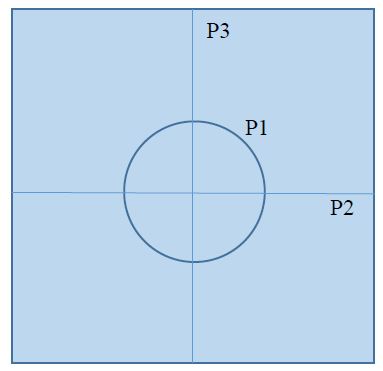
  • Plane 1 – equator (this always happens: Just make plane 1 the equator) 𝑃1(0𝑁, 0𝐸).
  • Plane 2 – Prime Meridian 𝑃2(90𝑁, 0𝐸)
  • Plane 3 – Intl Date Line 𝑃3(90𝑁, 90𝐸)
  • Plane 4 – at an angle to all of those 𝑃4(45𝑁, 45𝐸)

Here is our mapping with P1, P2, and P3 on it:

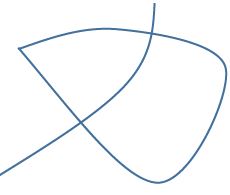
Now, how to represent P4? Aha! The inside of the unit circle is the southern hemisphere, and the outside is the northern. P4 must hit the equator a two points 180 degrees apart, go inside the southern hemisphere, and then outside to the northern. Thus:

The white region is a NONtriangular region created by the intersection of four planes. These are strange-looking regions, and I spent a long time – several days – vainly trying to count max regions created when I added P5, P6 etc. But one thing was clear: not all of the regions are triangular, nor can they be. For if a plane (say P4) cuts through a triangular region, it will create a new triangular region and a non-triangular “quadrilateral”, as in the figure below. So counting triangles from points is NOT the solution here!

Solving a Math Competition Problem: Part 4

This series of posts concerns solving the following problem from the 2016 University of Maryland High School Mathematics Competition.

A sphere is divided into regions by 9 planes that are passing through its center. What is the largest possible number of regions that are created on its surface?

a. 2^8

b. 2^9

c. 81

d. 76

e. 74

This series was actually written by my friend Jeff Cagle, department head for mathematics at Chapelgate Christian Academy, as he tried technique after technique to solve this problem. I thought that his resolution to the problem was an excellent example of the process of mathematical problem-solving, and (with his permission) I am posting the process of his solution here. (For the record, I have no doubt that I would not have been able to solve this problem.)

OK, so I wanted to prove that each region would be a triangle. So I decided to project the sphere onto a plane. There’s a standard way of doing that, used both by map-makers and mathematicians. Place the sphere with the south pole on the plane at the origin. Then for each point on the sphere, run a line from the north pole through that point to the plane. This gives a 1-1 mapping of sphere to plane. The diagram below shows this mapping, with the points A and B on the sphere mapping to the points A’ and B’ on the plane respectively.

Notice that in the mapping above, the south pole is mapped to the origin (“straight down”), while the north pole itself cannot be mapped. We call the north point the “point at infinity.” Also notice that the equator gets mapped to a circle. And, any circle around the sphere that goes through the north pole will also go through the south pole, and so becomes a line in the plane.


Solving a Math Competition Problem: Part 3

This series of posts concerns solving the following problem from the 2016 University of Maryland High School Mathematics Competition.

A sphere is divided into regions by 9 planes that are passing through its center. What is the largest possible number of regions that are created on its surface?

a. 2^8

b. 2^9

c. 81

d. 76

e. 74

This series was actually written by my friend Jeff Cagle, department head for mathematics at Chapelgate Christian Academy, as he tried technique after technique to solve this problem. I thought that his resolution to the problem was an excellent example of the process of mathematical problem-solving, and (with his permission) I am posting the process of his solution here. (For the record, I have no doubt that I would not have been able to solve this problem.)

AHH! Insight! Each plane must intersect the others because they all pass through the center. And two planes intersect in a line. And the line must intersect the sphere at two points. SO, we can count intersection points: There are 9 planes, and each plane will intersect the other 8, so there are 9 ∗ 8 = 72 intersection points IF we arrange the planes for maximum regions. More generally, if we have n planes arranged for max intersection points, we will have 𝑛(𝑛 − 1) intersection points.
Wait, let’s do this carefully. There are 9 planes, and they can each intersect 8 different planes; but that counts the intersections of plane A and plane B twice, so there are (9*8)/2 = 36 lines of intersection, but 36 ∗ 2 = 72 points of intersection with the sphere. So our problem just got narrower: Given 72 intersection points defining various regions on the sphere, how many regions do we get?
And that’s where the problem stands as of this writing. My preliminary conjecture is that each region will be a “triangle” (officially, spherical triangle) on the surface of the sphere, especially if we are maximizing regions. I need to prove that conjecture and then count triangles, which shouldn’t be too hard.

Solving a Math Competition Problem: Part 2

This series of posts concerns solving the following problem from the 2016 University of Maryland High School Mathematics Competition.

A sphere is divided into regions by 9 planes that are passing through its center. What is the largest possible number of regions that are created on its surface?

a. 2^8

b. 2^9

c. 81

d. 76

e. 74

This series was actually written by my friend Jeff Cagle, department head for mathematics at Chapelgate Christian Academy, as he tried technique after technique to solve this problem. I thought that his resolution to the problem was an excellent example of the process of mathematical problem-solving, and (with his permission) I am posting the process of his solution here. (For the record, I have no doubt that I would not have been able to solve this problem.)

At this point, various methods suggested themselves. Perhaps we could use recursion: let N_n be the regions created by n planes, and then we could examine the number of additional regions formed by n+1 planes?

Or, related to this, perhaps we needed to find the number of intersection points of each of the planes, and then relate the number of intersection points to the number of regions. But how to describe the intersection points?

It did occur to me that if we have n planes situated for maximal regions, they will divide the equator up into 2n subintervals, and adding another plane will divide up two of those subintervals into 4. Did that help? Well, it could help count the number of regions touching the equator: two for each subinterval (one north of equator, one south). But what about the regions not touching the equator? Hmph.

One possible way to visualize this problem is to project the plane onto a sphere. I know how to
do that, but counting the regions still seems hard.

For a while, I toyed with the situation where we have

  • Plane 1 – equator (this always happens: Just make plane 1 the equator) 𝑃1(0𝑁, 0𝐸).
  • Plane 2 – Prime Meridian 𝑃2(90𝑁, 0𝐸)
  • Plane 3 – Intl Date Line 𝑃3(90𝑁, 90𝐸)
  • Plane 4 – at an angle to all of those 𝑃4(45𝑁, 45𝐸)

I looked at my daughter’s wall map of the world: P4 goes through Tblisi Georgia and south of French Polynesia.

Where does P4 intersect the others? Could I make a formula to find the intersection points?


Solving a Math Competition Problem: Part 1

This series of posts concerns solving the following problem from the 2016 University of Maryland High School Mathematics Competition.

A sphere is divided into regions by 9 planes that are passing through its center. What is the largest possible number of regions that are created on its surface?

a. 2^8

b. 2^9

c. 81

d. 76

e. 74

This series was actually written by my friend Jeff Cagle, department head for mathematics at Chapelgate Christian Academy, as he tried technique after technique to solve this problem. I thought that his resolution to the problem was an excellent example of the process of mathematical problem-solving, and (with his permission) I am posting the process of his solution here. (For the record, I have no doubt that I would not have been able to solve this problem.)

On my first pass, all I could do was to visualize the first three planes, one at the equator, one passing through the prime meridian in Greenwich England, and one passing through the International Date Line. That gave me 2^3=8 regions, so my preliminary conjecture was “b. 2^9”. But I couldn’t prove it. And when I tried to mentally add a fourth plane to my diagram – one starting in Ukraine or something and hitting the equator halfway between the others – I found that I couldn’t clearly see that plane and count the regions formed. That vexed me for a while, and I put it away for the day.

The next day, I realized that I wasn’t going to be able to picture these planes, and I needed to find a way to describe their directions mathematically. The picture I had was of the equatorial plane and a second plane passing through it in the center. That second plane could be rotated any amount around the equator – described by one angle – and then elevated by tilting to a different angle. So I conjectured that two angles uniquely describe each plane: 𝜃 to describe angle around and 𝜙 to describe angle of elevation.

In the shower, I realized that I had just rediscovered latitude and longitude! That made me feel much better about my mathematical description as likely correct.

But now, how to turn the mathematical description into a solution? If I have one plane at (𝜃1,𝜙1), how do I count the regions it creates with the other planes?

Meet the Math Professor Who’s Fighting Gerrymandering With Geometry

From the Chronicle of Higher Education: Meet the Math Professor Who’s Fighting Gerrymandering With Geometry, an interview with Dr. Moon Duchin, an associate professor of math and director of the Science, Technology and Society program at Tufts.

Q. What is the Metric Geometry and Gerrymandering Group’s aim?

A. In redistricting, one of the principles that’s taken seriously by courts is that districts should be compact. The U.S. Constitution does not say that, but many state constitutions do, and it’s taken as a kind of general principle of how districts ought to look.

But nobody knows exactly what compactness means. People just have the idea that it means the shape shouldn’t be too weird, shouldn’t be too eccentric; it should be a kind of reasonable shape. Lots of people have taken a swing at that over the years. Which definition you choose actually has stakes. It changes what maps are acceptable and what maps aren’t. If you look at the Supreme Court history, what you’ll see is that a lot of times, especially in the ’90s, the court would say, Look, some shapes are obviously too bizarre but we don’t know how to describe the cutoff. How bizarre is too bizarre? We don’t know; that sounds hard.

Q. It’s like how they define obscenity.

A. Exactly. When I started thinking about this, I was surprised to see that even though there were different mathematical attempts at a definition, you don’t ever see mathematicians testifying in court about it. So our first aim was to think like mathematicians about compactness and look at all the definitions that already exist, and compare them and try to prove theorems about the relationships between the definitions.

What courts have been looking for is one definition of compactness that they can understand, that we can compute, and that they can use as a kind of go-to standard. I don’t have any illusions that we’re going to settle that debate forever, but I think we can make a contribution to the debate.

See also her lecture for the Mathematical Association of America’s Distinguished Lecture Series: