

Source: https://www.grammarly.com/blog/complement-compliment/
From the Chronicle of Higher Education: Meet the Math Professor Who’s Fighting Gerrymandering With Geometry, an interview with Dr. Moon Duchin, an associate professor of math and director of the Science, Technology and Society program at Tufts.
Q. What is the Metric Geometry and Gerrymandering Group’s aim?
A. In redistricting, one of the principles that’s taken seriously by courts is that districts should be compact. The U.S. Constitution does not say that, but many state constitutions do, and it’s taken as a kind of general principle of how districts ought to look.
But nobody knows exactly what compactness means. People just have the idea that it means the shape shouldn’t be too weird, shouldn’t be too eccentric; it should be a kind of reasonable shape. Lots of people have taken a swing at that over the years. Which definition you choose actually has stakes. It changes what maps are acceptable and what maps aren’t. If you look at the Supreme Court history, what you’ll see is that a lot of times, especially in the ’90s, the court would say, Look, some shapes are obviously too bizarre but we don’t know how to describe the cutoff. How bizarre is too bizarre? We don’t know; that sounds hard.
Q. It’s like how they define obscenity.
A. Exactly. When I started thinking about this, I was surprised to see that even though there were different mathematical attempts at a definition, you don’t ever see mathematicians testifying in court about it. So our first aim was to think like mathematicians about compactness and look at all the definitions that already exist, and compare them and try to prove theorems about the relationships between the definitions.
What courts have been looking for is one definition of compactness that they can understand, that we can compute, and that they can use as a kind of go-to standard. I don’t have any illusions that we’re going to settle that debate forever, but I think we can make a contribution to the debate.
See also her lecture for the Mathematical Association of America’s Distinguished Lecture Series:
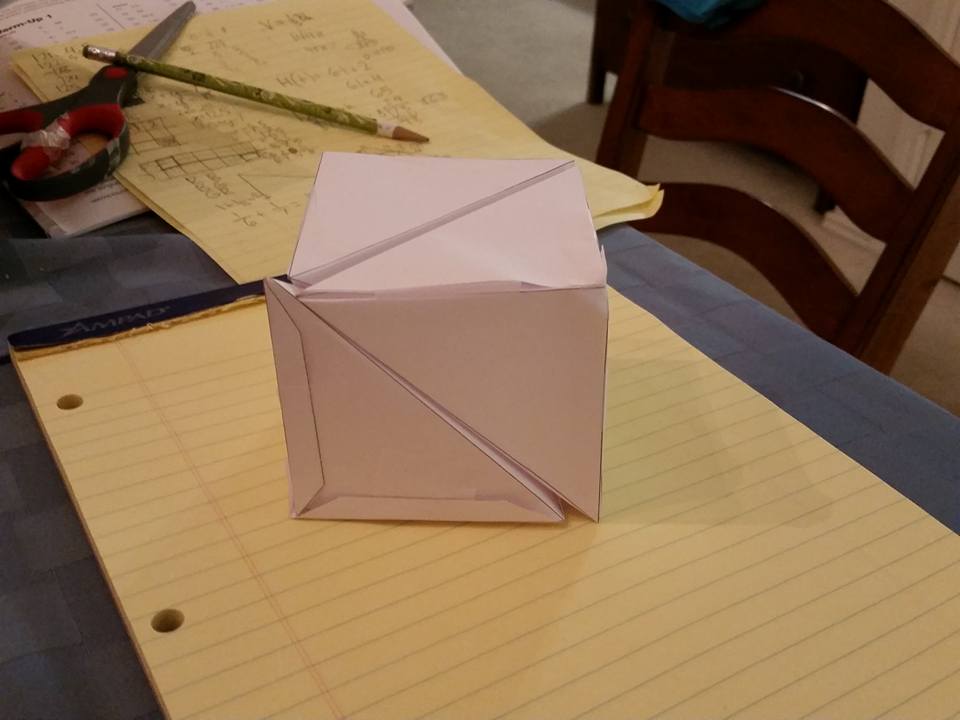
I didn’t believe this counterintuitive trick until I tried it myself… the instructions can be found at http://www.maa.org/…/horizons/RichesonImpossibleCylinder.pdf
Three blank sheets of paper: 5 cents.
Printer ink: more expensive per ounce than fine perfume.
15 small pieces of Scotch tape: 2 cents.

Visually demonstrating that the volume of a pyramid is one-third the product of the height and the area of the base: Priceless.
In my capstone class for future secondary math teachers, I ask my students to come up with ideas for engaging their students with different topics in the secondary mathematics curriculum. In other words, the point of the assignment was not to devise a full-blown lesson plan on this topic. Instead, I asked my students to think about three different ways of getting their students interested in the topic in the first place.
I plan to share some of the best of these ideas on this blog (after asking my students’ permission, of course).
This student submission comes from my former student Tramashika DeWalt. Her topic, from Geometry: defining intersection.

How could you as a teacher create an activity or project that involves your topic?
I would create a Kahoot to define intersection for my students. I would begin with the basic definition, which is, where lines cross over, meet, or have a common point (Unknown, Math is Fun, 2016). Thereafter, I would display pictures that visually portray intersection and that do not portray intersection. Within the same Kahoot, I would provide the students with the more advanced definition of intersection, intersection sets, “The intersection of two sets A and B is the set of elements common to both A and B” (Unknown, Math is Fun, 2016) according to MathIsFun.com. Like before, I would follow the definition up with pictures for the students to determine if the set intersects or not. After the Kahoot, I would have the students to get into groups of 4, with a large piece of paper, to come up with intersections from their daily life. Finally, the groups would display their findings and we will discuss the results as a class.
How can this topic be used in your students’ future courses in mathematics or science?
This topic can and will be used in my students’ future math courses. As I mentioned above, the basic definition of intersection will be extended to intersecting sets. In set intersection, the student will have to determine what elements each set has in common (that intersect) in order to determine where the sets intersect. The student will also have to know that the elements that are not common for both sets are not included in the intersection of the two sets. Intersection is used throughout math, so students can encounter it in high school, calculus, functions and modeling, real analysis, abstract algebra, etc. Not only will my students’ encounter intersection in future math courses, but they will also encounter intersections in life. For instance, when they are at a stop light (intersection), at a four-way stop sign (intersection), or even walking around UNT (students’ paths and sidewalks intersect all the time here).
How can technology be used to effectively engage students with this topic? Note: It’s not enough to say “such-and-such is a great website”; you need to explain in some detail why it’s a great website.
As mentioned above, I would create a Kahoot, on kahoot.it, to effectively engage my students with technology to define and solidify the definition of intersection. I would layout my Kahoot by starting with the definition of intersection. Then I would have a variety of picture that would either display a form of intersection, or that would not display a form of intersection. Kahoot is awesome because it allows students to use their cell phone, iPad, or tablet to respond to questions created by the teacher. I feel the Kahoot will be very engaging because it allows the student time to play on their phone (so that the teacher doesn’t have to confiscate them for inappropriate use), listen to cool background music as they solve their problems, and learning about the particular topic at hand, all while having fun. Now Kahoot even has a podium at the end of the Kahoot that displays the top three point earners.
Kahootit! (n.d.). Retrieved from Kahoot!: create.kahoot.it
https://play.kahoot.it/#/?quizId=8648bc78-08d2-4ea8-9cb8-d23df904ebca
Unknown. (2016). Math is Fun. Retrieved from Math is Fun: http://www.mathsisfun.com/definitions/intersection.html
Unknown. (2016). Math is Fun. Retrieved from Math is Fun: http://www.mathsisfun.com/definitions/intersection-sets-.html
In my capstone class for future secondary math teachers, I ask my students to come up with ideas for engaging their students with different topics in the secondary mathematics curriculum. In other words, the point of the assignment was not to devise a full-blown lesson plan on this topic. Instead, I asked my students to think about three different ways of getting their students interested in the topic in the first place.
I plan to share some of the best of these ideas on this blog (after asking my students’ permission, of course).
This student submission comes from my former student Sarah Asmar. Her topic, from Algebra II: deriving the distance formula.
How could you as a teacher create an activity or project that involves your topic?
Many high school students complain about why they have to take a math class or that math is not fun. Deriving and even learning the distance formula is not interesting for very many students. One way that I would engage my students would be to take the entire class outside to teach this lesson. We will walk down to the football and I will have a three students go to one corner of the football field while the rest of the class stands at the opposite corner diagonally. I will then hand a stopwatch to three other students. Each of them will have one stopwatch. The three students on the opposite corner will be running to the corner where the rest of the class is standing. The students holding a stopwatch, will each be timing one of the students running. I will ask one student to run horizontally and then vertically on the outrebounds of the football field, one student will run vertically and then horizontally, and the last student will run diagonally through the football field. Once all three students have made it to the corner where the rest of the class is, I will then ask everyone “Who do you think made it to the class the fastest?” I will allow them to say what they think and why, and then I will ask the students with the stopwatches to share the times of each of the students that ran. At the end, this will get the students to conclude that the student that ran diagonally got to the entire class the fastest. This is a short activity, but it changes the atmosphere for the students by taking class outside for a little, and it is fun.
What interesting things can you say about the people who contributed to the discovery and/or the development of this topic?
There were three main mathematicians/philosophers that contributed to the discovery of this topic. Pythagoras, Euclid and Descartes all played a roll in deriving the distance formula. Pythagoras is a very famous mathematician. At first, he saw geometry as a bunch of rules that were derived by empirical measurements, but later he came up with a way to connect geometric elements with numbers. Pythagoras is known for one of the most famous theorems in the mathematical world, the Pythagorean Theorem. The theorem touches on texts from Babylon, Egypt, and China, but Pythagoras was the one who gave it its form. The distance formula comes from the Pythagorean Theorem. Euclid is known as “The Father of Geometry.” He has five general axioms and five geometrical postulates. However, in his third postulate, he states that you can create a circle with any given distance and radius. This is represented by the formula x2+y2=r2. The distance formula comes from this equation as well. Last but not least, Descartes was the one who created the coordinate system. When finding the distance between two points on a coordinate plane, we would need to use the distance formula. All three of these men helped form the distance formula.
How can technology be used effectively engage students with this topic?
Students find everything more interesting when they are able to use technology to learn. There is a website that allows students to explore math topics using what is called a Gizmo. A Gizmo can be used to solve for the distance between two points. The students are allowed to pick what their two points are and then use the distance formula to find the distance between the points they chose. When students have control over something, they tend to do what they are supposed to do without any complaints. The Gizmo allows students to explore on their own without the teacher having to tell them what to do step by step. I can even ask the students to plot three points that form a right triangle and have them find the distance of the points that form the hypotenuse. This can allow the students to make the connection between the distance formula and Pythagorean Theorem. There are many applications out there, but I remember using Gizmos when I was in high school and I loved it. It is a great tool to explore a mathematical topic.
References:
http://www.storyofmathematics.com/greek_pythagoras.html
http://www.storyofmathematics.com/hellenistic_euclid.html
http://www.storyofmathematics.com/17th_descartes.html
In my capstone class for future secondary math teachers, I ask my students to come up with ideas for engaging their students with different topics in the secondary mathematics curriculum. In other words, the point of the assignment was not to devise a full-blown lesson plan on this topic. Instead, I asked my students to think about three different ways of getting their students interested in the topic in the first place.
I plan to share some of the best of these ideas on this blog (after asking my students’ permission, of course).
This student submission again comes from my former student Katelyn Kutch. Her topic: how to engage geometry students when defining the words acute, right, and obtuse.
How could you as a teacher create an activity or project that involves your topic?
As a teacher I think that a fun activity that is not too difficult but will need the students to be up and around the room is kind of like a mix and match game. I will give a bunch a students, a multiple of three, different angles. And then I will give the rest of the students cards with acute, obtuse, and right triangle listed on them. The students with the angles will then have to get in groups of three to form one of the three triangles. Once the students are in groups of three, they will then find another student with the type of triangle and pair with them. They will then present and explain to rest of the class why they paired up the way that they did. I think that it would be a good way for the students to be up and around and decide for themselves what angles for what triangles and then to show their knowledge by explaining it to the class.
How does this topic extend what your students should have learned in previous courses?
The topic of defining acute, right, and obtuse triangles extend what my students should already know about the different types, acute, right, and obtuse, angles. The students should already know the different types of angles and their properties. We can use their previous knowledge to build towards defining the different types of triangles. I will explain to the students that defining the triangles is like defining the angles. If they can tell me what angles are in the triangle and then tell me the properties of the triangles then they can reason with it and discover which triangle it is by looking at the angles.

How has this topic appeared in pop culture (movies, TV, current music, theatre, etc.)?
I found an article that I like that was written about a soccer club, FC Harlem. FC Harlem was getting a new soccer field as part of an initiative known as Operation Community Cup, which revitalizes soccer fields in Columbus and Los Angeles. This particular field, when it was opened, had different triangles and angles spray painted on the field in order to show the kids how soccer players use them in games. Time Warner Cable was the big corporation in on this project.
References:
http://www.twcableuntangled.com/2010/10/great-day-for-soccer-in-harlem/
In my capstone class for future secondary math teachers, I ask my students to come up with ideas for engaging their students with different topics in the secondary mathematics curriculum. In other words, the point of the assignment was not to devise a full-blown lesson plan on this topic. Instead, I asked my students to think about three different ways of getting their students interested in the topic in the first place.
I plan to share some of the best of these ideas on this blog (after asking my students’ permission, of course).
This student submission comes from my former student Perla Perez. Her topic, from Geometry: finding the area of a parallelogram.
How does this topic extend what your students should have learned in previous courses?
A parallelogram is a two dimensional shape in which the opposite sides of the shape are parallel to each other and the opposite angles are equal. To find the area of a parallelogram the height is multiplied by the base. Before being able to solve for the area of a parallelogram, a learner must have foundational knowledge of what defines a base and height of a shape; as well as be able to understand what it means for lines to be parallel and to intersect (which is taught in grade 4). There are many different types of parallelograms; to name a few: rectangles, rhombuses, and squares. A rectangle is a special parallelogram in which it not only fits the criteria to be considered a parallelogram but all angles are equal. Because of the fact that all angles are equal, students tend to learn how to find the area of a rectangle first, and later learn to apply it to other parallelograms. Although, during elementary education students learn how to measure an angle, define parallel lines, and can even define perpendicular lines these topics are also taught in their high school geometry classes, typically in the beginning of the year.
References:
Click to access Grade4_TEKS_0814.pdf
http://ritter.tea.state.tx.us/rules/tac/chapter111/ch111c.html
How can technology (YouTube, Khan Academy [khanacademy.org], Vi Hart, Geometers Sketchpad, graphing calculators, etc.) be used to effectively engage students with this topic? Note: It’s not enough to say “such-and-such is a great website”; you need to explain in some detail why it’s a great website.
Khan Academy provides numerous amounts of resource such as videos, practice question, and even tools that can help illustrate certain topics. One tool available to students helps them understand that the method to find the area of any parallelogram is the same as that of a rectangle. This tool can be found here: https://www.khanacademy.org/math/cc-sixth-grade-math/cc-6th-geometry-topic/cc-6th-parallelogram-area/a/area-of-parallelogram
This tool allows students to translate a right triangle “cut” from the parallelogram to the opposite side to create a rectangle by moving the green dot above.
Educators can begin the lesson by starting out with a rectangle shape and having students find the area. Then, with the tool at hand, have either the teacher or student translate it to look different, and finally prompt the students to see if the area has changed or not. To solidify this concept, the website offers two problems they can solve and visually represents the formula of the area of a parallelogram. By using this tool students visualize the relationship
between a rectangle and any parallelogram and therefore the area as well.
What interesting things can you say about the people who contributed to the discovery and/or the development of this topic? (You might want to consult Math Through The Ages.)
Euclid is known as the father of geometry. “Euclid’s Elements form one of the most beautiful and influential works of science in the history of humankind. Its beauty lies in its logical development of geometry and other branches of mathematics.“ With that said, in this great book of knowledge, Euclid separates topics by smaller books. He proves what parallel lines are in book one as well as the theorem of an area of a parallelogram in proposition 34, “In
parallelogrammic areas the opposite sides and angles equal one another, and the diameter bisects the areas.” Euclid however does not necessarily defines the criteria to be considered a parallelogram. Throughout his books he comes back to the concept of this shape and continues to add more contextual understanding such as relations to parallel lines, triangles, and different bisections made. Although Euclid’s E lements was written in 300 BC, his work is still being taught in high school geometry classrooms today.
Resources:
http://aleph0.clarku.edu/~djoyce/elements/bookVI/bookVI.html
https://en.wikipedia.org/wiki/Euclid%27s_Elements
In my capstone class for future secondary math teachers, I ask my students to come up with ideas for engaging their students with different topics in the secondary mathematics curriculum. In other words, the point of the assignment was not to devise a full-blown lesson plan on this topic. Instead, I asked my students to think about three different ways of getting their students interested in the topic in the first place.
I plan to share some of the best of these ideas on this blog (after asking my students’ permission, of course).
This student submission comes from my former student Nicholas Sullivan. His topic, from Geometry: perimeters of polygons.
How could you as a teacher create an activity or project that involves your topic?
As a future educator teaching the subject of perimeter of a polygon I would suggest making a project for your students. The main materials needed would be poster board and duct tape, but its possible for the project to end up bigger than a poster board. Using the duct tape the students will fold it in half to make a small “fence”. The students will be able to choose from a variety of situations in which they need to create a fence for certain open areas. An example of situation would be a barn that needs sectioned off areas for chickens, cows, goats, and horses. The student using their own judgement would create the optimal fenced in area to separate the animals as necessary. Then once finished they would need to figure out how much fence to buy, first by converting the model to actual dimensions and then finding the total amount of fence. By the end of the lesson they will realize that no matter what kind of indents they made into the fenced in area they still had to count it as part of the fence, which relates to how perimeter works, you have to find the total amount of distance around any polygon.
What are the contributions of various cultures to this topic?
How have different cultures throughout time used this topic in their society?
Ancient Egyptians and Babylonains used perimeter amongst other complex math calculations around 1800 B.C. Building the pyramids involved finding the perimeter of the different sections of the pyramids, such that the next layer be measured out and cut correctly. Perimeter breaks down to mean “around measure”. Many people were trying to efficiently and correctly compute the perimeter of a circle (we later came to know this as circumference). Knowing the perimeter of a wheel can help you know how much distance one full wheel rotation takes. Perimeter is a concrete subject and there was not any credit for anyone who “discovered” perimeter, because its something that people have always done, and needed to do.
How can technology be used to effectively engage students with this topic?
This youtube video very clearly introduces the main topics related to perimeter. I would use it as an introductory video to engage the students and get some of the vocabulary in their head. I really enjoy the way it talks about breaking a square and taking the edges off, laying them side by side and how that is also the perimeter. This video could set up an activity involving a similar activity to that, for example using string to create a square, and then measuring how long the string is, and comparing that to the perimeter. If everything is done correctly you will get the same answer doing both ways.
In my capstone class for future secondary math teachers, I ask my students to come up with ideas for engaging their students with different topics in the secondary mathematics curriculum. In other words, the point of the assignment was not to devise a full-blown lesson plan on this topic. Instead, I asked my students to think about three different ways of getting their students interested in the topic in the first place.
I plan to share some of the best of these ideas on this blog (after asking my students’ permission, of course).
This student submission again comes from my former student Matthew Garza. His topic, from Geometry: the geometric mean.
How has this topic appeared in high culture?
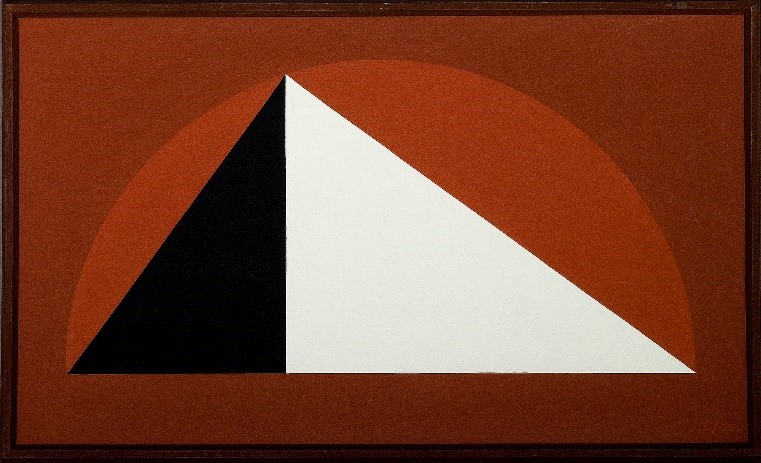
Crockett Johnson was an artist, writer, and mathematician who worked as an art editor for McGraw-Hill in the 1920s. By the 1930s, he was making cartoons; in the 40s he was known for his “Barnaby” comic strips, which appeared in several American Newspapers. He wrote “Harold and the Purple Crayon” in 1955, which may be one his most famous works. In the 1960s he created a series of more than 100 paintings to honor of geometry and geometric mathematicians. Among them was this painting of a construction of the geometric mean of two numbers – line up the lengths and use that as the diameter of a circle, and draw a line from where the two lengths meet up to the circle. If the students know the Pythagorean theorem, they could try to prove that. Crockett Johnson also created a new construction of a regular septagon, using a compass and marked ruler (and trigonometric identities). I found another one of his mathematical paintings on the Smithsonian’s website, of a golden rectangle, and laid it over the geometric mean painting. It seems he included the golden ratio in his work, although I could not find anything verifying this. In general, Crockett Johnson is an interesting person, and that should help engage students.
Wikipedia page: https://en.wikipedia.org/wiki/Crockett_Johnson
Painting at Smithsonian: http://americanhistory.si.edu/collections/search/object/nmah_694664
Another Bio: https://divisbyzero.com/2016/03/23/a-geometry-theorem-looking-for-a-geometric-proof
Regular septagon proof: http://www.jstor.org/stable/3616804?seq=1#page_scan_tab_contents
How have different cultures throughout time used this topic in their society?
Finding much information on the history of the geometric mean is pretty difficult. Pythagoras seems to be generally credited for “discovering” the geometric mean, and the Greek mathematicians are famous for the three means – arithmetic, geometric, and harmonic. Although one not-necessarily credible source explained the word “geometry” comes from words meaning “land measurement.” From this, we can easily consider the task of land management – to find a square plot of land of equal area to a rectangular one, the side length of the square should be the geometric mean of the two sides of the rectangle. For this reason, I believe the geometric mean of at least two numbers must have been used as far back as math has been used for commerce; so pretty close to as far back as math has been used (I wouldn’t be surprised if Egyptians, or even Babylonians, were at least aware of such a relationship, whether or not a constructive proof existed).
How has this topic appeared in the news?
Geometric mean is extremely useful for rates and values on varying scales. Rates are used as products – consider something like an investment with a varying return rate for each year. The regular arithmetic mean of the different rates would not give correct results – after one year at rate a, a quantity k becomes ak; after a second year at rate b, the original k is now bak. The yearly average, if taken arithmetically, gives [(a+b)2/4]k after 2 years; if the geometric mean is used, it gives (√ab)2k = abk, so it’s more appropriate. With regard to values on varying scales, it prevents a top-heavy average. Clearly, geometric mean is very useful, which is why finding news will work in a pinch, like if you forgot to plan. Just do a google news search for geometric mean and you find several articles. It’s mostly economic news. The following were not. Alternatively, a search in a scholarly database gives plenty of examples of geometric mean in action, although the technical writing may be difficult for students to get into for an engage.
Geometric mean to measure water quality: http://www.lajollalight.com/sd-beach-water-advisories-20161004-story.html
To measure general wellness of a nation: http://247wallst.com/healthcare-economy/2016/09/22/obesity-violence-helps-push-us-to-no-28-in-global-health-ratings
College sports stats: http://www.usatoday.com/story/sports/ncaaf/2016/10/11/sec-dominates-college-football-computer-composite-rankings/91910190/

