
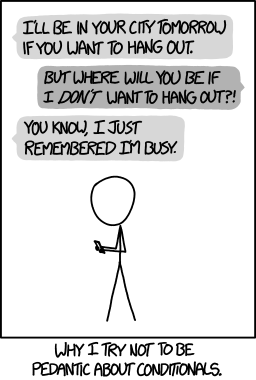
Source: http://xkcd.com/1652/
Source: http://xkcd.com/1652/
In my capstone class for future secondary math teachers, I ask my students to come up with ideas for engaging their students with different topics in the secondary mathematics curriculum. In other words, the point of the assignment was not to devise a full-blown lesson plan on this topic. Instead, I asked my students to think about three different ways of getting their students interested in the topic in the first place.
I plan to share some of the best of these ideas on this blog (after asking my students’ permission, of course).
This student submission comes from my former student Tiffany Jones. Her topic, from Geometry: recognizing equivalent statements.

How could you as a teacher create an activity or project that involves your topic?
How has this topic appeared in pop culture?
The topic of recognizing equivalent statements appears in pop culture in Lewis Carroll’s “Alice’s Adventures in Wonderland”. English mathematician Reverend Charles Lutwidge Dodgson published the work in 1865 under the pseudonym Lewis Carroll.
Reverend Charles Lutwidge Dodgson was a mathematician, so it is not surprising that mathematical concepts appear in his writing. During the tea party scene, examples of logic statements are present. More specifically, how statements and their converse do not have the same meaning or truth-value. The March Hare asks Alice to say what she means, to which she responds with that she means what she says, thinking that to be the same thing. The Hatter disagrees and the conversation continues with three examples to show Alice that the statements are not the same. Here is the text:
Here is the excerpt from the text from chapter seven:
‘Do you mean that you think you can find out the answer to it?’ said the March Hare.
‘Exactly so,’ said Alice.
‘Then you should say what you mean,’ the March Hare went on.
‘I do,’ Alice hastily replied; ‘at least—at least I mean what I say—that’s the same thing, you know.
”Not the same thing a bit!’ said the Hatter. ‘You might just as well say that “I see what I eat” is the same thing as “I eat what I see”!
”You might just as well say,’ added the March Hare, ‘that “I like what I get” is the same thing as “I get what I like”!
”You might just as well say,’ added the Dormouse, who seemed to be talking in his sleep, ‘that “I breathe when I sleep” is the same thing as “I sleep when I breathe”!
”It IS the same thing with you,’ said the Hatter, and here the conversation dropped, and the party sat silent for a minute, while Alice thought over all she could remember about ravens and writing–desks, which wasn’t much.
The lesson on logical statements and truth-values would start with a reading of this section of text or viewing of a clip that keeps the original text. Take a simple statement and write its converse, inverse, and contrapositive. For example, “I like what I get” becomes “I get what I like”, “I do not like what I do not get”, and “I do not get what I do not like”, respectively. Discuss the truth-values of each of the statements show that the original and contrapositive are equivalent and that the converse and inverse are equivalent, to help the students see patterns when rewriting a statement.
Then the students will complete a worksheet by MathBits.com to ensure that they understand the process with simple English sentences and to introduce them to the idea with simple mathematical statements. The worksheet includes a portion of the text above for the students’ reference. The worksheet has the students take two simple sentence and write them in the form of “if…, then..”, then the students are to write their converse, inverse, and contrapositive. Next, the students compare the truth-values of each statement. Finally, the students are given two mathematical statements and are asked to determine the truth-values.
How can this topic be used in your students’ future courses in mathematics or science?
Recognizing equivalent statements appears in analysis courses and courses which proofs are often used. Being able to recognize equivalent statements adds another tool to the the tool box of proof writing. With Proof writing, sometimes the contrapositive form of the statement is easier to prove than the original statement itself.
For example, in Math 4050 Advanced Study of Secondary Mathematics Curriculum, the proof of the following theorem is easier to prove by contrapositive than just straight on.
If a prime p divides m*n with m and n composite, then p divides m or p divides n.
The contrapositive, if p does not divide m and p does not divide n with p, m, and n the same as before, then p does not divide m*n, follows easily (with a little clairvoyance) from another theorem for the class.
Carroll, Lewis. Alice’s Adventures in Wonderland. Lit2Go Edition. 1865. Web. <http://etc.usf.edu/lit2go/1/alices-adventures-in-wonderland/>. October 1, 2015.
Carroll, Lewis. “Chapter VII: A Mad Tea-Party.” Alice’s Adventures in Wonderland. Lit2Go Edition. 1865. Web. <http://etc.usf.edu/lit2go/1/alices-adventures-in-wonderland/17/chapter-vii-a-mad-tea-party/>. October 1, 2015.
Roberts, Frederick, and MathBits.com. Alice in Wonderland Worksheet. S.l.: Commission of the European Communities, 1993. Mathbits. Commission of the European Communities. Web. 1 Oct. 2015
University of North Texas course math 4950 Advanced Study of Secondary Mathematics Curriculum lecture Fall 2015 taught Dr. John Quintanilla
I’m doing something that I should have done a long time ago: collecting a series of posts into one single post. Here’s my series on the mathematical magic show that I’ll perform from time to time.
Part 1: Introduction.
Part 2a, 2b, and 2c: The 1089 trick.
Part 3a, 3b, and 3c: A geometric magic trick (see also here).
Part 4a, 4b, 4c, and 4d: A trick using binary numbers.
Part 5a, 5b, 5c, 5d: Predicting a digit that’s been erased from a number.
Part 6: Finale.
Part 7: The Fitch-Cheney 5-card trick.
Part 8a, 8b, 8c: A trick using Pascal’s triangle.
I’m not a big fan of science fiction, but I know enough to know that Isaac Asimov was one of the great science fiction novelists of the 20th century. The following was written by him in the October 1980 issue of The Magazine of Fantasy and Science Fiction and was reprinted in his book Counting the Eons, which was published in 1983. (I’m now holding the battered and torn pages of my copy of this book; I devoured Asimov’s musings on mathematics and science when I was young.)
Robotics has become a sufficiently well development technology to warrant articles and books on its history and I have watched this in amazement, and in some disbelief, because I invented it.
No, not the technology, the word.
In October 1941, I wrote a robot story entitled “Runaround,” first published in the March 1942 issue of Astounding Science Fiction, in which I recited, for the first time, my Three Laws of Robotics. Here they are:
- A robot must not injure a human being or, through inaction, allow a human being to come to harm.
- A robot must obey the orders give it by human beings except where those orders would conflict with the First Law.
- A robot must protect its own existence, except where such protection would conflict with the First or Second Laws.
Clearly, the order in which the Three Laws of Robotics matters. Shuffling the order leads to 

Source: http://www.xkcd.com/1613/
Let
be the proposition “We are in style at time
,” let
be the proposition “We crash down at time
be the proposition “We come back at time
.
The straightforward way of translating this into English is, “If we never go out of style, then whenever we crash down we come back at a later time. This approximately matches the second half of the chorus of one of Taylor Swift’s hit songs.
Context: This semester, I taught discrete mathematics for the first time. Part of the discrete mathematics course includes an introduction to predicate and propositional logic for our math majors. As you can probably guess from their names, students tend to think these concepts are dry and uninteresting even though they’re very important for their development as math majors.
In an effort to making these topics more appealing, I spent a few days mining the depths of popular culture in a (likely futile) attempt to make these ideas more interesting to my students. In this series, I’d like to share what I found. Naturally, the sources that I found have varying levels of complexity, which is appropriate for students who are first learning prepositional and predicate logic.
When I actually presented these in class, I either presented the logical statement and had my class guess the statement in actual English, or I gave my students the famous quote and them translate it into predicate logic. However, for the purposes of this series, I’ll just present the statement in predicate logic first.
Let
be the proposition “
loves her at time
,
where
is now.
The clunky translation is “There was a time that I loved her, and nobody loved her before that time.” More succinctly, this is the title of the song that’s been played for countless father-daughter dances at wedding receptions since 2006. (I cannot tell a lie: I always turn into a sobbing and amorphous pile of mush whenever I hear this song.)
Context: This semester, I taught discrete mathematics for the first time. Part of the discrete mathematics course includes an introduction to predicate and propositional logic for our math majors. As you can probably guess from their names, students tend to think these concepts are dry and uninteresting even though they’re very important for their development as math majors.
In an effort to making these topics more appealing, I spent a few days mining the depths of popular culture in a (likely futile) attempt to make these ideas more interesting to my students. In this series, I’d like to share what I found. Naturally, the sources that I found have varying levels of complexity, which is appropriate for students who are first learning prepositional and predicate logic.
When I actually presented these in class, I either presented the logical statement and had my class guess the statement in actual English, or I gave my students the famous quote and them translate it into predicate logic. However, for the purposes of this series, I’ll just present the statement in predicate logic first.
Let
be the proposition “You go talk to
be the proposition “We are getting back together at time
,
where time 0 is now.
Of course, this is the ending part of the chorus to “We Are Never Ever Getting Back Together.”
Context: This semester, I taught discrete mathematics for the first time. Part of the discrete mathematics course includes an introduction to predicate and propositional logic for our math majors. As you can probably guess from their names, students tend to think these concepts are dry and uninteresting even though they’re very important for their development as math majors.
In an effort to making these topics more appealing, I spent a few days mining the depths of popular culture in a (likely futile) attempt to make these ideas more interesting to my students. In this series, I’d like to share what I found. Naturally, the sources that I found have varying levels of complexity, which is appropriate for students who are first learning prepositional and predicate logic.
When I actually presented these in class, I either presented the logical statement and had my class guess the statement in actual English, or I gave my students the famous quote and them translate it into predicate logic. However, for the purposes of this series, I’ll just present the statement in predicate logic first.
Let
be the proposition “You are
be the proposition “
be the proposition “You believe
,
where the domain is all people.
The straightforward way of translating this into English is, “If you are 15 years old and there exists someone who says that he/she loves you, then you believe him/her.” This approximately matches the chorus of one of Taylor Swift’s earliest hits.
Context: This semester, I taught discrete mathematics for the first time. Part of the discrete mathematics course includes an introduction to predicate and propositional logic for our math majors. As you can probably guess from their names, students tend to think these concepts are dry and uninteresting even though they’re very important for their development as math majors.
In an effort to making these topics more appealing, I spent a few days mining the depths of popular culture in a (likely futile) attempt to make these ideas more interesting to my students. In this series, I’d like to share what I found. Naturally, the sources that I found have varying levels of complexity, which is appropriate for students who are first learning prepositional and predicate logic.
When I actually presented these in class, I either presented the logical statement and had my class guess the statement in actual English, or I gave my students the famous quote and them translate it into predicate logic. However, for the purposes of this series, I’ll just present the statement in predicate logic first.
Let
,
where the domain is all times and
is now.
The straightforward way of translating this into English is, “It is false that there exists a time in the past that the cold bothered me.” Also, DeMorgan’s Laws could be applied:

which can be read “For all times in the past, the cold did not bother me.” Of course, this is the closing line of the chorus of the signature tune from Frozen.
Of course, I can’t mention Frozen without mentioning its parodies; this is the best one that I’ve seen.
Context: This semester, I taught discrete mathematics for the first time. Part of the discrete mathematics course includes an introduction to predicate and propositional logic for our math majors. As you can probably guess from their names, students tend to think these concepts are dry and uninteresting even though they’re very important for their development as math majors.
In an effort to making these topics more appealing, I spent a few days mining the depths of popular culture in a (likely futile) attempt to make these ideas more interesting to my students. In this series, I’d like to share what I found. Naturally, the sources that I found have varying levels of complexity, which is appropriate for students who are first learning prepositional and predicate logic.
When I actually presented these in class, I either presented the logical statement and had my class guess the statement in actual English, or I gave my students the famous quote and them translate it into predicate logic. However, for the purposes of this series, I’ll just present the statement in predicate logic first.
Let
be the proposition “
.
This pretty much matches the opening line of the 1960s hit song by The Byrds from Ecclesiastes 3.
Context: This semester, I taught discrete mathematics for the first time. Part of the discrete mathematics course includes an introduction to predicate and propositional logic for our math majors. As you can probably guess from their names, students tend to think these concepts are dry and uninteresting even though they’re very important for their development as math majors.
In an effort to making these topics more appealing, I spent a few days mining the depths of popular culture in a (likely futile) attempt to make these ideas more interesting to my students. In this series, I’d like to share what I found. Naturally, the sources that I found have varying levels of complexity, which is appropriate for students who are first learning prepositional and predicate logic.
When I actually presented these in class, I either presented the logical statement and had my class guess the statement in actual English, or I gave my students the famous quote and them translate it into predicate logic. However, for the purposes of this series, I’ll just present the statement in predicate logic first.
 Mean Green Math