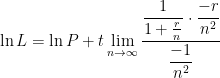
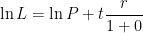
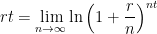
Different definitions of e (Part 8): Connecting the two definitions

In this series of posts, I consider how two different definitions of the number e are related to each other. The number e is usually introduced at two different places in the mathematics curriculum:

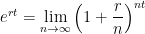
  1. Algebra II/Precalculus: If P dollars are invested at interest rate r for t years with continuous compound interest, then the amount of money after t years is A = Pe^{rt}.
  2. Calculus: The number e is defined to be the number so that the area under the curve y = 1/x from x = 1 to x = e is equal to 1, so that

\displaystyle \int_1^e \frac{dx}{x} = 1.

These two definitions appear to be very, very different. One deals with making money. The other deals with the area under a hyperbola. Amazingly, these two definitions are related to each other. In this series of posts, I’ll discuss the connection between the two.

logareagreen line

In yesterday’s post, I proved the following theorem, thus completing a long train of argument that began with the second definition of e and ending with a critical step in the derivation of the continuous compound interest formula. Today, I present an alternate proof of the theorem using L’Hopital’s rule.

Theorem. \displaystyle \lim_{h \to 0} \left( 1 + h \right)^{1/h} = e.

Proof #2. Let’s write the left-hand side as

L = \displaystyle \lim_{h \to 0} \left( 1 + h \right)^{1/h}.

Let’s take the natural logarithm of both sides:

\ln L = \displaystyle \ln \left[ \lim_{h \to 0} \left( 1 + h \right)^{1/h} \right]

Since g(x) = \ln x is continuous, we can interchange the function and the limit on the right-hand side:

\ln L = \displaystyle \lim_{h \to 0} \ln (1+h)^{1/h}

\ln L = \displaystyle \lim_{h \to 0} \frac{1}{h} \ln(1+h)

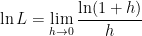
\ln L = \displaystyle \lim_{h \to 0} \frac{\ln(1+h)}{h}

The right-hand side follows the indeterminate form 0/0, as so we may apply L’Hopital’s Rule. Taking the derivative of both the numerator and denominator, we find

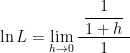
\ln L = \displaystyle \lim_{h \to 0} \frac{ \displaystyle ~ \frac{1}{1+h} ~}{1}

\ln L = \displaystyle \lim_{h \to 0} \frac{1}{1+h}

\ln L = \displaystyle \frac{1}{1+0} = 1.

Therefore, the original limit is L = e^1 = e.


Different definitions of e (Part 7): Connecting the two definitions

In this series of posts, I consider how two different definitions of the number e are related to each other. The number e is usually introduced at two different places in the mathematics curriculum:

  1. Algebra II/Precalculus: If P dollars are invested at interest rate r for t years with continuous compound interest, then the amount of money after t years is A = Pe^{rt}.
  2. Calculus: The number e is defined to be the number so that the area under the curve y = 1/x from x = 1 to x = e is equal to 1, so that

\displaystyle \int_1^e \frac{dx}{x} = 1.

These two definitions appear to be very, very different. One deals with making money. The other deals with the area under a hyperbola. Amazingly, these two definitions are related to each other. In this series of posts, I’ll discuss the connection between the two.

logareagreen line

We begin with the second definition, which is usually considered the true definition of e. From this definition, I have shown in a previous post that we can derive the differentiation formulas

\displaystyle \frac{d}{dx} (\ln x) = \frac{1}{x} \qquad and \qquad \displaystyle \frac{d}{dx} \left( e^x \right) = e^x

beginning with this definition of the number e.

Theorem. \displaystyle \lim_{h \to 0} \left( 1 + h \right)^{1/h} = e.

Proof #1. Recall the definition of a derivative

f'(x) = \displaystyle \lim_{h \to 0} \frac{f(x+h) - f(x)}{h}.

Let’s apply this to the function f(x) = \ln x:

\displaystyle \frac{d}{dx} (\ln x) = \displaystyle \lim_{h \to 0} \frac{\ln(x+h) - \ln x}{h}

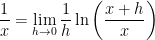
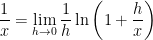
\displaystyle \frac{1}{x} = \displaystyle \lim_{h \to 0} \frac{1}{h} \ln \left( \frac{x+h}{x} \right)

\displaystyle \frac{1}{x} = \displaystyle \lim_{h \to 0} \frac{1}{h} \ln \left( 1 + \frac{h}{x} \right)

\displaystyle \frac{1}{x} = \displaystyle \lim_{h \to 0} \ln \left(1 + \frac{h}{x} \right)^{1/h}

(I’ll note parenthetically that I’ll need the above line for a future post in this series.) At this point, let’s substitute x = 1:

1 = \displaystyle \lim_{h \to 0} \ln (1 + h)^{1/h}

Let’s now apply the exponential function to both sides:

e^1 = \exp \left[ \displaystyle \lim_{h \to 0} \ln (1 + h)^{1/h} \right]

Since g(x) = e^x is continuous, we can interchange the function and the limit on the right-hand side:

e = \displaystyle \lim_{h \to 0} \exp \left[ \ln (1 + h)^{1/h} \right]

Finally, since g(x) = e^x and f(x) = \ln x are inverse functions, we can conclude

e = \displaystyle \lim_{h \to 0} (1 + h)^{1/h}.

(A second proof of this theorem, using L’Hopital’s Rule, will be presented in tomorrow’s post.)

green line

The next theorem establishes, at last, the connection between the continuous compound interest formula and the area under the hyperbola. I’ve noted that my students feel a certain sense of accomplishment after reaching this point of the exposition.

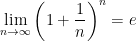
Theorem. \displaystyle \lim_{n \to \infty} \left(1 + \frac{1}{n} \right)^{n} = e.

Proof. Though a little bit of real analysis is necessary to make this rigorous, we can informally see why this has to be true by letting n = 1/h for h positive. Then the expression (1+h)^{1/h} becomes \left( 1 + \frac{1}{n} \right)^n. Also, as h \to 0, then n \to \infty.

Different definitions of e (Part 6): Continuous compound interest

In this series of posts, I consider how two different definitions of the number e are related to each other. The number e is usually introduced at two different places in the mathematics curriculum:

  1. Algebra II/Precalculus: If P dollars are invested at interest rate r for t years with continuous compound interest, then the amount of money after t years is A = Pe^{rt}.
  2. Calculus: The number e is defined to be the number so that the area under the curve y = 1/x from x = 1 to x = e is equal to 1, so that

\displaystyle \int_1^e \frac{dx}{x} = 1.

These two definitions appear to be very, very different. One deals with making money. The other deals with the area under a hyperbola. Amazingly, these two definitions are related to each other. In this series of posts, I’ll discuss the connection between the two.

I should say at the outset that the second definition is usually considered the true definition of e. However, compound interest usually appears earlier in the mathematics curriculum than definite integrals, and so an informal definition of e is given at that stage of the curriculum.

logareagreen line

In yesterday’s post, I presented an informal derivation of the continuous compound interest formula A = Pe^{rt} from the discrete compound interest formula A = \displaystyle P \left( 1 + \frac{r}{n} \right)^{nt}. In today’s post, I’d like to give the more formal derivation using calculus.

What does it mean for something to compound continuously? In a nutshell, the rate at which the money increases should be proportional to the amount currently present. In other words, \$10,000 should earn ten times as much interest as \$1,000. Since A'(t) is the rate at which the money increases and A(t) is the current amount, that means

A'(t) = r A(t)

for some constant of proportionality r. This is a differential equation which can be solved using standard techniques. We divide both sides by A(t) and then integrate:

\displaystyle \frac{A'(t)}{A(t)} = r

\displaystyle \int \frac{A'(t)}{A(t)} dt = \int r dt

\ln |A(t)| = r t + C

|A(t)| = e^{rt+C} = e^rt e^C = C_1 e^{rt}

A(t) = \pm C_1 e^{rt}

A(t) = C_2 e^{rt}

(Technically, a better solution would use an integrating factor [see also MathWorld], but I find that the above derivation is much more convincing to students who are a few semesters removed from a formal course in differential equations.) When presenting this in class, I’ll sometimes lazily write C in place of C_1, with the understanding that e to an arbitrary constant is just an arbitrary positive constant. Also, on the last line, plus or minus an arbitrary constant is just an arbitrary constant (which I’ll usually write as C instead of C_2).

To solve for the missing constant C_2, we use the initial condition A(0) = P:

A(0) = C_2 e^{r\cdot 0}

P = C_2 \cdot 1

P = C_2

Replacing C_2 by P, we have arrived at the continuous compound interest formula A(t) = Pe^{rt}.

Different definitions of e (Part 5): Continuous compound interest

In this series of posts, I consider how two different definitions of the number e are related to each other. The number e is usually introduced at two different places in the mathematics curriculum:

  1. Algebra II/Precalculus: If P dollars are invested at interest rate r for t years with continuous compound interest, then the amount of money after t years is A = Pe^{rt}.
  2. Calculus: The number e is defined to be the number so that the area under the curve y = 1/x from x = 1 to x = e is equal to 1, so that

\displaystyle \int_1^e \frac{dx}{x} = 1.

These two definitions appear to be very, very different. One deals with making money. The other deals with the area under a hyperbola. Amazingly, these two definitions are related to each other. In this series of posts, I’ll discuss the connection between the two.

I should say at the outset that the second definition is usually considered the true definition of e. However, compound interest usually appears earlier in the mathematics curriculum than definite integrals, and so an informal definition of e is given at that stage of the curriculum.

logareagreen lineAt this point in the exposition, I have justified the formula A = \displaystyle P \left(1 + \frac{r}{n} \right)^{nt} for computing the value of an investment when interest is compounded n times a year. We have also made the informal definition

\displaystyle \left(1 + \frac{1}{n} \right) \to e \qquad as \qquad n \to \infty.

We are now in position to give an informal derivation of the continuous compound interest formula. Though this derivation is informal, I have found it to be very convincing for my Precalculus students (as well as to my class of future high school teachers).

The basic idea is to rewrite the discrete compound interest formula so that it contains a term like \displaystyle \frac{1}{\hbox{something}} instead of \displaystyle \frac{r}{\hbox{something}}. In this way, we can think like an MIT freshman and reduce to previous work.

To this end, let n = mr. Then the discrete compound interest formula becomes
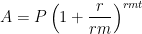
A = P\displaystyle \left( 1 + \frac{r}{n} \right)^{nt}

A = P\displaystyle \left( 1 + \frac{r}{rm} \right)^{rmt}

A = P\displaystyle \left( 1 + \frac{1}{m} \right)^{mrt}

A = P\displaystyle \left[ \left( 1 + \frac{1}{m} \right)^m \right]^{rt}

Inside of the brackets is our familiar friend \displaystyle \left( 1 + \frac{1}{m} \right)^m, except that the name of the variable has changed from n to m. But that’s no big deal: as n tends to infinity, then m does as well since m = n/r and both n and r are positive. Therefore, as interest is compounded more frequently, we have replace the thing inside the brackets with the number e. This leads us to the formula for continuous compound interest:

A =P e^{rt}

Again, my experience is that college students have no conceptual understanding of this formula or even a memory of seeing it derived once upon a time. They remember is it as coming out of nowhere, as a number in a formula or as a button on a calculator. It really shouldn’t be this way. The above calculation is perhaps a harder sell to high school students that the other calculations that I’ve posted in this series, but I firmly believe that this explanation is within the grasp of good students at the time that they take Algebra II and Precalculus.
Of course, the above derivation is highly informal. For starters, it rests upon the limit

\displaystyle \lim_{n \to \infty} \left(1 + \frac{1}{n} \right)^n = e,

which cannot be formally proven using only the tools of Algebra II and Precalculus. Second, the above computation rests upon the continuity of the function A(x) = P x^{rt}, so that we can simply replace \displaystyle \left( 1 + \frac{1}{m} \right)^m with its limit e. My experience is that students are completely comfortable making this substitution, even though professional mathematicians realize that interchanging limits requires continuity.

So, mathematically speaking, the above argument should not be considered a proper derivation of the continuous compound interest formula. Still, I have found that the above argument to be quite convincing to Algebra II and Precalculus students, appropriate to their current level of mathematical development.


Different definitions of e (Part 4): Continuous compound interest

In this series of posts, I consider how two different definitions of the number e are related to each other. The number e is usually introduced at two different places in the mathematics curriculum:

  1. Algebra II/Precalculus: If P dollars are invested at interest rate r for t years with continuous compound interest, then the amount of money after t years is A = Pe^{rt}.
  2. Calculus: The number e is defined to be the number so that the area under the curve y = 1/x from x = 1 to x = e is equal to 1, so that

\displaystyle \int_1^e \frac{dx}{x} = 1.

These two definitions appear to be very, very different. One deals with making money. The other deals with the area under a hyperbola. Amazingly, these two definitions are related to each other. In this series of posts, I’ll discuss the connection between the two.

I should say at the outset that the second definition is usually considered the true definition of e. However, compound interest usually appears earlier in the mathematics curriculum than definite integrals, and so an informal definition of e is given at that stage of the curriculum.

logareagreen lineAt this point in the exposition, I have justified the formula A = \displaystyle P \left(1 + \frac{r}{n} \right)^{nt} for computing the value of an investment when interest is compounded n times a year. We have also seen that A increases as n increases, but that A appears to level off as n gets very large. This observation forms the basis for the continuous compound interest formula A = P e^{rt}.

To begin, let’s consider plug in variables to make the compound interest formula as simple as possible. Let’s start with 1 dollar (so that P = 1) that earns 100% interest (so that r = 1) for one year (so that t = 1). This isn’t financially realistic, of course, but let’s run with it. Then the compound interest formula becomes

A = \displaystyle \left( 1 + \frac{1}{n} \right)^n

As before, let’s see what happens as n increases. As before, I’ll plug numbers into a calculator in real time, asking my students to use their calculators along with me.

  1. If n = 1, then A = (1+1)^1 = 2. I’ll usually double-check with my class to make sure that they believe this answer… that $1 compounded once at 100% interest results in $2.
  2. If n = 2, then A = (1.5)^2 = 2.25.
  3. If n = 4, then A = (1.25)^4 \approx 2.441.
  4. If n = 10, then A = (1.1)^{10} \approx 2.593.
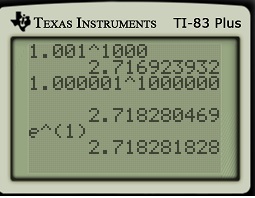
  5. If n = 1000, then A = (1.001)^{1000} \approx 2.71692
  6. If n = 1,000,000, then A = (1.000001)^{1000000} \approx 2.71828

As before, the final amount A appears to be increasing toward something. That something is defined to be the number e. So, as n tends toward infinity, we’ll define the limiting value to be the number e.

ecalculatorIn my experience, college students have no memory of learning how they first saw the number e when they were in high school. They remember is it as coming out of nowhere, as a number in a formula or as a button on a calculator. It really shouldn’t be this way. The above calculation is a natural consequence of the discrete compound interest formula, which makes the appearance of the number e to be a bit more natural.

Of course, this “definition” of the number e is highly informal. What we’re really claiming is

\displaystyle \lim_{n \to \infty} \left(1 + \frac{1}{n} \right)^n = e.

At this point in the mathematical curriculum, students only have the haziest notion of what a limit actually means, let alone the more formal treatment that’s presented in calculus… not to mention a proper \delta-\epsilon treatment of limit in an honors calculus class or in real analysis. So, mathematically speaking, the above argument should not be considered a proper definition of the number e, but a working definition so that high school students can get comfortable with the number e before seeing it again in their future mathematical courses.

 

Different definitions of e (Part 3): Discrete compound interest

In this series of posts, I consider how two different definitions of the number e are related to each other. The number e is usually introduced at two different places in the mathematics curriculum:

  1. Algebra II/Precalculus: If P dollars are invested at interest rate r for t years with continuous compound interest, then the amount of money after t years is A = Pe^{rt}.
  2. Calculus: The number e is defined to be the number so that the area under the curve y = 1/x from x = 1 to x = e is equal to 1, so that

\displaystyle \int_1^e \frac{dx}{x} = 1.

These two definitions appear to be very, very different. One deals with making money. The other deals with the area under a hyperbola. Amazingly, these two definitions are related to each other. In this series of posts, I’ll discuss the connection between the two.

I should say at the outset that the second definition is usually considered the true definition of e. However, compound interest usually appears earlier in the mathematics curriculum than definite integrals, and so an informal definition of e is given at that stage of the curriculum.

logareagreen lineAt this point in the exposition, I have justified the formula A = \displaystyle P \left(1 + \frac{r}{n} \right)^{nt} for computing the value of an investment when interest is compounded n times a year. In tomorrow’s post, I’ll discuss how the above formula naturally leads to the formula A = P e^{rt} when interest is continuously compounded.

The bridge between these two formulas is considering increasing values of n. So far in the presentation, we have considered an investment of $1000 making 4% interest for 2 years. In the first post of this series, we made the following computations:

1. If interest is compounded annually (n = 1), then A = \$1000(1.04)^2 = \$1081.60.

2. If interest i compounded semiannually (n = 2), then A = \$1000(1.02)^4 \approx \$1082.43.

3. If interest is compounded quarterly (n = 4), then A = \$1000(1.01)^8 \approx \$1082.86.

So I ask my class, “What happens to the final amount as interest is compounded more frequently?” They easily observe that the final amount increases somewhat. A natural question, then, is to find how much it can increase. So let’s make the compounding more frequent and let’s see what happens.

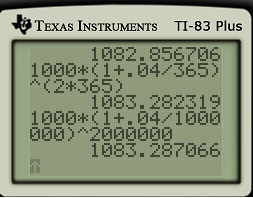
4. Daily: (n = 365). Then A = \$1000 \displaystyle \left( 1 + \frac{0.04}{365} \right)^{730} \approx \$1083.28.

5. About twice a minute (n = 1,000,000): Then A = \$1000 \displaystyle \left( 1 + \frac{0.04}{1,000,000} \right)^{2,000,000} \approx \$1083.29.

Of course, I perform all of these calculations in real time on a calculator so that students can follow along:

interestcalculator

Students quickly observe that the final amount continues to increase as n increases. However, the final amount appears to be leveling off… we can’t make the final amount arbitrarily large just by compounding the interest more frequently.

This provides a natural bridge to continuous compound interest, the topic of tomorrow’s post.

I’ll also note parenthetically that this is why financial institutions are required to disclose the annual percentage rate of a loan (among other things). Otherwise, banks could get away with declaring “Only 2% interest monthly!!” That sounds like 24% annual interest. However, (1.02)^{12} \approx 1.26824, and so the annual percentage rate would really be 26.824%.

Different definitions of e (Part 2): Discrete compound interest

In this series of posts, I consider how two different definitions of the number e are related to each other. The number e is usually introduced at two different places in the mathematics curriculum:

  1. Algebra II/Precalculus: If P dollars are invested at interest rate r for t years with continuous compound interest, then the amount of money after t years is A = Pe^{rt}.
  2. Calculus: The number e is defined to be the number so that the area under the curve y = 1/x from x = 1 to x = e is equal to 1, so that

\displaystyle \int_1^e \frac{dx}{x} = 1.

These two definitions appear to be very, very different. One deals with making money. The other deals with the area under a hyperbola. Amazingly, these two definitions are related to each other. In this series of posts, I’ll discuss the connection between the two.

I should say at the outset that the second definition is usually considered the true definition of e. However, compound interest usually appears earlier in the mathematics curriculum than definite integrals, and so an informal definition of e is given at that stage of the curriculum.

logareagreen line

In yesterday’s post, I used a numerical example to justify the compound interest formula A = \displaystyle P \left(1 + \frac{r}{n} \right)^{nt} when interest is compounded n times a year. In a couple of days, I’ll discuss how the above formula naturally leads to the formula A = P e^{rt} when interest is continuously compounded. Today, I’d like to give some pedagogical thoughts about both formulas.

The mathematics in yesterday’s post was pretty straightforward: apply the simple interest formula I = P r t a few times and see if a pattern can be developed. However, my observation is that college students have no memory of being taught how the compound interest formula A = P \displaystyle \left( 1 + \frac{r}{n} \right)^{nt} can be seen as a natural consequence of the simple interest formula. In other words, they’d just use the compound interest formula without having any conceptual understanding of where the formula came from.

For my math majors who aspire to become secondary teachers in the future, I’ll make my observation that there’s absolutely no reason why students couldn’t discover this formula on their own similar to the outline above. Doubtlessly, it would take more time that I use in my college class… I can usually cover the points in yesterday’s post in about 10 minutes or less, even allowing for students to pause and interject the next step of the calculation. So while the pace would be slower for a class of high school students, the mathematical ideas are simple enough to be understood by high school students.


Different definitions of e (Part 1): Discrete compound interest

In the previous series of posts, I consider how two different definitions of a logarithmic function are actually related to each other. In this series of posts, I consider how two different definitions of the number e are related to each other.

The number e is usually introduced at two different places in the mathematics curriculum:

  1. Algebra II/Precalculus: If P dollars are invested at interest rate r for t years with continuous compound interest, then the amount of money after t years is A = Pe^{rt}.
  2. Calculus: The number e is defined to be the number so that the area under the curve y = 1/x from x = 1 to x = e is equal to 1, so that

\displaystyle \int_1^e \frac{dx}{x} = 1.

These two definitions appear to be very, very different. One deals with making money. The other deals with the area under a hyperbola. Amazingly, these two definitions are related to each other. In this series of posts, I’ll discuss the connection between the two.

I should say at the outset that the second definition is usually considered the true definition of e. However, compound interest usually appears earlier in the mathematics curriculum than definite integrals, and so an informal definition of e is given at that stage of the curriculum.

logareagreen line

I begin this series of posts with a justification for the compound interest formula A = \displaystyle P \left(1 + \frac{r}{n} \right)^{nt} when interest is compounded n times a year. My experience is that most math majors are familiar with this formula from their high school experience but have absolutely no idea about why it is true, and so the presentation below fills in a major hole in their preparation to become secondary teachers themselves.

In the near future, I’ll discuss how the above formula naturally leads to the formula A = P e^{rt} when interest is continuously compounded.

green lineI start with a sequence of numerical examples.

A. Suppose that you invest $1,000 at 4% interest for 2 years. (At the time of this writing, a fixed interest rate of 4% is almost mythological, but let’s leave that aside for the sake of the problem.) How much money do you have if the money is compounded annually? Here are the brute force steps. (To make the presentation less dry, I make sure that my students are volunteering each answer before proceeding to the next step.)

  1. Amount of interest earned in Year 1 = \$1000(0.04) = \$40.
  2. Total amount of money after Year 1 = \$1000 + \$40 = \$1040.
  3. Amount of interest earned in Year 2 = \$1040(0.04) = \$41.60.
  4. Total amount of money earned in Year 2 = \$1040 + \$41.60 = \$1081.60.

B. Let’s repeat the above problem, except this time the 4% interest is compounded twice a year. In other words, 2% interest is applied every six months.

  1. Amount of interest earned in first six months = \$1000(0.02) = \$20.
  2. Total amount of money after first six months = \$1000 + \$20 = \$1020.
  3. Amount of interest earned in second six months = \$1020(0.02) = \$20.40.
  4. Total amount of money earned after second six months = \$1020 + \$20.40 = \$1040.40.

At this point, I’ll make a big production about how much work this is, and we’re only halfway done with this calculation! So, I’ll rhetorically ask my class, is there an easier way to do this? Let’s take a look back at the first calculation, adding some observations.

  1. Amount of interest earned in Year 1 = \$1000(0.04).
  2. Total amount of money after Year 1 = \$1000 + \$1000(0.04) = \$1000(1 + 0.04) = \$1040.
  3. Amount of interest earned in Year 2 = \$1040(0.04).
  4. Total amount of money earned in Year 2 = \$1040 + \$1040(0.04) = \$1040(1 + 0.04) = \$1000 (1+0.04)(1+0.04)

= \$1000(1+0.04)^2.

Then I’ll check with a calculator to confirm that \$1000(1+0.04)^2 is indeed equal to \$1081.60.

Let’s now return to the problem when the 4% interest is compounded twice a year. We’re only halfway through the calculation, but let’s recapitulate what we’ve done so far. Since this is very similar to the above work, students usually can produce the logic very quickly.

  1. Amount of interest earned in first six months = \$1000(0.02) .
  2. Total amount of money after first six months = \$1000 + \$1000(0.02) = \$1000(1+0.02) = \$1020.
  3. Amount of interest earned in second six months = \$1020(0.02).
  4. Total amount of money earned after second six months = \$1020 + \$1020(0.02) = \$1020(1 + 0.02) = \$1000(1+0.02)(1+0.02).

= \$1000(1+0.02)^2.

At this point, I’ll ask my class what they think how much money will accumulate after two years. Invariably, they guess the correct answer of $latex $1000(1+0.02)^4$. If my class seems to get it, I usually will just accept this as the correct answer without explicitly running through steps 5 through 8 to get to the end of the fourth six weeks.

C. What is the money makes 4% interest compounded four times a year for 2 years? By this point, my students can usually guess the answer: A = 1000(1.01)^8. The 0.01 comes from dividing the 4% into four parts. The 8 comes from the number of compounding periods over 2 years.

D. By this point, we have pretty much arrived at the compound interest formula: A = P \displaystyle \left(1 + \frac{r}{n} \right)^{nt}. The above argument justifies the formula; the actual proof of the formula is very similar to the above numerical examples, and so I don’t use class time to formally prove it.

Tomorrow, I’ll give some pedagogical thoughts about these computations.


Different definitions of logarithm (Part 8)

There are two apparently different definitions of a logarithm that appear in the secondary mathematics curriculum:

  1. From Algebra II and Precalculus: If a > 0 and a \ne 1, then f(x) = \log_a x is the inverse function of g(x) = a^x.
  2. From Calculus: for x > 0, we define \ln x = \displaystyle \int_1^x \frac{1}{t} dt.

In the previous posts of this series, we established the connection between these two apparently different ways of defining a logarithm.

In this post, I describe some natural consequences of Definition 2 as it relates to calculus involving logarithmic and exponential functions. None of the results that follow are new to the senior math majors taking my capstone course. However, they almost unanimously tell me that they never learned why these rules worked when they were taking the calculus sequence several semesters ago… instead, they were given these rules to just memorize without worrying about where they came from. (I don’t doubt that some of them were taught the logical development that’s shown below, but perhaps they forgot about it since they were never held responsible for this logical development on homework or exams when they were freshmen or sophomores.)

A pedagogical note: because none of these theorems should be a surprise to students, I’ll write the left-hand sides and the equal sign on the board and then leave the right-hand side blank. After my students tell me what the punch line of the theorem should be, then I’ll write the complete statement of the theorem on the board before proceeding to the proof. If my students can’t remember the punch-line (which has happened for Theorem 2 below), I’ll just start the proof until we reach the conclusion and then fill in the blank right-hand side of the theorem’s statement later.

green lineTheorem 1. \displaystyle \frac{d}{dx} (\ln x) = \displaystyle \frac{1}{x}

Proof. This is a consequence of the Fundamental Theorem of Calculus. Loosely stated, the derivative of an integral is the original function.

green line

Theorem 2. \displaystyle \frac{d}{dx} (\log_a x) = \displaystyle \frac{1}{x \ln a}

Proof. This is a consequence of the change-of-base formula:

\log_a x = \displaystyle \frac{\log_e x}{\log_e a} = \displaystyle \frac{\ln x}{\ln a}

\frac{d}{dx} \left( \log_a x \right) = \displaystyle \frac{d}{dx} \left( \frac{\ln x}{\ln a} \right)

Since \ln a is just a constant, we conclude

\frac{d}{dx} \left( \log_a x \right) = \displaystyle \frac{1}{\ln a} \cdot \frac{d}{dx} ( \ln x ) = \displaystyle \frac{1}{\ln a} \cdot \frac{1}{x}

green line

Theorem 3. \displaystyle \frac{d}{dx} \left( a^x \right) = a^x \ln a

Proof. This proof uses a standard trick. Suppose that

y = a^x

so that

\log_a y = x

We need to compute the derivative \displaystyle \frac{dy}{dx}. To this end, let’s apply implicit differentiation to this last equation:

\displaystyle \frac{1}{y \ln a} \cdot \frac{dy}{dx} = 1

\displaystyle \frac{dy}{dx} = y \ln a

\displaystyle \frac{d}{dx} \left( a^x \right) = a^x \ln a

Technical Note: The above proof assumes that the derivative \displaystyle \frac{dy}{dx} exists in the first place, and so, technically, implicit differentiation is inappropriate (even if it does produce the correct answer). However, the existence proof is quite difficult, requiring an advanced version of the Mean Value Theorem. So, for pedagogical reasons, I have absolutely no qualms about showing the above proof to students in a class that does not require second-semester real analysis as a prerequisite.

Pedagogical Note: After presenting this proof to my students, students are usually emotionally stunned. They usually tell me that they never saw how the derivative of an inverse function could be computed back when they were in the calculus sequence… it was just another formula that they had to memorize. So (time permitting), to let this idea sink in a little further, I’ll go off on a tangent (pun intended)…

…to find the derivative of an inverse trigonometric function:

y = \sin^{-1} x

\sin y = x

\cos y \cdot \displaystyle \frac{dy}{dx} = 1

\displaystyle \frac{dy}{dx} = \frac{1}{\cos y}

\displaystyle \frac{dy}{dx} = \frac{1}{\sqrt{1 - \sin^2 y}}

\displaystyle \frac{dy}{dx} = \frac{1}{\sqrt{1-x^2}}

I’ll then invite students to figure out the derivatives of y = \cos^{-1} x and y = \tan^{-1} x on their own after class.

green line

Theorem 4. \displaystyle \frac{d}{dx} \left( e^x \right) = e^x

Proof. Let a = e in Theorem 3. Alternatively, repeat the above argument for the inverse functions e^x and \ln x.


Different definitions of logarithm (Part 7)

There are two apparently different definitions of a logarithm that appear in the secondary mathematics curriculum:

  1. From Algebra II and Precalculus: If a > 0 and a \ne 1, then f(x) = \log_a x is the inverse function of g(x) = a^x.
  2. From Calculus: for x > 0, we define \ln x = \displaystyle \int_1^x \frac{1}{t} dt.

The connection between these two apparently different ideas begins with the following theorem, which was proven in the few previous posts.

Theorem. Let a \in \mathbb{R}^+ \setminus \{1\}. Suppose that f: \mathbb{R}^+ \rightarrow \mathbb{R} has the following four properties:

  1. f(1) = 0
  2. f(a) = 1
  3. f(xy) = f(x) + f(y) for all x, y \in \mathbb{R}^+
  4. f is continuous

Then f(x) = \log_a x for all x \in \mathbb{R}^+.

green lineAt this point, we have provided enough groundwork to make the connection between these two different ways of viewing a logarithm.

Let’s define the function (for x > 0)

A(x) = \displaystyle \int_1^x \frac{1}{t} dt.

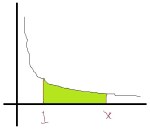
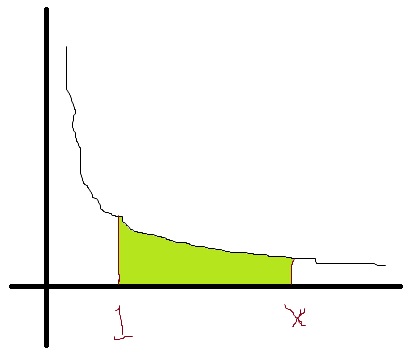
I’ll illustrate this with the appropriate area under the hyperbola y = \frac{1}{x}. (Please forgive the crudeness of this drawing; I’m only using Microsoft Paint.)

logareaSo if x is the right-hand limit, then A(x) is just the shaded area under the curve.

Often, someone will interject, “Hey, I know how to do that… it’s just the natural logarithm of x.” To which I will respond, “Yes, that’s true. But why is it the natural logarithm of x?” I have yet to encounter a student who can immediately answer this question (which, of course, is the whole point of me presenting this in class). In other words, I want my students to realize that, many semesters ago, they pretty much accepted on faith that the above integral is equal to \ln x, but they were never told the reason why. And now — several semesters after completing the calculus sequence — we’re finally going over the reason why.

To start, I’ll say, “OK, A is defined as an integral. That means that it must have…” Someone will usually volunteer, “A derivative.” I’ll respond, “That’s right. The Fundamental Theorem of Calculus says that this function is differentiable. So, if something is differentiable, then it also must be…” Someone will usually volunteer, “Continuous.” My response: “That’s right. So A must be continuous. So that’s Property 4: this function is continuous.” I’ll continue: “Let’s see if we can get the other properties.”

I’ll next move to Property 1, as it’s the next easiest. I’ll ask the class, “Can you prove to me that A(1) = 0?” After a moment of thought, someone will notice that

A(1) = \displaystyle \int_1^1 \frac{1}{t} dt.

must be equal to 0 since the left and right endpoints of the integral are the same.

Then I’ll skip over to Property 3, which requires a little more thought. To begin, we can write

A(xy) = \displaystyle \int_1^{xy} \frac{1}{t} dt = \displaystyle \int_1^{x} \frac{1}{t} dt + \int_x^{xy} \frac{1}{t} dt .

Before proceeding, I’ll ask my class why the above line has to be true. After a couple moments, someone will volunteer something like “The area from 1 to x plus the area from x to xy has to be equal to the area from 1 to xy.”

I’ll then say something like, “We can simplify one of the integrals on the right-hand side right away. Which one?” Students quickly see that the first integral on the right, \displaystyle \int_1^{x} \frac{1}{t} dt, is of course equal to A(x). So then I’ll ask, “So what do I want the last integral to be equal to?” Students look back at Property 3 and answer, “That should be A(y).

So, if we can show the final integral is equal to A(y), we have established Property 3. To this end, I will perform a somewhat unusual looking u-substitution:

t = ux

In this formula, I encourage my students to think of t as the old variable of integration, u as the new variable of integration, and x as an unknown number that is constant. So I’ll say parenthetically, “If t = 5u, how do we find dt?” Students of course answer, “dt must be 5 du.” So I’ll follow up: “If t = xu, how do we find dt?” Students get the idea:

t = x \, du

So to complete the u-substitution, we must adjust the limits of integration. For the lower limit,

t = x \Longrightarrow u = \displaystyle \frac{x}{x} = 1

 For the upper limit,

t = xy \Longrightarrow u = \displaystyle \frac{xy}{x} = y

So we can now complete the u-substitution of the second integral:

A(xy) = \displaystyle \int_1^{xy} \frac{1}{t} dt = \displaystyle \int_1^{x} \frac{1}{t} dt + \int_x^{xy} \frac{1}{t} dt .

A(xy) = \displaystyle \int_1^{x} \frac{1}{t} dt + \int_1^{y} \frac{1}{xu} x \, du .

A(xy) = \displaystyle \int_1^{x} \frac{1}{t} dt + \int_1^{y} \frac{1}{u} \, du .

Students recognize that, except for the variable of integration, the last integral is just A(y), which leads to the punch line

A(xy) = A(x) + A(y)

In other words, we have established that the function A satisfies Property 3.

So the only property left is Property 2. To that end, let’s define the number e so that the area in green above is equal to 1. There’s no other way to describe this number…. we just increase x far enough along the x-axis until the area under the hyperbola is equal to 1. Wherever this happens, that’s the number that we’ll call e. So, by definition, A(e) = 1.

Therefore, by the above theorem, we conclude that A(x) = \log_e x, written more simply as \ln x.

green line

To summarize: using the above theorem, we are able to establish that the integral \displaystyle \int_1^x \frac{1}{t} dt has all of the properties of a logarithm and therefore must be a logarithmic function. The only catch is that we had to define e to be the base of this logarithm through an unusual definition concerning the area under a hyperbola.

Of course, this is not the “standard” definition of e that is usually encountered in a Precalculus class. More on these different definitions in a future series of posts.

One more pedagogical note: My experience is that I can cover the content of the first 7 posts of this series in a single 50-minute lecture and still keep my students’ attention. Naturally, I’ll recapitulate the highlights of this logical development at the start of the next lecture by way of review, as this is an awful lot to absorb at once.