Computing e to Any Power (Part 5)

In this series, I’m exploring the following ancedote from the book Surely You’re Joking, Mr. Feynman!, which I read and re-read when I was young until I almost had the book memorized.

One day at Princeton I was sitting in the lounge and overheard some mathematicians talking about the series for e^x, which is 1 + x + x^2/2! + x^3/3! Each term you get by multiplying the preceding term by x and dividing by the next number. For example, to get the next term after x^4/4! you multiply that term by x and divide by 5. It’s very simple.

When I was a kid I was excited by series, and had played with this thing. I had computed e using that series, and had seen how quickly the new terms became very small.

I mumbled something about how it was easy to calculate e to any power using that series (you just substitute the power for x).

“Oh yeah?” they said. “Well, then what’s e to the 3.3?” said some joker—I think it was Tukey.

I say, “That’s easy. It’s 27.11.”

Tukey knows it isn’t so easy to compute all that in your head. “Hey! How’d you do that?”

Another guy says, “You know Feynman, he’s just faking it. It’s not really right.”

They go to get a table, and while they’re doing that, I put on a few more figures.: “27.1126,” I say.

They find it in the table. “It’s right! But how’d you do it!”

“I just summed the series.”

“Nobody can sum the series that fast. You must just happen to know that one. How about e to the 3?”

“Look,” I say. “It’s hard work! Only one a day!”

“Hah! It’s a fake!” they say, happily.

“All right,” I say, “It’s 20.085.”

They look in the book as I put a few more figures on. They’re all excited now, because I got another one right.

Here are these great mathematicians of the day, puzzled at how I can compute e to any power! One of them says, “He just can’t be substituting and summing—it’s too hard. There’s some trick. You couldn’t do just any old number like e to the 1.4.”

I say, “It’s hard work, but for you, OK. It’s 4.05.”

As they’re looking it up, I put on a few more digits and say, “And that’s the last one for the day!” and walk out.

What happened was this: I happened to know three numbers—the logarithm of 10 to the base e (needed to convert numbers from base 10 to base e), which is 2.3026 (so I knew that e to the 2.3 is very close to 10), and because of radioactivity (mean-life and half-life), I knew the log of 2 to the base e, which is.69315 (so I also knew that e to the.7 is nearly equal to 2). I also knew e (to the 1), which is 2. 71828.

The first number they gave me was e to the 3.3, which is e to the 2.3—ten—times e, or 27.18. While they were sweating about how I was doing it, I was correcting for the extra.0026—2.3026 is a little high.

I knew I couldn’t do another one; that was sheer luck. But then the guy said e to the 3: that’s e to the 2.3 times e to the.7, or ten times two. So I knew it was 20. something, and while they were worrying how I did it, I adjusted for the .693.

Now I was sure I couldn’t do another one, because the last one was again by sheer luck. But the guy said e to the 1.4, which is e to the.7 times itself. So all I had to do is fix up 4 a little bit!

They never did figure out how I did it.

My students invariably love this story; let’s take a look at the third calculation.

Feynman knew that e^{0.69315} \approx 2, so that

e^{0.69315} e^{0.69315} = e^{1.3863} \approx 2 \times 2 = 4.

Therefore, again using the Taylor series expansion:

e^{1.4} = e^{1.3863} e^{0.0137} = 4 e^{0.0137}

\approx 4 \times (1 + 0.0137)

= 4 + 4 \times 0.0137

\approx 4.05.

Again, I have no idea how he put on a few more digits in his head (other than his sheer brilliance), as this would require knowing the value of \ln 2 to six or seven digits as well as computing the next term in the Taylor series expansion.

Computing e to Any Power (Part 4)

In this series, I’m exploring the following ancedote from the book Surely You’re Joking, Mr. Feynman!, which I read and re-read when I was young until I almost had the book memorized.

One day at Princeton I was sitting in the lounge and overheard some mathematicians talking about the series for e^x, which is 1 + x + x^2/2! + x^3/3! Each term you get by multiplying the preceding term by x and dividing by the next number. For example, to get the next term after x^4/4! you multiply that term by x and divide by 5. It’s very simple.

When I was a kid I was excited by series, and had played with this thing. I had computed e using that series, and had seen how quickly the new terms became very small.

I mumbled something about how it was easy to calculate e to any power using that series (you just substitute the power for x).

“Oh yeah?” they said. “Well, then what’s e to the 3.3?” said some joker—I think it was Tukey.

I say, “That’s easy. It’s 27.11.”

Tukey knows it isn’t so easy to compute all that in your head. “Hey! How’d you do that?”

Another guy says, “You know Feynman, he’s just faking it. It’s not really right.”

They go to get a table, and while they’re doing that, I put on a few more figures.: “27.1126,” I say.

They find it in the table. “It’s right! But how’d you do it!”

“I just summed the series.”

“Nobody can sum the series that fast. You must just happen to know that one. How about e to the 3?”

“Look,” I say. “It’s hard work! Only one a day!”

“Hah! It’s a fake!” they say, happily.

“All right,” I say, “It’s 20.085.”

They look in the book as I put a few more figures on. They’re all excited now, because I got another one right.

Here are these great mathematicians of the day, puzzled at how I can compute e to any power! One of them says, “He just can’t be substituting and summing—it’s too hard. There’s some trick. You couldn’t do just any old number like e to the 1.4.”

I say, “It’s hard work, but for you, OK. It’s 4.05.”

As they’re looking it up, I put on a few more digits and say, “And that’s the last one for the day!” and walk out.

What happened was this: I happened to know three numbers—the logarithm of 10 to the base e (needed to convert numbers from base 10 to base e), which is 2.3026 (so I knew that e to the 2.3 is very close to 10), and because of radioactivity (mean-life and half-life), I knew the log of 2 to the base e, which is.69315 (so I also knew that e to the.7 is nearly equal to 2). I also knew e (to the 1), which is 2. 71828.

The first number they gave me was e to the 3.3, which is e to the 2.3—ten—times e, or 27.18. While they were sweating about how I was doing it, I was correcting for the extra.0026—2.3026 is a little high.

I knew I couldn’t do another one; that was sheer luck. But then the guy said e to the 3: that’s e to the 2.3 times e to the.7, or ten times two. So I knew it was 20. something, and while they were worrying how I did it, I adjusted for the .693.

Now I was sure I couldn’t do another one, because the last one was again by sheer luck. But the guy said e to the 1.4, which is e to the.7 times itself. So all I had to do is fix up 4 a little bit!

They never did figure out how I did it.

My students invariably love this story; let’s take a look at the second calculation.

Feynman knew that e^{2.3026} \approx 10 and e^{0.69315} \approx 2, so that

e^{2.3026} e^{0.69315} = e^{2.99575} \approx 10 \times 2 = 20.

Therefore, again using the Taylor series expansion:

e^3 = e^{2.99575} e^{0.00425} = 20 e^{0.00425}

\approx 20 \times (1 + 0.00425)

= 20 + 20 \times 0.00425

= 20.085.

Again, I have no idea how he put on a few more digits in his head (other than his sheer brilliance), as this would require knowing the values of \ln 10 and \ln 2 to six or seven digits as well as computing the next term in the Taylor series expansion:

e^3 = e^{\ln 20} e^{3 - \ln 20}

\approx 20 (1 +e^{ 0.0042677})

$\approx 20 \times \left(1 + 0.0042677 + \frac{0.0042677^2}{2!} \right)$

\approx 20.0855361\dots

This compares favorably with the actual answer, e^3 \approx 20.0855392\dots.

Computing e to Any Power (Part 3)

In this series, I’m exploring the following ancedote from the book Surely You’re Joking, Mr. Feynman!, which I read and re-read when I was young until I almost had the book memorized.

One day at Princeton I was sitting in the lounge and overheard some mathematicians talking about the series for e^x, which is 1 + x + x^2/2! + x^3/3! Each term you get by multiplying the preceding term by x and dividing by the next number. For example, to get the next term after x^4/4! you multiply that term by x and divide by 5. It’s very simple.

When I was a kid I was excited by series, and had played with this thing. I had computed e using that series, and had seen how quickly the new terms became very small.

I mumbled something about how it was easy to calculate e to any power using that series (you just substitute the power for x).

“Oh yeah?” they said. “Well, then what’s e to the 3.3?” said some joker—I think it was Tukey.

I say, “That’s easy. It’s 27.11.”

Tukey knows it isn’t so easy to compute all that in your head. “Hey! How’d you do that?”

Another guy says, “You know Feynman, he’s just faking it. It’s not really right.”

They go to get a table, and while they’re doing that, I put on a few more figures.: “27.1126,” I say.

They find it in the table. “It’s right! But how’d you do it!”

“I just summed the series.”

“Nobody can sum the series that fast. You must just happen to know that one. How about e to the 3?”

“Look,” I say. “It’s hard work! Only one a day!”

“Hah! It’s a fake!” they say, happily.

“All right,” I say, “It’s 20.085.”

They look in the book as I put a few more figures on. They’re all excited now, because I got another one right.

Here are these great mathematicians of the day, puzzled at how I can compute e to any power! One of them says, “He just can’t be substituting and summing—it’s too hard. There’s some trick. You couldn’t do just any old number like e to the 1.4.”

I say, “It’s hard work, but for you, OK. It’s 4.05.”

As they’re looking it up, I put on a few more digits and say, “And that’s the last one for the day!” and walk out.

What happened was this: I happened to know three numbers—the logarithm of 10 to the base e (needed to convert numbers from base 10 to base e), which is 2.3026 (so I knew that e to the 2.3 is very close to 10), and because of radioactivity (mean-life and half-life), I knew the log of 2 to the base e, which is.69315 (so I also knew that e to the.7 is nearly equal to 2). I also knew e (to the 1), which is 2. 71828.

The first number they gave me was e to the 3.3, which is e to the 2.3—ten—times e, or 27.18. While they were sweating about how I was doing it, I was correcting for the extra.0026—2.3026 is a little high.

I knew I couldn’t do another one; that was sheer luck. But then the guy said e to the 3: that’s e to the 2.3 times e to the.7, or ten times two. So I knew it was 20. something, and while they were worrying how I did it, I adjusted for the .693.

Now I was sure I couldn’t do another one, because the last one was again by sheer luck. But the guy said e to the 1.4, which is e to the.7 times itself. So all I had to do is fix up 4 a little bit!

They never did figure out how I did it.

My students invariably love this story; let’s take a look at the first calculation.

Feynman knew that e^{2.3026} \approx 10 and e^1 \approx 2.71828, so that

e^{3.3026} = e^{2.3026} \times e^1 \approx 10 \times 2.71828 = 27.1828.

That’s all well and good, but how did Feynman give an initial answer of 27.11 in his head? The book doesn’t say, but we can guess that he used the Taylor series approximation:

e^x = 1 + x - \displaystyle \frac{x^2}{2!} + \frac{x^3}{3!} + \dots

e^{-0.0026} \approx 1 - 0.0026

Therefore,

e^{3.3} = e^{3.3026} e^{-0.0026} \approx 27.1828 (1 - 0.0026)

\approx 27.18 - 27 \times 26 \times 0.0001

\approx 27.18 - 700 \times 0.0001

= 27.18 - 0.07

= 27.11.

However, I’m not going to lie… I have no idea (other than his sheer genius with numbers) how he was able to mentally tack on two extra digits. The above calculation, to four decimal places, yields e^{3.3} \approx 27.1121, which is incorrect in the fourth decimal place. Indeed, if we use the more precise value of \ln 10 = 2.3025851\dots, we would obtain

e^{3.3} = e^{3.3025851\dots} e^{-0.0025851\dots} \approx 27.1828 (1 - 0.0025851\dots)

e^{3.3} \approx 27.112548\dots,

which is still incorrect in the fourth decimal place. In other words, Feynman could not have just used the first two terms of the Taylor expansion of e^x to obtain his answer of 27.1126. Therefore, Feynman must have used the next term in the Taylor series expansion as well as at least five decimal places of \ln 10 to make this calculation:

e^{3.3} = e^{3.3025851\dots} e^{-0.0025851\dots} \approx 27.1828  \displaystyle \left(1 - 0.0025851\dots + \frac{(0.0025851\dots)^2}{2!} \right)

And I have no idea how he could possibly have done this in his head in only a minute or two.

Computing e to Any Power (Part 2)

In this series, I’m looking at a wonderful anecdote from Nobel Prize-winning physicist Richard P. Feynman from his book Surely You’re Joking, Mr. Feynman!. This story concerns a time that he computed e^x mentally for a few values of x, much to the astonishment of his companions.

Part of this story directly ties to calculus.

One day at Princeton I was sitting in the lounge and overheard some mathematicians talking about the series for e^x, which is 1 + x + x^2/2! + x^3/3! Each term you get by multiplying the preceding term by x and dividing by the next number. For example, to get the next term after x^4/4! you multiply that term by x and divide by 5. It’s very simple.

When I was a kid I was excited by series, and had played with this thing. I had computed e using that series, and had seen how quickly the new terms became very small.

As noted, this refers to the Taylor series expansion of e^x, which is can be used to compute e to any power. The terms get very small very quickly because of the factorials in the denominator, thus lending itself to the computation of e^x. Indeed, this series is used by modern calculators (with a few tricks to accelerate convergence). In other words, the series from calculus explains how the mysterious “black box” of a graphing calculator actually works.

Continuing the story…

“Oh yeah?” they said. “Well, then what’s e to the 3.3?” said some joker—I think it was Tukey.

I say, “That’s easy. It’s 27.11.”

Tukey knows it isn’t so easy to compute all that in your head. “Hey! How’d you do that?”

Another guy says, “You know Feynman, he’s just faking it. It’s not really right.”

They go to get a table, and while they’re doing that, I put on a few more figures.: “27.1126,” I say.

They find it in the table. “It’s right! But how’d you do it!”

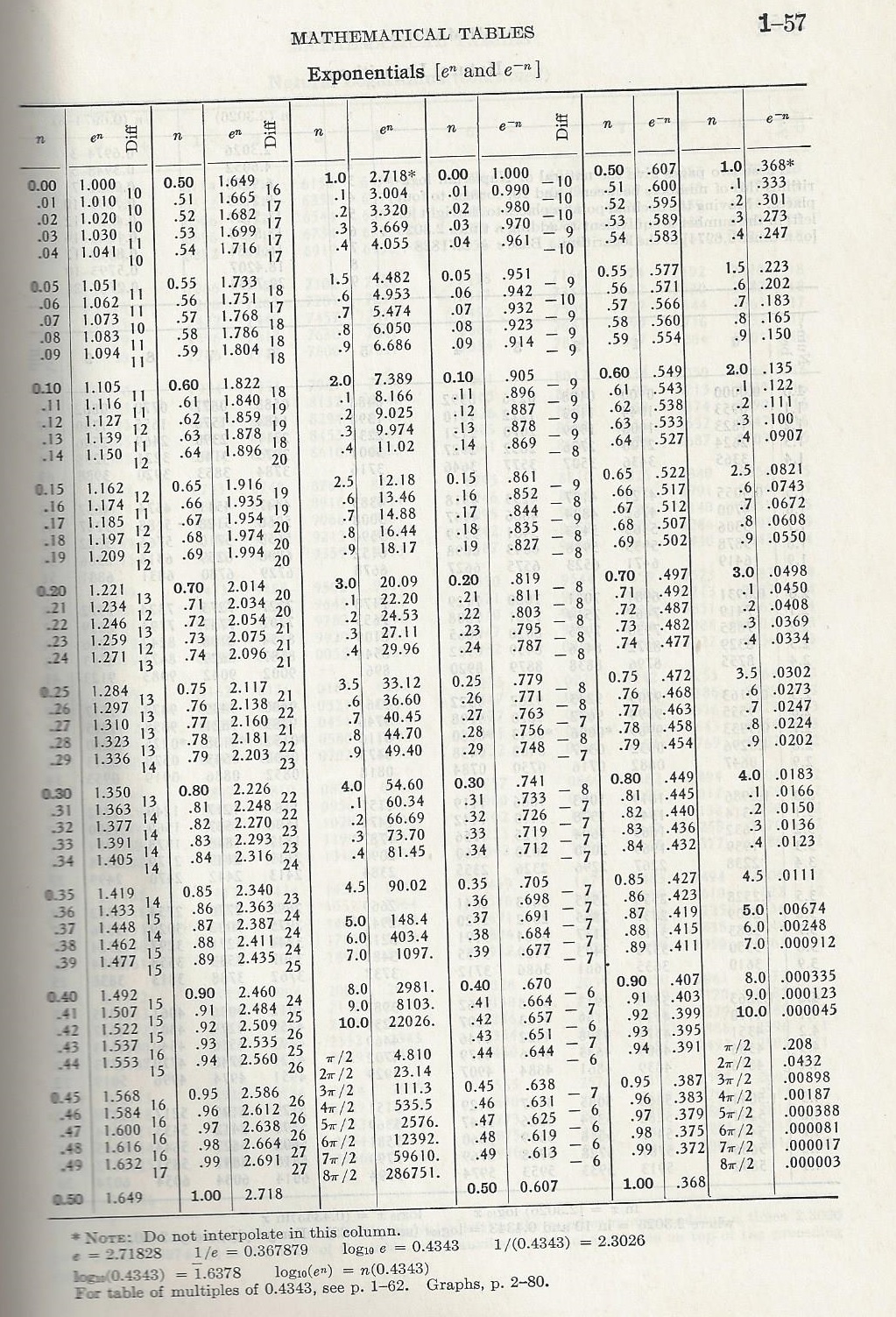
For now, I’m going to ignore how Feynman did this computation in his head and instead discuss “the table.” The setting for this story was approximately 1940, long before the advent of handheld calculators. I’ll often ask my students, “The Brooklyn Bridge got built. So how did people compute e^x before calculators were invented?” The answer is by Taylor series, which were used to produce tables of values of e^x. So, if someone wanted to find e^{3.3}, they just had a book on the shelf.

For example, the following page comes from the book Marks’ Mechanical Engineers’ Handbook, 6th edition, which was published in 1958 and which I happen to keep on my bookshelf at home.

ExponentTable

Look down the fifth and sixth columns of this table, we see that e^{3.3} \approx 27.11. Somebody had computed all of these things (and plenty more) using the Taylor series, and they were compiled into a book and sold to mathematicians, scientists, and engineers.

But what if we needed an approximation better more accurate than four significant digits? Back in those days, there were only two options: do the Taylor series yourself, or buy a bigger book with more accurate tables.

Computing e to Any Power (Part 1)

Whenever I teach natural logarithms, I always share the following anecdote from the book Surely You’re Joking, Mr. Feynman!, which I read and re-read when I was young until I almost had the book memorized.

One day at Princeton I was sitting in the lounge and overheard some mathematicians talking about the series for e^x, which is 1 + x + x^2/2! + x^3/3! Each term you get by multiplying the preceding term by x and dividing by the next number. For example, to get the next term after x^4/4! you multiply that term by x and divide by 5. It’s very simple.

When I was a kid I was excited by series, and had played with this thing. I had computed e using that series, and had seen how quickly the new terms became very small.

I mumbled something about how it was easy to calculate e to any power using that series (you just substitute the power for x).

“Oh yeah?” they said. “Well, then what’s e to the 3.3?” said some joker—I think it was Tukey.

I say, “That’s easy. It’s 27.11.”

Tukey knows it isn’t so easy to compute all that in your head. “Hey! How’d you do that?”

Another guy says, “You know Feynman, he’s just faking it. It’s not really right.”

They go to get a table, and while they’re doing that, I put on a few more figures.: “27.1126,” I say.

They find it in the table. “It’s right! But how’d you do it!”

“I just summed the series.”

“Nobody can sum the series that fast. You must just happen to know that one. How about e to the 3?”

“Look,” I say. “It’s hard work! Only one a day!”

“Hah! It’s a fake!” they say, happily.

“All right,” I say, “It’s 20.085.”

They look in the book as I put a few more figures on. They’re all excited now, because I got another one right.

Here are these great mathematicians of the day, puzzled at how I can compute e to any power! One of them says, “He just can’t be substituting and summing—it’s too hard. There’s some trick. You couldn’t do just any old number like e to the 1.4.”

I say, “It’s hard work, but for you, OK. It’s 4.05.”

As they’re looking it up, I put on a few more digits and say, “And that’s the last one for the day!” and walk out.

What happened was this: I happened to know three numbers—the logarithm of 10 to the base e (needed to convert numbers from base 10 to base e), which is 2.3026 (so I knew that e to the 2.3 is very close to 10), and because of radioactivity (mean-life and half-life), I knew the log of 2 to the base e, which is.69315 (so I also knew that e to the.7 is nearly equal to 2). I also knew e (to the 1), which is 2. 71828.

The first number they gave me was e to the 3.3, which is e to the 2.3—ten—times e, or 27.18. While they were sweating about how I was doing it, I was correcting for the extra.0026—2.3026 is a little high.

I knew I couldn’t do another one; that was sheer luck. But then the guy said e to the 3: that’s e to the 2.3 times e to the.7, or ten times two. So I knew it was 20. something, and while they were worrying how I did it, I adjusted for the .693.

Now I was sure I couldn’t do another one, because the last one was again by sheer luck. But the guy said e to the 1.4, which is e to the.7 times itself. So all I had to do is fix up 4 a little bit!

They never did figure out how I did it.

My students invariably love this story.

In this series, I’d like to take a deeper look at this wonderful anecdote.

Difference of Two Powers (Index)

I’m doing something that I should have done a long time ago: collecting a series of posts into one single post. The following links comprised my series on getting students to discover the formula for factoring x^n - y^n.

Part 1: A numerical way of discovering the formula for x^2 - y^2.

Part 2: A geometric way of discovering the formula for x^2 - y^2.

Part 3: Pedagogical thoughts on the importance of students discovering the formula for x^3 - y^3.

Part 4: A geometric way of discovering the formula for x^3 - y^3.

Part 5: Guiding students to the formula for x^n - y^n.


Lessons from teaching gifted elementary students (Part 6b)

Every so often, I’ll informally teach a class of gifted elementary-school students. I greatly enjoy interacting with them, and I especially enjoy the questions they pose. Often these children pose questions that no one else will think about, and answering these questions requires a surprising depth of mathematical knowledge.

Here’s a question I once received:

255/256 to what power is equal to 1/2? And please don’t use a calculator.

Here’s how I answered this question without using a calculator… in fact, I answered it without writing anything down at all. I thought of the question as

\displaystyle \left( 1 - \epsilon \right)^x = \displaystyle \frac{1}{2}.

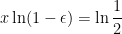
\displaystyle x \ln (1 - \epsilon) = \ln \displaystyle \frac{1}{2}

\displaystyle x \ln (1 - \epsilon) = -\ln 2

I was fortunate that my class chose 1/2, as I had memorized (from reading and re-reading Surely You’re Joking, Mr. Feynman! when I was young) that \ln 2 \approx 0.693. Therefore, we have

x \ln (1 - \epsilon) \approx -0.693.

Next, I used the Taylor series expansion

\ln(1+t) = t - \displaystyle \frac{t^2}{2} + \frac{t^3}{3} \dots

to reduce this to

-x \epsilon \approx -0.693,

or

x \approx \displaystyle \frac{0.693}{\epsilon}.

For my students’ problem, I had \epsilon = \frac{1}{256}, and so

x \approx 256(0.693).

So all I had left was the small matter of multiplying these two numbers. I thought of this as

x \approx 256(0.7 - 0.007).

Multiplying 256 and 7 in my head took a minute or two:

256 \times 7 = 250 \times 7 + 6 \times 7

= 250 \times (8-1) + 42

= 250 \times 8 - 250 + 42

= 2000 - 250 + 42

= 1750 + 42

= 1792.

Therefore, 256 \times 0.7 = 179.2 and 256 \times 0.007 = 1.792 \approx 1.8. Therefore, I had the answer of

x \approx 179.2 - 1.8 = 177.4 \approx 177.

So, after a couple minutes’ thought, I gave the answer of 177. I knew this would be close, but I had no idea it would be so close to the right answer, as

x = \displaystyle \frac{\displaystyle \ln \frac{1}{2} }{\displaystyle \ln \frac{255}{256}} \approx 177.0988786\dots

Lessons from teaching gifted elementary school students (Part 6a)

Every so often, I’ll informally teach a class of gifted elementary-school students. I greatly enjoy interacting with them, and I especially enjoy the questions they pose. Often these children pose questions that no one else will think about, and answering these questions requires a surprising depth of mathematical knowledge.

Here’s a question I once received:

255/256 to what power is equal to 1/2? And please don’t use a calculator.

Answering this question is pretty straightforward using algebra:

\displaystyle \left( \frac{255}{256} \right)^x = \displaystyle \frac{1}{2}.

\displaystyle x \ln  \frac{255}{256} = \ln \displaystyle \frac{1}{2}

x \displaystyle \frac{ \displaystyle \ln \frac{1}{2} }{\ln \displaystyle \frac{255}{256}}

However, doing this without a calculator — and thus maintaining my image in front of these elementary school students — is a little formidable.

I’ll reveal how I did this — getting the answer correct to the nearest integer — in tomorrow’s post. In the meantime, I’ll leave a thought bubble if you’d like to think about it on your own.

green_speech_bubble

Another poorly written word problem (Part 9)

Textbooks have included the occasional awful problem ever since Pebbles Flintstone and Bamm-Bamm Rubble chiseled their homework on slate tablets while attending Bedrock Elementary. But even with the understanding that there have been children have been doing awful homework problems since the dawn of time (and long before the advent of the Common Core), this one is a doozy.

While the ball is on the 20-yard line, a defensive end is suddenly cursed so that he commits a penalty every down that causes the following:

a. The ball is moved half the distance to the goal line, and
b. The down is replayed.

Show that the ball will eventually travel the entire 20-yard distance to the goal.

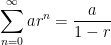
Sigh. The textbook expects students to use the formula for an infinite geometric series

\displaystyle \sum_{n=0}^\infty ar^n = \displaystyle \frac{a}{1-r}

with a = 10 and r = 0.5. However, this series only works if there are an infinite number of terms, so that any finite partial sum will be less than 20. Therefore, saying that the ball “will eventually travel” all 20 yards is misleading, as this implies that this happens after a finite amount of time.


Engaging students: Fibonacci sequence

In my capstone class for future secondary math teachers, I ask my students to come up with ideas for engaging their students with different topics in the secondary mathematics curriculum. In other words, the point of the assignment was not to devise a full-blown lesson plan on this topic. Instead, I asked my students to think about three different ways of getting their students interested in the topic in the first place.

I plan to share some of the best of these ideas on this blog (after asking my students’ permission, of course).

This student submission comes from my former student Taylor Vaughn. Her topic, from Precalculus: the Fibonacci sequence.

green line

How has this topic appeared in pop culture (movies, TV, current music, video games, etc.)?
The article “Music and the Fibonacci sequence and Phi” talks about how the Fibonacci sequence correlates how the keys on the piano are laid out. Also talks about how the sequence also affects the frequency of chords. One thing I like about this article is that it doesn’t just talk about the sequence in one way, like how the instrument is made, but also different aspects like the chord. In other showings of the Fibonacci sequence they talk about pine cones and flowers. Personally, I think that music is something that is more relatable to students and a lot of people have seen a piano, but never just thought about the making. People who are that involved in music, probably noticed that there was some pattern to the keys, but didn’t think that by any chance that it was related to math.
green line
What interesting things can you say about the people who contributed to the discovery and/or the development of this topic?
Since the sequence is named Fibonacci sequence you may think that the founder’s name is Fibonacci, but actually his name is Leonardo of Pisa. The nickname Fibonacci comes from the shortening of the Latin term “filius Bonacci”, which means son of Bonacci. Well why does that matter? That was his dad’s last name. Also, the Latin phrase is incorporated in the title of his book. One thing that I found cool, was that Leonardo actually had a North African education. When talking about mathematicians you never hear anything about Africa. So let’s look at the history of the sequence itself. After reading a few articles, some believe that he actually didn’t discover the sequence himself, but merely saw it during his travels and he was the one to actually write about it. Edouard Lucas is the person who named the sequence, the Fibonacci sequence. When Fibonacci wrote about the sequence it was in the 1200’s, Lucas wasn’t around until the 1800’s. That is 600 years that the sequence didn’t have a name. So during that time, what did people refer to it as? I really don’t know. Lucas is the person to look more into the sequence and noticed that the numbers have a common ratio, which is now called the golden ratio, he also discovered other patterns that lie in the sequence.
green line
How can technology (YouTube, Khan Academy [khanacademy.org], Vi Hart, Geometers Sketchpad, graphing calculators, etc.) be used to effectively engage students with this topic?
The video Doodling in Math: Spirals, Fibonacci, and Being a Plant [1 of 3] was an engaging video because it actually shows the sequence in different objects. For example, when she talks about the sequence in pine cones she actually gets glitter paint, and shows and counts the diagonals on the pine cone. Also I like that she uses pine cones of different sizes and shapes, and shows that the pattern still holds s that students don’t think that it was planned that she picked up that type of pine cone. I also like that she brings in relevant object like fruit. I think this is a good engage because it shows patterns of things that students see often, but never stopped and paused to think about. One thing I don’t like about Vi Hart is the speed that she talks. I normally have to watch the video multiple times to get all the information she gives. In a classroom, you really don’t have the time to allow students to watch the video multiple times. This video could also be given as homework before their lesson and it would allow students to watch it multiple times and could turn in their notes, or provide questions for them to answer. I definitely think that the video is cool and would spike some interest in entering sequences.

Citations
Meisner, Gary. “Music and the Fibonacci Sequence and Phi – The Golden Ratio: Phi, 1.618.” The Golden Ratio Phi 1618. N.p., 04 May 2012. Web. 15 Nov. 2015.
Knott, Dr. Ron. “Contents of This Page.” Who Was Fibonacci? Ron Knott, 11 Mar. 1998. Web.    15 Nov. 2015.
Knott, Ron, and The Plus Team. “The Life and Numbers of Fibonacci.” The Life and Numbers of Fibonacci. N.p., 4 Nov. 2013. Web. 15 Nov. 2015.
Hart, Vi. “Doodling in Math: Spirals, Fibonacci, and Being a Plant [1 of 3].” YouTube. YouTube, 21 Dec. 2011. Web. 15 Nov. 2015.