Engaging students: Order of operations

In my capstone class for future secondary math teachers, I ask my students to come up with ideas for engaging their students with different topics in the secondary mathematics curriculum. In other words, the point of the assignment was not to devise a full-blown lesson plan on this topic. Instead, I asked my students to think about three different ways of getting their students interested in the topic in the first place.

I plan to share some of the best of these ideas on this blog (after asking my students’ permission, of course).

This student submission comes from my former student Chais Price. His topic, from Pre-Algebra: order of operations.

green line

How could you as a teacher create an activity or project that involves your topic?

With a concept as foundational as the order of operations, an interactive activity involving precise directions given from the teacher to the class would be appropriate and hopefully engaging. To clarify on this topic, imagine a teacher that explains to the class that we have a problem to solve. That problem could be that there is a hidden homework pass locked away inside a box. The only way to unlock the box to get the homework pass out is by following a set of simple instructions in order (possibly even a scavenger hunt). After the class completes the instructions, they are then to vocalize what they just did emphasizing he order. The Teacher can start off with saying from this point on everything I say is fair game as far as any directions I give you. So everyone stand up. Take off your shoes left shoe first then right. Next bring your shoes to the front of the class room and return to your desk. Do 5 jumping jacks and spin around twice and be seated. After students do this and recite back verbally their actions in order the teacher can then ask them do repeat the given directions backwards.


green line

  • How can this topic be used in your students’ future courses in mathematics or science?

The topic of the order of operations will be used in all high school math classes and most undergraduate math courses. It is truly a fundamental topic. Without knowing the order of which operation to apply first, the challenge remains. How then can our solution be correct?If you add or subtract before you apply an exponential or division step then the answer will be incorrect. If the answer is correct then it is purely coincidence. One example of this is anywhere the quadratic formula is used which is quite often. Any time something doesn’t factor nicely we use the quadratic formula. Just take what is inside the radical for instance. B^2-4ac. If b = 2, a= 2, and c=-2 and we apply the b^2- 4 before we multiply 4ac then we are left with a 0 inside the radical which would not be correct. We need to apply the order like this: b^2= 4 and -4ac = – ((4)(2)(-2)). Thus we have 4+16= 20 inside the radical if we did the steps in the order we were supposed to.


green line

How can technology (YouTube, Khan Academy [khanacademy.org], Vi Hart, Geometers Sketchpad, graphing calculators, etc.) be used to effectively engage students with this topic? Note: It’s not enough to say “such-and-such is a great website”; you need to explain in some detail why it’s a great website.

I personally use technology such as YouTube and other sites where I can find videos of certain topics. I find these sites to be an abundant source of learning material. Take the topic of order of operations like we are discussing today. Each student has somewhat of a different learning style. With resources such as YouTube you are certain to find someone who can explain the topic to meet an individual learning style. These sites can be composed of lectures, examples, and misc. They are not put out just by teachers but students as well. When I searched order of operations on YouTube I found about 20 different videos on the first page. They ranged from beginning order of operations to multiple lessons building upon the concept. One video was even taken in the classroom with actual students (hopefully with permission). In addition I also found this video that I thought was pretty interesting. I will let you be the judge of that.


Mister, C. [learningscienceisfun]. ( 2010, October 31). PEMDAS- Order of Operations RAP [Official Music Video] Mister C. Retrieved from https://www.youtube.com/watch?v=OWyxWg2-LTY
Engaging students: Fractions, decimals, and percents

In my capstone class for future secondary math teachers, I ask my students to come up with ideas for engaging their students with different topics in the secondary mathematics curriculum. In other words, the point of the assignment was not to devise a full-blown lesson plan on this topic. Instead, I asked my students to think about three different ways of getting their students interested in the topic in the first place.

I plan to share some of the best of these ideas on this blog (after asking my students’ permission, of course).

This student submission comes from my former student Belle Duran. Her topic, from Pre-Algebra: fractions, decimals, and percents.

green line

D1. What interesting things can you say about the people who contributed to the discovery and/or development of this topic?

In the early 17th century, calculating left all remainders in fraction form since the decimal has not been invented yet; this left a lot of redundant calculating for early mathematicians as well as a lot of room for small errors. Napier thought this to be “troublesome to mathematical practice” that he created an early version of a calculator known as Napier’s logarithms (an early appearance of the notorious laziness of mathematicians). They made computing numbers so simple that they became standard for astronomers, mathematicians, and anyone who did extensive computation; except for, of course, the people who had to construct the tables (consisting of over 30,000 numbers). Since it required a lot of computation, Napier resorted to expressing the logarithms in decimals. While Napier did not invent the decimal, he was considered one of the earliest to adopt and promote its use.

In 31 BC, ruler of Rome, August, taxed the sales of goods and slaves that were based on fractions of a hundred; trading usually involved large amounts of money that 100 became a common base for mathematical operations (“per cento” is Italian for “of hundred”). From the term, abbreviations were created such as “p 100 oder p cento”. In 1425, an uneducated scribe wrote “pc” and adorned the c with a little loop; from there, the sign evolved to a combination of loop and fraction bar.

green line

D5. How have different cultures throughout time used this topic in their society?

Dating back to around 1650 B.C., Egyptian mathematicians used unit fractions; they would write five sevenths as 5/7= ½ + 1/7 + 1/14. Also, they did not use the same fraction twice, so they could not write 2/7 as 1/7+1/7, but 2/7=1/4+1/28.

In the Middle Ages, a bar over the units digit was used to separate a whole number from its fractional part, the idea deriving from Indian mathematics. It remains in common use as an under bar to superscript digits, such as monetary values.


green line

A2. How could you as a teacher create an activity or project that involves your topic?

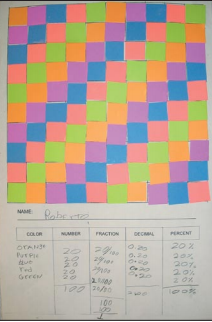
One way I, as a teacher, can create an activity that involves decimals, fractions and percents is to incorporate it with art. I found inspiration from an article titled, “Masterpieces to Mathematics: Using Art to Teach Fraction, Decimal, and Percent Equivalents.” Each student would receive a 100 square grid and a large amount of colored squares (red, green, blue, purple, orange) to create and glue on their square grid paper in a design of their choosing:

As seen on the image above, when the students were done with their masterpiece, they would have another sheet consisting of columns: color, number, fraction, decimal, and percent. They would list the colors they used under the color column, and then count the amount of squares of each color and record it in the number column. They would then convert the number of each color used compared to the total amount of squares (100) to a fraction, decimal, and percent. To further their understanding, I could ask the students to block out the outer squares and ask to calculate the new number of each color, fraction, decimal, and percent from the new total (64).

Percent

References: http://www.17centurymaths.com/contents/napier/jimsnewstuff/Napiers%20Bones/NapiersBones.html

http://www.decodeunicode.org/u+0025

< http://mason.gmu.edu/~jsuh4/math%20masterpiece.pdf>

< http://english.stackexchange.com/questions/177757/why-are-decimals-read-as-fractions-by-some-cultures>

< http://www.princeton.edu/~achaney/tmve/wiki100k/docs/Decimal_separator.html&gt;


Lessons from teaching gifted elementary school students (Part 3b)

Every so often, I’ll informally teach a class of gifted elementary-school students. I greatly enjoy interacting with them, and I especially enjoy the questions they pose. Often these children pose questions that no one else will think about, and answering these questions requires a surprisingly depth of mathematical knowledge.

Here’s a question I once received:

Suppose

A \times A = B

B \times B \times B = C

C \times C \times C \times C= D

If the pattern goes on, and if A = 2, what is Z?

In yesterday’s post, we found that the answer was

Z =2^{26!} =  10^{26! \log_{10} 2} \approx 10^{1.214 \times 10^{26}},

a number with approximately 1.214 \times 10^{26} digits.

How can we express this number in scientific notation? We need to actually compute the integer and decimal parts of 26! \log_{10} 2, and most calculators are not capable of making this computation.

Fortunately, Mathematica is able to do this. We find that

Z \approx 10^{121,402,826,794,262,735,225,162,069.4418253767}

\approx 10^{0.4418253767} \times 10^{121,402,826,794,262,735,225,162,069}

\approx 2.765829324 \times 10^{121,402,826,794,262,735,225,162,069}

Here’s the Mathematica syntax to justify this calculation. In Mathematica, \hbox{Log} means natural logarithm:

bigexponent

Again, just how big is this number? As discussed yesterday, it would take about 12.14 quadrillion sheets of paper to print out all of the digits of this number, assuming that Z was printed in a microscopic font that uses 100,000 characters per line and 100,000 lines per page. Since 250 sheets of paper is about an inch thick, the volume of the 12.14 quadrillion sheets of paper would be

1.214 \times 10^{16} \times 8.5 \times 11 \times \displaystyle \frac{1}{250} \hbox{in}^3 \approx 1.129 \times 10^{17} \hbox{in}^3

By comparison, assuming that the Earth is a sphere with radius 4000 miles, the surface area of the world is

4 \pi (4000 \times 5280 \times 12) \hbox{in}^2 \approx 8.072 \times 10^{17} \hbox{in}^2.

Dividing, all of this paper would cover the entire world with a layer of paper about 0.14 inches thick, or about 35 sheets deep. In other words, the whole planet would look something like the top of my desk.

green lineWhat if we didn’t want to print out the answer but just store the answer in a computer’s memory? When written in binary, the number 2^{26!} requires…

26! bits of memory, or…

about 4.03 \times 10^{26} bits of memory, or…

about $latex 5.04 \times 10^{25} bytes of memory, or …

about 5.04 \times 10^{13} terabytes of memory, or…

about 50.4 trillion terabytes of memory.

Suppose that this information is stored on 3-terabyte external hard drives, so that about 50.4/3 = 16.8 trillion of them are required. The factory specs say that each hard drive measures 129 \hbox{mm} \times 42 \hbox{mm} \times 167 \hbox{mm}. So the total volume of the hard drives would be 1.52 \times 10^{19} \hbox{mm}^3, or 15.2 \hbox{km}^3.

By way of comparison, the most voluminous building in the world, the Boeing Everett Factory (used for making airplanes), has a volume of only 0.0133 \hbox{km}^3. So it would take about 1136 of these buildings to hold all of the necessary hard drives.

The cost of all of these hard drives, at $100 each, would be about $1.680 quadrillion. So it’d be considerably cheaper to print this out on paper, which would be about one-seventh the price at $242 trillion.

Of course, a lot of this storage space would be quite repetitive since 2^{26!}, in binary, would be a one followed by 26! zeroes.

Lessons from teaching gifted elementary school students (Part 3a)

Every so often, I’ll informally teach a class of gifted elementary-school students. I greatly enjoy interacting with them, and I especially enjoy the questions they pose. Often these children pose questions that no one else will think about, and answering these questions requires a surprisingly depth of mathematical knowledge.

Here’s a question I once received:

Suppose

A \times A = B

B \times B \times B = C

C \times C \times C \times C= D

If the pattern goes on, and if A = 2, what is Z?

I leave a thought bubble in case you’d like to think this. (This is significantly more complicated to do mentally than the question posed in yesterday’s post.) One way of answering this question appears after the bubble.

green_speech_bubble

Let’s calculate the first few terms to try to find a pattern:

B = 2 \times 2 = 2^2

C = 2^2 \times 2^2 \times 2^2 = 2^6

D = 2^6 \times 2^6 \times 2^6 \times 2^6 = 2^{24}

etc.

Written another way,

A = 2^1 = 2^{1!}

B = 2^{2!}

C = 2^{3!}

D = 2^{4!}

Naturally, elementary school students have no prior knowledge of the factorial function. That said, there’s absolutely no reason why a gifted elementary school student can’t know about the factorial function, as it only consists of repeated multiplication.

Continuing the pattern, we see that Z = 2^{26!}. Using a calculator, we find Z \approx 2^{4.032014611 \times 10^{26}}.

If you try plugging that number into your calculator, you’ll probably get an error. Fortunately, we can use logarithms to approximate the answer. Since 2 = 10^{\log_{10} 2}, we have

Z = \left( 10^{\log_{10} 2} \right)^{4.032014611 \times 10^{26}} = 10^{4.032014611 \times 10^{26} \log_{10} 2}

Plugging into a calculator, we find that

Z \approx 10^{1.214028268 \times 10^{26}} = 10^{121.4028628 \times 10^{24}}

We conclude that the answer has more than 121 septillion digits.

How big is this number? if Z were printed using a microscopic font that placed 100,000 digits on a single line and 100,000 lines on a page, it would take 12.14 quadrillion pieces of paper to write down the answer (6.07 quadrillion if printed double-sided). If a case with 2500 sheets of paper costs $100, the cost of the paper would be $484 trillion ($242 trillion if double-sided), dwarfing the size of the US national debt (at least for now). Indeed, the United States government takes in about $3 trillion in revenue per year. At that rate, it would take the country about 160 years to raise enough money to pay for the paper (80 years if double-sided).

And that doesn’t even count the cost of the ink or the printers that would be worn out by printing the answer!

Lessons from teaching gifted elementary school students (Part 2)

Every so often, I’ll informally teach a class of gifted elementary-school students. I greatly enjoy interacting with them, and I especially enjoy the questions they pose. Often these children pose questions that no one else will think about, and answering these questions requires a surprisingly depth of mathematical knowledge.

Here’s a question I once received:

Suppose

A \times A = B

B \times B = C

C \times C = D

If the pattern goes on, and if A = 2, what is Z?

I leave a thought bubble in case you’d like to think this. One way of answering this question appears after the bubble.

green_speech_bubble

Let’s calculate the first few terms to try to find a pattern:

B = 2 \times 2 = 2^2

C = 2^2 \times 2^2 = 2^4

D = 2^4 \times 2^4 = 2^8

etc.

Written another way,

A = 2^1 = 2^{2^0}

B = 2^{2^1}

C = 2^{2^2}

D = 2^{2^3}

Continuing the pattern, we see that Z = 2^{2^{25}}, or Z = 2^{33,554,432}.

If you try plugging that number into your calculator, you’ll probably get an error. Fortuniately, we can use logarithms to approximate the answer. Since 2 = 10^{\log_{10} 2}, we have

Z = \left( 10^{\log_{10} 2} \right)^{33,554,432} = 10^{33,554,432 \log_{10} 2}

Plugging into a calculator, we find that

Z \approx 10^{10,100,890.5195}

\approx 10^{0.5195} 10^{10,100,890}

\approx 3.307 \times 10^{10,100,890}

green line

When this actually happened to me, it took me about 10 seconds to answer — without a calculator — “I’m not sure, but I do know that the answer has about 10 million digits.” Naturally, my class was amazed. How did I do this so quickly? I saw that the answer was going to be Z = 2^{2^{25}}, so I used the approximation 2^{10} \approx 1000 to estimate

2^{25} = 2^5 \times 2^{10} \times 2^{10} \approx 32 \times 1000 \times 1000 = 32,000,000

Next, I had memorized the fact that that \log_{10} 2 \approx 0.301 \approx 1/3. So I multiplied 32,000,000 by 1/3 to get approximately 10 million. As it turned out, this approximation was a lot more accurate than I had any right to expect.


Lessons from teaching gifted elementary school students (Part 1)

Every so often, I’ll informally teach a class of gifted elementary-school students. I greatly enjoy interacting with them, and I especially enjoy the questions they pose. Often these children pose questions that no one else will think about, and answering these questions requires a surprisingly depth of mathematical knowledge.

Here’s a question I once received:

When playing with my calculator, I noticed the following pattern:

256 \times 256 = 65,5\underline{36}

257 \times 257 = 66,0\underline{49}

258 \times 258 = 66,5\underline{64}

Is there a reason why the last two digits are perfect squares? I know it usually doesn’t work out this way.

I leave a thought bubble in case you’d like to think this. One way of answering this question appears after the bubble.

green_speech_bubbleThe answer is: This always happens as long as the tens digits is either 0 or 5.

To see why, let’s expand (50n + k)^2, where n and k are nonnegative integers and 0 \le k \le 9. If n is odd, then the tens digit of 50n+k will be a 5. But if n is even, then the tens digit of 50n+k will be 0.

Whether n is even or odd, we get

(50n+k)^2 = 2500n^2 + 100nk + k^2 = 100(25n^2 + nk) + k^2

The expression inside the parentheses is not important; what is important is that 100(25n^2 + nk) is a multiple of 100. Therefore, the contribution of this term to the last two digits of (50n+k)^2 is zero. We conclude that the last two digits of (50n+k)^2 is just k^2.

Naturally, elementary-school students are typically not ready for this level of abstraction. That’s what I love about this question: this is a completely natural question for a curious grade-school child to ask, but the teacher has to have a significantly deeper understanding of mathematics to understand the answer.

Texans QB Ryan Fitzpatrick’s Son Shows Off Math Skills During Postgame Press Conference (Part 2)

From Bleacher Report:

Houston Texans quarterback Ryan Fitzpatrick… threw for 358 yards and six touchdowns in a 45-21 victory over the Tennessee Titans on Sunday [November 30, 2014]. However, [his son] Brady was the star of the postgame press conference.

Fitzpatrick put his son on the spot at the end of the press conference. In a matter of seconds, Brady was able to multiply 93 by 97 in his head.

Source: http://bleacherreport.com/articles/2284833-texans-qb-ryan-fitzpatricks-son-shows-off-math-skills-during-postgame-presser

After the thought bubble, I’ll reveal the likely way that young Brady did this.

green_speech_bubble

Here’s a trick for multiplying two numbers in their 90s which is accessible to bright elementary-school students. We begin by multiplying out (100-x)(100-y):

(100-x)(100-y) = 10,000 - 100x - 100y + xy

(100-100y) = 100(100 - [x+y]) + xy

For 93 \times 97, we have x = 7 and y = 3. So x+y = 10, and 100 - [x+y] = 90. So the first two digits of the product is 90.

Also, xy = 21. So the last two digits are 21.

Put them together, and we get the product $100 \times 90 + 21 = 9021$.

I don’t expect that young Brady knew all of this algebra, but I expect that he did the above mental arithmetic to put together the product. Well done, young man.

Texans QB Ryan Fitzpatrick’s Son Shows Off Math Skills During Postgame Press Conference (Part 1)

From Bleacher Report:

Houston Texans quarterback Ryan Fitzpatrick… threw for 358 yards and six touchdowns in a 45-21 victory over the Tennessee Titans on Sunday [November 30, 2014]. However, [his son] Brady was the star of the postgame press conference.

Fitzpatrick put his son on the spot at the end of the press conference. In a matter of seconds, Brady was able to multiply 93 by 97 in his head.

Source: http://bleacherreport.com/articles/2284833-texans-qb-ryan-fitzpatricks-son-shows-off-math-skills-during-postgame-presser

I’ll reveal the (likely) way that young Brady Fitzpatrick pulled this off tomorrow. In the meantime, I’ll leave a thought bubble if you’d like to try to figure it out on your own.

green_speech_bubble

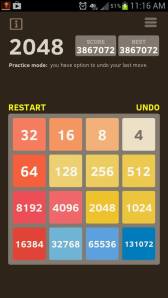
2048 and algebra: Index

I’m doing something that I should have done a long time ago: collect past series of posts into a single, easy-to-reference post. The following posts formed my series on using algebra to study the 2048 game… with a special focus on reaching the event horizon of 2048 which cannot be surpassed.

2048-0Part 1: Introduction and statement of problem

Part 2: First insight: How points are accumulated in 2048

Part 3: Second insight: The sum of the tiles on the board

Part 4: Algebraic formulation of the two insights

Part 5: Algebraic formulation applied to a more complicated board

Part 6: Algebraic formulation applied to the event horizon of 2048

Part 7: Calculating one of the complicated sums in Part 6 using a finite geometric series

Part 8: Calculating another complicated sum in Part 6 using a finite geometric series

Part 9: Repeating Part 8 by reversing the order of summation in a double sum

Part 10: Estimating the probability of reaching the event horizon in game mode