A vivid illustration of a discontinuous function

The essay Singular Limits in the May 2002 issue of Physics Today has a vivid illustration of a discontinuous function F(x) which measures the ickiness one feels after eating an apple but observing that proportion x of a maggot is still inside the apple. For this function, \displaystyle \lim_{x \to 0^+} F(x) \ne F(0).

Biting into an apple and finding a maggot is unpleasant enough, but finding half a maggot is worse. Discovering one-third of a maggot would be more distressing still: The less you find, the more you might have eaten. Extrapolating to the limit, an encounter with no maggot at all should be the ultimate bad-apple experience. This remorseless logic fails, however, because the limit is singular: A very small maggot fraction (f \ll 1) is qualitatively different from no maggot (f=0). 

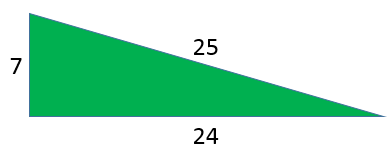
High School Students Finding New Proofs of Old Theorems (Part 2): Pythagorean theorem

This is a new favorite story to share with students: two high school students recently figured out multiple new proofs of the Pythagorean theorem.

Professional article in the American Mathematical Monthly (requires a subscription): https://maa.tandfonline.com/doi/full/10.1080/00029890.2024.2370240

Video describing one of their five ideas:

Interview in MAA Focus: http://digitaleditions.walsworthprintgroup.com/publication/?i=836749&p=14&view=issueViewer

Interview by 60 Minutes:

https://www.youtube.com/watch?v=VHeWndnHuQs

Praise from Michelle Obama: https://www.facebook.com/michelleobama/posts/i-just-love-this-story-about-two-high-school-students-calcea-johnson-and-nekiya-/750580956432311/

High School Students Finding New Proofs of Old Theorems (Part 1): Dividing a line segment with straightedge and compass

This is one of my all-time favorite stories to share with students: how a couple of ninth graders in 1995 played with Geometer’s Sketchpad and stumbled upon a brand-new way of using only a straightedge and compass to divide a line segment into any number of equal-sized parts. This article was published in 1997 and made quite a media sensation at the time.

Higher derivatives in ordinary speech

Just about every calculus student is taught that the first derivative is useful for finding the slope of a curve and finding velocity from position, and that the second derivative is useful for finding the concavity of a curve and finding acceleration from position.

I recently came across a couple of quotes that, taken literally, are statements about third and fifth derivatives.

Per Wikipedia, President Nixon announced in 1972 that the rate of increase of inflation was decreasing. Taken literally, this claims that “the second derivative of inflation is negative, and so the third derivative of purchasing power [since inflation is the derivative of purchasing power] is negative.” As dryly stated in the Notices of the American Mathematical Society, “[t]his was the first time a sitting president used the third derivative to advance his case for reelection”; the article then ponders the implications of the abuse of mathematics.

More recently, the popular blog Math With Bad Drawings had some fun analyzing a clause that appeared in a 2013 op-ed piece: “As the rate of acceleration of innovation increases…” Taken literally, the words rate, innovation and increases all refer to a first derivative (innovation would be the rate at which technology changes), while the word acceleration refers to a second derivative. Therefore, taken literally and not rhetorically (which was clearly the authors’ intent), this brief clause is a claim that the fifth derivative of technology is positive.

Horrible False Analogy

I had forgotten the precise assumptions on uniform convergence that guarantees that an infinite series can be differentiated term by term, so that one can safely conclude

\displaystyle \frac{d}{dx} \sum_{n=1}^\infty f_n(x) = \sum_{n=1}^\infty f_n'(x).

This was part of my studies in real analysis as a student, so I remembered there was a theorem but I had forgotten the details.

So, like just about everyone else on the planet, I went to Google to refresh my memory even though I knew that searching for mathematical results on Google can be iffy at best.

And I was not disappointed. Behold this laughably horrible false analogy (and even worse graphic) that I found on chegg.com:

Suppose Arti has to plan a birthday party and has lots of work to do like arranging stuff for decorations, planning venue for the party, arranging catering for the party, etc. All these tasks can not be done in one go and so need to be planned. Once the order of the tasks is decided, they are executed step by step so that all the arrangements are made in time and the party is a success.

Similarly, in Mathematics when a long expression needs to be differentiated or integrated, the calculation becomes cumbersome if the expression is considered as a whole but if it is broken down into small expressions, both differentiation and the integration become easy.

Pedagogically, I’m all for using whatever technique an instructor might deem necessary to to “sell” abstract mathematical concepts to students. Nevertheless, I’m pretty sure that this particular party-planning analogy has no potency for students who have progressed far enough to rigorously study infinite series.

Predicate Logic and Popular Culture (Part 277): Kellie Pickler

Let T be the set of all times, and let G(t) measure how good day t is. Translate the logical statement

\exists t_1 < 0 \exists t_2 < 0 \forall t \in T ( (t \ne t_1 \land t \ne t_2) \Longrightarrow (G(t) < G(t_1) \land G(t) < G(t_2)),

where time 0 is today.

This matches the chorus of “Best Days of Your Life” by Kellie Pickler, co-written by and featuring Taylor Swift.

Context: Part of a discrete mathematics course includes an introduction to predicate and propositional logic for our math majors. As you can probably guess from their names, students tend to think these concepts are dry and uninteresting even though they’re very important for their development as math majors.

In an effort to making these topics more appealing, I spent a few days mining the depths of popular culture in a (likely futile) attempt to make these ideas more interesting to my students. In this series, I’d like to share what I found. Naturally, the sources that I found have varying levels of complexity, which is appropriate for students who are first learning prepositional and predicate logic.

When I actually presented these in class, I either presented the logical statement and had my class guess the statement in actual English, or I gave my students the famous quote and them translate it into predicate logic. However, for the purposes of this series, I’ll just present the statement in predicate logic first.

Predicate Logic and Popular Culture (Part 276): Heart

Let T be the set of all times, and let G(t) be the statement “I got by on my own at time t.” Translate the logical statement

\forall t \in T ( ((t<0) \longrightarrow G(t) ) \land (t \ge 0) \longrightarrow \sim G(t)),

where time 0 is today.

This matches the opening line of the fabulous power ballad “Alone” by Heart.

And while I’ve got this song in mind, here’s the breakout performance by a young unknown Carrie Underwood on American Idol.

Context: Part of a discrete mathematics course includes an introduction to predicate and propositional logic for our math majors. As you can probably guess from their names, students tend to think these concepts are dry and uninteresting even though they’re very important for their development as math majors.

In an effort to making these topics more appealing, I spent a few days mining the depths of popular culture in a (likely futile) attempt to make these ideas more interesting to my students. In this series, I’d like to share what I found. Naturally, the sources that I found have varying levels of complexity, which is appropriate for students who are first learning prepositional and predicate logic.

When I actually presented these in class, I either presented the logical statement and had my class guess the statement in actual English, or I gave my students the famous quote and them translate it into predicate logic. However, for the purposes of this series, I’ll just present the statement in predicate logic first.