In my capstone class for future secondary math teachers, I ask my students to come up with ideas for engaging their students with different topics in the secondary mathematics curriculum. In other words, the point of the assignment was not to devise a full-blown lesson plan on this topic. Instead, I asked my students to think about three different ways of getting their students interested in the topic in the first place.
I plan to share some of the best of these ideas on this blog (after asking my students’ permission, of course).
This student submission again comes from my former student Caitlin Kirk. Her topic, from Geometry (and proof writing): distinguishing between inductive and deductive reasoning.

C. Culture: How has this topic appeared in pop culture (movies, TV, current music, video games, etc.)?
Inductive and deductive reasoning are often used on TV, radio, or in print in the form of advertising.
Deductive Reasoning
Man: What’s better, faster or slower?
All kids: Faster!
Man: And what’s fast?
Boy: My mom’s car and a cheetah.
Girl: A space ship.
Man: And what’s slow?
Boy: My grandma’s slow.
Man: Would you like her better if she was fast?
Boy: I bet she would like it if she was fast.
Man: Hmm, maybe give her some turbo boosters?
Boy: Or tape a cheetah to her back.
Man: Tape a cheetah to her back, it seems like you’ve thought about this before.
Narrator: It’s not complicated, faster is better. And iPhone 5 downloads fastest on AT&T 4G.
Deductive reasoning, which applies a general rule to specific examples, can be seen in advertisements like the AT&T commercial above. The kids establish in their conversation that faster things are better. The narrator says that iPhone 5 downloads fastest on AT&T 4G. Thus the viewer is left with the conclusion that AT&T 4G is better. This commercial’s deduction can be summed up as follows:
Faster things are better.
AT&T 4G is faster.
AT&T 4G is better. (conclusion)
Inductive Reasoning
Hotch: Sprees usually end in suicide. If he’s got nothing to live for, why wouldn’t he end it?
Reid: Because he’s not finished yet.
Reid: He’s obviously got displaced anger and took it out on his first victim.
Hotch: The stock boy represented someone. We need to know who. What about the other victims.
Reid: Defensive.
Hotch: Was he military?
Garcia: Negative.
Hotch: He’s lashing out. There’s got to be a reason. Rossi and Prentiss, dig through his house. Reid and JJ, get to the station. Morgan and I will take the crime scene. This guy’s got anger, endless targets and a gun. And from the looks of it, he just got started.
Inductive reasoning, which uses specific examples to make a general rule, can be seen frequently in episodes of TV shows or movies that involve crime scene investigation. The show Criminal Minds features a special unit of the FBI that profiles criminals. They do this by interviewing criminals who have already been caught and then inducing general rules about all criminals in order to catch the one they are looking for. Conversations among the profilers, like the one above, lead to inductive reasoning that can be summed up as follows:
He has nothing to live for.
He doesn’t want to commit suicide.
He wasn’t in the military.
He has displaced anger.
He has endless targets.
He has a gun.
He is a dangerous man who will hurt more people. (conclusion)
C. Culture: How has this topic appeared in high culture (art, classical music, theatre, etc.)?
When in the Course of human events, it becomes necessary for one people to dissolve the political bands which have connected them with another, and to assume among the powers of the earth, the separate and equal station to which the Laws of Nature and of Nature’s God entitle them, a decent respect to the opinions of mankind requires that they should declare the causes which impel them to the separation.
We hold these truths to be self-evident, that all men are created equal, that they are endowed by their Creator with certain unalienable rights, that among these are Life, Liberty, and the pursuit of Happiness. That to secure these rights, Governments are instituted among Men, deriving their just powers from the consent of the governed. That whenever any Form of Government becomes destructive of these ends, it is the Right of the People to alter or to abolish it, and to institute new Government, laying its foundation on such principles and organizing its powers in such form, as to them shall seem most likely to effect their Safety and Happiness.
-The Declaration of Independence
July, 4, 1776
The Declaration of Independence was drafted as a deductive argument as to why the United States can and should be a country independent of Great Britain. Thomas Jefferson drafted the declaration with a series of premises leading to four different conclusions.
- George III is a tyrant
- The colonies have a right to be free and independent states
- All political connections between Britain and the colonies should be dissolved
- The “united states” have the right to do all things that free nations do
These four conclusions then serve as premises for the final conclusion that the United States is now an independent country. The declaration is a great example of deductive reasoning because it takes specific examples, such as the 27 grievances against the monarch, and makes logical conclusions, such as “George III is a tyrant,” from the examples. Its deduction can be plainly seen.
The Declaration of Independence is a great example of high culture to use in the classroom because every student who is educated in the United States will have some knowledge of this document. Therefore learning to analyze it “mathematically” in terms of deductive versus inductive reasoning, is a great engagement tool.
E. Technology: How can technology be used to effectively engage students with this topic?
Crime Scene Games & Deductive Reasoning: https://sites.google.com/a/wcsga.net/mock-trial/crime-scene-games-deductive-reasoning
This website contains links to several crime scene investigation games. Several of the games require students to collect clues, compare evidence, and then determine who is responsible for committing a given crime. These games are great for having students use their deductive skills. A couple of the other games require students to review given qualities of a criminal and inductively decide who the criminal in a scenario is based on these broad statements.
This website could be used to engage students easily. Having students play a game, especially one like these where they cannot pick out the mathematical skill they are using, is a great way to get students to abandon their potential distaste for a topic and be involved. After the students have completed a game and solved their crime, the teacher can smoothly transition into a geometrical lesson on inductive and deductive reasoning. The teacher will have activated the students’ knowledge of reasoning through a fun game. They will then be in a better position to learn a new, mathematical application of the reasoning they just used.





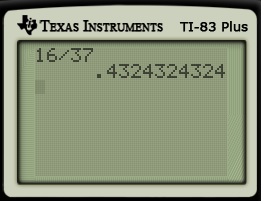













 . After all, there’s a second
  after the first
  , and the ending
  is consistent with rounding up the
  .
. , which also would truncate after 10 decimal places to the result shown above.
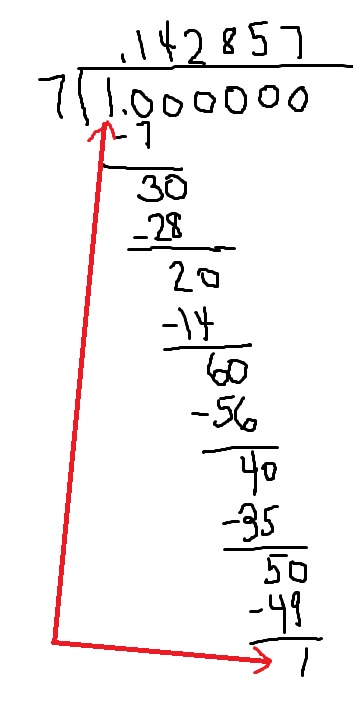
 ) or else a terminating decimal representation. Though a more formal proof would be preferred by professional mathematicians, the idea is simple: in the algorithm for long division for
  . So we eventually have to arrive at a remainder that was seen before. If that remainder is
  , then the decimal representation terminates. Otherwise, the decimal representation repeats itself.
 into its decimal representation as long as the denominator
  .
.





 . I must have been lucky, because I have yet to meet a student that also saw this rule. The following is not a formal proof of the rule, but it does work for the purposes of memorization.
 . The decimal expansion can be remembered by repeating “3, 2, 6” along with repeating “up, down.” Repeating both patterns, we get
 :
:


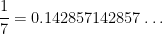
 , the digits repeat in the same pattern as
  , the second smallest of the digits
  is
is  . So we’ll drop the first
  and start on
 , the fourth smallest of the digits
  . So we’ll drop the first
  and start on
 and
and  . For
. For  , the rule is multiply
  , and so
 , and so
 , and so
 , the only lowest-term fractions are
  ,
,  ,
,  , and
, and  . To begin, the first should be memorized:



 instead of its decimal expansion.)
 A report of the General Accounting office,
  to produce the time in seconds. This calculation was performed using a 24 bit fixed point register. In particular, the value
  seconds.


 binary,
 decimal. Multiplying by the number of tenths of a second in
  .
. meters per second, and so travels more than half a kilometer in this time. This was far enough that the incoming Scud was outside the “range gate” that the Patriot tracked.



 .
. by plugging into a calculator and reporting the first three to six decimal places, like
  . This is especially disappointing when there are accessible techniques for getting the exact answer (in this case,
  ) without using a calculator at all.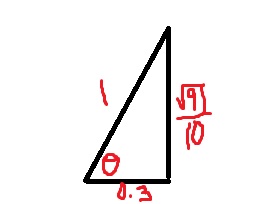

 or
or  because of roundoff errors.
 . More mathematically,

 if
if 


 .
. , the terms of the sequence are negative, which is clearly incorrect.
 , with about fourteen
  s. (Of course, only the first ten digits are actually displayed.)





 is a root of the polynomial
  . Therefore,
  and then iteratively find the next guesses using the recursively defined sequence
 , we may write
 ,
,
 . In cell A1, I entered
  .
.
 ). After 8 steps, the answer is correct to 4 significant digits (
 ). On the 9th step, the answer is correct to 9 significant digits (
 ).
).![\sqrt[k]{a}](https://s0.wp.com/latex.php?latex=%5Csqrt%5Bk%5D%7Ba%7D&bg=ffffff&fg=000000&s=0&c=20201002) is a root of
is a root of  , Newton’s method reduces to
 ,
, .
.
