
I’m a couple months late with this, but my colleague Jason Ermer at Collaborative Mathematics has published Challenge 11 on his website: http://www.collaborativemathematics.org/
Author: John Quintanilla
I'm a Professor of Mathematics and a University Distinguished Teaching Professor at the University of North Texas. For eight years, I was co-director of Teach North Texas, UNT's program for preparing secondary teachers of mathematics and science.
Engaging students: Computing trigonometric functions
In my capstone class for future secondary math teachers, I ask my students to come up with ideas for engaging their students with different topics in the secondary mathematics curriculum. In other words, the point of the assignment was not to devise a full-blown lesson plan on this topic. Instead, I asked my students to think about three different ways of getting their students interested in the topic in the first place.
I plan to share some of the best of these ideas on this blog (after asking my students’ permission, of course).
This student submission comes from my former student Nataly Arias. Her topic, from Precalculus: computing trigonometric functions.

How has this topic appeared in pop culture (movies, TV, current music, video games, etc.)?
Trigonometry does not only relate to mathematics, trigonometry is also used in real life. Many people don’t know that trigonometry is involved in video games. In game development, there are many situations where you will need to use trig functions. Video games are full of triangles. For example in order to calculate the direction the player is heading you will form a triangle and use sine, cosine, or tangent to solve. The trig function used depends on the values given. For example if the opposite and adjacent values are given (the xSpeed and ySpeed), the function you will need to calculate the direction of the player is tangent. This is represented by the equation Tan( Dir ) = xSpeed /ySpeed. Again, by applying the inverted function of tan to both sides of the equal sign, we get an equation that will return the player’s direction. In a spaceship game you will need to use trigonometric functions to have one ship shoot a laser in the direction of the other ship, play a warning sound effect if an enemy ship is getting too close, or have one ship start moving in the direction of another ship to chase. Trig is used in several situations in video games some more examples include calculating a new trajectory after a collision between two objects such as billiard balls, rotating a spaceship or other vehicle, properly handling the trajectory of projectiles shot from a rotated weapon, and determining if a collision between two objects is happening.
How has this topic appeared in high culture (art, classical music, theatre, etc.)?
The “unit circle” is a circle with a radius of 1 that is centered at the origin in the Cartesian coordinate system in the Euclidean plane. Because the radius is 1 we can directly measure sine, cosine, and tangent. The unit circle has made parts of mathematics easier and neater. The concepts of the unit circle go far back into the past. Not only do we use and see circles in mathematics we also can see circles in art form. We can also use trigonometric functions to determine the best position to view a painting hanging on an art gallery wall. For example you can determine the angle between a person’s eye and the top and base of the painting when a person is standing 1m away, 2 m away, 3 m away and so on. By comparing your data you can estimate the best position for a person to stand in front of the painting. Also using trig functions and your handy calculator you can develop a formula that describes the relationship between the distance away from the painting and the angle that exists between the person’s eye and the top and bottom of the painting.
How have different cultures throughout time used this topic in their society?
Today the unit circle is used as a helpful tool to help calculate trig functions. Trig functions are taught in trigonometry, pre-calculus and are frequently used in advanced math classes. Many people don’t realize that not only are trig functions learned and used in school but throughout time several cultures have used trig functions in their society. The main application of trigonometry in past cultures was in astronomy. In 1900 BC the Babylonians kept details of stars, the motion of planets, and solar eclipses by using angular distance measured on the celestial sphere. In 1680-1620 BC the Egyptians used ancient forms of trigonometry for building pyramids. The idea of dividing a circle into 360 equal pieces goes back to the sexagesimal counting system of the ancient Sumerians. Early astronomical calculations wedded the sexagesimal system to circles and the rest is history. Today in trigonometry the unit circle has a radius of 1 unlike the Greek, Indian, Arabic, and early Europeans who used a circle of some other convenient radius. In today’s society trigonometry is everywhere. The mathematics used behind trigonometry is the same mathematics that allows us to store sound waves digitally onto a CD. We use it without even knowing it. When we plug something into the wall there is trigonometry involved. The sine and cosine wave are the waves that are running through the electrical circuit known as alternating current.
References
http://www.math.ucdenver.edu/~jloats/Student%20pdfs/40_Trigonometry_Trenkamp.pdf
http://www.math.dartmouth.edu/~matc/math5.geometry/unit9/unit9.html
http://en.wikipedia.org/wiki/Trigonometric_functions
http://aleph0.clarku.edu/~djoyce/ma105/trighist.html
http://www.slideshare.net/mgeis784/building-the-unit-circle
http://www.softlion.nl/download/article/Trigonometry.pdf
http://www.raywenderlich.com/35866/trigonometry-for-game-programming-part-1
http://stackoverflow.com/questions/3946892/trigonometry-and-game-development
100 years ago…
Sadly, a current conundrum in secondary mathematics education was very much on the minds of mathematicians in 1914.

Proof without words: A relation between the sides of a right trapezoid

The Mayan Activity: A Way of Teaching Multiple Quantifications in Logical Contexts
Every so often, I’ll publicize through this blog an interesting article that I’ve found in the mathematics or mathematics education literature that can be freely distributed to the general public. Today, I’d like to highlight Kyeong Hah Roh & Yong Hah Lee (2011) The Mayan Activity: A Way of Teaching Multiple Quantifications in Logical Contexts, PRIMUS: Problems, Resources, and Issues in Mathematics Undergraduate Studies, 21:8, 685-698, DOI: 10.1080/10511970.2010.485602
Here’s the abstract:
In this article, we suggest an instructional intervention to help students understand statements involving multiple quantifiers in logical contexts. We analyze students’ misinterpretations of multiple quantifiers related to the ϵ-N definition of convergence and point out that they result from a lack of understanding of the significance of the order of the quantifiers in the definition. We introduce the Mayan activity which is designed to cause and then to help resolve students’ cognitive dissonance. In particular, the Mayan stonecutter story in the activity is presented in an understandable and colloquial form so that students can recognize the independence of ϵ from N in the ϵ-N definition. Consequently, the Mayan activity can be regarded as a useful instructional intervention to study statements related to the ϵ-N definition of convergence.
The full article can be found here: http://dx.doi.org/10.1080/10511970.2010.485602
Engaging students: Verifying trigonometric identities
In my capstone class for future secondary math teachers, I ask my students to come up with ideas for engaging their students with different topics in the secondary mathematics curriculum. In other words, the point of the assignment was not to devise a full-blown lesson plan on this topic. Instead, I asked my students to think about three different ways of getting their students interested in the topic in the first place.
I plan to share some of the best of these ideas on this blog (after asking my students’ permission, of course).
This student submission comes from my former student Michelle McKay. Her topic, from Precalculus: verifying trigonometric identities.
How could you as a teacher create an activity or project that involves your topic?

Engaging students with trigonometric identities may seem daunting, but I believe the key to success for this unit lies within allowing students to make the discovery of the identities themselves.
For this particular activity, I will focus on some trigonometric identities that can be derived using the Pythagorean Theorem. Before beginning this activity, students must already know about the basic trig functions (sine, cosine, and tangent) along with their corresponding reciprocals (cosecant, secant, and cotangent).
Using this diagram (or a similar one), have students write out the relationship between all sides using the Pythagorean Theorem.
Students should all come to the conclusion of: x2 + y2 = r2.
For higher leveled students, you may want to remind them of the adage SohCahToa, with emphasis on sine and cosine for this next part. You might ask, “How can we rearrange the above equation into something remotely similar to a trigonometric function?”
Ultimately, we want students to divide each side by r2. This will give us:
Again, SohCahToa. Students, perhaps with some leading questions, should see that we can substitute sine and cosine functions into the above equation, giving us the identity:
cos2θ + sin2θ = 1
From this newly derived identity, students can then go on to find tan2θ + 1 = sec2θand then 1 + cot2θ = csc2θ.
How can technology be used to effectively engage students with this topic?
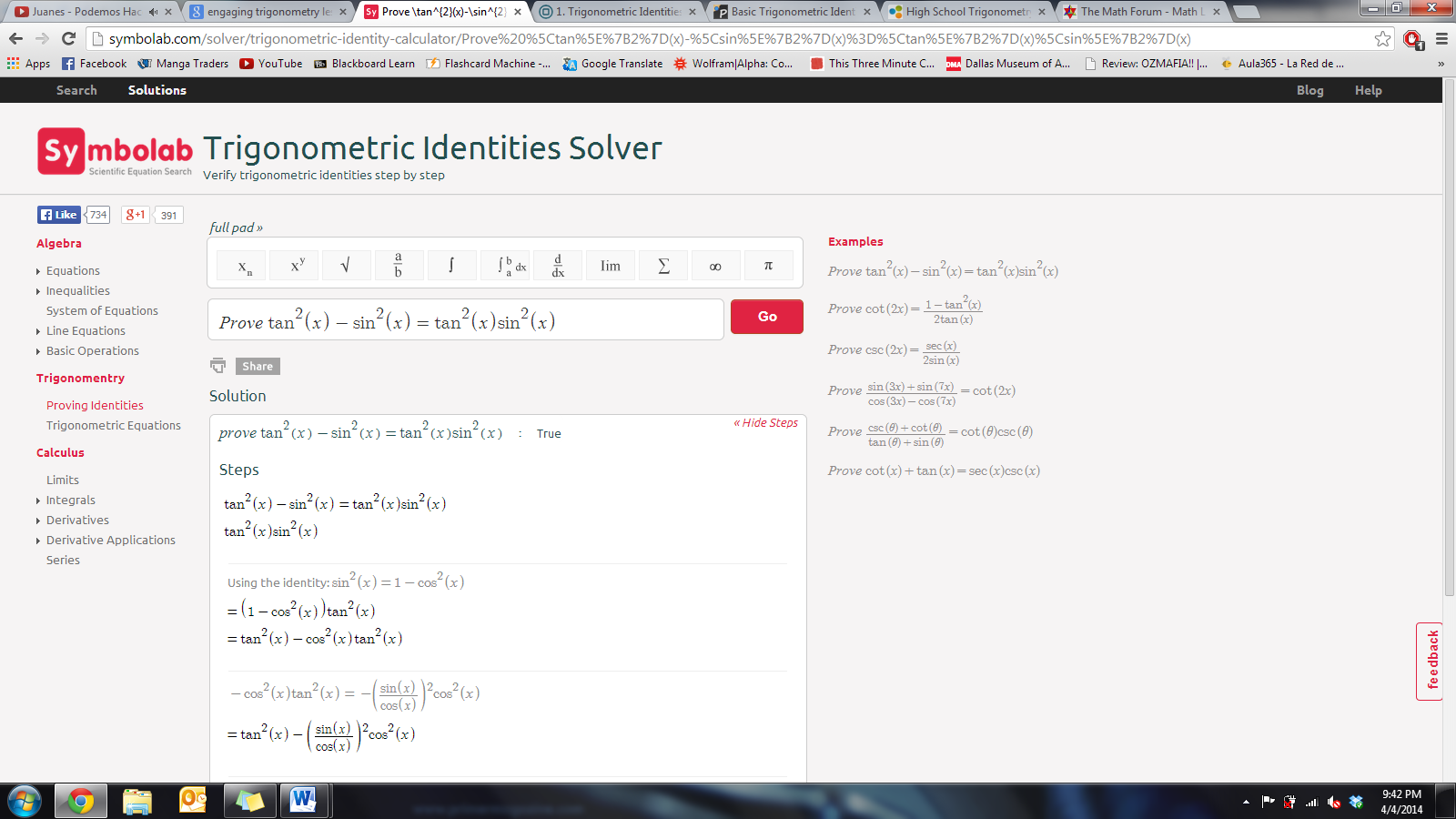
For engaging the students and encouraging them to play around with identities, I find the Trigonometric Identities Solver by Symbolab to be a fabulous technological supplement. Students can enter in identities that they may need more help understanding and this website will state whether the identity is true or not, and then provide detailed steps on how to derive the identity.
A rather fun activity that may utilize this site is to challenge the students to come up with their own elaborate trigonometric identity.
Another online tool students can explore is the interactive graph from http://www.intmath.com. In fact, students could also use this right after they derive the identities from the earlier activity. This site does a wonderful job at providing a visual representation of the trigonometric functions’ relationships to one another. It also allows the students to explore the functions using concrete numbers, rather than the general Ө. Although this site only shows the cos2θ + sin2θ = 1identity in action, it would not be difficult for students to plug in the data from this graph to numerically verify the other identities.

What are the contributions of various cultures to this topic?
The beginning of trigonometry began with the intention of keeping track of time and the quickly expanding interest in the study of astronomy. As each civilization inherited old discoveries from their predecessors, they added more to the field of trigonometry to better explain the world around them. The below table is a very brief compilation of some defining moments in trigonometry’s history. It is by no means complete, but was created with the intention to capture the essence of each civilization’s biggest contributions.
| Civilization | People of Interest | Contributions |
| Egyptians |
|
– Earliest ideas of angles.- The Egyptian seked was the cotangent of an angle at the base of a building. |
| Babylonians | – Division of the circle into 360 degrees.- Detailed records of moving celestial bodies (which, when mapped out, resembled a sine or cosine curve).- May have had the first table of secants. | |
| Greek |
|
– Chords.- Trigonometric proofs presented in a geometric way.- First widely recognized trigonometric table: Corresponding values of arcs and chords.- Equivalent of the half-angle formula. |
| Indian |
|
– Sine and cosine series.- Formula for the sine of an acute angle.- Spherical trigonometry.- Defined modern sine, cosine, versine, and inverse sine. |
| Islamic |
|
– – First accurate sine and cosine tables.- – First table for tangent values.- – Discovery of reciprocal functions (secant and cosecant).- – Law of Sines for spherical trigonometry.- – Angle addition in trigonometric functions. |
| Germans | – “Modern trigonometry” was born by defining trigonometry functions as ratios rather than lengths of lines. |
It is interesting to note that while the Chinese were making many advances in other fields of mathematics, there was not a large appreciation for trigonometry until long after they approached the study and other civilizations had made significant contributions.
Sources
- http://www.intmath.com/analytic-trigonometry/1-trigonometric-identities.php
- http://www.intmath.com/analytic-trigonometry/trig-ratios-interactive.php
- http://symbolab.com/solver
- http://www.trigonometry-help.net/history-of-trigonometry.php
- http://nrich.maths.org/6843&part=
- http://www.scribd.com/doc/33216837/The-History-of-Trigonometry-and-of-Trigonometric-Functions-May-Span-Nearly-4
- http://www.britannica.com/EBchecked/topic/605281/trigonometry/12231/History-of-trigonometry
2048 and algebra: Index
I’m doing something that I should have done a long time ago: collect past series of posts into a single, easy-to-reference post. The following posts formed my series on using algebra to study the 2048 game… with a special focus on reaching the event horizon of 2048 which cannot be surpassed.
 Part 1: Introduction and statement of problem
Part 2: First insight: How points are accumulated in 2048
Part 3: Second insight: The sum of the tiles on the board
Part 4: Algebraic formulation of the two insights
Part 5: Algebraic formulation applied to a more complicated board
Part 6: Algebraic formulation applied to the event horizon of 2048
Part 7: Calculating one of the complicated sums in Part 6 using a finite geometric series
Part 8: Calculating another complicated sum in Part 6 using a finite geometric series
Part 9: Repeating Part 8 by reversing the order of summation in a double sum
Part 10: Estimating the probability of reaching the event horizon in game mode
2048 and algebra (Part 10)
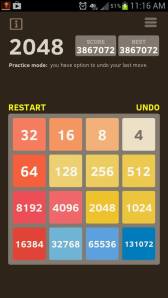
In this series of posts, I used algebra to show that 114,795 moves were needed to produce the following final board. This board represents the event horizon of 2048 that cannot be surpassed.

I reached after about four weeks of intermittent doodling. It should be noted that the above game board was accomplished in practice mode, and I needed perhaps a couple thousand undos to offset the bad luck of a tile randomly appearing in an unneeded place.
For what it’s worth, my personal best in game mode was reaching the 8192-tile. I’m convinced that, even with the random placements of the new 2-tiles and 4-tiles, the skilled player can reach the 2048-tile nearly every time and should reach the 4096-tile most of the time. However, reaching the 8192-tile requires more luck than skill, and reaching the 16384-tile requires an extraordinary amount of luck.
So what are the odds of a skilled player reaching the event horizon in game mode, without the benefit of undoing the previous move? I will employ Fermi estimation to approach this question. Of the approximately 100,000 moves, I estimate that about 5% of the moves require a certain 2-tile or 4-tile to appear at a certain location on the board. For example, in the initial stages of the game, the board is wide open and really doesn’t matter a whole lot where the new tiles appear. However, when the board gets quite crowded, it’s essential that new tiles appear in certain places, or else even a highly skilled player will get stuck.
What is the probability of getting the right tile on each of these occasions? Usually it’s quite high (over 90%). But sometimes it’s necessary to get a 4-tile in exactly the right place when there are four blank spaces (estimated probability of 3%). So let’s estimate 10% to be the probability for getting the right tile for all of these occasions. Let’s also assume that the random number generator is indeed random, so that the tiles appear independently of all other tiles.
With these estimates, I can estimate the probability of reaching the event horizon in game as 

How small is 


is the probability that someone stranded in the vacuum of space will be picked up by a starship within 30 seconds.
is the probability of skidding down a beam of light… or having a million-gallon vat of custard appearing in the sky and dumping its contents on you without warning.
is the probability of a person turning into a penguin.
is the probability of having one of your arms suddenly elongate.
is the probability of an infinite number of monkeys randomly typing out Hamlet.
These are the events to which the probability of reaching the event horizon in 2048 without any undos should be compared.
2048 and algebra (Part 9)
In this series of posts, I consider how algebra can be used to answer a question about the 2048 game: From looking at a screenshot of the final board, can I figure out how many moves were needed to reach the final board? Can I calculate how many new 2-tiles and 4-tiles were introduced to the board throughout the course of this game? In this post, we consider the event horizon of 2048, which I reached after about four weeks of intermittent doodling:
In yesterday’s post, we developed a system of two equations in two unknowns to solve for 


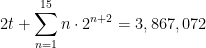
In this post and tomorrow’s post, I consider how the two sums in the above equations can be obtained without directly adding the terms.
In yesterday’s post, we used the formula for the sum of a finite geometric series to calculate the second sum:

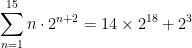
In this post, I perform this calculation again, except symbolically and more compactly. The key initial steps are writing the series as a double sum and then interchanging the order of summation (much like reversing the order of integration in a double integral). This is a trick that I’ve used again and again in my own research efforts, but it seems that the students that I teach have never learned this trick. Here we go:

The inner sum is a finite geometric series with 



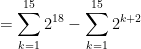
The first sum is merely the sum of a constant. The second sum is another finite geometric series with 15 terms, common ratio of 2, and initial term 



2048 and algebra (Part 8)
In this series of posts, I consider how algebra can be used to answer a question about the 2048 game: From looking at a screenshot of the final board, can I figure out how many moves were needed to reach the final board? Can I calculate how many new 2-tiles and 4-tiles were introduced to the board throughout the course of this game? In this post, we consider the event horizon of 2048, which I reached after about four weeks of intermittent doodling:
In yesterday’s post, we developed a system of two equations in two unknowns to solve for
In this post and tomorrow’s post, I consider how the two sums in the above equations can be obtained without directly adding the terms.
In yesterday’s post, we showed that the formula for the sum of a finite geometric series can be used to calculate the first sum:

Let’s now consider the second (and more complicated) sum, which can be written as

For reasons that will become clear shortly, this sum can be written in expanded form as



Let’s now rearrange the terms of this sum. We will do this by adding along the diagonals instead of along the rows. In this way, the above sum can be rearranged as




Each of these new rows (or the original diagonals) is a geometric series and can be calculated using the formula:




So, thus far in the calculation, we have established that
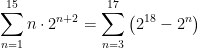
Simplifying,
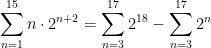
The first sum on the right is the sum of a constant being added to itself 15 times:
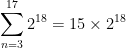
The second sum on the right is yet another geometric series. Indeed, it’s the same geometric series from the first diagonal above:

Therefore,

Not surprisingly, this matches the sum that was found via direct addition.
 Mean Green Math