A friend from Tennessee sent me this jewel recently.
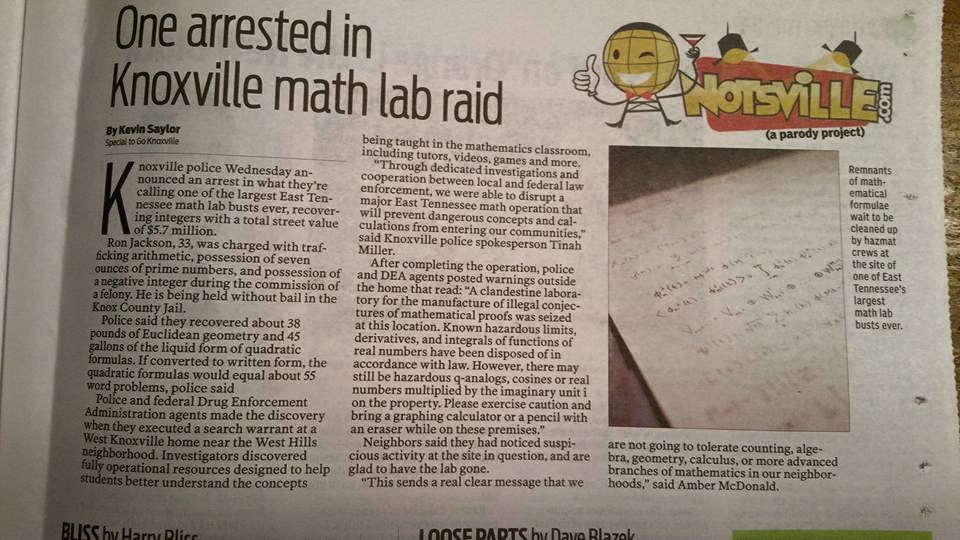
A friend from Tennessee sent me this jewel recently.
I stumbled across the following engaging and readable Q&A with Dr. Jonathan Pillow, a professor at Princeton who’s studying how the brain works using mathematics and statistics. I thought that this might be appropriate way of engaging students who think that the study of mathematics is utterly unimportant.
One of the standard topics in an undergraduate statistics course is the principle that two things that are highly correlated do not necessarily have a cause-and-effect relationship. Here is a hilarious example of this fallacy.
And, in case you’re wondering, here’s the rest of the story:
I’m doing something that I should have done a long time ago: collect past series of posts into a single, easy-to-reference post. The following posts formed my series on various lessons I’ve learned while trying to answer the questions posed by gifted elementary school students. (This is updated from my previous index.)
Part 1: A surprising pattern in some consecutive perfect squares.
Part 2: Calculating 2 to a very large exponent.
Part 3a: Calculating 2 to an even larger exponent.
Part 3b: An analysis of just how large this number actually is.
Part 4a: The chance of winning at BINGO in only four turns.
Part 4b: Pedagogical thoughts on one step of the calculation.
Part 4c: A complicated follow-up question.
Part 5a: Exponentiation is multiplication as multiplication is to addition. So, multiplication is to addition as addition is to what? (I offered the answer of incrementation, but it was rejected: addition requires two inputs, while incrementation only requires one.)
Part 5b: Why there is no binary operation that completes the above analogy.
Part 5c: Knuth’s up-arrow notation for writing very big numbers.
Part 5d: Graham’s number, reputed to be the largest number ever to appear in a mathematical proof.
Textbooks have included the occasional awful problem ever since Pebbles Flintstone and Bamm-Bamm Rubble chiseled their homework on slate tablets while attending Bedrock Elementary. But even with the understanding that there have been children have been doing awful homework problems since the dawn of time (and long before the advent of the Common Core), this one is a doozy.
There’s no sense having a debate about standards for elementary mathematics if textbook publishers can’t construct sentences that can be understood by elementary students.

I recently came across an excellent article promoting internships from math majors who would like to use their quantitative skills in an industrial setting (as opposed to an academic setting). The concluding paragraph:
Faculty will continue to train students for academic careers. Some will pursue tenure-track positions in the institutions of their choice, but an increasing number of our students will take positions very different from our own. Let’s learn about those options and share them with our students. Then, when a student takes a good job and enjoys a successful career, let’s call that a win.
Here’s the full article: http://www.americanscientist.org/blog/pub/internships-connect-math-students-to-new-career-paths
I really enjoyed this, courtesy of BuzzFeed:
This mathematical trick was not part of my Pi Day magic show but probably should have been… I’ve performed this for my Precalculus classes in the past but flat forgot about it when organizing my Pi Day show. The next time I perform a magic show, I’ll do this one right after the 1089 trick. (I think I learned this trick from a Martin Gardner book when I was young, but I’m not sure about that.)
Here’s a description of the trick. I give my audience a deck of cards and ask them to select six cards between ace and nine (in other words, no tens, jacks, queens, or kings). The card are placed face up, side by side.
After about 5-10 seconds, I secretly write a pull out a card from the deck and place it face down above the others.
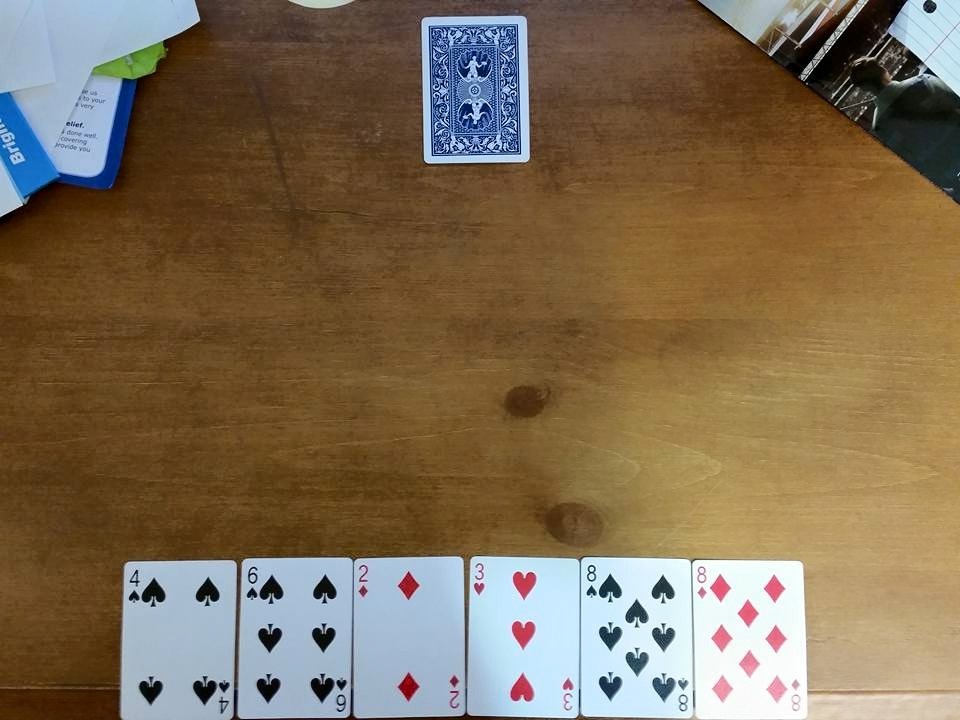
I then announce that we’re going to some addition together… with the understanding that I’ll never write down a number larger than 9. For example, the 4 and 6 of spades are next to each other. Obviously, 

Continuing in this way (and having the audience participate in the arithmetic so that this doesn’t get boring), I eventually get to this position:

Finally, I add the two cards at the top (and, in this case, subtract 9) to get 

I’ll often perform this trick when teaching Precalculus, as the final answer involving Pascal’s triangle. As discussed yesterday, suppose that the six cards are 


Not surprisingly, the coefficients in the above chart involve the numbers in Pascal’s triangle. Indeed, the reason that I chose to use 6 cards (as opposed to any other number of cards) is that the bottom row has only 1, 5, and 10 as coefficients, and 


My students usually find this to be a clever application of Pascal’s triangle for impressing their friends after class.
 P.S. After typing this series, it hit me that it’s really easy to do this trick mod 10 (which means getting rids of only the face cards prior to the trick). All the magician has to do is subtly ensure that the second and fifth cards are both even or both odd, so that


(If the magician can’t control the placement of the second and fifth cards so that one is even and one is odd, the answer will be just 

Henceforth, I’ll be doing this trick mod 10 instead of mod 9.
This mathematical trick was not part of my Pi Day magic show but probably should have been… I’ve performed this for my Precalculus classes in the past but flat forgot about it when organizing my Pi Day show. The next time I perform a magic show, I’ll do this one right after the 1089 trick. (I think I learned this trick from a Martin Gardner book when I was young, but I’m not sure about that.)
Here’s a description of the trick. I give my audience a deck of cards and ask them to select six cards between ace and nine (in other words, no tens, jacks, queens, or kings). The card are placed face up, side by side.
After about 5-10 seconds, I secretly write a pull out a card from the deck and place it face down above the others.
I then announce that we’re going to some addition together… with the understanding that I’ll never write down a number larger than 9. For example, the 4 and 6 of spades are next to each other. Obviously,
Continuing in this way (and having the audience participate in the arithmetic so that this doesn’t get boring), I eventually get to this position:
Finally, I add the two cards at the top (and, in this case, subtract 9) to get
How does this trick work? This is an exercise in modular arithmetic (see also Wikipedia). Suppose that the six cards are
Therefore, the top card will simply be 
That’s a pretty big calculation for the magician to do on the spot. Fortunately, 


For the case at hand, 





I now add the rest of the cards, subtracting 9 as I go along. For this example, I’d add the 2 first to get 9, which is 0 after subtracting another 9. I then add the remaining cards of 4, 3, and 8 (remembering that the 8 is basically 

The key point of this calculation is to subtract 9 whenever possible to keep the numbers small, making it easier to do in your head when performing the trick.