An NFL player was just accepted to the math PhD program at MIT

I really enjoyed writing this post.

John Urschel is an amazingly talented young man that I’ve profiled before on this blog. Not only is he an offensive lineman for the Baltimore Ravens, but he’s also an accomplished young mathematician who was just accepted into the doctorate program at the Massachusetts Institute of Technology. From the news article:

The 6’3”, 305-pound offensive lineman will begin a PhD in mathematics at the Massachusetts Institute of Technology this year. The Hulk-like math geek, who graduated from Penn State with a 4.0 grade point average, will study spectral graph theory, numerical linear algebra, and machine learning.

In 2015, Urschel played in the NFL playoffs for the Ravens while simultaneously (pdf) working on a paper on graph eigenfunctions. (What have you done lately?) The paper, entitled, “A Cascadic Multigrid Algorithm for Computing the Fielder Vector of Graph Laplacians,” is available online.



What Happens if the Explanatory and Response Variables Are Sorted Independently?

From the category “I Can’t Believe What I Just Read,” the following question was posed to a question-and-answer statistics board last month:

Suppose we have data set (X_i,Y_i) with n points. We want to perform a linear regression, but first we sort the X_i values and the Y_i values independently of each other, forming data set (X_i,Y_j). Is there any meaningful interpretation of the regression on the new data set? Does this have a name?
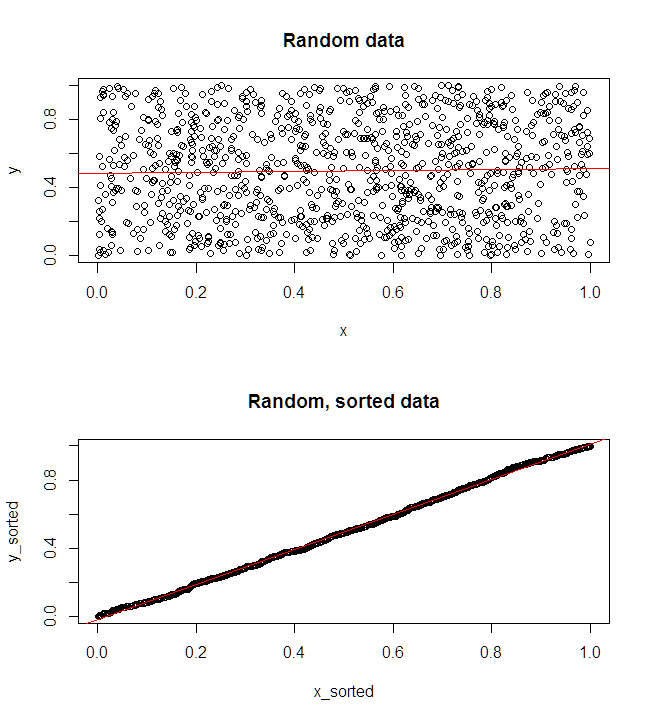
I imagine this is a silly question so I apologize, I’m not formally trained in stats. In my mind this completely destroys our data and the regression is meaningless. But my manager says he gets “better regressions most of the time” when he does this (here “better” means more predictive). I have a feeling he is deceiving himself.

The answers were priceless:

Your intuition is correct: the independently sorted data have no reliable meaning because the inputs and outputs are being randomly mapped to one another rather than what the observed relationship was.

There is a (good) chance that the regression on the sorted data will look nice, but it is meaningless in context.

And:

If you want to convince your boss, you can show what is happening with simulated, random, independent x,y data. With R:

And:

This technique is actually amazing. I’m finding all sorts of relationships that I never suspected. For instance, I would have not have suspected that the numbers that show up in Powerball lottery, which it is CLAIMED are random, actually are highly correlated with the opening price of Apple stock on the same day! Folks, I think we’re about to cash in big time. 🙂

The sad end of the story, from the original poster:

Thank you for all of your nice and patient examples. I showed him the examples by @RUser4512 and @gung and he remains staunch. He’s becoming irritated and I’m becoming exhausted. I feel crestfallen. I want my work to mean something. I will probably begin looking for other jobs soon.

The Unsuccessful Self-Treatment of a Case of “Writer’s Block”

In 1974, Dennis Upper published his wry and classic intellectual treatise entitled The Unsuccessful Self-Treatment of a Case of “Writer’s Block” in the Journal of Applied Behavior Analysis. If you’ve never seen this before, trust me, you want to see this: http://www.ncbi.nlm.nih.gov/pmc/articles/PMC1311997/pdf/jaba00061-0143a.pdf

Postscript: In 2007, several authors were able to replicate this work in their paper A Multisite Cross-Cultural Replication of Upper’s (1974) Unsuccessful Self-Treatment of Writer’s Block: http://www.ncbi.nlm.nih.gov/pmc/articles/PMC2078566/pdf/jaba-40-04-773.pdf

High-pointing a football?

Today is one of the high points of the American sports calendar: the AFC and NFC championship games to determine who plays in the Super Bowl.

A major pet peeve of mine while watching sports on TV: football announcers who “explain” that a receiver made a great reception because “he caught the ball at its highest point.”

Ignoring the effects of air resistance, the trajectory of a thrown football is parabolic, and the ball is the essentially the same height above the ground when it is either thrown or caught. (Yes, there might be a difference of at most three feet, but that’s negligible compared to the distance that a football is typically thrown.) Therefore, a football reaches the highest point of its trajectory approximately halfway between the quarterback and the receiver.

And anyone who can catch the ball that far above the ground should be immediately tested for steroids.

Preparation for Industrial Careers in the Mathematical Sciences: Building a Better Filter

The Mathematical Association of America recently published a number of promotional videos showing various mathematics can be used in “the real world.” Here’s the third pair of videos describing how mathematics is used for certain problems in materials science. From the YouTube descriptions:

Dr. Sumanth Swaminathan of W. L. Gore & Associates talks about his career path and the research questions about filtration that he considers. He works to understand the different waste capture mechanisms of filtration devices and to mathematically optimize the microstructure to create better filters.

Prof. Louis Rossi of the Department of Mathematical Sciences of the University of Delaware presents two introductory mathematical models that one can use to understand and characterize filters and the filtration processes.


New world record for largest prime number

As of this week, we have a new world record for the largest known prime number:

2^{74,207,281}-1

The adjective known is important, because there are an infinite number of prime numbers (but not all of them are known). A good video describing this finding is below.

A good article is here:

https://www.washingtonpost.com/news/speaking-of-science/wp/2016/01/20/the-newest-prime-number-is-more-than-22-million-digits-long/?tid=sm_tw

The antiderivative of 1/(x^4+1): Index

I’m doing something that I should have done a long time ago: collecting a series of posts into one single post. The following links comprised my series on the computation of

\displaystyle \int \frac{dx}{x^4+1}

Part 1: Introduction.

Part 2: Factoring the denominator using De Moivre’s Theorem.

Part 3: Factoring the denominator using the difference of two squares.

Part 4: The partial fractions decomposition of the integrand.

Part 5: Partial evaluation of the resulting integrals.

Part 6: Evaluation of the remaining integrals.

Part 7: An apparent simplification using a trigonometric identity.

Part 8: Discussion of the angles for which the identity holds.

Part 9: Proof of the angles for which the identity holds.

Part 10: Implications for using this identity when computing definite integrals.


Diamond Rio and Proofs

Sometimes it’s pretty easy for students to push through a proof from beginning to end. For example, in my experience, math majors have little trouble with each step of the proof of the following theorem.

Theorem. If z, w \in \mathbb{C}, then \overline{z+w} = \overline{z} + \overline{w}.

Proof. Let z = a + bi, where a, b \in \mathbb{R}, and let w = c + di, where c, d \in \mathbb{R}. Then

\overline{z + w} = \overline{(a + bi) + (c + di)}

= \overline{(a+c) + (b+d) i}

= (a+c) - (b+d) i

= (a - bi) + (c - di)

= \overline{z} + \overline{w}

\square

For other theorems, it’s not so easy for students to start with the left-hand side and end with the right-hand side. For example:

Theorem. If z, w \in \mathbb{C}, then \overline{z \cdot w} = \overline{z} \cdot \overline{w}.

Proof. Let z = a + bi, where a, b \in \mathbb{R}, and let w = c + di, where c, d \in \mathbb{R}. Then

\overline{z \cdot w} = \overline{(a + bi) (c + di)}

= \overline{ac + adi + bci + bdi^2}

= \overline{ac - bd + (ad + bc)i}

= ac - bd - (ad + bc)i

= ac - bd - adi - bci.

A sharp math major can then provide the next few steps of the proof from here; however, it’s not uncommon for a student new to proofs to get stuck at this point. Inevitably, somebody asks if we can do the same thing to the right-hand side to get the same thing. I’ll say, “Sure, let’s try it”:

\overline{z} \cdot \overline{w} = \overline{(a + bi)} \cdot \overline{(c + di)}

= (a-bi)(c-di)

= ac -adi - bci + bdi^2

= ac - bd - adi - bci.

\square

I call working with both the left and right sides to end up at the same spot the Diamond Rio approach to proofs: “I’ll start walking your way; you start walking mine; we meet in the middle ‘neath that old Georgia pine.” Not surprisingly, labeling this with a catchy country song helps the idea stick in my students’ heads.

Though not the most elegant presentation, this is logically correct because the steps for the right-hand side can be reversed and appended to the steps for the left-hand side:

Proof (more elegant). Let z = a + bi, where a, b \in \mathbb{R}, and let w = c + di, where c, d \in \mathbb{R}. Then

\overline{z \cdot w} = \overline{(a + bi) (c + di)}

= \overline{ac + adi + bci + bdi^2}

= \overline{ac - bd + (ad + bc)i}

= ac - bd - (ad + bc)i

= ac - bd - adi - bci

= ac -adi - bci + bdi^2

= (a-bi)(c-di)

= \overline{(a + bi)} \cdot \overline{(c + di)}

\overline{z} \cdot \overline{w}.

\square





