
From the category “This Is Completely Useless”: here’s what a 15-square puzzle looks like when you arrange the tiles in order of how many factors they have.
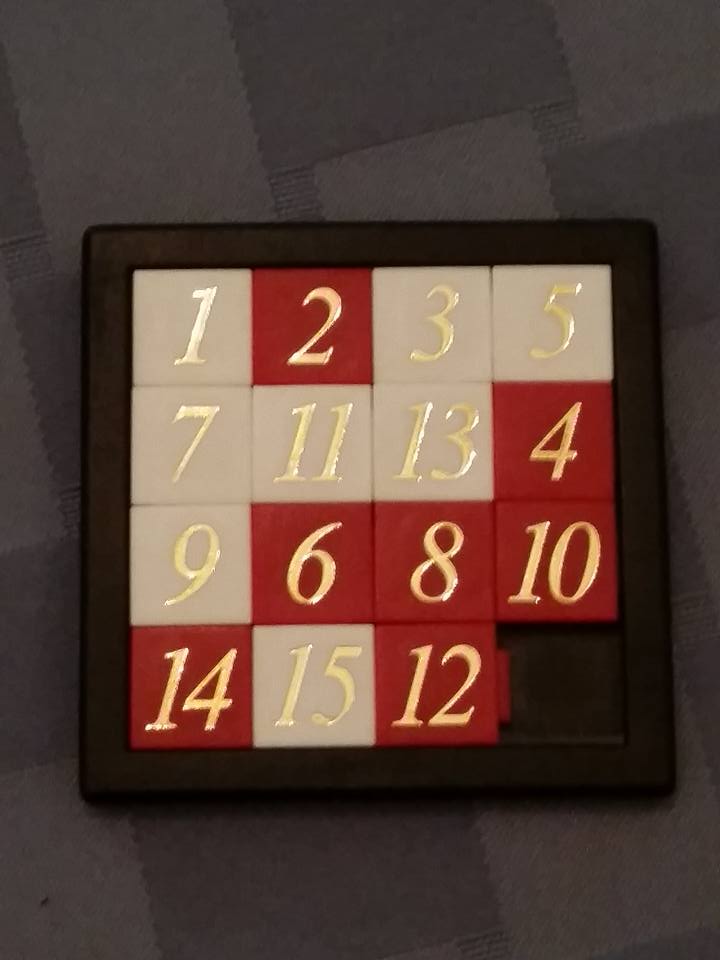
From the category “This Is Completely Useless”: here’s what a 15-square puzzle looks like when you arrange the tiles in order of how many factors they have.
I really enjoyed this thoughtful blogpost from Math With Bad Drawings. A sample:

See the whole thing here: https://mathwithbaddrawings.com/2016/10/26/the-student-to-teacher-dictionary/
I’m doing something that I should have done a long time ago: collecting a series of posts into one single post. The links below show the mathematical magic show that I’ll perform from time to time.
Part 1: Introduction.
Part 2a, Part 2b, and Part 2c: The 1089 trick.
Part 3a, Part 3b, and Part 3c: A geometric magic trick.
Part 4a: Part 4b, Part 4c, and Part 4d: A trick using binary numbers.
Part 5a, Part 5b, Part 5c, and Part 5d: A trick using the rule for checking if a number is a multiple of 9.
Part 7: The Fitch-Cheney card trick, which is perhaps the slickest mathematical card trick ever devised.
Part 8a, Part 8b, and Part 8c: A trick using Pascal’s triangle.
Part 9: Mentally computing 


Part 6: The Grand Finale.
And, for the sake of completeness, here’s a recent picture of me just before I performed an abbreviated version of this show for UNT’s Preview Day for high school students thinking about enrolling at my university.

Behold, a three-dimensional calendar on the faces of a rhombic dodecahedron:

Source: https://www.wired.com/2016/10/gorgeous-12-sided-wooden-calendar-geometry-nerd-life/
From a recent article in the Boston Globe, https://www.bostonglobe.com/ideas/2016/09/15/teaching-parents-talk-math-with-their-kids/kZ777JUPFW3Yewr31yMqSO/story.html:
Researchers with a group called the DREME Network (which stands for Development and Research in Early Math Education) say it’s time for parents to begin to teach their preschool-age children basic math concepts with the same urgency that they encourage reading…
The concepts and skills that make a difference with kids ages 3 to 5 (which is where the DREME Network is focused) are so basic that any adult can handle them: counting objects and recognizing that the last number stated describes the total number of objects, talking about patterns, going on “shape hunts,” ordering sets from biggest to smallest.
“People think of math in a very narrow way, but block play, puzzles, spatial aspects of our cognition, these are also important to mathematics. We’re not advocating drilling kids,” says Susan Levine, a psychologist at the University of Chicago and DREME Network member.
From the category “I Really Don’t Recommend That Anyone Does This But It Sure Makes a Great Story Now”: I recently told my students about the time in Spring 2000 that, in the middle of class, I playfully threw an eraser at a wise-cracking student sitting in the back row…
…and I aimed about three feet above his head so that the eraser would richochet off the back wall…
…but the eraser kind of knuckleballed and inadvertently sailed barely over the head of the student sitting in front of him and then nailed him square in the chest…
…and I somehow kept a straight face as if I really had intended to peg him with a cloud of chalkdust…
…and, the next day, my students gave me a half-dozen new erasers for fresh ammuntion.
Ah, memories.
In my capstone class for future secondary math teachers, I ask my students to come up with ideas for engaging their students with different topics in the secondary mathematics curriculum. In other words, the point of the assignment was not to devise a full-blown lesson plan on this topic. Instead, I asked my students to think about three different ways of getting their students interested in the topic in the first place.
I plan to share some of the best of these ideas on this blog (after asking my students’ permission, of course).
This student submission again comes from my former student Perla Perez. Her topic, from Pre-Algebra: determining which of two fractions is largest if the denominators are unequal.

What interesting (i.e., uncontrived) word problems using this topic can your students do now? (You may find resources such as http://www.spacemath.nasa.gov to be very helpful in this regard; feel free to suggest others.)
Students are introduced to fractions in elementary school, but at a certain point this topic can become tedious. Trying to introduce new concepts to a topic they’ve seen and practiced for a while can be a challenge. A good idea can be to give them a problem at the start of class that they can answer after the day’s lesson is done. Students are given a word problem such as:
“James was arguing with John that he could eat more pizza than him, while John without a doubt believed the opposite. It got to the point where everyone in class had established their own opinions on it. So Nancy came up with a solution and ordered two large pizzas to see who could eat the most. Well, when the pizzas arrived they noticed that one pizza was cut into 10 equal pieces and the other into 16 equal pieces. After they devoured all that they could, John had eaten 7/10 and James had eaten 13/16. Now, who at the most pizza?”
After giving the students to time to think about the problem without any more information, get a show of hands to see who they think ate the most. Write up the number of students who voted for James and John somewhere visible. Then, at the end of the lesson, give and explain the answer.
How has this topic appeared in the news?
The euro currently cost .890646 or 445323/500000 of a dollar. The British Pound .753423 or 753423/1000000 of a dollar. Now which currency is cheaper? If the fraction were only given to a student, some might be able to say the British pound because the 7 is greater that the 8 while others might say euro because of the 5 in denominator, and some that have no idea. There’s actually a formula to find out which is: AMOUNTto=(AMOUNTfrom X RATE from)/RATEto Although most times currency exchange is shown in decimal form, it gives a broader sense of how a simple concept relates to big-world topics. It is important for students to be able to determine if 3/7 is greater or less than 4/5, so that one day they can apply it to their daily lives. The exchange rate is just one example of different fractions being used in today’s society; in this case how the use of decimals and fractions translate to foreign relations. By relating the outside world to a classroom, educators can show students that there is more to numbers than just a grade in a class. These real world concepts can help students better understand the application of the material.
References:
http://www.mathinary.com/currency_conversion.jsp
http://www.x-rates.com/table/?from=USD&amount=1
What interesting things can you say about the people who contributed to the discovery and/or the development of this topic? (You might want to consult Math Through The Ages.)
To students it may seem as if fractions have always been there. Some may have not thought much of its origin. A brief interesting part of history can be shared to spark some light in the matter. Well although there were contributions from the Babylonians, Arabs, and Ancient Rome, it was the Egyptians in 1800 BC seem to be the ones already using them. But interesting enough it isn’t like how it is seen today. Rather than seeing a fraction be an integer over another they used hieroglyphics and base ten.
For example, “The Egyptians wrote all their fractions using what we call unit 1 as its numerator (top number). They put a mouth picture (which meant part) above a number to make it into a unit fraction.”
It would be represented like,

Because of this method it was difficult to compute so they had to use numerous tables. Although our methods have changed one thing still remains the same; the way we use manipulatives in showing how fractions with different denominators compare. For instance, we have circle pictures that visually show fractions with different denominators can ease student into understanding them better.
Babylonians, though found a simpler way of representing fractious with symbols. All in all, it is interesting how visual description can be helpful still in today’s society.
References:
In my capstone class for future secondary math teachers, I ask my students to come up with ideas for engaging their students with different topics in the secondary mathematics curriculum. In other words, the point of the assignment was not to devise a full-blown lesson plan on this topic. Instead, I asked my students to think about three different ways of getting their students interested in the topic in the first place.
I plan to share some of the best of these ideas on this blog (after asking my students’ permission, of course).
This student submission again comes from my former student Marissa Arevalo. Her topic, from Algebra: adding and subtracting a mixture of positive and negative integers.
How could you as a teacher create an activity or project that involves your topic?
An activity written by Kim Claryon The National Council of Teachers of Mathematics involves students understanding what it means when adding a negative integer, subtracting a positive integer, etc. This activity is called Zip, Zilch, Zero. Students are set in a group of 3 to 4 and dealt seven cards each, where the rest of the cards are left as a draw pile with a single card in the discard pile. Red cards are negative values and black cards are positive where Ace is equal to one, Jack is equal to eleven, Queen is equal to twelve, and King is equal to thirteen. Each student must draw a card from the top of the draw/discard pile. The point of the game is to add cards together to make a “Zip” or equal zero. the object of the game is that when a player plays the last card in their hand, all of the hands are scored by subtracting the absolute value of the sum of the cards in the hands from the absolute value of the cards played in a “Zip”. The winner has the highest score. Do note that the rules may be very tricky to understand as first and should be read aloud in class to help the games to go smoothly. Rules can be found on the website given below.
How has this topic appeared in high culture (art, classical music, theatre, etc.)?
In a lot of idealizations of math by students, they do not associate STEM subjects with that of art. However, as a student who likes to paint and draw, I know that the arts involve a lot of mathematical logic in its creation, so one way to get the students involved, is to show that math is in everything. Therefore, I found a website with a video that discusses positive and negative space in a picture. In the video there is a black and white image of a tree on a flat landscape without anything in the background. The white space of the photo is referred to as the negative space and the black is the positive space as it is the subject and area of interest. In the video, the narrator describes that as the image is made smaller and larger that the value of the negative and positive space increases or decreases.

This can be a great engage as far as to asking the students to observe what happens when you make the subject area smaller or larger and whether or not that means if the negative space has decreased or increased. This could lead to a discussion as to how this relates to numbers and how the values of an integer change based on adding or subtracting from it.
How can technology (YouTube, Khan Academy [khanacademy.org], Vi Hart, Geometers Sketchpad, graphing calculators, etc.) be used to effectively engage students with this topic?
A video I found on a blog “Embrace the Drawing Board” when I was looking through Pinterest had a very entertaining video that demonstrates what happens when adding or subtracting positive and negative integers. On the video the positive integers were green army men and the negative integers were red army men that were fighting in a “War of the Integers”. For example, in each battle, an equal amount of red and green army men will die on both sides when combining, or adding, the red and green men onto the battle field.
This is a great beginning to a sort of game between the students in which two students can play with one as the negative army and the other as the positive army. They can take turns to roll a pair of die where that number is the number of army they are brining to battle. Both students take turns deciding whose value goes first in the equation and then constructs the equations on a sheet of paper to figure out which side won the battle. Then, after about five to ten minutes of addition, the operation switches to subtraction, and the students continue to switch in whose number goes where in the equations.
_____ + ______ = ________
_____ — ______ = ________
Afterwards the teacher allow a student lead discussion by asking them what happened when subtracting a negative, adding a negative, etc. Then students can create their own theories and develop their own theories as to why they happened before the teacher can address any misconceptions.
References:
Click to access ZZZ-AS-RulesandRecord.pdf
http://thevirtualinstructor.com/positive-and-negative-space.html
http://mrpiccmath.weebly.com/blog/category/lesson%20ideas
It turns out that Matlab can be used to optimally place ornaments on a Christmas tree: https://github.com/tsangiotis/christmasSpirit

Yesterday’s post of mathematically wrapping presents was tongue in cheek. This one is elegant and a nice application of principles from geometry.
Source: http://lifehacker.com/the-mathematical-way-to-wrap-presents-of-various-shapes-1748323319
 Mean Green Math