
My colleague Jason Ermer at Collaborative Mathematics has just published Challenge 09 on his website:
Year: 2014
Engaging students: Probability and odds
In my capstone class for future secondary math teachers, I ask my students to come up with ideas for engaging their students with different topics in the secondary mathematics curriculum. In other words, the point of the assignment was not to devise a full-blown lesson plan on this topic. Instead, I asked my students to think about three different ways of getting their students interested in the topic in the first place.
I plan to share some of the best of these ideas on this blog (after asking my students’ permission, of course).
This student submission again comes from my former student Michelle Nguyen. Her topic, from Pre-Algebra: probability and odds.

A2. How could you as a teacher create an activity or project that involves your topic?
As a teacher, I would place 100 red marbles and 25 blue marbles in a bag and have each group of students draw a marble each time from a bag for five times. After drawing a marble, the student would put the marble back and then redraw. After five times, the class would come together and the students would compare how many red marbles to how many blue marbles they have. The students will compare the ratios and guess if there are more red marbles or blue marbles in the bag given. By doing this, the students will see whether there is a big chance of drawing a red or blue marble. After doing the activities, I would ask questions that will scaffold the students into saying that there is a higher probability in picking a red marble than a blue marble because the red marbles are picked more often when compared to the blue marbles that got picked.
D1. What interesting things can you say about the people who contributed to the discovery and/or the development of this topic?
With the popularity of gambling rising in the French society, mathematical methods were needed for computing chances. A popular gambler named De Mere talked to Pascal about questions about chances. Therefore, Pascal talked to his friend Fermat and they began the study of probability. The created the method called classical approach which is the probability fractions we use today. In order to verify the results of the classical approach, Fermat and Pascal used the frequency method. During this method, one would repeat a game a large number of times with the same conditions. Bernoulli wrote a book named Ars Conjectandi in 1973 to prove the classical approach and the frequency method are consistent with another one. Later on Abraham De Moive wrote a book to provide different examples of how the classical methods can be used. As time passed by, probability moved from games of chance to scientific problems. Laplace wrote a book about the theory of probability but he only considered the classical method. After the publication of this book, many mathematicians found that the classical method was unrealistic for general use and they attempted to redefine probability in terms of the frequency method. Later on, Kolmogorov developed the first rigorous approach to probability in 1933. There are still researches going on about probability in the mathematical field of measure theory.
C1. How has this topic appeared in pop culture (movies, TV, current music, video games, etc.)?
In the movie “21” there is math problem that is similar to the popular Monty Hall problem. In the movie, a kid is given the chance to pick one out of three doors with a car in it in order to win. Once a door is chosen, the announcer will open a door without a car. Therefore, the start off is 33% of a car existing and 66% with an empty door. Since a door was open, the chance of switching your choices gives you a higher winning percentage because the one you chose at the beginning will still be 33% while switching will change your chances to 66%. This youtube video is a clip from the movie:
References:
http://www.math.wichita.edu/history/activities/prob-act.html#prob1
http://staff.ustc.edu.cn/~zwp/teach/Prob-Stat/A%20short%20history%20of%20probability.pdf
http://www.examiner.com/article/21-and-the-monty-hall-problem
Engaging students: Prime Factorizations
In my capstone class for future secondary math teachers, I ask my students to come up with ideas for engaging their students with different topics in the secondary mathematics curriculum. In other words, the point of the assignment was not to devise a full-blown lesson plan on this topic. Instead, I asked my students to think about three different ways of getting their students interested in the topic in the first place.
I plan to share some of the best of these ideas on this blog (after asking my students’ permission, of course).
This student submission again comes from my former student Michael Dixon. His topic, from Pre-Algebra: prime factorizations.
A1. What word problems can your students do now?
One word problem that is easily relatable would be something involving food!
For instance: “Don loves peanut butter and jelly sandwiches. One day he noticed a jumbo jar of peanut butter has 72 servings and a jar of jam only has 40 servings. If he opened the [first] jars on the same day and used exactly one serving each day, how many days until he emptied a peanut butter jar and a jam jar on the same day? Use prime factorization to solve.”
Obviously, this involves finding the least common multiple of 72 and 40. I would introduce this problem at the beginning of class, after my students have already been introduced to the idea of prime factorizations. I do not expect that my students would know how to calculate the lcm using prime factorizations, rather I would want to strike up a class discussion asking students to explore what they know about factorizations and see if they can find any patterns that would lead to the solution. I want to lead them to the idea that prime factorizations make finding the lcm far easier than listing the multiples of each number, especially when large numbers are involved.
B1. Future Curriculum
As mentioned in the previous paragraph, students can learn to use prime factorizations to calculate the greatest common factor or the least common multiple of numbers easily. To take this quite a bit further, we can introduce students to the idea of using factorizations, gcd, and lcm in formal abstract proofs. We would ask them to actually prove anything, just think about the ideas. Ask students how they know that the math that they use everyday actually works. Why does every number have a unique factorization? Why can I calculate the gcd and lcm of any two numbers, and know that that answer is the only answer? Then explain that later on, in higher level math classes, we actually flawlessly prove why our number system works, and how and why primes are important, such as in the Euler Phi function. Without prime factorizations, we would be unable to prove quite a lot of the math that we take for granted.
E1. How can technology be used to engage students?
After your students have been working with prime factorizations for a while and they are getting more proficient, what’s an obvious escalation? Make the numbers larger! Ask your students to factor numbers like 198 and 456. See how long it takes them to work through these. Then, ask them how long it would take to factor numbers like 2756 or even 12857. How could they do these? Is it even reasonable to try? What about 51,234,587 (this is actually prime)?
Here we can introduce using a computer, and using a computer to do the calculations for us. Just a simple website is adequate to show them just how useful computers are when doing large calculations. A website such as Math is Fun is an excellent tool to demonstrate the magnitude of some prime numbers and composite numbers, and show that even as numbers get very, very large, they are not divisible by any numbers other than themselves and one.
References
www.mathsisfun.com/numbers/prime-factorization-tool.html
http://tulyn.com/wordproblems/prime_factorization-word_problem-7928.html
Science and Engineering of the Winter Olympics
I know I’m late posting this, but these videos from NBC are pretty good. Other sports-themed engagement ideas can be found by navigating the website.
https://www.nbclearn.com/science-and-engineering-of-the-2014-olympic-winter-games
Probability question from the AMC->8 contest
Keiko tosses one penny and Ephraim tosses two pennies. The probability that Ephraim gets the same number of heads as Keiko is…
The solution is described in the video below.
Permutations and Combinations
Courtesy of Math with Bad Drawings is a nice derivation of the formulas for permutations and combinations:
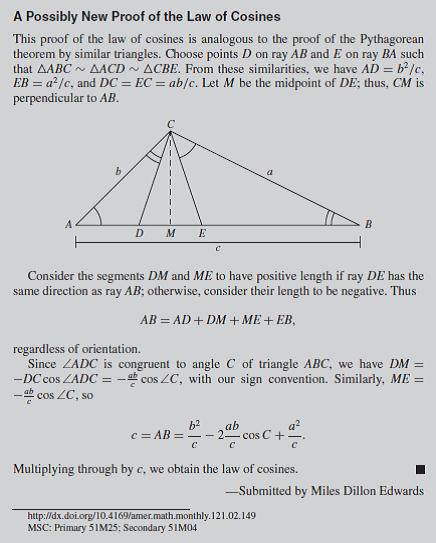
A New Proof of the Law of Cosines
Engaging students: Solving one-step linear equations
In my capstone class for future secondary math teachers, I ask my students to come up with ideas for engaging their students with different topics in the secondary mathematics curriculum. In other words, the point of the assignment was not to devise a full-blown lesson plan on this topic. Instead, I asked my students to think about three different ways of getting their students interested in the topic in the first place.
I plan to share some of the best of these ideas on this blog (after asking my students’ permission, of course).
This student submission again comes from my former student Jessica Trevizo. Her topic, from Pre-Algebra: solving one-step linear equations.
A2. How could you as a teacher create an activity or project that involves your topic?
Many students have played “Around the World” at one point in their elementary childhood, or have at least heard of the game. Around the World is an activity that is commonly used by elementary school teachers when they are teaching multiplication. Students are supposed to sit in the form of a circle. One person is chosen to attempt to go around the world. He/she will stand behind a student and will compete against the student that is sitting down. Once both students are ready the teacher holds up a multiplication card. The student who responds with the correct answer first gets the chance to move on to the next person. If the student who is standing up loses then he/she gets to sit down while the other student who obtained the correct answer advances. Every person has to attempt the problem on a sheet of paper, but they are not allowed to call out the answer. The student who “goes around the world” first is the winner. If a student is not able to complete the entire circle then the student who advanced the farthest is the winner. The same idea will be used after the students have learned how to solve one step linear equations. After having a deep conceptual understanding of the topic it is very important for the students to keep practicing problems. Around the World allows the students to keep practicing in an entertaining way. The students should be able to solve the equations within 30 seconds since it only requires one step to solve. The ability to use calculators with this activity will vary depending on the level of difficulty of the problems as well as the teacher.
B1. How can this topic be used in your students’ future courses in mathematics or science?
Being able to solve one step linear equations is an important skill that every student should acquire. After the students learn how to solve one step linear equations they are expected to be able to solve multi-step equations, solve absolute value equations, solve inequalities, finding the side lengths of a shape given a certain area in geometry, etc. If the students are not able to master solving one step linear equations then they will have a very difficult time in other math courses.
In geometry the Pythagorean Theorem requires the skill to solve one step equations. Students are expected to solve for the missing variable in order to find the missing side length of a right triangle. In Algebra II the students are required to manipulate equations in order to solve systems of linear equations through substitution. Also this basic skill is necessary when finding the inverse of a function. This topic is also used in physics. For example, if the student is asked to find the acceleration of an object given only the force and the mass, then it involves using Newton’s second law which states Force=mass*acceleration.
E1. How can technology (YouTube, Khan Academy [khanacademy.org], Vi Hart, Geometers Sketchpad, graphing calculators, etc.) be used to effectively engage students with this topic?
This website is an amazing tool that allows the students to visualize how to solve linear equations using algebra tiles. If the teacher decides to teach this lesson using algebra tiles in the classroom, then this website will allow the students to continue to practice at home. Also, the website automatically lets the student know if he/she responded correctly. Obtaining quick results allows the student to know whether or not they truly understand how to solve the equations as opposed to having a worksheet with 50 problems for homework and not knowing if the same mistake was repeated. Also, by using the online algebra tiles the students are able to understand the zero pair concept and see how it is being applied. This website can also be used for other algebra topics such as factoring, the distributive property, and substitution.
http://illuminations.nctm.org/Activity.aspx?id=3482
Engaging students: Order of operations
In my capstone class for future secondary math teachers, I ask my students to come up with ideas for engaging their students with different topics in the secondary mathematics curriculum. In other words, the point of the assignment was not to devise a full-blown lesson plan on this topic. Instead, I asked my students to think about three different ways of getting their students interested in the topic in the first place.
I plan to share some of the best of these ideas on this blog (after asking my students’ permission, of course).
This student submission again comes from my former student Dorathy Scrudder. Her topic, from Pre-Algebra: order of operations.
B2. How does this topic extend what your students should have learned in previous courses?
Students should know how to add, subtract, multiply, divide, and use exponents by the time we cover this topic. To begin the class, I will have students split into two groups. Both groups will be given a series of one-step equations that correspond to a multi-step equation; however, one group will be given the steps out of order. We will then discuss why the two groups were working on the same multi-step equation but have different answers. The students should find it interesting and ask a few follow up questions such as, a) how do we know which answer is correct – it is correct by use of the order of operations which was decided on by mathematicians in the 1600s; b) how do we know what order to do the operations in – we use the acronym PEMDAS which stands for Parenthesis, Exponents, Multiplication/Division, Addition/Subtraction; c) how are we supposed to remember the acronym – we can either pronounce it pem-das or use the saying Please Excuse My Dear Aunt Sally.
C2. How has this topic appeared in high culture (art, classical music, theatre, etc.)?
The order of operations is also utilized in many areas outside of math. Take a play for example. To begin, an actor or actress must first audition for the desired role. Once they have been hired, the actor/actress must learn their lines and then rehearse with the other actors and actresses before the opening night of the play. The actor/actress cannot perform the opening night if they have not learned their lines yet. The set designers must also follow the order of operations. They must first design what they want the set to look like and then decide what materials they need and how much to buy. Once they have the materials, they cannot start painting intricate details until they have constructed the set. Following the order of operations is an important concept and hopefully these examples will help the students understand why we need to follow the steps in the given order.
D2. How was this topic adopted by the mathematical community?
Multiplication before addition has been a common practice since before algebra was written, however, it was always an assumption and mathematicians never felt that it had to be proved. The earliest printing that we have where multiplication comes before addition is from the early 1600s. Dr. Peterson, from Ask Dr. Math, has stated that he believes the term “order of operations” has only just come into common use within the past century by textbook authors. Sarah Sass, from University of Colorado in Denver, has found that students have trouble when it comes to the multiplication and division step and again at the addition and subtraction step of the order of operations. She suggests that instead of using “please excuse my dear aunt sally,” in which students often assume all multiplication comes before division and all addition comes before subtraction, Sass suggests that we teach “Pandas Eat: Mustard on Dumplings, and Apples with Spice.” This allows the students to understand that the mustard and dumplings, or the multiplication and division, go together at the same time, while the apples and spice, or addition and subtraction, are completed at the same time, all from the left to the right.
References:
http://www.math.ucdenver.edu/~jloats/Student%20pdfs/4_Order%20of%20OperationsSass.pdf
http://mathforum.org/library/drmath/view/52582.html
10,000 page views
I’m taking a one-day break from my usual posts on mathematics and mathematics education to note a symbolic milestone: yesterday, meangreenmath.com surpassed 10,000 total page views since its inception last June. Many thanks to the followers of this blog, and I hope that you’ll continue to find this blog to be a useful resource to you.
Here are my 12 most viewed posts so far, in chronological order by category.
Square roots and logarithms without a calculator:
https://meangreenmath.com/2013/08/03/square-roots-without-a-calculator-part-3/
https://meangreenmath.com/2013/08/06/square-roots-without-a-calculator-part-6/
Ideas for engaging students, from Teach North Texas students studying to become secondary mathematics teachers:
https://meangreenmath.com/2013/09/06/engaging-students-deriving-the-pythagorean-theorem/
https://meangreenmath.com/2013/10/16/engaging-students-laws-of-exponents/
https://meangreenmath.com/2013/11/06/engaging-students-right-triangle-trigonometry/
Other:
https://meangreenmath.com/2013/06/26/geometrical-magic-trick/
https://meangreenmath.com/2013/08/15/full-lesson-plan-magic-squares-2/
 Mean Green Math