In my capstone class for future secondary math teachers, I ask my students to come up with ideas for engaging their students with different topics in the secondary mathematics curriculum. In other words, the point of the assignment was not to devise a full-blown lesson plan on this topic. Instead, I asked my students to think about three different ways of getting their students interested in the topic in the first place.
I plan to share some of the best of these ideas on this blog (after asking my students’ permission, of course).
This student submission comes from my former student Alyssa Dalling. Her topic, from Geometry: finding the area of a square or rectangle.
D. How have different cultures throughout time used this topic in their society?
For three thousand years, the Great Pyramid of Giza was the world’s tallest man-made structure. It is also the oldest structure of the Seven Wonders of the Ancient World. It was built by cutting huge stones into rectangles then placing each stone into place to create the base. It is believed by many that the pharaoh Khufu had his vizier Hemon create the design for the great Pyramids. What is amazing about the design of the Pyramid of Giza is that each of the four sides of the base has an average error of only 58 millimeters in length. Meaning the base is almost a perfect square!
It would be fun to start the engage with introducing the Pyramid of Giza and explaining the facts above. Then students would be given the dimensions of other pyramids where they would have to find the area of the base to see whether they created a square or rectangular pyramid. This would get them excited about this topic because students would be exploring math that has actually been used in real life.
The Mesoamericans also built pyramids with square and rectangular bases. The picture above is in a city known as Chechen Itza which is located in the Mexican state of Yucatan. It is called El Castillo, and also known as the Temple of Kukulkan. Unlike the Egyptian pyramids though, the Mayan pyramids were usually meant as steps to get to a temple on top. The pyramids consisted of several square bases stacked onto each other with steps up each side. El Castillo consists of nine square terraces each about 8.4 feet tall. The main base of the pyramid is approximately 55.3 meters (181 feet).
What would be fun to do is have students find the area of each level and compare it to all the levels on the pyramid. I feel students would have fun seeing just how big this type of structure is and understanding the planning it took to create the different levels in this pyramid.
B. How can this topic be used in your students’ future courses in mathematics or science?
Finding the area of squares and rectangles will be used a lot in Algebra and Algebra II. One example in Algebra is when students start solving for unknown variables. A student would be asked to find the area of a square when they have two unknown sides.
The following is an example engage problem students would use the finding the area of a square or rectangle to solve.
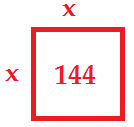
Principal Smith has decided the school needs a new practice basketball court. The current practice court is a square with an area of 144 square feet. She wants the new court to be a rectangle twice as long as it is wide. Find the length of all the sides of both the old court and the new court and find the area of the new court.
So
Then
The square court has sides of 12.
The rectangular court has sides of 12×24 and an area of 288 square feet.
In my capstone class for future secondary math teachers, I ask my students to come up with ideas for engaging their students with different topics in the secondary mathematics curriculum. In other words, the point of the assignment was not to devise a full-blown lesson plan on this topic. Instead, I asked my students to think about three different ways of getting their students interested in the topic in the first place.
I plan to share some of the best of these ideas on this blog (after asking my students’ permission, of course).
This student submission comes from my former student Alyssa Dalling. Her topic, from Precalculus: the equation of a circle.
A. How could you as a teacher create an activity or project that involves your topic?
A fun way to engage students and also introduce the standard form of an equation of a circle is the following:
Start by separating the class into groups of 2 or 3
Pass each group a specific amount of flashcards. (Each group will have the same flashcards)
Each flashcard has a picture of a graphed circle and the equation of that circle in standard form
The students will work together to figure out how the pictures of the circle relate to the equation
This will help students understand how different aspects of a circle relate to its standard form equation. The following is an example of a flashcard that could be passed out.
C. How has this topic appeared in high culture (art, classical music, theatre, etc.)?
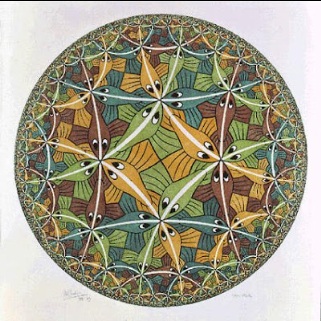
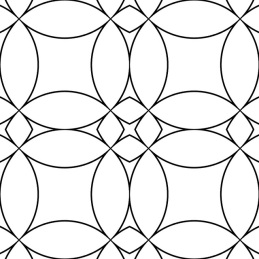
Circles have been used through history in many different works of art. One such type is called a tessellation. The word Tessellate means to cover a plane with a pattern in such a way as to leave no region uncovered. So, a tessellation is created when a shape or shapes are repeated over and over again. The pictures above show just a few examples of how circles are used in different types of art. A good way to engage students would be to show them a few examples of tessellations using circles.
E. How can technology be used to effectively engage students with this topic?
Khan Academy has a really fun resource for using equations to graph circles. At the beginning of class, the teacher could allow students to play around with this program. It allows students to see an equation of a circle in standard form then they would graph the circle. It gives hints as well as the answer when students are ready. The good thing about this is that even if a student goes straight to the answer, they are still trying to identify the connection between the equation of the circle and the answer Khan Academy shows.
This is the last in a series of posts about square roots and other roots, hopefully providing a deeper look at an apparently simple concept. However, in this post, we discuss how calculators are programmed to compute square roots quickly.
Today’s movie clip, therefore, is set in modern times:
So how do calculators find square roots anyway? First, we recognize that is a root of the polynomial . Therefore, Newton’s method (or the Newton-Raphson method) can be used to find the root of this function. Newton’s method dictates that we begin with an initial guess and then iteratively find the next guesses using the recursively defined sequence
For the case at hand, since , we may write
,
which reduces to
This algorithm can be programmed using C++, Python, etc.. For pedagogical purposes, however, I’ve found that a spreadsheet like Microsoft Excel is a good way to sell this to students. In the spreadsheet below, I use Excel to find . In cell A1, I entered as a first guess for . Notice that this is a really lousy first guess! Then, in cell A2, I typed the formula
=1/2*(A1+2000/A1)
So Excel computes
.
Then I filled down that formula into cells A3 through A16.
Notice that this algorithm quickly converges to , even though the initial guess was terrible. After 7 steps, the answer is only correct to 2 significant digits (). After 8 steps, the answer is correct to 4 significant digits (). On the 9th step, the answer is correct to 9 significant digits ().
Indeed, there’s a theorem that essentially states that, when this algorithm converges, the number of correct digits basically doubles with each successive step. That’s a lot better than the methods shown at the start of this series of posts which only produced one extra digit with each step.
This algorithm works for finding th roots as well as square roots. Since is a root of , Newton’s method reduces to
,
which reduces to the above sequence if .
See also this Wikipedia page for further historical information as well as discussion about how the above recursive sequence can be obtained without calculus.
This is the fifth in a series of posts about calculating roots without a calculator, with special consideration to how these tales can engage students more deeply with the secondary mathematics curriculum. As most students today have a hard time believing that square roots can be computed without a calculator, hopefully giving them some appreciation for their elders.
Today’s story takes us back to a time before the advent of cheap pocket calculators: 1949.
The following story comes from the chapter “Lucky Numbers” of Surely You’re Joking, Mr. Feynman!, a collection of tales by the late Nobel Prize winning physicist, Richard P. Feynman. Feynman was arguably the greatest American-born physicist — the subject of the excellent biography Genius: The Life and Science of Richard Feynman — and he had a tendency to one-up anyone who tried to one-up him. (He was also a serial philanderer, but that’s another story.) Here’s a story involving how, in the summer of 1949, he calculated without a calculator.
The first time I was in Brazil I was eating a noon meal at I don’t know what time — I was always in the restaurants at the wrong time — and I was the only customer in the place. I was eating rice with steak (which I loved), and there were about four waiters standing around.
A Japanese man came into the restaurant. I had seen him before, wandering around; he was trying to sell abacuses. (Note: At the time of this story, before the advent of pocket calculators, the abacus was arguably the world’s most powerful hand-held computational device.) He started to talk to the waiters, and challenged them: He said he could add numbers faster than any of them could do.
The waiters didn’t want to lose face, so they said, “Yeah, yeah. Why don’t you go over and challenge the customer over there?”
The man came over. I protested, “But I don’t speak Portuguese well!”
The waiters laughed. “The numbers are easy,” they said.
They brought me a paper and pencil.
The man asked a waiter to call out some numbers to add. He beat me hollow, because while I was writing the numbers down, he was already adding them as he went along.
I suggested that the waiter write down two identical lists of numbers and hand them to us at the same time. It didn’t make much difference. He still beat me by quite a bit.
However, the man got a little bit excited: he wanted to prove himself some more. “Multiplição!” he said.
Somebody wrote down a problem. He beat me again, but not by much, because I’m pretty good at products.
The man then made a mistake: he proposed we go on to division. What he didn’t realize was, the harder the problem, the better chance I had.
We both did a long division problem. It was a tie.
This bothered the hell out of the Japanese man, because he was apparently well trained on the abacus, and here he was almost beaten by this customer in a restaurant.
“Raios cubicos!” he says with a vengeance. Cube roots! He wants to do cube roots by arithmetic. It’s hard to find a more difficult fundamental problem in arithmetic. It must have been his topnotch exercise in abacus-land.
He writes down a number on some paper— any old number— and I still remember it: . He starts working on it, mumbling and grumbling: “Mmmmmmagmmmmbrrr”— he’s working like a demon! He’s poring away, doing this cube root.
Meanwhile I’m just sitting there.
One of the waiters says, “What are you doing?”.
I point to my head. “Thinking!” I say. I write down on the paper. After a little while I’ve got .
The man with the abacus wipes the sweat off his forehead: “Twelve!” he says.
“Oh, no!” I say. “More digits! More digits!” I know that in taking a cube root by arithmetic, each new digit is even more work that the one before. It’s a hard job.
He buries himself again, grunting “Rrrrgrrrrmmmmmm …,” while I add on two more digits. He finally lifts his head to say, “!”
The waiter are all excited and happy. They tell the man, “Look! He does it only by thinking, and you need an abacus! He’s got more digits!”
He was completely washed out, and left, humiliated. The waiters congratulated each other.
How did the customer beat the abacus?
The number was . I happened to know that a cubic foot contains cubic inches, so the answer is a tiny bit more than . The excess, , is only one part in nearly , and I had learned in calculus that for small fractions, the cube root’s excess is one-third of the number’s excess. So all I had to do is find the fraction , and multiply by (divide by and multiply by ). So I was able to pull out a whole lot of digits that way.
A few weeks later, the man came into the cocktail lounge of the hotel I was staying at. He recognized me and came over. “Tell me,” he said, “how were you able to do that cube-root problem so fast?”
I started to explain that it was an approximate method, and had to do with the percentage of error. “Suppose you had given me . Now the cube root of is …”
He picks up his abacus: zzzzzzzzzzzzzzz— “Oh yes,” he says.
I realized something: he doesn’t know numbers. With the abacus, you don’t have to memorize a lot of arithmetic combinations; all you have to do is to learn to push the little beads up and down. You don’t have to memorize 9+7=16; you just know that when you add 9, you push a ten’s bead up and pull a one’s bead down. So we’re slower at basic arithmetic, but we know numbers.
Furthermore, the whole idea of an approximate method was beyond him, even though a cubic root often cannot be computed exactly by any method. So I never could teach him how I did cube roots or explain how lucky I was that he happened to choose .
The key part of the story, “for small fractions, the cube root’s excess is one-third of the number’s excess,” deserves some elaboration, especially since this computational trick isn’t often taught in those terms anymore. If , then , so that . Since , the equation of the tangent line to at is
.
The key observation is that, for , the graph of will be very close indeed to the graph of . In Calculus I, this is sometimes called the linearization of at . In Calculus II, we observe that these are the first two terms in the Taylor series expansion of about .
For Feynman’s problem, , so that if $x \approx 0$. Then $\latex \sqrt[3]{1729.03}$ can be rewritten as
This last equation explains the line “all I had to do is find the fraction , and multiply by .” With enough patience, the first few digits of the correction can be mentally computed since
So Feynman could determine quickly that the answer was .
By the way,
So the linearization provides an estimate accurate to eight significant digits. Additional digits could be obtained by using the next term in the Taylor series.
I have a similar story to tell. Back in 1996 or 1997, when I first moved to Texas and was making new friends, I quickly discovered that one way to get odd facial expressions out of strangers was by mentioning that I was a math professor. Occasionally, however, someone would test me to see if I really was a math professor. One guy (who is now a good friend; later, we played in the infield together on our church-league softball team) asked me to figure out without a calculator — before someone could walk to the next room and return with the calculator. After two seconds of panic, I realized that I was really lucky that he happened to pick a number close to . Using the same logic as above,
.
Knowing that this came from a linearization and that the tangent line to lies above the curve, I knew that this estimate was too high. But I didn’t have time to work out a correction (besides, I couldn’t remember the full Taylor series off the top of my head), so I answered/guessed , hoping that I did the arithmetic correctly. You can imagine the amazement when someone punched into the calculator to get
This post is not really about finding square roots but continues Part 8 of this series. Continuing the theme of this series, let’s go back in time to when scientific calculators were not invented… say, 1850.
This is a favorite activity that I use when teaching logarithms to precalculus students. I begin by writing the following on the board, in three or four columns:
In other words, I tell the answer to only and . The challenge: fill in the rest without a calculator.
In my classes, we found these logarithms by large-group discussion. However, there’s no reason why this couldn’t be done by dividing a class into small groups and letting the groups collaborate. Indeed, I suggested this idea to a former student who was struggling to come up with an engaging activity involving logarithms for an Algebra II class that she was about to teach. She took this idea and ran with it, and she told me it was a big hit with her students.
I provide a thought bubble if you’d like to think about it before I give the answers.
Step 1. Three of these values — , , and — can be found exactly since they’re powers of .
Step 2. Most of the others can be found by using the laws of logarithms for products, quotients, and powers involving , , and . For example,
.
Of this group, usually is the hardest for students to recognize.
Step 3 (optional). A few of the logarithms, like , cannot be determined in terms of and . But they can be approximated to reasonable accuracy with a little creativity. For example,
.
For a really good approximation, we use the fact that .
.
To approximate , we could use the fact that , or . So
Naturally, any and all of the above results can be confirmed with a scientific calculator.
In my opinion, here are some of the pedagogical benefits of the above activity.
1. This activity solidifies students’ knowledge about the laws of logarithms. The laws of logarithms become less abstract, changing from into something more tangible and comfortable, like positive integers.
2. Hopefully the activity will demystify for students the curious decimal expansions when a calculator returns logarithms. In other words, hopefully the above activity will help
3. The activity should promote some understanding of the values of base-10 logarithms. For example, for and for .
4. Students should see that, for large , is not much larger than . This is another way of saying that the graph of increases very slowly as increases. So this should provide some future intuition for the graphs of logarithmic functions.
5. The values of are used to construct the unevenly-spaced lines and/or tick marks in log-log graphs and log-linear graphs (which are standard plotting options on many scientific calculators).
I’m in the middle of a series of posts concerning the elementary operation of computing a root. This is such an elementary operation because nearly every calculator has a button, and so students today are accustomed to quickly getting an answer without giving much thought to (1) what the answer means or (2) what magic the calculator uses to find roots. I like to show my future secondary teachers a brief history on this topic… partially to deepen their knowledge about what they likely think is a simple concept, but also to give them a little appreciation for their elders.
To begin, let’s again go back to a time before the advent of pocket calculators… say, 1952.
This story doesn’t go back to 1952 but to Boxing Day 2012 (the day after Christmas). For some reason, my daughter — out of the blue — asked me to compute without a calculator. As my daughter adores the ground I walk on — and I want to maintain this state of mind for as long as humanly possible — I had no choice but to comply. So I might as well have been back in 1952.
In the past few posts, I discussed how log tables and slide rules were used by previous generations to perform this calculation. The problem was that all of these tools were in my office and not at home, and hence were not of immediate use.
The good news is that I had a few logarithms memorized:
, , ,
and .
I had the first two logs memorized when I was a child; the third I memorized later. As I’ll describe, the first three logarithms can be used with the laws of logarithms to closely approximate the base-10 logarithm of nearly any number. The last logarithm was important in previous generations for using the change-of-base formula from to . It was also prominently mentioned in the chapter “Lucky Numbers” from a favorite book of my childhood, Surely You’re Joking Mr. Feynman, so I had that memorized as well.
To begin, I first noticed that , and I knew I could get since . So I started with
I did all of the above calculations by hand, cutting off after three decimal places (since I had those base-10 logarithms memorized to only three decimal places). Therefore,
So, to complete the calculation, I had to find the value of so that . This was by far the hardest step, since it could only be done by trial and error. I forget exactly what steps I tried, but here’s a sample:
. Too big.
. Too small.
. Too small.
. Too big.
Eventually, I got to
So, after a hour or two of arithmetic, I told her my answer: . You can imagine my sheer delight when we checked my answer with a calculator:
In Part 9, I’ll discuss my opinion about whether or not these kinds of calculations have any pedagogical value for students learning logarithms.
I’m in the middle of a series of posts concerning the elementary operation of computing a square root. This is such an elementary operation because nearly every calculator has a button, and so students today are accustomed to quickly getting an answer without giving much thought to (1) what the answer means or (2) what magic the calculator uses to find square roots. I like to show my future secondary teachers a brief history on this topic… partially to deepen their knowledge about what they likely think is a simple concept, but also to give them a little appreciation for their elders.
Today’s topic — slide rules — not only applies to square roots but also multiplication, division, and raising numbers to any exponent (not just to the power). To begin, let’s again go back to a time before the advent of pocket calculators… say, the 1950s.
Nearly all STEM professionals were once proficient in the use of slide rules. I never learned how to use one as a student. As a college professor, I bought a fairly inexpensive one from Slide Rule Universe. If you’ve never seen a slide rule, here’s a picture of a fairly advanced one. There are multiple rows of numbers and a sliding plastic piece that has a thin vertical line, allowing direct correspondence from one row of numbers to another. (The middle rows are on a piece that slides back and forth; this is necessary for doing multiplication and division with a slide rule.)
Let’s repeat the problem from Part 6 and try to find
.
We recall that . The logarithm on the right-hand side can be estimated by looking at a slide rule. Here’s a picture from my slide rule:
The important parts of this picture are the bottom two rows. Note that the thin red line is lined up between and ; indeed, the red line is about one-third of way from to . On the bottom row, the thin red line is lined up with . So we estimate that , so that .
Working the other direction, we must find . We move the thin red line to a different part of the slide rule:
This time, the thin red line is lined up with on the bottom row. On the row above, the red line is lined up almost exactly on , but perhaps a little to the left of . So we estimate that or .
The correct answer is .
Not bad for a piece of plastic.
Because taking square roots is so important, many slide rules have lines that simulate a square-root function… without the intermediate step of taking logarithms. Let’s consider again at the above picture, but this time let’s look at the second row from the top. Notice that the thin red line goes between and on the second line. (FYI, the line repeats itself to the left, so that the user can tell the difference between and .) Then looking down to the second line from the bottom, we see that the square root is a little less than , as before.
In addition to square roots, my personal slide rule has lines for cube roots, sines, cosines, and tangents. In the past, more expensive slide rules had additional lines for the values of other mathematical functions.
More thoughts on slide rules:
1. Slide rules can be used for multiplication and division; the Slide Rule University website also a good explanation for how this works.
2. In a fairly modern film, Apollo 13 (released in 1995 but set in 1970), engineers using slide rules were shown to dramatic effect.
3. Slide rule apps can be downloaded onto both iPhones and Android smartphones; here’s the one that I use. I personally take great anachronistic pleasure in using a slide rule app on my smartphone.
4. While slide rules have been supplanted by scientific calculators, I do believe that slide rules still have modern pedagogical value. I’ve had many friends tell me that, when they were in school, they were asked to construct their own slide rules from scratch (though not as detailed as professional slide rules). I think this would be a reasonable exploration activity that can still engage today’s students (as well as give them some appreciation for their elders).
I’m in the middle of a series of posts concerning the elementary operation of computing a square root. This is such an elementary operation because nearly every calculator has a button, and so students today are accustomed to quickly getting an answer without giving much thought to (1) what the answer means or (2) what magic the calculator uses to find square roots. I like to show my future secondary teachers a brief history on this topic… partially to deepen their knowledge about what they likely think is a simple concept, but also to give them a little appreciation for their elders.
In Parts 3-5 of this series, I discussed how log tables were used in previous generations to compute logarithms and antilogarithms.
Today’s topic — log tables — not only applies to square roots but also multiplication, division, and raising numbers to any exponent (not just to the power). After showing how log tables were used in the past, I’ll conclude with some thoughts about its effectiveness for teaching students logarithms for the first time.
To begin, let’s again go back to a time before the advent of pocket calculators… say, the 1880s.
Aside from a love of the movies of both Jimmy Stewart and John Wayne, I chose the 1880s on purpose. By the end of that decade, James Buchanan Eads had built a bridge over the Mississippi River and had designed a jetty system that allowed year-round navigation on the Mississippi River. Construction had begun on the Panama Canal. In New York, the Brooklyn Bridge (then the longest suspension bridge in the world) was open for business. And the newly dedicated Statue of Liberty was welcoming American immigrants to Ellis Island.
And these feats of engineering were accomplished without the use of pocket calculators.
Here’s a perfectly respectable way that someone in the 1880s could have computed to reasonably high precision. Let’s write
.
Take the base-10 logarithm of both sides.
.
Then log tables can be used to compute .
Step 1. In our case, we’re trying to find . We know that and , so the answer must be between and . More precisely,
.
To find , we see from the table that
and
So, to estimate , we will employ linear interpolation. That’s a fancy way of saying “Find the line connecting and , and find the point on the line whose coordinate is . Finding this line is a straightforward exercise in the point-slope form of a line:
So we estimate . Thus, so far in the calculation, we have
Step 2. We then take the antilogarithm of both sides. The term antilogarithm isn’t used much anymore, but the principle is still taught in schools: take to the power of both the left- and right-hand sides. We obtain
The first part of the right-hand side is easy: . For the second-part, we use the log table again, but in reverse. We try to find the numbers that are closest to in the body of the table. In our case, we find that
and .
Once again, we use linear interpolation to find the line connecting and , except this time the coordinate of is known and the coordinate is unknown.
Since the table is only accurate to four significant digits, we estimate that . Therefore,
By way of comparison, the answer is , rounding at the hundredths digit. Not bad, for a generation born before the advent of calculators.
With a little practice, one can do the above calculations with relative ease. Also, many log tables of the past had a column called “proportional parts” that essentially replaced the step of linear interpolation, thus speeding the use of the table considerably.
Log tables can be used for calculations more complex than finding a square root. For example, suppose I need to calculate
Using the log table, and without using a calculator, I find that
That’s the correct answer to four significant digits. Using a calculator, we find the answer is
I’m in the middle of a series of posts concerning the elementary operation of computing a square root. This is such an elementary operation because nearly every calculator has a button, and so students today are accustomed to quickly getting an answer without giving much thought to (1) what the answer means or (2) what magic the calculator uses to find square roots. I like to show my future secondary teachers a brief history on this topic… partially to deepen their knowledge about what they likely think is a simple concept, but also to give them a little appreciation for their elders.
One way that square roots can be computed without a calculator is by using log tables. This was a common computational device before pocket scientific calculators were commonly affordable… say, the 1920s.
As many readers may be unfamiliar with this blast from the past, Parts 3 and 4 of this series discussed the mechanics of how to use a log table. In Part 6, I’ll discuss how square roots (and other operations) can be computed with using log tables.
In this post, I consider the modern pedagogical usefulness of log tables, even if logarithms can be computed more easily with scientific calculators.
A personal story: In either 1981 or 1982, my parents bought me my first scientific calculator. It was a thing of beauty… maybe about 25% larger than today’s TI-83s, with an LED screen that tilted upward. When it calculated something like , the screen would go blank for a couple of seconds as it struggled to calculate the answer. I’m surprised that smoke didn’t come out of both sides as it struggled. It must have cost my parents a small fortune, maybe over $1000 after adjusting for inflation. Naturally, being an irresponsible kid in the early 1980s, it didn’t last but a couple of years. (It’s a wonder that my parents didn’t kill me when I broke it.)
So I imagine that requiring all students to use log tables fell out of favor at some point during the 1980s, as technology improved and the prices of scientific calculators became more reasonable.
I regularly teach the use of log tables to senior math majors who aspire to become secondary math teachers. These students who have taken three semesters of calculus, linear algebra, and several courses emphasizing rigorous theorem proving. In other words, they’re no dummies. But when I show this blast from the past to them, they often find the use of a log table to be absolutely mystifying, even though it relies on principles — the laws of logarithms and the point-slope form of a line — that they think they’ve mastered.
So why do really smart students, who after all are math majors about to graduate from college, struggle with mastering log tables, a concept that was expected of 15- and 16-year-olds a generation ago? I personally think that a lot of their struggles come from the fact that they don’t really know logarithms in the way that students of previous generation had to know them in order to survive precalculus. For today’s students, a logarithm is computed so easily that, when my math majors were in high school, they were not expected to really think about its meaning.
For example, it’s no longer automatic for today’s math majors to realize that has to be between and someplace. They’ll just punch the numbers in the calculators to get an answer, and the process happens so quickly that the answer loses its meaning.
They know by heart that and that . But it doesn’t reflexively occur to them that these laws can be used to rewrite as .
When encountering , their first thought is to plug into a calculator to get the answer, not to reflect and realize that the answer, whatever it is, has to be between and someplace.
Today’s math majors can be taught these approximation principles, of course, but there’s unfortunately no reason to expect that they received the same training with logarithms that students received a generation ago. So none of this discussion should be considered as criticism of today’s math majors; it’s merely an observation about the training that they received as younger students versus the training that previous generations received.
So, do I think that all students today should exclusively learn how to use log tables? Absolutely not.If college students who have received excellent mathematical training can be daunted by log tables, you can imagine how the high school students of generations past must have felt — especially the high school students who were not particularly predisposed to math in the first place.
People like me that made it through the math education system of the 1980s (and before) received great insight into the meaning of logarithms. However, a lot of students back then found these tables as mystifying as today’s college students, and perhaps they did not survive the system because they found the use of the table to be exceedingly complex. In other words, while they were necessary for an era that pre-dated pocket calculators, log tables (and trig tables) were an unfortunate conceptual roadblock to a lot of students who might have had a chance at majoring in a STEM field. By contrast, logarithms are found easily today so that the steps above are not a hindrance to today’s students.
That said, I do argue that there is pedagogical value (as well as historical value) in showing students how to use log tables, even though calculators can accomplish this task much quicker. In other words, I wouldn’t expect students to master the art of performing the above steps to compute logarithms on the homework assignments and exams. But if they can’t perform the above steps, then there’s room for their knowledge of logarithms to grow.
And it will hopefully give today’s students a little more respect for their elders.
I’m in the middle of a series of posts concerning the elementary operation of computing a square root. In Part 3 of this series, I discussed how previous generations computed logarithms without a calculator by using log tables. In this post, I’ll discuss how previous generations computed, using the language of the time, antilogarithms. In Part 5, I’ll discuss my opinions about the pedagogical usefulness of log tables, even if logarithms can be computed more easily with scientific calculators. And in Part 6, I’ll return to square roots — specifically, how log tables can be used to find square roots.
Let’s again go back to a time before the advent of pocket calculators… say, 1943.
The following log tables come from one of my prized possessions: College Mathematics, by Kaj L. Nielsen (Barnes & Noble, New York, 1958).
How to use the table, Part 5. The table can also be used to work backwards and find an antilogarithm. The term antilogarithm isn’t used much anymore, but the principle is still used in teaching students today. Suppose we wish to solve
, or .
Looking through the body of the table, we see that appears on the row marked and the column marked . Therefore, $10^{0.9509} \approx 8.93$. Again, this matches (to three and almost four significant digits) the result of a modern calculator.
How to use the table, Part 6. Linear interpolation can also be used to find antilogarithms. Suppose we’re trying to evaluate , or find the value of so that $\log_{10} x = 0.9387$. From the table, we can trap between
and
So we again use linear interpolation, except this time the value of is known and the value of is unknown:
So we estimate This matches the result of a modern calculator to four significant digits:
How to use the table, Part 7.
How to use the table, Part 8.
Note: Sorry, but I’m not sure what happened… when the post came up this morning (August 4), I saw my work in Parts 7 and 8 had disappeared. Maybe one of these days I’ll restore this.





 is a root of the polynomial
  . Therefore,
  and then iteratively find the next guesses using the recursively defined sequence
 , we may write
 ,
,
 . In cell A1, I entered
  as a first guess for
  .
.
 ). After 8 steps, the answer is correct to 4 significant digits (
 ). On the 9th step, the answer is correct to 9 significant digits (
 ).
). th roots as well as square roots. Since
 ![\sqrt[k]{a}](https://s0.wp.com/latex.php?latex=%5Csqrt%5Bk%5D%7Ba%7D&bg=ffffff&fg=000000&s=0&c=20201002) is a root of
is a root of  , Newton’s method reduces to
 ,
, .
.![\sqrt[3]{1729.03}](https://s0.wp.com/latex.php?latex=%5Csqrt%5B3%5D%7B1729.03%7D&bg=ffffff&fg=000000&s=0&c=20201002) without a calculator.
without a calculator. . He starts working on it, mumbling and grumbling: “Mmmmmmagmmmmbrrr”— he’s working like a demon! He’s poring away, doing this cube root.
 on the paper. After a little while I’ve got
  .
. !”
!” cubic inches, so the answer is a tiny bit more than
  , is only one part in nearly
  , and I had learned in calculus that for small fractions, the cube root’s excess is one-third of the number’s excess. So all I had to do is find the fraction
  , and multiply by
  (divide by
  and multiply by
  . Now the cube root of
  is
is  , then
  , so that
  . Since
  , the equation of the tangent line to
  at
at  is
is .
. , the graph of
  will be very close indeed to the graph of
  at
at  . In Calculus II, we observe that these are the first two terms in the
  .
. , so that
 ![\sqrt[3]{1+x} \approx 1 + \frac{1}{3} x](https://s0.wp.com/latex.php?latex=%5Csqrt%5B3%5D%7B1%2Bx%7D+%5Capprox+1+%2B+%5Cfrac%7B1%7D%7B3%7D+x&bg=ffffff&fg=000000&s=0&c=20201002) if $x \approx 0$. Then $\latex \sqrt[3]{1729.03}$ can be rewritten as
if $x \approx 0$. Then $\latex \sqrt[3]{1729.03}$ can be rewritten as![\sqrt[3]{1729.03} = \sqrt[3]{1728} \sqrt[3]{ \displaystyle \frac{1729.03}{1728} }](https://s0.wp.com/latex.php?latex=%5Csqrt%5B3%5D%7B1729.03%7D+%3D+%5Csqrt%5B3%5D%7B1728%7D+%5Csqrt%5B3%5D%7B+%5Cdisplaystyle+%5Cfrac%7B1729.03%7D%7B1728%7D+%7D&bg=ffffff&fg=000000&s=0&c=20201002)
![\sqrt[3]{1729.03} = 12 \sqrt[3]{\displaystyle 1 + \frac{1.03}{1728}}](https://s0.wp.com/latex.php?latex=%5Csqrt%5B3%5D%7B1729.03%7D+%3D+12+%5Csqrt%5B3%5D%7B%5Cdisplaystyle+1+%2B+%5Cfrac%7B1.03%7D%7B1728%7D%7D&bg=ffffff&fg=000000&s=0&c=20201002)
![\sqrt[3]{1729.03} \approx 12 \left( 1 + \displaystyle \frac{1}{3} \times \frac{1.03}{1728} \right)](https://s0.wp.com/latex.php?latex=%5Csqrt%5B3%5D%7B1729.03%7D+%5Capprox+12+%5Cleft%28+1+%2B+%5Cdisplaystyle+%5Cfrac%7B1%7D%7B3%7D+%5Ctimes+%5Cfrac%7B1.03%7D%7B1728%7D+%5Cright%29&bg=ffffff&fg=000000&s=0&c=20201002)
![\sqrt[3]{1729.03} \approx 12 + 4 \times \displaystyle \frac{1.03}{1728}](https://s0.wp.com/latex.php?latex=%5Csqrt%5B3%5D%7B1729.03%7D+%5Capprox+12+%2B+4+%5Ctimes+%5Cdisplaystyle+%5Cfrac%7B1.03%7D%7B1728%7D&bg=ffffff&fg=000000&s=0&c=20201002)



 .
.![\sqrt[3]{1729.03} \approx 12.00238378\dots](https://s0.wp.com/latex.php?latex=%5Csqrt%5B3%5D%7B1729.03%7D+%5Capprox+12.00238378%5Cdots&bg=ffffff&fg=000000&s=0&c=20201002)

 without a calculator — before someone could walk to the next room and return with the calculator. After two seconds of panic, I realized that I was really lucky that he happened to pick a number close to
  . Using the same logic as above,
 .
. lies above the curve, I knew that this estimate was too high. But I didn’t have time to work out a correction (besides, I couldn’t remember the full Taylor series off the top of my head), so I answered/guessed
  , hoping that I did the arithmetic correctly. You can imagine the amazement when someone punched into the calculator to get


 and
and  . The challenge: fill in the rest without a calculator.
 ,
,  , and
, and  ,
, 

 .
. .
. .
. .
. , or
, or  . So
. So
 into something more tangible and comfortable, like positive integers.
 for
for  and
and  for
for  .
. ,
,  is not much larger than
  . This is another way of saying that the graph of
  increases very slowly as
  are used to construct the unevenly-spaced lines and/or tick marks in
  button, and so students today are accustomed to quickly getting an answer without giving much thought to (1) what the answer means or (2) what magic the calculator uses to find roots. I like to show my future secondary teachers a brief history on this topic… partially to deepen their knowledge about what they likely think is a simple concept, but also to give them a little appreciation for their elders.
![\sqrt[19]{25727}](https://s0.wp.com/latex.php?latex=%5Csqrt%5B19%5D%7B25727%7D&bg=ffffff&fg=000000&s=0&c=20201002) without a calculator. As my daughter adores the ground I walk on — and I want to maintain this state of mind for as long as humanly possible — I had no choice but to comply. So I might as well have been back in 1952.
without a calculator. As my daughter adores the ground I walk on — and I want to maintain this state of mind for as long as humanly possible — I had no choice but to comply. So I might as well have been back in 1952. ,
, .
. to
to  . It was also prominently mentioned in the chapter “Lucky Numbers” from a favorite book of my childhood,
  for
for  .
. , and I knew I could get
  since
since  . So I started with






 . This was by far the hardest step, since it could only be done by trial and error. I forget exactly what steps I tried, but here’s a sample:
 . Too small.
 . Too small.
 . Too big.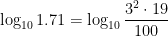





![\sqrt[19]{25727} \approx 1.71](https://s0.wp.com/latex.php?latex=%5Csqrt%5B19%5D%7B25727%7D+%5Capprox+1.71&bg=ffffff&fg=000000&s=0&c=20201002) . You can imagine my sheer delight when we checked my answer with a calculator:
. You can imagine my sheer delight when we checked my answer with a calculator: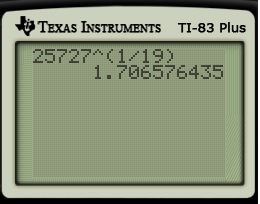
 power). To begin, let’s again go back to a time before the advent of pocket calculators… say, the 1950s.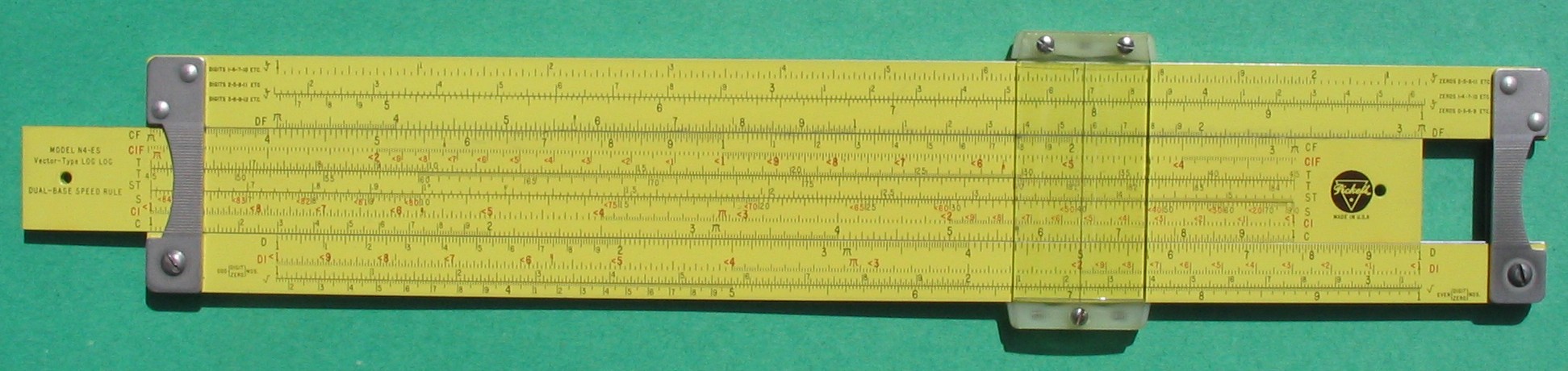
 .
. . The logarithm on the right-hand side can be estimated by looking at a slide rule. Here’s a picture from my slide rule: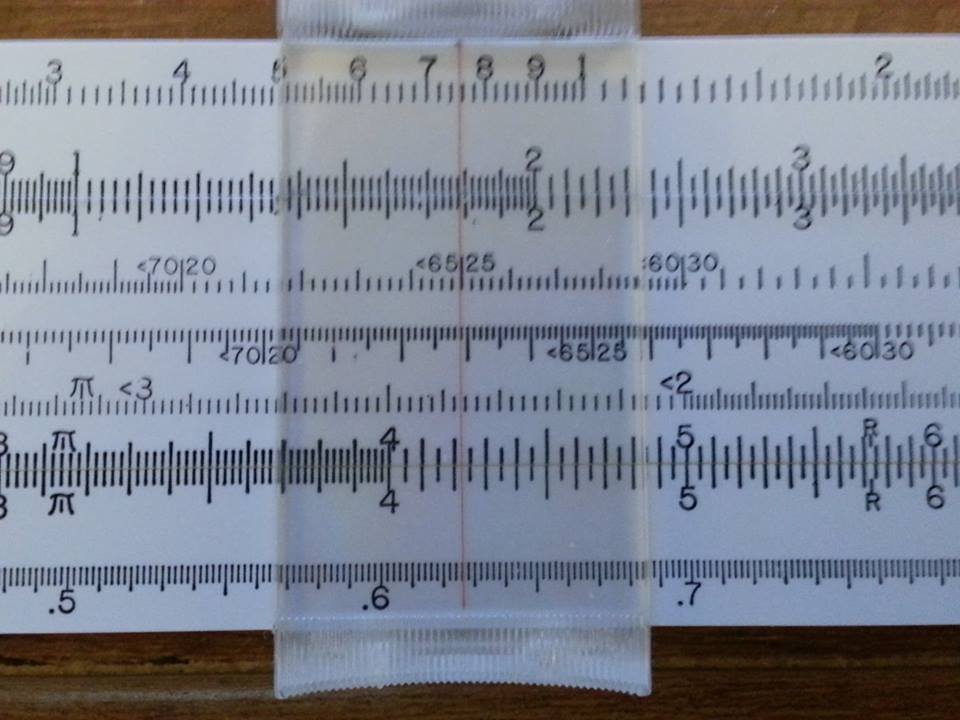
 and
and  ; indeed, the red line is about one-third of way from
  . So we estimate that
  , so that
  .
. . We move the thin red line to a different part of the slide rule: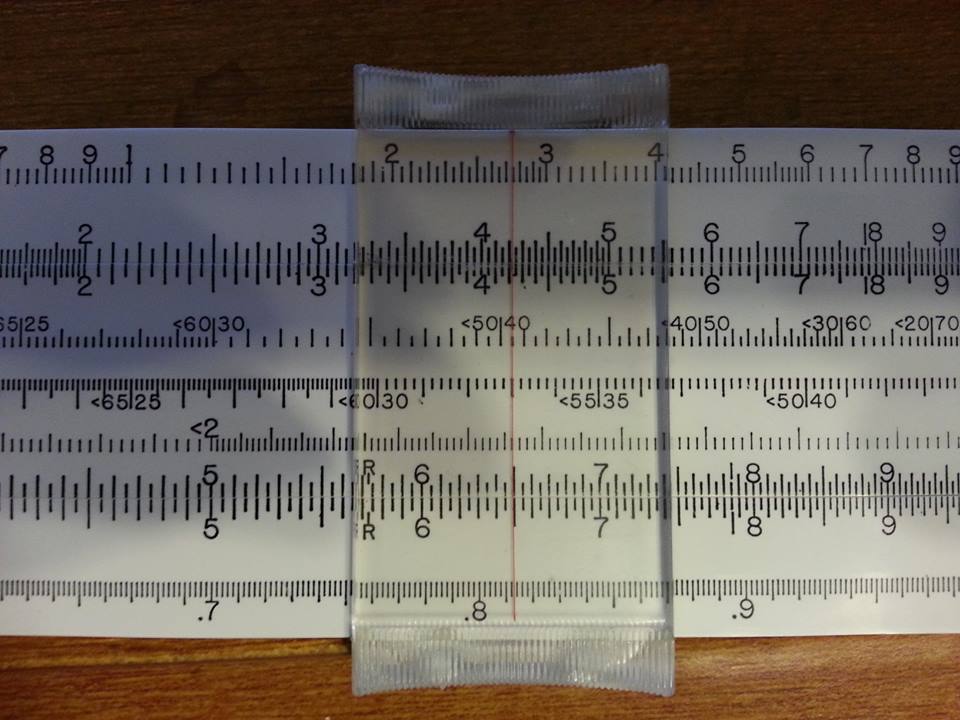
 on the bottom row. On the row above, the red line is lined up almost exactly on
  , but perhaps a little to the left of
  or
or  .
. .
. and
and  on the second line. (FYI, the line repeats itself to the left, so that the user can tell the difference between
  , as before.
 to reasonably high precision. Let’s write
 .
. .
.

 and
and  , so the answer must be between
  .
. , we see from the table that
 and
and 
 and
and  , and find the point on the line whose
  coordinate is
  . Finding this line is a straightforward exercise in the



 . Thus, so far in the calculation, we have

 . For the second-part, we use the log table again, but in reverse. We try to find the numbers that are closest to
  in the body of the table. In our case, we find that
 and
and  .
. and
and  , except this time the
  coordinate of



 . Therefore,
 , rounding at the hundredths digit. Not bad, for a generation born before the advent of calculators.





 and that
  . But it doesn’t reflexively occur to them that these laws can be used to rewrite
  .
. , their first thought is to plug into a calculator to get the answer, not to reflect and realize that the answer, whatever it is, has to be between
  , or
, or  .
. appears on the row marked
  and the column marked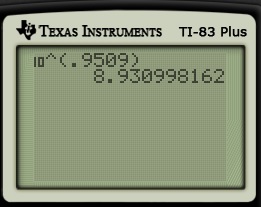
 , or find the value of
  between
 and
and 
 is known and the value of





 This matches the result of a modern calculator to four significant digits: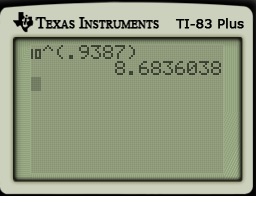
 Mean Green Math