Engaging students: Order of operations

In my capstone class for future secondary math teachers, I ask my students to come up with ideas for engaging their students with different topics in the secondary mathematics curriculum. In other words, the point of the assignment was not to devise a full-blown lesson plan on this topic. Instead, I asked my students to think about three different ways of getting their students interested in the topic in the first place.

I plan to share some of the best of these ideas on this blog (after asking my students’ permission, of course).

This student submission comes from my former student Alyssa Dalling. Her topic, from Pre-Algebra: order of operations.

green line

C. How has this topic appeared in pop culture (movies, TV, current music, video games, etc.)?

Hannah Montana is a Disney series that aired from 2006-2011. On this episode titled “Sleepwalk This Way”, Miley’s dad writes her a new song which she reads and doesn’t like. She decides to keep her dislike of the new song to herself causing her to start sleepwalking. In order to not tell her dad what she thinks of the song while sleepwalking, Miley stops sleeping which causes her many problems. One such problem occurs when Miley gets dressed in the wrong order causing her to get an unwanted result.

I would start out the class by showing the first 46 seconds of this Hannah Montana scene. (Editor’s note: Trust me, this is hilarious.) This scene is perfect for the engage because it is a way to relate the order of operations to getting dressed. After watching the scene, the teacher would explain that just like getting dressed in the proper order is important, the order of operations when doing math is as well. The students would learn PEMDAS (parenthesis, exponents, multiplication, division, addition, and subtraction) and try different problems to get them better acquainted with the concept.

green line

B. How can this topic be used in your students’ future courses in mathematics or science?

The order of operations will be used in almost every math class following Pre-Algebra. One example is in Algebra II when students start working with problems involving simplifying numbers and multiple variables. One example is

\left( \displaystyle \frac{18a^{4x} b^2}{-6 a^x b^5} \right)^3

Start out the class by asking students how the order of operations says to answer this question.  Most students will follow method two below. Upon completion of this lesson, students will learn multiple methods of problem solving which expand their previous knowledge of order of operations.

The first method students can use is to raise the numerator and denominator to the third power before simplifying. By raising each variable to the third power, no rules in the order of operations will be broken showing the student there is more than one way to use the order of operations. (Reference Method One below).

The method most students will originally think of is simplifying the fraction before raising it to the third power. The student would follow their previous knowledge of PEMDAS in order to simplify the equation to the reduced form. (Reference Method Two below). In either case, the students will see that the solution can be found by using a variety of different means that all fall under the order of operations.

Method One:

Alyssa_order1

Method Two:

Alyssa_order2

Resources: http://www.glencoe.com/sec/math/algebra/algebra2/algebra2_05/extra_examples/chapter5/lesson5_1.pdf

green line

B. How can this topic be used in your students’ future courses in mathematics or science?

An understanding of the order of operations is relied upon in Calculus as well. One application is when learning the chain rule. The following YouTube video does a fun job at explaining the chain rule by using a catchy song. The students are able to learn the rule and see examples that they can use to help them with this concept. Start it at 1:32 and end it at 2:10 (shown below).

The chain rule is used to find the derivative of the composition of two functions. So if f and g are functions, then the derivative of f(g(x)) can be found using the chain rule. Using the example F(x) = (x^3+5x)^2 , the chain rule states that the derivative will be F'(x) = f'(z) g'(x). Following this definition, the student finds the derivative to be 2(x^3+5x)(3x^2+5) . This is where the order of operations comes in. The student must use their previously acquired skills from Pre-Algebra as well as Algebra II to simplify the expression. From their previously acquired knowledge, the student would know they would have to multiply the 2 by each expression in f'(z). Also, if a question asked the student to find the derivative when x=3, the student would have to use their knowledge of the order of operations to find the solution after applying the chain rule.

Resources: http://archives.math.utk.edu/visual.calculus/2/chain_rule.4/index.html


Engaging students: Finding x- and y-intercepts

In my capstone class for future secondary math teachers, I ask my students to come up with ideas for engaging their students with different topics in the secondary mathematics curriculum. In other words, the point of the assignment was not to devise a full-blown lesson plan on this topic. Instead, I asked my students to think about three different ways of getting their students interested in the topic in the first place.

I plan to share some of the best of these ideas on this blog (after asking my students’ permission, of course).

This student submission again comes from my former student Maranda Edmonson. Her topic, from Algebra: finding x- and y-intercepts. Unlike most student submissions, Maranda’s idea answers three different questions at once.


green lineApplications: How could you as a teacher create an activity or project that involves your topic?

Culture: How has this topic appeared in pop culture (movies, TV, current music, video games, etc.)?

Technology: How can technology be used to effectively engage students with this topic?

This link is to a reflection by a mathematics teacher who used the popular TV show “The Big Bang Theory” to teach linear functions. She taught this lesson prior to teaching students about finding y-intercepts of linear functions, but it can be adapted in order to teach how to find the intercepts themselves.

ENGAGE:

One thing I would not change would be to show the students the above clip of the show where Howard and Sheldon are heatedly discussing crickets at the beginning of the activity. By showing the video at the beginning, students will be engaged and want to figure out what will be done throughout the lesson. Being a clip of a popular show that many probably watch during the week, students will be even more engaged and interested since they are able to watch something that they are already familiar with. Being something that they are already familiar with or can relate to, students have a tendency to remember the material or at least the topic longer than they would remember something that they were unfamiliar with or could not relate.

In the clip, Sheldon argues that the cricket the guys hear while eating dinner is a snowy tree cricket based on the temperature of the room and the frequency of chirps; Howard argues that it is an ordinary field cricket.  The beginning of their discussion is as follows:

Sheldon: “Based on the number of chirps per minute, and the ambient temperature in this room, it is a snowy tree cricket.”

Howard: “Oh, give me a frickin’ break. How could you possibly know that?”

Sheldon: “In 1890, Amos Dolbear determined that there was a fixed relationship between the number of chirps per minute of the snowy tree cricket and the ambient temperature – a precise relationship that is not present with ordinary field crickets.”

The whole episode revolves around the guys finding the exact genus and species of the cricket, but that is not the importance here. The importance of this clip is the linear relationship between the temperature and the number of chirps per minute of the cricket, which the activity should then be centered around.

EXPLORE:

After showing the short clip, it could be beneficial to show students the Wikipedia link that discusses Dolbear’s Law. Toward the bottom of the page, the relationship is written out in several formats, but there is a basic linear function that students could focus on for the activity.

Assuming students know how to graph linear functions (as stated above, the link is for a lesson the teacher taught before teaching students about y-intercepts), I would have students graph Dolbear’s Law on a piece of graph paper. The challenge would be for students to find out what happens when there are variations to the number of chirps of the cricket, the temperature or both to see how the graph changes – specifically where the graph crosses each axis.

 EXPLAIN/ELABORATE/EVALUATE:

At this point, students should be able to state what changes they noticed with the graph – specifically where the graph crossed the axes as changes are made to the function. After they have explained what they found, fill in any gaps and correct vocabulary as needed. Basically, teach what little there is left for the lesson. Follow-up by providing extra examples or a worksheet for students to practice before giving them a quiz or test to assess their performance.

Non-geometric infinite series (Part 12)

I conclude this series of posts with thoughts about infinite series which use reciprocals of positive integers. I offer this post for the enrichment of talented Precalculus students who have exhibited mastery of geometric series.

Geometric. As we’ve discussed at length, the series

1 + \displaystyle \frac{1}{2} + \frac{1}{4} + \frac{1}{8} + \frac{1}{16} + \dots

converges and is in fact equal to 2.

Harmonic. Including the reciprocals of all positive integers is called a harmonic series:

1 + \displaystyle \frac{1}{2} + \frac{1}{3} + \frac{1}{4} + \frac{1}{5} + \dots

As shown in the link to the MathWorld website, this series actually diverges, even though the terms get smaller and smaller.

So we’ve made an observation: if too many reciprocals are included, the series diverges. But if we take enough of them away, then we can still end up with a series that is infinite but converges.

Squares. Let’s now consider the reciprocals of perfect squares:

1 + \displaystyle \frac{1}{4} + \frac{1}{9} + \frac{1}{16} + \frac{1}{25} + \dots

Clearly, we’ve taken away a lot of the terms of the harmonic series? Have we taken enough away so that the series converges? It turns out that the answer is yes. And the answer is precisely what you’d think it should be (not): \pi^2/6. This is just another way that the circumference of a circle has an odd way of appearing in the most unexpected of places.

The proof that this series equals \pi^2/6 requires the clever use of Parseval’s theorem from Fourier analysis.

Fourth Powers. Let’s now turn to the reciprocals of fourth powers:

1 + \displaystyle \frac{1}{16} + \frac{1}{81} + \frac{1}{256} + \frac{1}{625} + \dots

By the Direct Comparison Test and the series for reciprocals of squares, this series converges. Using Parseval’s theorem, it can be shown that the answer is \pi^4/90.

Cubes. Now let’s investigate the reciprocals of cubes:

1 + \displaystyle \frac{1}{8} + \frac{1}{27} + \frac{1}{64} + \frac{1}{125} + \dots

Again by the Direct Comparison Test and the series for reciprocals for squares, this series must converge. This sum is called Apéry’s constant.  However, and amazingly, no one knows what the answer is. Of course, a computer can be programmed to evaluate this series to as many decimal places as desired. According to Wikipedia, this sum was evaluated to over 100 billion decimal places in 2010. However, to the best of my knowledge, no one has figured out if there’s a simple way of writing the answer, like \pi^2/6 or \pi^4/90.

So if you figure out a simple way to evaluate Apéry’s constant, feel free to call me collect.

The previous four series are example of Riemann’s zeta function, which is of central importance in number theory and is the focus of the celebrated Riemann Hypothesis, for which a solution is worth a cool $1 million.

Primes. Now let’s consider the reciprocals of primes:

\displaystyle \frac{1}{2} + \frac{1}{3} + \frac{1}{5} + \frac{1}{7} + \frac{1}{11} + \dots

As noted above, the harmonic series diverges, but if we remove enough terms from the harmonic series, then it’s possible to make an infinite series that converges. So the central question is, did we remove enough fractions (by taking away all of the composite denominators) so that the series converges?

Surprisingly, the answer is no: the sum of the reciprocals of the primes actually diverges. The proof actually requires a graduate-level class in analytic number theory.

green line

By no means would I expect high school students to master all of the above facts. As noted above, the subject of this post is mostly for the enrichment of high school students who have mastered infinite geometric series.

That said, students who know the following facts from Precalculus will be well-served when they reach calculus and other university-level mathematics courses.

  • They should either know the formula for an infinite geometric series or else be able to quickly derive it.
  • They should know that not every infinite geometric series is geometric.
  • They should know that not every infinite series converges.
  • They should be familiar with the meaning of the terms converge and diverge.

Formula for an infinite geometric series (Part 11)

Many math majors don’t have immediate recall of the formula for an infinite geometric series. They often can remember that there is a formula, but they can’t recollect the details. While it’s I think it’s OK that they don’t have the formula memorized, I think is a real shame that they’re also unaware of where the formula comes from and hence are unable to rederive the formula if they’ve forgotten it.

In this post, I’d like to give some thoughts about why the formula for an infinite geometric series is important for other areas of mathematics besides Precalculus. (There may be others, but here’s what I can think of in one sitting.)

1. An infinite geometric series is actually a special case of a Taylor series. (See https://meangreenmath.com/2013/07/05/reminding-students-about-taylor-series-part-5/ for details.) Therefore, it would be wonderful if students learning Taylor series in Calculus II could be able to relate the new topic (Taylor series) to their previous knowledge (infinite geometric series) which they had already seen in Precalculus.

2. An infinite geometric series is also a special case of the binomial series (1+x)^n, when n does not have to be a positive integer and hence Pascal’s triangle cannot be used to find the expansion.
3. Infinite geometric series is a rare case when an infinite sum can be found exactly. In Calculus II, a whole battery of tests (e.g., the Root Test, the Ratio Test, the Limit Comparison Test) are introduced to determine whether a series converges or not. In other words, these tests only determine if an answer exists, without determining what the answer actually is.

Throughout the entire undergraduate curriculum, I’m aware of only four types of series that can actually be evaluated exactly.

  • An infinite geometric series with -1 < r < 1
  • The Taylor series of a real analytic function. (Of course, an infinite geometric series is a special case of a Taylor series.)
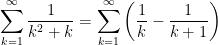
  • A telescoping series. For example, using partial fractions and cancelling a bunch of terms, we find that

\displaystyle \sum_{k=1}^\infty \frac{1}{k^2+k} = \displaystyle \sum_{k=1}^\infty \left( \frac{1}{k} - \frac{1}{k+1} \right)

\displaystyle \sum_{k=1}^\infty \frac{1}{k^2+k} = \displaystyle \left( 1 - \frac{1}{2} \right) + \left( \frac{1}{2} - \frac{1}{3} \right) \dots

\displaystyle \sum_{k=1}^\infty \frac{1}{k^2+k} = 1

4. Infinite geometric series are essential for proving basic facts about decimal representations that we often take for granted.

5. Properties of an infinite geometric series are needed to find the mean and standard deviation of a geometric random variable, which is used to predict the number of independent trials needed before an event happens. This is used for analyzing the coupon collector’s problem, among other applications.

Formula for an infinite geometric series (Part 10)

I conclude this series of posts by considering the formula for an infinite geometric series. Somewhat surprisingly (to students), the formula for an infinite geometric series is actually easier to remember than the formula for a finite geometric series.

One way of deriving the formula parallels the derivation for a finite geometric series. If a_1, a_2, a_3, \dots are the first terms of an infinite geometric sequence, let

S = a_1 + a_2 + a_3 + \dots

Recalling the formula for an geometric sequence, we know that

a_2 = a_1 r

a_3 = a_1 r^2

\vdots

Substituting, we find

S = a_1 + a_1 r+ a_1 r^2 \dots

Once again, we multiply both sides by -r.

-rS = -a_1r - a_1 r^2- a_1 r^3 \dots

Next, we add the two equations. Notice that almost everything cancels on the right-hand side… except for the leading term a_1.  (Unlike yesterday’s post, there is no “last” term that remains since the series is infinite.) Therefore,

S - rS = a_1

S(1-r) = a_1

S = \displaystyle \frac{a_1}{1-r}

A quick pedagogical note: I find that this derivation “sells” best to students when I multiply by -r and add, as opposed to multiplying by r and subtracting.

green line

The above derivation is helpful for remembering the formula but glosses over an extremely important detail: not every infinite geometric series converges. For example, if a_1 = 1 and r = 2, then the infinite geometric series becomes

1 + 2 + 4 + 8 + 16 + \dots,

which clearly does not have a finite answer. We say that this series diverges. In other words, trying to evaluate this sum makes as much sense as trying to divide a number by zero: there is no answer.

That said, it can be shown that, as long as -1 < r < 1, then the above geometric series converges, so that

a_1 + a_1 r + a_1 r^2 + \dots = \displaystyle \frac{a_1}{1-r}

The formal proof requires the use of the formula for a finite geometric series:

a_1 + a_1 r + a_1 r^2 + \dots + a_1 r^{n-1} = \displaystyle \frac{a_1(1-r^n)}{1-r}

We then take the limit as n \to \infty:

\displaystyle \lim_{n \to \infty} a_1 + a_1 r + a_1 r^2 + \dots + a_1 r^{n-1} = \displaystyle \lim_{n \to \infty} \frac{a_1(1-r^n)}{1-r}

a_1 + a_1 r + a_1 r^2 + \dots = \displaystyle \lim_{n \to \infty} \frac{a_1(1-r^n)}{1-r}

On the right-hand side, the only piece that contains an n is the term r^n. If -1 < r < 1, then r^n \to 0 as n \to \infty. (This limit fails, however, if r \ge 1 or r \le -1.) Therefore,

a_1 + a_1 r + a_1 r^2 + \dots = \displaystyle \lim_{n \to \infty} \frac{a_1(1-0)}{1-r} = \displaystyle \frac{a_1}{1-r}

Formula for an infinite geometric series (Part 9)

I continue this series of posts by considering the formula for an infinite geometric series. Somewhat surprisingly (to students), the formula for an infinite geometric series is actually easier to remember than the formula for a finite geometric series.

One way of deriving the formula parallels yesterday’s post. If a_1, a_2, a_3, \dots are the first terms of an infinite geometric sequence, let

S = a_1 + a_2 + a_3 + \dots

Recalling the formula for an geometric sequence, we know that

a_2 = a_1 r

a_3 = a_1 r^2

\vdots

Substituting, we find

S = a_1 + a_1 r+ a_1 r^2 \dots

For example, if a_1 = \displaystyle \frac{1}{2} and r = \displaystyle \frac{1}{2}, we have

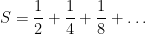
S = \displaystyle \frac{1}{2} + \frac{1}{4} + \frac{1}{8} + \dots

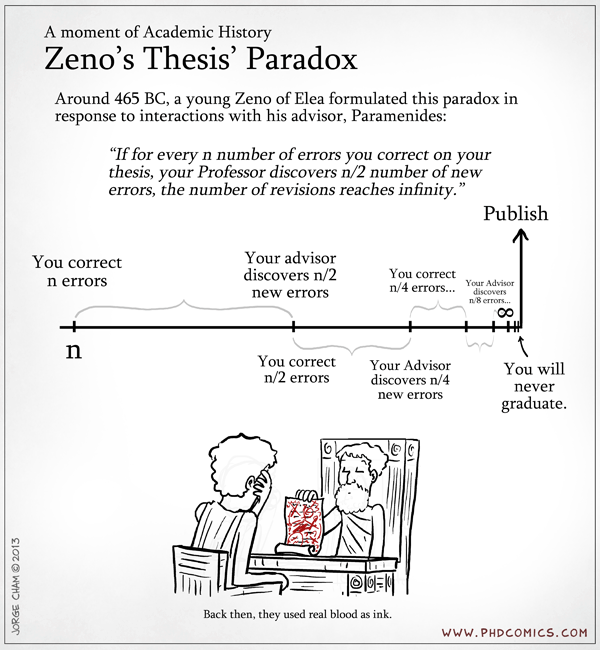
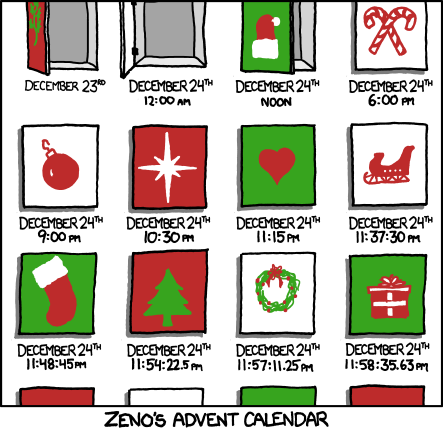
This is perhaps the world’s most famous infinite series, as this is the subject of Zeno’s paradox. When I teach infinite series in class, I often engage the students by reminding students about Zeno’s paradox and then show them this clip from the 1994 movie I.Q.

This clip is almost always a big hit with my students.

Even after showing this clip, some students resist the idea that an infinite series can have a finite answer. For such students, I use a physical demonstration: I walk half-way across the classroom, then a quarter, and so on… until I walk head-first into a walk at full walking speed. The resulting loud thud usually confirms for students that an infinite sum can indeed have a finite answer.

green line

P.S. PhD Comics recently had a cartoon concerning Zeno’s paradox. Source: http://www.phdcomics.com/comics/archive.php?comicid=1610

phd071913s_zeno

Here’s another one. Source: http://www.xkcd.com/994/

xkcdadvent_calendar

Formula for a finite geometric series (Part 8)

As I’ve said before, I’m not particularly a fan of memorizing formulas. Apparently, most college students aren’t fans either, because they often don’t have immediate recall of certain formulas from high school when they’re needed in the collegiate curriculum.

While I’m not a fan of making students memorize formulas, I am a fan of teaching students how to derive formulas. Speaking for myself, if I ever need to use a formula that I know exists but have long since forgotten, the ability to derive the formula allows me to get it again.

Which leads me to today’s post: the derivation of the formulas for the sum of a finite geometric series. This topic is commonly taught in Precalculus but, in my experience, is often forgotten by students years later when needed in later classes.

green lineLike its counterpart for arithmetic series, the formula for a finite geometric series can be derived using the patented Bag of Tricks. Socrates gave the Bag of Tricks to Plato, Plato gave it to Aristotle, it passed down the generations, my teacher taught the Bag of Tricks to me, and I teach it to my students.

If a_1, \dots, a_n are the first n terms of an geometric sequence, let

S = a_1 + a_2 + a_3 + \dots + a_{n-1} + a_n

Recalling the formula for an geometric sequence, we know that

a_2 = a_1 r

a_3 = a_1 r^2

\vdots

a_{n-1} = a_1 r^{n-2}

a_n = a_1 r^{n-1}

Substituting, we find

S = a_1 + a_1 r+ a_1 r^2 \dots + a_1 r^{n-2} + a_1 r^{n-1}

At this point, we use something different from the patented Bag of Tricks: we multiply both sides by -r.

-rS = -a_1r - a_1 r^2- a_1 r^3 \dots - a_1 r^{n-1} - a_1 r^n

Next, we add the two equations. Notice that almost everything cancels on the right-hand side. The a_1 r cancel, the a_1 r^2 cancel, yada yada yada, and the a_1 r^{n-1} cancel. The only terms that remain are a_1 and -a_1 r^n. So

S - rS = a_1 - a_1 r^n

S(1-r) = a_1 (1- r^n)

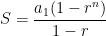
S = \displaystyle \frac{a_1 ( 1-r^n) }{1-r}

A quick pedagogical note: I find that this derivation “sells” best to students when I multiply by -r and add, as opposed to multiplying by r and subtracting.

green line

This formula is also a straightforward consequence of the factorization formula

x^n - y^n = (x-y)(x^{n-1} + x^{n-2} y + \dots +x y^{n-2} + y^{n-1})

Just let x=1 and y=r, and then multiply both sides by the first term a_1.

However, in my experience, most students don’t have instant recall of this formula either. They can certainly remember the formula for the difference of two squares (which is a special case of the above formula), but they often can’t remember that the difference of two cubes has a formula. (And, while I’m on the topic, they also can’t remember that the sum of two cubes can always be factored.)

green line

Pedagogically, the most common mistake that I see students make when using this formula is using the wrong exponent on the right-hand side. For example, suppose the problem is to simplify

48 +24+ 12 + 6 + 3 + 1.5 + 0.75 + 0.375

Here’s the common mistake: student solve for n using the formula for a geometric sequence. They solve for the unknown exponent (often using logarithms) and find that 0.375 = 48 (0.5)^7. They conclude that n=7, and then plug into for formula for a geometric series:

S = \displaystyle \frac{48 ( 1-(0.5)^7) }{1-0.5} = 95.25 (incorrect)

This answer is clearly wrong, since the sum of the original series must have a 5 in the thousandths place. The answer 95.25 is the correct answer to the wrong question — that’s the sum of the first seven terms of the sequence (stopping at 0.75), but the original series has eight terms. Using the formula correctly, we find

S = \displaystyle \frac{48 ( 1-(0.5)^8) }{1-0.5} = 95.625 (correct)

Not surprisingly, the difference between the incorrect and correct answers is 0.375, the eighth term.

To help students avoid this mistake, I re-emphasize that the number n stands for the number of terms in the series. In particular, it does not mean the exponent needed to give the last term in the series. That exponent, of course, is n-1, not n.

Formula for an arithmetic series (Part 7)

As we’ve discussed, the formula for an arithmetic series is

S_n = \displaystyle \frac{n}{2} (2a_1 + [n-1] d) = \displaystyle \frac{n}{2} (a_1 + a_n),

where n is the number of terms, a_1 is the first term, d is the common difference, and a_n is the last term. This formula may be more formally expressed as

S = \displaystyle \sum_{k=1}^n a_k = \displaystyle \frac{n}{2} (2a_1 + [n-1] d) = \displaystyle \frac{n}{2} (a_1 + a_n)

For homework and on tests, students are asked to directly plug into this formula and to apply this problem with word problems, like finding the total number of seats in an auditorium with 50 rows, where there are 12 seats in the front row and each row has two more seats than the row in front of it.

In my opinion, the ability to solve questions like the one below is the acid test for determining whether a student — who I assume can solve routine word problems like the one above — really understands series or is just familiar with series. In other words, if a student can solve routine word problems but is unable to handle a problem like the one below, then there’s still room for that student’s knowledge of series to deepen.

Calculate \displaystyle \sum_{k=11}^{60} (5k - 2)

There are two reasonable approaches for solving this problem.

Solution #1. Notice that 5k - 2 = 5(k-1) + 5 - 2 = 3 + 5(k-1). So this is really an arithmetic series whose first term is 3 and whose common difference is 5. Therefore,

S = \displaystyle \sum_{k=1}^{60} a_k = \displaystyle \frac{60}{2} (2[3] + [60-1] 5)=9030

However, I’m supposed to start the series on k=11, not k=1. That means that I need to subtract off the first ten terms of the above series. Now

S = \displaystyle \sum_{k=1}^{10} a_k = \displaystyle \frac{10}{2} (2[3] + [10-1] 5)= 255

Finally,

\displaystyle \sum_{k=11}^{60} a_k = \displaystyle \sum_{k=1}^{60} a_k - \displaystyle \sum_{k=1}^{10} a_k = 9030 - 255 = 8775

green line

Solution #2. Writing out the terms, we see that

\displaystyle \sum_{k=11}^{60} (5k - 2) = (5[11]-2) + (5[12]-2) + \dots + (5[60]-2)

or

\displaystyle \sum_{k=11}^{60} (5k - 2) = 53+58 + \dots +298

The right-hand side is an arithmetic series whose “first” term is 53 and whose last (50th) term is 298. Therefore,

\displaystyle \sum_{k=11}^{60} (5k - 2) = \frac{50}{2} (53+298) = 8775

green line

Of the two solutions, I suppose I have a mild preference for the first, as the second solution won’t work for something like \displaystyle \sum_{k=11}^{60} k^2. However, both solution demonstrate that the student is actually thinking about the meaning of the series instead of just plugging numbers in a formula, and so I’d be happy with either one in a Precalculus class.

Formula for an arithmetic series (Part 6)

In the previous posts of this series, I described two methods of deriving the formula

\displaystyle \sum_{k=1}^n k = \frac{n(n+1)}{2}

The first method concerned reversing the terms of the sum (or, almost equivalently, taking the terms in pairs). The second method used mathematical induction.

Mathematical induction can be applied to arithmetic series as well as other series. However, the catch is that you have to know the answer before proving that the answer actually is correct. By contrast, the first method did not require us to know the answer in advance — it just fell out of the calculation — but it cannot be applied to series that are not arithmetic.

Here’s a third method using the principle of telescoping series. This method has the strengths of the previous two methods: it does not require us to know the answer in advance, and it can also be applied to some other series which are not arithmetic.

To begin, consider the sum

\displaystyle \sum_{k=1}^n [k^2 - (k-1)^2]

At this early point, students often object, “Where did that come from?” I’ve said it before but I’ll say it again: I tell them my usual tongue-in-cheek story that this idea comes from the patented Bag of Tricks. Socrates gave the Bag of Tricks to Plato, Plato gave it to Aristotle, it passed down the generations, my teacher taught the Bag of Tricks to me, and I teach it to my students.

In any event, I will evaluate this sum in two different ways.

Step 1. Just write out the terms of the series, starting from k=1 and ending with k =n.

\displaystyle \sum_{k=1}^n [k^2 - (k-1)^2] = [1^2 - 0^2] + [2^2 - 1^2] + [3^2 - 2^2] + \dots + [n^2 - (n-1)^2]

Notice that, on the right-hand side, the 1^2 terms cancel, the 2^2 terms cancel, and so on. In fact, almost everything cancels. The only two terms that aren’t cancelled are the 0^2 and n^2 terms. Therefore,

\displaystyle \sum_{k=1}^n [k^2 - (k-1)^2] = n^2 - 0^2 = n^2

Step 2. Next, we’ll rewrite the original sum by expanding out the terms inside of the sum:

\displaystyle \sum_{k=1}^n [k^2 - (k-1)^2] = \displaystyle \sum_{k=1}^n [k^2 - (k^2 -2k + 1)]

\displaystyle \sum_{k=1}^n [k^2 - (k-1)^2] = \displaystyle \sum_{k=1}^n [2k-1]

\displaystyle \sum_{k=1}^n [k^2 - (k-1)^2] = \displaystyle \sum_{k=1}^n 2k - \displaystyle \sum_{k=1}^n 1

\displaystyle \sum_{k=1}^n [k^2 - (k-1)^2] = 2\displaystyle \sum_{k=1}^n k - \displaystyle \sum_{k=1}^n 1

Step 3. Of course, these different looking answers from Steps 1 and 2 have to be the same, so let’s set them equal to each other:

2\displaystyle \sum_{k=1}^n k - \displaystyle \sum_{k=1}^n 1 = n^2

There is one unknown in this equation, \displaystyle \sum_{k=1}^n k. The second sum is just the constant 1 added to itself n times, and so \displaystyle \sum_{k=1}^n 1 = n. Therefore, we solve for the unknown:

2 \left(\displaystyle \sum_{k=1}^n k \right) - n = n^2

2 \left(\displaystyle \sum_{k=1}^n k \right) = n^2 + n

\displaystyle \sum_{k=1}^n k = \displaystyle \frac{n^2 + n}{2}

green lineThe beauty of this approach is that this approach can be continued. For example, to obtain \displaystyle \sum_{k=1}^n k^2, we begin with

\displaystyle \sum_{k=1}^n [k^3 - (k-1)^3]

Step 1. By telescoping series,

\displaystyle \sum_{k=1}^n [k^3 - (k-1)^3] = n^3 - 0^3 = n^3

Step 2. Using the binomial theorem,

\displaystyle \sum_{k=1}^n [k^3 - (k-1)^3] = \displaystyle \sum_{k=1}^n [k^3 - (k^3 -3k^2+3k- 1)]

\displaystyle \sum_{k=1}^n [k^2 - (k-1)^2] = 3\displaystyle \sum_{k=1}^n k^2 - 3\displaystyle \sum_{k=1}^n k + \displaystyle \sum_{k=1}^n 1

\displaystyle \sum_{k=1}^n [k^2 - (k-1)^2] = 3\displaystyle \sum_{k=1}^n k^2 - 3\left( \frac{n(n+1)}{2} \right) + n

Step 3. Setting these two expressions equal to each other,

3\displaystyle \sum_{k=1}^n k^2 - 3\left( \frac{n(n+1)}{2} \right) + n= n^3

And we eventually conclude that:

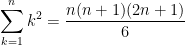
\displaystyle \sum_{k=1}^n k^2 = \displaystyle \frac{n(n+1)(2n+1)}{6}

And then this could be continued to obtain closed-form expressions for higher exponents of k.