Math majors are completely comfortable with the formula for the area of a circle. However, they often tell me that they don’t remember a proof or justification for why this formula is true. And they certainly don’t remember a justification that would be appropriate for showing geometry students.
In this series of posts, I’ll discuss several ways that the area of a circle can be found using calculus. I’ll also discuss a straightforward classroom activity by which students can discover for themselves why .
A circle centered at the origin with radius may be viewed as the region between and . These two functions intersect at and . Therefore, the area of the circle is the integral of the difference of the two functions:
This may be evaluated by using the trigonometric substitution and changing the range of integration to to . Since , we find
We note that the above proof uses the fact that calculus with trigonometric functions must be done with radians and not degrees. In other words, we had to change the range of integration to and not .
In my capstone class for future secondary math teachers, I ask my students to come up with ideas for engaging their students with different topics in the secondary mathematics curriculum. In other words, the point of the assignment was not to devise a full-blown lesson plan on this topic. Instead, I asked my students to think about three different ways of getting their students interested in the topic in the first place.
I plan to share some of the best of these ideas on this blog (after asking my students’ permission, of course).
This student submission comes from my former student Angel Pacheco. His topic, from Precalculus: computing trigonometric functions using a unit circle.
How can this topic be used in your students’ future courses in mathematics or science?
The first course to bring in the unit circle is Pre-Calculus. It is used in a lot in calculus when it comes to finding certain values of trigonometric functions. Knowing how the unit circle works, it allows the students to solve a lot of trigonometric functions on their own. Once students reach college level mathematics, they will learn that the unit circle is a key element to trigonometry. Trigonometry is a huge part of all the calculus courses.
Science contains a lot of trigonometry, mainly physics. The law of sine and cosine allows the students to determine the angle an object is or even how far it is. Being able to use the unit circle to solve for functions, it allows them to use it any subject whether it be a science or a math class. Students or scientists that know how to solve trigonometric functions using the unit circle allows them to compute certain things on paper as opposed to relying on a calculator to do all the work.
How can technology (YouTube, Khan Academy [khanacademy.org], Vi Hart, Geometers Sketchpad, graphing calculators, etc.) be used to effectively engage students with this topic?
Technology can be used to introduce and also evaluate their content. There are different ways to use technology. One example is using Khan Academy videos to show students how it works or how Khan explains. Students having to look at a video can have them engage on the topic. My personal favorite is to create an exciting video and put it on YouTube. I have noticed that parodies are a popular trend so creating a parody with the unit circle with a popular song will be effective to engaging the students to this topic. The next thing I would use for technology is graphing calculators. I think if the students see that the calculator gives them the same answer as the values they learned from the unit circle, they would be amazed on how the concept of the unit circle is. My classmates and I were in complete shock when we realized how the unit circle worked. My former teacher also had a clock based off of the unit circle so we had to learn it in order to read the time.
How could you as a teacher create an activity or project that involves your topic?
The link below shows a sample lesson that allows the students work in groups to solve trigonometric functions and create a table that shows the solution to certain problems. The students will have a calculator with them that can be used for checking their answers to see if they are on the right track with the assignment. Also, having access to the computers to research particular things that they need for explaining will be acceptable. In my opinion, I feel that there is some tweaking that I recommend making it more effective. I would like to have a website that visually shows the unit circle. If possible, I would like for the students to have a worksheet that allows them to know which steps to follow to ensure that they are on the right track. A great form of assessment will be a quiz following this activity. I feel asking them to draw the unit circle and also solve certain trigonometric functions to see if they understand it. I would also like to like to bring in all six of the functions and show the relation with the unit circle.
Throughout grades K-10, students are slowly introduced to the concept of angles. They are told that there are degrees in a right angle, degrees in a straight angle, and a circle has degrees. They are introduced to and right triangles. Fans of snowboarding even know the multiples of degrees up to or even degrees.
Then, in Precalculus, we make students get comfortable with , , , , , and multiples thereof.
We tell students that radians and degrees are just two ways of measuring angles, just like inches and centimeters are two ways of measuring the length of a line segment.
Still, students are extremely comfortable with measuring angles in degrees. They can easily visualize an angle of , but to visualize an angle of radians, they inevitably need to convert to degrees first. In his book Surely You’re Joking, Mr. Feynman!, Nobel-Prize laureate Richard P. Feynman described himself as a boy:
I was never any good in sports. I was always terrified if a tennis ball would come over the fence and land near me, because I never could get it over the fence – it usually went about a radian off of where it was supposed to go.
Naturally, students wonder why we make them get comfortable with measuring angles with radians.
The short answer, appropriate for Precalculus students: Certain formulas are a little easier to write with radians as opposed to degrees, which in turn make certain formulas in calculus a lot easier.
The longer answer, which Precalculus students would not appreciate, is that radian measure is needed to make the derivatives of and look palatable.
In both of these formulas, the angle must be measured in radians.
Students may complain that it’d be easy to make a formula of is measured in degrees, and they’d be right:
and
However, getting rid of the makes the following computations from calculus a lot easier.
2a. Early in calculus, the limit
is derived using the Sandwich Theorem (or Pinching Theorem or Squeeze Theorem). I won’t reinvent the wheel by writing out the proof, but it can be found here. The first step of the proof uses the formula for the above formula for the area of a circular sector.
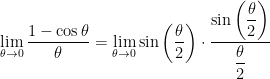
2b. Using the trigonometric identity , we replace by to find
3. Both of the above limits — as well as the formulas for and — are needed to prove that and . Again, I won’t reinvent the wheel, but the proofs can be found here.
So, to make a long story short, radians are used to make the derivatives $y = \sin x$ and $y = \cos x$ easier to remember. It is logically possible to differentiate these functions using degrees instead of radians — see http://www.math.ubc.ca/~feldman/m100/sinUnits.pdf. However, possible is not the same thing as preferable, as calculus is a whole lot easier without these extra factors of floating around.
Far too often, students settle for a numerical approximation of a solution that can be found exactly. To give an extreme example, I have met quite intelligent college students who were convinced that was literally equal to .
That’s an extreme example of something that nearly all students do — round off a complicated answer to a fixed number of decimal places. In trigonometry, many students will compute by plugging into a calculator and reporting the first three to six decimal places, like . This is especially disappointing when there are accessible techniques for getting the exact answer (in this case, ) without using a calculator at all.
Unfortunately, even maintaining eight, nine, or ten decimal places of accuracy may not be good enough, as errors tend to propagate as a calculation continues. I’m sure every math teacher has an example where the correct answer was exactly $\displaystyle\frac{3}{2}$ but students returned an answer of or because of roundoff errors.
Students may ask, “What’s the big deal if I round off to five decimal places?” Here’s a simple example — which can be quickly demonstrated in a classroom — of how such truncation errors can propagate. I’m going to generate a recursive sequence. I will start with . Then I will alternate multiplying by and then subtracting . More mathematically,
if
Here’s what happens exactly:
So, repeating these two steps, the sequence alternates between and .
But looks what happens if I calculate the first twelve terms of this sequence on a calculator.
Notice that by the time I reach , the terms of the sequence are negative, which is clearly incorrect.
So what happened?
This is a natural by-product of the finite storage of a calculator. The calculator doesn’t store infinitely many digits of $\displaystyle \frac{1}{3}$ in memory because a calculator doesn’t possess an infinite amount of memory. Instead, what gets stored is something like the terminating decimal , with about fourteen s. (Of course, only the first ten digits are actually displayed.)
So multiplying by and then subtracting produces a new and different terminating decimal with three less s. Do this enough times, and you end up with negative numbers.
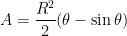
Is calculus really necessary for obtaining a Taylor series? Years ago, while perusing an old Schaum’s outline, I found a very curious formula for the area of a circular segment:
The thought occurred to me that was the first term in the Taylor series expansion of about , and perhaps there was a way to use this picture to generate the remaining terms of the Taylor series.
This insight led to a paper which was published in College Mathematics Journal: cmj38-1-058-059. To my surprise and delight, this paper was later selected for inclusion in The Calculus Collection: A Resource for AP and Beyond, which is a collection of articles from the publications of Mathematical Association of America specifically targeted toward teachers of AP Calculus.
Although not included in the article, it can be proven that this iterative method does indeed yield the successive Taylor polynomials of , adding one extra term with each successive step.
I carefully scaffolded these steps into a project that I twice assigned to my TAMS precalculus students. Both semesters, my students got it… and they were impressed to know the formula that their calculators use to compute . So I think this project is entirely within the grasp of precocious precalculus students.
I personally don’t know of a straightforward way of obtaining the expansion of without calculus. However, once the expansion of is known, the expansion of can be surmised without calculus. To do this, we note that
Truncating the series after terms and squaring — and being very careful with the necessary simplifications — yield the first terms in the Taylor series of .


![A = \displaystyle \int_{-r}^r \left[g(x) - f(x) \right] \, dx= \displaystyle \int_{-r}^r 2 \sqrt{r^2 - x^2} \, dx](https://s0.wp.com/latex.php?latex=A+%3D+%5Cdisplaystyle+%5Cint_%7B-r%7D%5Er+%5Cleft%5Bg%28x%29+-+f%28x%29+%5Cright%5D+%5C%2C+dx%3D+%5Cdisplaystyle+%5Cint_%7B-r%7D%5Er+2+%5Csqrt%7Br%5E2+-+x%5E2%7D+%5C%2C+dx&bg=ffffff&fg=000000&s=0&c=20201002)


![A = \displaystyle r^2 \left[ \theta + \frac{1}{2} \sin 2\theta \right]_{-\pi/2}^{\pi/2}](https://s0.wp.com/latex.php?latex=A+%3D+%5Cdisplaystyle+r%5E2+%5Cleft%5B+%5Ctheta+%2B+%5Cfrac%7B1%7D%7B2%7D+%5Csin+2%5Ctheta+%5Cright%5D_%7B-%5Cpi%2F2%7D%5E%7B%5Cpi%2F2%7D&bg=ffffff&fg=000000&s=0&c=20201002)
![A = \displaystyle r^2 \left[ \left( \displaystyle \frac{\pi}{2} + \frac{1}{2} \sin \pi \right) - \left( - \frac{\pi}{2} + \frac{1}{2} \sin (-\pi) \right) \right]](https://s0.wp.com/latex.php?latex=A+%3D+%5Cdisplaystyle+r%5E2+%5Cleft%5B+%5Cleft%28+%5Cdisplaystyle+%5Cfrac%7B%5Cpi%7D%7B2%7D+%2B+%5Cfrac%7B1%7D%7B2%7D+%5Csin+%5Cpi+%5Cright%29+-+%5Cleft%28+-+%5Cfrac%7B%5Cpi%7D%7B2%7D+%2B+%5Cfrac%7B1%7D%7B2%7D+%5Csin+%28-%5Cpi%29+%5Cright%29+%5Cright%5D&bg=ffffff&fg=000000&s=0&c=20201002)
![[-\pi/2,\pi/2]](https://s0.wp.com/latex.php?latex=%5B-%5Cpi%2F2%2C%5Cpi%2F2%5D&bg=ffffff&fg=000000&s=0&c=20201002)
![[-90^o, 90^o]](https://s0.wp.com/latex.php?latex=%5B-90%5Eo%2C+90%5Eo%5D&bg=ffffff&fg=000000&s=0&c=20201002)
 degrees in a right angle,
  degrees in a straight angle, and a circle has
  degrees. They are introduced to
  and
and  right triangles. Fans of snowboarding even know the multiples of
  or even
  degrees.
 ,
,  ,
,  ,
,  ,
,  , and multiples thereof.
 , but to visualize an angle of
  radians, they inevitably need to convert to degrees first. In his book
  and
and  look palatable.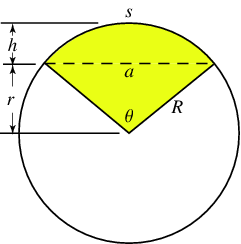
 in a circle with radius

 and
and 
 makes the following computations from calculus a lot easier.
 , we replace
  by
by  to find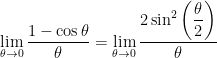


 and
and  — are needed to prove that
  and
and 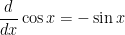 . Again, I won’t reinvent the wheel, but the proofs can be found
  floating around.
 using trig identities.


 .
. is in the first quadrant,


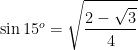

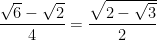 ,
, was literally equal to
  .
. by plugging into a calculator and reporting the first three to six decimal places, like
  . This is especially disappointing when there are accessible techniques for getting the exact answer (in this case,
  ) without using a calculator at all.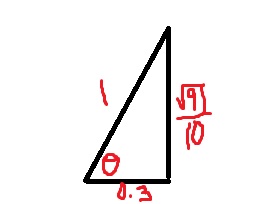

 or
or  because of roundoff errors.
 and then subtracting
  . More mathematically,

 if
if 


 .
.
 , the terms of the sequence are negative, which is clearly incorrect.
 , with about fourteen
  s. (Of course, only the first ten digits are actually displayed.)
 about
about  , and perhaps there was a way to use this picture to generate the remaining terms of the Taylor series.
 without calculus. However, once the expansion of
 terms and squaring — and being very careful with the necessary simplifications — yield the first
  Mean Green Math