Engaging students: Solving for unknown parts of triangles and rectangles

In my capstone class for future secondary math teachers, I ask my students to come up with ideas for engaging their students with different topics in the secondary mathematics curriculum. In other words, the point of the assignment was not to devise a full-blown lesson plan on this topic. Instead, I asked my students to think about three different ways of getting their students interested in the topic in the first place.

I plan to share some of the best of these ideas on this blog (after asking my students’ permission, of course).

This student submission comes from my former student Michelle McKay. Her topic, from Algebra I: solving for unknown parts of triangles and rectangles.

green line

A. How could you as a teacher create an activity or project that involves your topic?

There are several different ideas that immediately come to mind on how to center a lesson around solving for unknown parts of rectangles and triangles. I would like to focus on and describe one. For this particular lesson, the student will start by making a prediction of which side(s) of a shape (triangle or rectangle) has the greatest length. Then, with a partner, they will use rulers and a handout to record the dimensions of both shapes. On the handout, they will work to fill out the chart provided. Then, we will reconvene as a class and talk about the discoveries made. For rectangles, I would ask first about what we found to be consistent for every rectangle. Using what we know, how we could find or solve for the length of one side if we only had certain parts of information? Similarly for triangles, I would begin by asking how each side differed from one another. Did the general shapes of the triangles make a difference? What was special about the right triangles? After these questions, I would introduce Pythagorean’s Theorem and have them solve for the side of triangles without rulers, then follow up with using rulers to verify their information.

green line

D. What interesting things can you say about the people who contributed to the discovery and/or the development of this idea?

Pythagoras of Samos: During Pythagoras’ time, math was considered to be a mixture of both religious and scientific beliefs and was often associated with secret societies and only those of very high social standing. As Pythagoras was one of the more influential mathematicians of his time, most details of his life were kept secret until centuries after his death, leaving very little reliable information to be pieced together in form of a biography. It is generally accepted that he was born on the island of Samos, which is now incorporated into the country of Greece. Little is known about his childhood, but most agree that he was very well educated and was acquainted with geometry before he traveled to Egypt. He was known to be almost sacrosanct and divine to those alive during his time and even a few well after his death. He founded a religious, and simultaneously mathematical, movement called Pythagoreanism, which consisted of two schools of thought: the “learners” and the “listeners”.

green line

D. What are the contributions of various cultures to this topic?

Time Period

Civilization

Contribution

Earliest known references:

23rd Century B.C.

Babylonians

–          Had rules for generating Pythagorean triples.

–          Comprehended the relationship of a right triangle’s sides.

–          Discovered the relationship of \sqrt{2}.


500 – 200 B.C.

Chinese

–          Gives a statement and geometrical demonstration of the Pythagorean Theorem (possibly before Pythagoras’ time).


570 – 495 B.C.

Greek

–          Golden rectangles were very vaguely referenced by Plato.

–          Euclid wrote a clear definition of what a rectangle is.

–          Pythagoras discovered a relationship between the sides of right triangles.


Earliest known references:
800 – 600 B.C.

Indian

–          Pythagorean Theorem was utilized in forming the proper dimensions for religious altars.

It is very hard to for historians to pinpoint with exact certainty which civilization was the first to discover what we know now as the Pythagorean Theorem. Many of the civilizations listed above existed during the same time period, but were geographically located on opposite ends of the map. Also due to loss of information from translations, damaged or completely destroyed texts, these dates and the authenticity of certain contributions are still debated to this day.

 Sources

  1. http://www-history.mcs.st-and.ac.uk/Biographies/Pythagoras.html
  2. http://ualr.edu/lasmoller/pythag.html
  3. http://www-history.mcs.st-and.ac.uk/Biographies/Euclid.html
  4. http://plato.stanford.edu/entries/pythagoreanism/

Engaging students: Vectors in two dimensions

In my capstone class for future secondary math teachers, I ask my students to come up with ideas for engaging their students with different topics in the secondary mathematics curriculum. In other words, the point of the assignment was not to devise a full-blown lesson plan on this topic. Instead, I asked my students to think about three different ways of getting their students interested in the topic in the first place.

I plan to share some of the best of these ideas on this blog (after asking my students’ permission, of course).

This student submission comes from my former student Derek Skipworth. His topic, from Precalculus: vectors in two dimensions.

green line

A. How could you as a teacher create an activity or project that involves your topic?

While it may be a cop-out to use this example since I am developing it for an actual lesson plan, I will go ahead and use it because I feel it is a strong activity.  I am developing a series of 21 problems that will be the base for forming the students’ treasure maps.  There will be three jobs: Cartographer, the map maker; Lie Detector, who checks for orthogonality; and Calculator, who will solve the vector problems.  The 21 problems will be broken down into 7 per page, and the students will switch jobs after each page.  The rule is that any vectors that are orthogonal with each other cannot be included in your map.  There are three of these on each page, so each group should end up with a total of 12 vectors on their map.  Once orthogonality is checked by the Lie Detector, the Calculator will do the expressed operations on the vector pairs to come up with the vector to be drawn.  The map maker will then draw the vector, as well as the object the vector leads to.  Each group will have their directions in different orders so that every group has their own unique map.  The idea is for the students to realize (if they checked orthogonality correctly) that, even though every map is different, the sum of all vectors still leads you to the same place, regardless of order.


green line

B. How does this topic extend what your students should have learned in previous courses?

Vectors build upon many topics from previous courses.  For one, it teaches the student to use the Cartesian plane in a new way than they have done previously.  Vectors can be expressed in terms of force in the x and y directions, which result in a representation very similar to an ordered pair.  It gets expanded to teach the students that unlike an ordered pair, which represents a distinct point in space, a vector pair represents a specific force that can originate from any point on the Cartesian Plane.

Vectors also build on previous knowledge of triangles.  When written as \langle x,y \rangle, we can find the magnitude of the vector by using the Pythagorean Theorem.  It gives them a working example of when this theorem can be applied on objects other than triangles.  It also reinforces the students trigonometry skills since the direction of a vector can also be expressed using magnitude and angles.


green line

E. How can technology be used to effectively engage students with this topic?

The PhET website has one of the best tools I’ve seen for basic knowledge of two dimensional vector addition, located at http://phet.colorado.edu/en/simulation/vector-addition.  This is a java-based program that lets you add multiple vectors (shown in red) in any direction or magnitude you want to get the sum of the vectors (shown in green).  Also shown at the top of the program is the magnitude and angle of the vector, as well as its corresponding x and y values.

What’s great about this program is it puts the power in the student’s hands.  They are not forced to draw multiple sets of vectors themselves.  Instead, they can quickly throw them in the program and manipulate them without any hassle.  This effectively allows the teacher to cover the topic quicker and more effectively due to the decreased amount of time needed to combine all vectors on a graph.

Area of a triangle: Pick’s theorem (Part 8)

The following is one of my all-time favorite paragraphs to ever appear in a professional mathematical journal.

Some years ago, the Northwest Mathematics Conference was held in Eugene, Oregon. To add a bit of local flavor, a forester was included on the program, and those who attended his session were introduced to a variety of nice examples which illustrated the important role that mathematics plays in the forest industry. One of his problems was concerned with the calculation of the area inside a polygonal region drawn to scale from field data obtained for a stand of timber by a timber cruiser. The standard method is to overlay a scale drawing with a transparency on which a square dot pattern is printed. Except for a factor dependent on the relative sizes of the drawing and the square grid, the area inside the polygon is computed by counting all of the dots fully inside the polygon, and then adding half of the number of dots which fall on the bounding edges of the polygon. Although the speaker was not aware that he was essentially using Pick’s formula, I was delighted to see that one of my favorite mathematical results was not only beautiful, but even useful.

D. DeTemple, cited in Branko Grunbaum and G. C. Shephard, “Pick’s Theorem,” American Mathematical Monthly, Vol. 100, pp. 150-161 (February 1993).

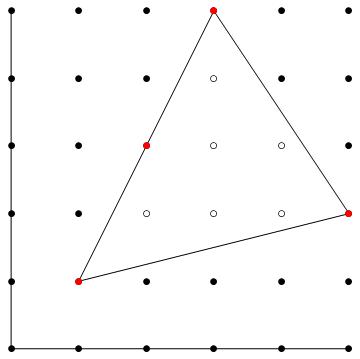
Suppose that the vertices of a triangle are (1,1), (3,5), and (4,2). What is the area of the triangle?

latticetriangleBecause the vertices of the triangle have integer coordinates, Pick’s Theorem offers an exceedingly simple way of finding the area of this triangle.

  1. There are 6 points (marked white) that are inside the triangle.
  2. There are 4 points (marked red) that are on the boundary of the triangle, including the three corners.
  3. Therefore, the area is A = 6 + \frac{1}{2} (4) - 1 = 7.

You can confirm this area by drawing the rectangle with corners at (1,1), (5,1), (5,5), and (1,5) and then taking away the three right triangles, leaving the triangle shown in the figure above.

Amazingly, this theorem is true for any polygonal figure — not just triangles — whose vertices have integer coordinates.

A decent classroom activity so that students can discover Pick’s theorem for themselves has been published by the National Council of Teachers of Mathematics. I modified this activity to teach my daughter and her friends last summer, so I say from first-hand experience that fourth-graders can use inductive reasoning to guess Pick’s theorem.

Additional references:

http://www.cut-the-knot.org/ctk/geoboard.shtml

http://www.cut-the-knot.org/ctk/Pick_proof.shtml

Area of a triangle: Vertices (Part 7)

Suppose that the vertices of a triangle are (1,2), (2,5), and (3,1). What is the area of the triangle?

At first blush, this doesn’t fall under any of the categories of SSS, SAS, or ASA. And we certainly aren’t given a base b and a matching height h. The Pythagorean theorem could be used to determine the lengths of the three sides so that Heron’s formula could be used, but that would be extremely painful to do.

Fortunately, there’s another way to find the area of a triangle that directly uses the coordinates of the triangle. It turns out that the area of the triangle is equal to the absolute value of

\displaystyle \frac{1}{2} \left| \begin{array}{ccc} 1 & 2 & 1 \\ 2 & 5 & 1 \\ 3 & 1 & 1 \end{array} \right|

Notice that the first two columns contain the coordinates of the three vertices, while the third column is just padded with 1s. Calculating, we find that the area is

\left| \displaystyle \frac{1}{2} \left( 5 + 6 + 2 - 15 - 4 - 1 \right) \right| = \left| \displaystyle -\frac{7}{2} \right| = \displaystyle \frac{7}{2}

In other words, direct use of the vertices is, in this case, a lot easier than the standard SSS, SAS, or ASA formulas.

A (perhaps) surprising consequence of this formula is that the area of any triangle with integer coordinates must either be an integer or else a half-integer. We’ll see this again when we consider Pick’s theorem in tomorrow’s post.

green line

There is another way to solve this problem by considering the three vertices as points in \mathbb{R}^3. The vector from (1,2,0) to (2,5,0) is \langle 1,3,0 \rangle, while the vector from (1,2,0) to (3,1,0) is \langle 2,-1,0 \rangle. Therefore, the area of the triangle is one-half the length of the cross-product of these two vectors. Recall that the cross-product of the two vectors is
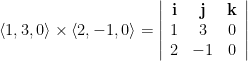
\langle 1,3,0 \rangle \times \langle 2,-1,0 \rangle = \left| \begin{array}{ccc} {\bf i} & {\bf j} & {\bf k} \\ 1 & 3 & 0 \\ 2 & -1 & 0 \end{array} \right|

\langle 1,3,0 \rangle \times \langle 2,-1,0 \rangle = -7{\bf k}

So the length of the cross-product is clearly 7, so that the area of the triangle is (again) \displaystyle \frac{7}{2}.

green line

The above technique works for any triangle in \mathbb{R}^3. For example, if we consider a triangle in three-dimensional space with corners at (1,2,3), (4,3,0), and (6,1,9), the area of the triangle may be found by “subtracting” the coordinates to find two vectors along the sides of the triangle and then finding the cross-product of those two vectors.

Furthermore, determinants may be used to find the volume of a tetrahedron in \mathbb{R}^3. Suppose that we now consider the tetrahedron with corners at (1,2,3), (4,3,0), (6,1,9), and (2,5,2). Let’s consider (1,2,3) as the “starting” point and subtract these coordinates from those of the other three points. We then get the three vectors

\langle 3,2,-3 \rangle, \langle 5,-1,6 \rangle, and \langle 1,3,-1 \rangle

One-third of the absolute value of the determinant of these three vectors will be the volume of the tetrahedron.

green line

This post has revolved around one central idea: a determinant represents an area or a volume. While this particular post has primarily concerned triangles and tetrahedra, I should also mention that determinants are similarly used (without the factors of 1/2 and 1/3) for finding the areas of parallelograms and the volumes of parallelepipeds.

This central idea is also the basis behind an important technique taught in multivariable calculus: integration in polar coordinates and in spherical coordinates.
In two dimensions, the formulas for conversion from polar to rectangular coordinates are

x = r \cos \theta and y = r \sin \theta

Therefore, using the Jacobian, the “infinitesimal area element” used for integrating is

dx dy = \left| \begin{array}{cc} \partial x/\partial r & \partial y/\partial r \\ \partial x/\partial \theta & \partial y/\partial \theta \end{array} \right| dr d\theta

dx dy = \left| \begin{array}{cc} \cos \theta & \sin \theta \\ -r \sin \theta & r \cos \theta \end{array} \right| dr d\theta

dx dy = (r \cos^2 \theta + r \sin^2 \theta) dr d\theta

dx dy = r dr d\theta

Similarly, using a 3 \times 3 determinant, the conversion dx dy dz = r^2 \sin \phi dr d\theta d\phi for spherical coordinates can be obtained.
References:

http://www.purplemath.com/modules/detprobs.htm

http://mathworld.wolfram.com/Parallelogram.html

http://en.wikipedia.org/wiki/Parallelogram#Area_formulas

http://mathworld.wolfram.com/Parallelepiped.html

http://en.wikipedia.org/wiki/Parallelopiped#Volume

Area of a triangle: Incenter (Part 6)

Incenter_750Source: http://mathworld.wolfram.com/Incircle.html

The incenter I of a triangle \triangle ABC is defined by the intersection of the angle bisectors of its three angles. A circle can be inscribed within \triangle ABC, as shown in the picture.

This incircle provides a different way of finding the area of \triangle ABC commonly needed for high school math contests like the AMC 10/12. Suppose that the sides a, b, and c are known and the inradius r is also known. Then \triangle ABI is a right triangle with base c and height r. So

\hbox{Area of ~} \triangle ABI = \displaystyle \frac{1}{2} cr

Similarly,

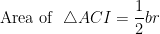
\hbox{Area of ~} \triangle ACI = \displaystyle \frac{1}{2} br

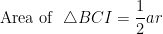
\hbox{Area of ~} \triangle BCI = \displaystyle \frac{1}{2} ar

Since the area of \triangle ABC is the sum of the areas of these three smaller triangles, we conclude that

\hbox{Area of ~} \triangle ABC = \displaystyle \frac{1}{2} r (a+b+c),

or

\hbox{Area of ~} \triangle ABC = rs,

where s = (a+b+c)/2 is the semiperimeter of \triangle ABC.

green lineThis also permits the computation of r itself. By Heron’s formula, we know that

\hbox{Area of ~} \triangle ABC = \sqrt{s(s-a)(s-b)(s-c)}

Equating these two expressions for the area of \triangle ABC, we can solve for the inradius r:

r = \displaystyle \sqrt{ \frac{(s-a)(s-b)(s-c)}{s} }

For much more about the inradius and incircle, I’ll refer to the MathWorld website.

Area of a triangle: SSS (Part 5)

triangle

In yesterday’s post, we discussed how the area K of a triangle can be found using SAS: two sides and the angle between the two sides. We found that

K = \displaystyle \frac{1}{2} a b \sin C

This can be used as the starting point for the derivation of Heron’s formula, which determines the area of a triangle using SSS (i.e., only the three sides). I won’t give the full derivation in this post — there’s no point in me retyping the details — but will refer to the Wikipedia page and the MathWorld page for the details. However, I will give the big ideas behind the derivation.

1. We begin by recalling that \sin^2 C + \cos^2 C = 1. Since 0 < C < 180^o, we know that \sin C must be positive, so that

\sin C = \sqrt{1 - \cos^2 C}

2. From the Law of Cosines, we know that

c^2 = a^2 + b^2 - 2 a b \cos C,

or

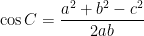
\cos C = \displaystyle \frac{a^2 + b^2 - c^2}{2ab}

3. Substituting, we see that

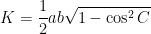
K = \displaystyle \frac{1}{2} ab \sqrt{1 - \cos^2 C}

K = \displaystyle \frac{1}{2} ab \sqrt{1 - \frac{(a^2+b^2-c^2)^2}{4a^2b^2}}

4. This last expression only contains the side lengths a, b, and c. So the “only” work that’s left is simplifying this right-hand side and seeing what happens. After considerable work — requiring factoring the difference of two squares on two different steps — we end up with Heron’s formula:

K = \sqrt{s (s-a) (s-b) (s-c)}

where s = \displaystyle \frac{a+b+c}{2} is the semiperimeter, or half the perimeter of the triangle.
A final note: If you actually are able to start with Step 3 and end with Heron’s formula on your own — without consulting a textbook or the Internet if you get stuck — feel free to cry out “More power!” and grunt like Tim “The Toolman” Taylor:

Area of a triangle: SAS, ASA, and the Law of Sines (Part 4)

The typical way students remember the area K of a triangle is

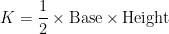
K = \displaystyle \frac{1}{2} \times \hbox{Base} \times \hbox{Height}

However, there are other formulas for the area of a triangle which can be helpful if the height is not immediately known.

Case 1: SAS. Suppose that two sides and the angle between the sides — say, b and c and the measure of angle A — are known.

triangle

If \overline{CD} is an altitude for \triangle ABC, then \triangle ACD is a right triangle. Therefore,

\sin A = \displaystyle \frac{\hbox{opposite}}{\hbox{hypotenuse}} = \displaystyle \frac{h}{b}, or h = b \sin A.

Therefore,

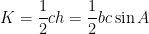
K = \displaystyle \frac{1}{2} ch = \displaystyle \frac{1}{2} bc \sin A.

Using the same picture, one can also show that

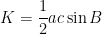
K = \displaystyle \frac{1}{2} ac \sin B

Also, with a different but similar picture, one can show that

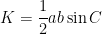
K = \displaystyle \frac{1}{2} ab \sin C

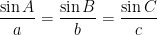
green lineAn important consequence of the SAS area formula is the Law of Sines. Since all three formulas must give the same area K, we have

\displaystyle \frac{1}{2} bc \sin A = \displaystyle \frac{1}{2} ac \sin B = \displaystyle \frac{1}{2} ab \sin C

Multiplying by \displaystyle \frac{2}{abc} produces the Law of Sines:

\displaystyle \frac{\sin A}{a} = \displaystyle \frac{\sin B}{b} = \displaystyle \frac{\sin C}{c}

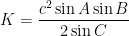
green lineCase 2: ASA. Now suppose that we are given the measures of two angles and the length of the side in between them — say, angles A and B and side c. Naturally, we can also get the measure of angle C since the sum of the measures of the three angles must be 180^o.

From the SAS formula and the Law of Sines, we have

K = \displaystyle \frac{1}{2} bc \sin A \quad \hbox{and} \quad \displaystyle b = \frac{c \sin B}{\sin C}

Combining these, we find

K = \displaystyle \frac{1}{2} \frac{c \sin B}{\sin C} \cdot c \sin A

K = \displaystyle \frac{c^2 \sin A \sin B}{2 \sin C}

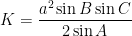
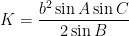
By similar reasoning, we can also find that

K = \displaystyle \frac{a^2 \sin B \sin C}{2 \sin A} ~~ and ~~ K = \displaystyle \frac{b^2 \sin A \sin C}{2 \sin B}

Area of a triangle: Equal cross-sections (Part 2)

Let’s take a second look at the familiar formula for the area of a triangle, A = \displaystyle \frac{1}{2}bh.

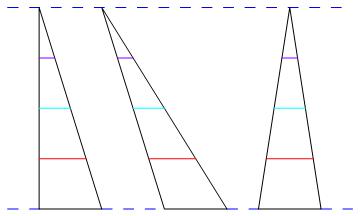
trianglecross1The picture above shows three different triangles: one right, one obtuse, and one acute. The three triangles have bases of equal length and also have the same height. Therefore, even though the triangles have different shapes (i.e., they’re not congruent), they have the same height.

Let’s take a second look at these three triangles. In each triangle, I’ve drawn in three “cross-section” line segments which are parallel to the base. Notice that corresponding cross-sections have equal length. In other words, the red line segments have the same length, the light-blue line segments have the same length, and the purple line segments have the same length.

Why is this true? There are two ways of thinking about this (for the sake of brevity, I won’t write out the details).

  • Algebraically, the length of the cross-section increases linearly as they descend from the top vertex to the bottom base. This linear increase does not depend upon the shape of the triangle. Since the three triangles have bases of equal length, the cross-sections have to have the same length.
  • Geometrically, the length of the cross-sections can be found with similar triangles, comparing the big original triangle to the smaller triangle that has a cross-section as its base. Again, the scale factor between the similar triangles depends only on the height of the smaller triangle and not on the shape of the original triangle. So the cross-sections have to have the same length.

So, since the three triangles share the same height and base length, the three triangles have the same area, and the corresponding cross-sections have the same length.

The reverse principle is also true. This is called Cavalieri’s principle. From Wikipedia:

Suppose two regions in a plane are included between two parallel lines in that plane. If every line parallel to these two lines intersects both regions in line segments of equal length, then the two regions have equal areas.

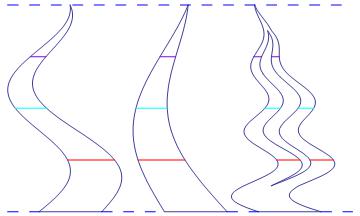
In other words, if I have any kind of shape that has cross-sections that match those of the triangles above, then the shape has the same area as the triangles. Geometrically, we can think of each triangle a bunch of line segments joined together. So while the positioning of the line segments affects the shape of the region, the positioning does not affect the area of the region.

For example, here are three non-triangular regions whose cross-sections match those of the above triangles. The region on the right is especially complex since it has a curvy hole in the middle, so that the cross-sections shown are actually two distinct line segments. Nevertheless, we can say with confidence that, by Cavalieri’s principle, the area of each region matches those of the triangles above.

trianglecross2

Though we wouldn’t expect geometry students to make this connection, Cavalieri’s principle may be viewed as a geometric version of integral calculus. In calculus, we teach that the area between the curves x = f(y) and x = F(y) is equal to

A = \displaystyle \int_{y_1}^{y_2} [F(y) - f(y)] \, dy = \displaystyle \int_{y_1}^{y_2} d(y) \, dy

where $d(y) = F(y) – f(y)$ is the difference in the two curves. In the above formula, I chose integration with respect to y since the $y-$coordinates are constant in the above cross-sections. The difference d(y) is precisely the length of the cross-sections. As with the triangles, the positioning of the cross-sections will affect the shape of the region, but the positioning of the cross-sections does not affect the length d(y) and hence does not affect the area A of the region.

Area of a triangle: Base and height (Part 1)

This begins a series of post concerning how the area of a triangle can be computed. This post concerns the formula that students most often remember:

A = \displaystyle \frac{1}{2} b h

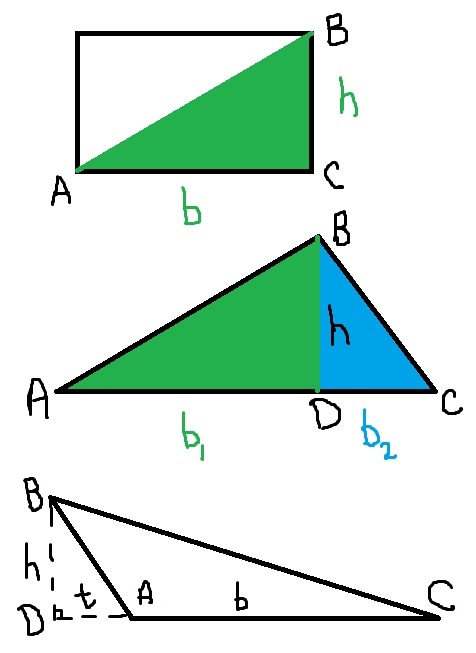
Why is this formula true? Consider \triangle ABC, and form the altitude from B to line AB. Suppose that the length of AC is b and that the altitude has length h. Then one of three things could happen:

triangles

Case 1. The altitude intersects AC at either A or C. Then \triangle ABC is a right triangle, which is half of a rectangle. Since the area of a rectangle is bh, the area of the triangle must be \displaystyle \frac{1}{2} bh.

Knowing the area of a right triangle will be important for Cases 2 and 3, as we will act like a good MIT freshman and use this previous work.

Case 2. The altitude intersects AC at a point D between A and C. Then \triangle ABD and \triangle BCD are right triangles, and so

\hbox{Area of~} \triangle ABC = \hbox{Area of ~} \triangle ABD + \hbox{~Area of~} \triangle BCD

\hbox{Area of~} \triangle ABC = \displaystyle \frac{1}{2} b_1 h + \frac{1}{2} b_2 h

\hbox{Area of~} \triangle ABC = \displaystyle \frac{1}{2} (b_1 + b_2) h

\hbox{Area of~} \triangle ABC = \displaystyle \frac{1}{2} bh

Case 3. The altitude intersects AC at a point D that is not in between A and C. Without loss of generality, suppose that A is between D and C. Then \triangle ABD and \triangle BCD are right triangles, and so

\hbox{Area of~} \triangle ABC = \hbox{Area of ~} \triangle BCD - \hbox{~Area of~} \triangle ACD

\hbox{Area of~} \triangle ABC = \displaystyle \frac{1}{2} (b+t) h + \frac{1}{2} t h

\hbox{Area of~} \triangle ABC = \displaystyle \frac{1}{2} (b+t-t) h

\hbox{Area of~} \triangle ABC = \displaystyle \frac{1}{2} bh

Engaging students: Measures of the angles in a triangle add to 180 degrees

In my capstone class for future secondary math teachers, I ask my students to come up with ideas for engaging their students with different topics in the secondary mathematics curriculum. In other words, the point of the assignment was not to devise a full-blown lesson plan on this topic. Instead, I asked my students to think about three different ways of getting their students interested in the topic in the first place.

I plan to share some of the best of these ideas on this blog (after asking my students’ permission, of course).

This student submission comes from my former student Claire McMahon. Her topic, from Geometry: the proof that the measures of the angles in a triangle add to 180^o.

green line

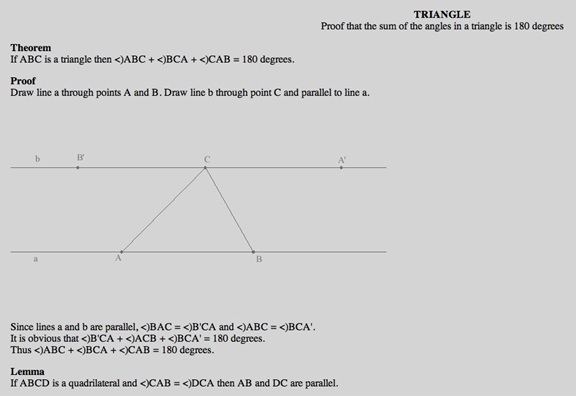
One of the hardest concepts in math is learning how to prove something that is already considered to be correct.  One of the more difficult concepts to teach could also be said on how to prove things that you had already believed and accepted in the first place.  One of these concepts happens to be that a triangle’s angles are always going to add up to 180 degrees.  Here is one of the proofs that I found that is absolutely simplistic and most kids will agree with you on it:

triangle1

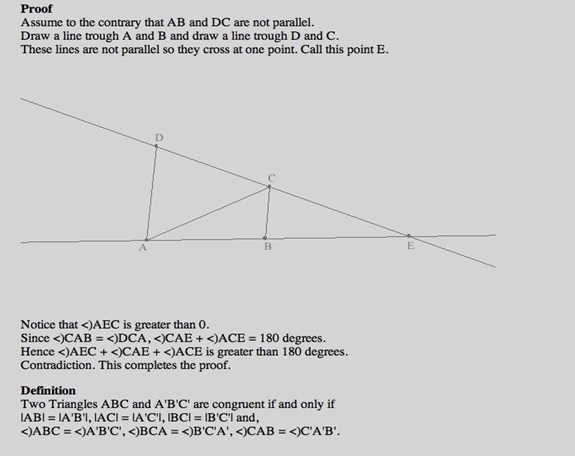
This particular proof is from the website http://www.mathisfun.com.  This is a great website to simply explain most math concepts and give exercises to practice those math facts.  For the more skeptical student, you can use a form of Euclidean and modern fact base to prove this more in depth.  I found this proof on http://www.apronus.com/geometry/triangle.htm.  Here you will see that there is no question as to why the proof above works and how it doesn’t work when you do a proof by contradiction.

triangle3 triangle2

green line

I stumbled across this awesome website that very simply put into context how easy it would be to prove that a triangle’s angles will always add up to 180 degrees.  In this activity you take the same triangle 3 times and then have them place all three of the angles on a straight line.  This proves that the angles in a triangle will always equal 180 degrees, which is a concept that should have already been taught as a straight line having an “angle” measure of 180. The website for this can be found here: http://www.regentsprep.org/Regents/math/geometry/GP5/TRTri.htm.

green line

The triangle is the basis for a lot of math.  There is one very important person that really started playing with the idea of a triangle and how 3 straight lines that close to form a figure has a certain amount of properties and similarities to parallels and other figures like it.  We base a whole unit on special right triangles in geometry in high school and never know exactly where the term right angle is derived.  This man that made the right angle so important in math is none other than Euclid himself.  While Euclid never introduced angle measures, he made it very apparent that 2 right angles are always going to be equal to the interior angles of a triangle.  Not only did Euclid prove this but he did so in a way that relates to all types of triangles and their similar counterparts using only a straight edge and a compass, pretty impressive!!