My Mathematical Magic Show: Part 3a

Last March, on Pi Day (March 14, 2015), I put together a mathematical magic show for the Pi Day festivities at our local library, compiling various tricks that I teach to our future secondary teachers. I was expecting an audience of junior-high and high school students but ended up with an audience of elementary school students (and their parents). Still, I thought that this might be of general interest, and so I’ll present these tricks as well as the explanations for these tricks in this series. From start to finish, this mathematical magic show took me about 50-55 minutes to complete. None of the tricks in this routine are original to me; I learned each of these tricks from somebody else.

green line

For my second trick, I’ll show something that my math teacher taught me when I was about 13 or 14. Everyone in the audience has a piece of paper and a pen or pencil. Here’s the patter:

Magician: Tell me a number between 5 and 10.

Child #1: (gives a number, call it x)

Magician: On a piece of paper, draw a shape with x corners. Don’t draw something really, really tiny… make sure it’s big enough to see well.

Audience: (draws a figure; an example for x=6 is shown) The Magician also draws this figure on the board.

geom_magic1Important Note: For this trick to work, the original shape has to be convex… something shaped like an L or M won’t work. Also, I chose a maximum of 10 mostly for ease of drawing and counting (and, for later, calculating).

Magician: Tell me another number between 5 and 10.

Child #2: (gives a number, call it y)

Magician: Now draw that many dots inside of your shape.The Magician also draws y dots inside the figure on the board, an example for y = 7 is shown.

geom_magic2Audience: (starts drawing y dots inside the figure) The Magician also calculates 2y + x - 2 and says, “Now while you’re doing that, I’m going to write a secret number on the board,” discreetly writes the answer on the board, and then covers up the answer with a piece of paper and some adhesive tape.

Magician: Now connect the dots with lines until you get all triangles. Just be sure that no two lines cross each other. For example, your figure could look like this:

geom_magic3

Audience: (quietly connects the dots until the shape is divided into triangles)

Magician: Now count the number of triangles.

Audience: (counts the triangles)

Magician: Was your answer… (removes the adhesive tape and displays the answer)?

The reason this magic trick works so well is that it’s so counter-intuitive. No matter what convex x-gon is drawn, no matter where the y points are located, and no matter how lines are drawn to create triangles, there will always be 2y + x - 2 triangles. For the example above, 2y+x-2 = 2\times 7 + 6 - 2 = 18, and there are indeed 18 triangles in the figure.

In tomorrow’s post, I’ll explain why this trick works.


Langley’s Adventitious Angles (Part 1)

Math With Bad Drawings had an interesting post about solving for x in the following picture (this picture is taken from http://thinkzone.wlonk.com/MathFun/Triangle.htm):

I had never heard of this problem before, but it’s apparently well known and is called Langley’s Adventitious Angles. See Math With Bad Drawings, Wikipedia, and Math Pages for more information about the solution of this problem. Math Pages has a nice discussion about mathematical aspects of this problem, including connections to the Laws of Sines and Cosines and to various trig identities.

I’d encourage you to try to solve for x without clicking on any of these links… a certain trick out of the patented Bag of Tricks is required to solve this problem using only geometry (as opposed to the Law of Cosines and the Law of Sines). I have a story that I tell my students about the patented Bag of Tricks: Socrates gave the Bag of Tricks to Plato, Plato gave it to Aristotle, it passed down the generations, my teacher taught the Bag of Tricks to me, and I teach it to my students. In the same post, Math With Bad Drawings has a nice discussion about pedagogical aspects of this problem concerning when a “trick” becomes a “technique”.

I recommend this problem for advanced geometry students who need to be challenged; even bright students will be stumped concerning coming up with the requisite trick on their own. Indeed, the problem still remains quite challenging even after the trick is shown.

The antiderivative of 1/(x^4+1): Part 9

In the course of evaluating the antiderivative

\displaystyle \int \frac{1}{x^4 + 1} dx,

I have stumbled across a very curious trigonometric identity:

\tan^{-1} ( x\sqrt{2} - 1 ) + \tan^{-1}( x \sqrt{2} + 1) = \tan^{-1} \left( \displaystyle \frac{x \sqrt{2}}{1 - x^2} \right) -\pi if x < x_2,

\tan^{-1} ( x\sqrt{2} - 1 ) + \tan^{-1}( x \sqrt{2} + 1) = \tan^{-1} \left( \displaystyle \frac{x \sqrt{2}}{1 - x^2} \right) if x_2 < x < x_1,

\tan^{-1} ( x\sqrt{2} - 1 ) + \tan^{-1}( x \sqrt{2} + 1) = \tan^{-1} \left( \displaystyle \frac{x \sqrt{2}}{1 - x^2} \right) + \pi if x> x_1,

where x_1 and x_2 are the unique values so that

\tan^{-1} ( x_1\sqrt{2} - 1 ) + \tan^{-1}( x_1 \sqrt{2} + 1) = \displaystyle \frac{\pi}{2},

\tan^{-1} ( x_2\sqrt{2} - 1 ) + \tan^{-1}( x_2 \sqrt{2} + 1) = -\displaystyle \frac{\pi}{2}.

I will now show that x_1 = 1 and x_2 = -1. Indeed, it’s apparent that these have to be the two transition points because these are the points where \displaystyle \frac{x \sqrt{2}}{1 - x^2} is undefined. However, it would be more convincing to show this directly.

To show that x_1 = 1, I need to show that

\tan^{-1} (\sqrt{2} - 1 ) + \tan^{-1}( \sqrt{2} + 1) = \displaystyle \frac{\pi}{2}.

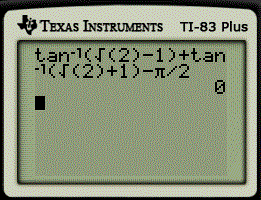
I could do this with a calculator…

arctangent…but that would be cheating.

Instead, let \alpha = \tan^{-1} (\sqrt{2} - 1 ) and \beta = \tan^{-1} (\sqrt{2} + 1 ), so that

\tan \alpha = \sqrt{2} - 1,

\tan \beta = \sqrt{2} + 1.

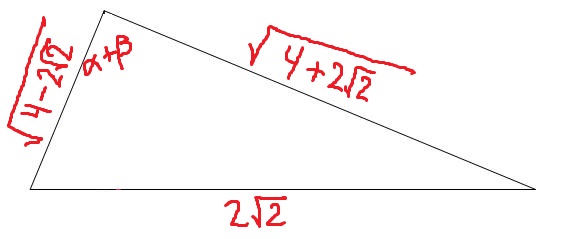
Indeed, by SOHCAHTOA, the angles \alpha and \beta can be represented in the figure below:
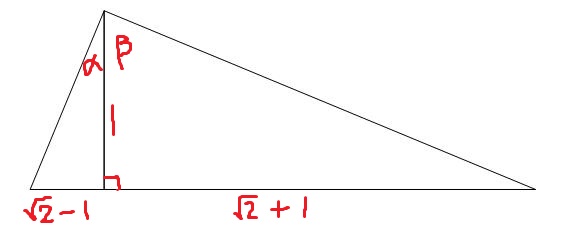

arctangenttriangle2The two small right triangles make one large triangle, and I will show that the large triangle is also a right triangle. To do this, let’s find the lengths of the three sides of the large triangle. The length of the longest side is clearly \sqrt{2} - 1 + \sqrt{2} + 1 = 2\sqrt{2}. I will use the Pythagorean theorem to find the lengths of the other two sides. For the small right triangle containing \alpha, the missing side is

\sqrt{ \left(\sqrt{2} - 1 \right)^2 + 1^2} = \sqrt{2 - 2\sqrt{2} + 1 + 1} = \sqrt{4-2\sqrt{2}}

Next, for the small right triangle containing \beta, the missing side is

\sqrt{ \left(\sqrt{2} + 1 \right)^2 + 1^2} = \sqrt{2 + 2\sqrt{2} + 1 + 1} = \sqrt{4+2\sqrt{2}}

So let me redraw the figure, eliminating the altitude from the previous figure:

arctangenttriangle3

Notice that the condition of the Pythagorean theorem is satisfied, since

\left( \sqrt{4-2\sqrt{2}} \right)^2 + \left( \sqrt{4+2\sqrt{2}} \right)^2 = 4 - 2\sqrt{2} + 4 + 2 \sqrt{2} = 8,

or

\left( \sqrt{4-2\sqrt{2}} \right)^2 + \left( \sqrt{4+2\sqrt{2}} \right)^2 = \left( 2\sqrt{2} \right)^2.

Therefore, by the converse of the Pythagorean theorem, the above figure must be a right triangle (albeit a right triangle with sides of unusual length), and so \alpha + \beta = \pi/2. In other words, x_1 = 1, as required.

To show that x_2 = -1, I will show that the function f(x) = \tan^{-1} ( x\sqrt{2} - 1 ) + \tan^{-1}( x \sqrt{2} + 1) is an odd function using the fact that \tan^{-1} x is also an odd function:

f(-x) = \tan^{-1} ( -x\sqrt{2} - 1 ) + \tan^{-1}( -x \sqrt{2} + 1)

= \tan^{-1} ( -[x\sqrt{2} + 1] ) + \tan^{-1}( -[x \sqrt{2} - 1])

= -\tan^{-1} ( x\sqrt{2} + 1 ) - \tan^{-1}( x \sqrt{2} - 1)

= - \left[ \tan^{-1} ( x\sqrt{2} + 1 ) + \tan^{-1}( x \sqrt{2} - 1) \right]

= -f(x).

Therefore, f(-1) = -f(1) = -\displaystyle \frac{\pi}{2}, and so x_2 = -1.

The antiderivative of 1/(x^4+1): Part 8

In the course of evaluating the antiderivative

\displaystyle \int \frac{1}{x^4 + 1} dx,

I’ve accidentally stumbled on a very curious looking trigonometric identity:

\tan^{-1} ( x\sqrt{2} - 1 ) + \tan^{-1}( x \sqrt{2} + 1) = \tan^{-1} \left( \displaystyle \frac{x \sqrt{2}}{1 - x^2} \right) -\pi if x < -1,

\tan^{-1} ( x\sqrt{2} - 1 ) + \tan^{-1}( x \sqrt{2} + 1) = \tan^{-1} \left( \displaystyle \frac{x \sqrt{2}}{1 - x^2} \right) if -1 < x < 1,

\tan^{-1} ( x\sqrt{2} - 1 ) + \tan^{-1}( x \sqrt{2} + 1) = \tan^{-1} \left( \displaystyle \frac{x \sqrt{2}}{1 - x^2} \right) + \pi if x> 1.

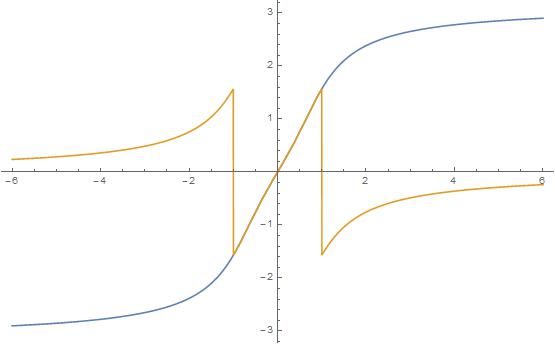
The extra -\pi and \pi are important. Without them, the graphs of the left-hand side and right-hand sides are clearly different if x < -1 or x > 1:

TwoArctangents1

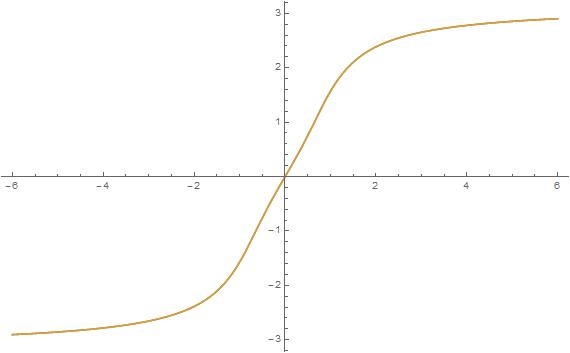
However, they match when those constants are included:

TwoArctangents2

Let’s see if I can explain why this trigonometric identity occurs without resorting to the graphs.

Since \tan^{-1} x assumes values between -\pi/2 and \pi/2, I know that

-\displaystyle \frac{\pi}{2} < \tan^{-1} ( x\sqrt{2} - 1 ) < \frac{\pi}{2},

-\displaystyle \frac{\pi}{2} < \tan^{-1} ( x\sqrt{2} + 1 ) < \frac{\pi}{2},

and so

-\pi< \tan^{-1} ( x\sqrt{2} - 1 ) + \tan^{-1} ( x\sqrt{2} + 1 ) < \pi.

However,

-\displaystyle \frac{\pi}{2} < \tan^{-1} \left( \displaystyle \frac{x \sqrt{2}}{1 - x^2} \right) < \frac{\pi}{2},

and so \tan^{-1} ( x\sqrt{2} - 1 ) + \tan^{-1} ( x\sqrt{2} + 1 ) and \tan^{-1} \left( \displaystyle \frac{x \sqrt{2}}{1 - x^2} \right) must differ if \tan^{-1} ( x\sqrt{2} - 1 ) + \tan^{-1} ( x\sqrt{2} + 1) is in the interval [-\pi,-\pi/2] or in the interval [\pi/2,\pi].

I also notice that

-\pi< \tan^{-1} ( x\sqrt{2} - 1 ) + \tan^{-1} ( x\sqrt{2} + 1 ) < \pi,

-\displaystyle \frac{\pi}{2} < -\tan^{-1} \left( \displaystyle \frac{x \sqrt{2}}{1 - x^2} \right) < \frac{\pi}{2},

and so

-\displaystyle \frac{3\pi}{2} < \tan^{-1} ( x\sqrt{2} - 1 ) + \tan^{-1} ( x\sqrt{2} + 1 )-\tan^{-1} \left( \displaystyle \frac{x \sqrt{2}}{1 - x^2} \right) < \frac{3\pi}{2}.

However, this difference can only be equal to a multiple of \pi, and there are only three multiples of \pi in the interval \displaystyle \left( -\frac{3\pi}{2}, \frac{3\pi}{2} \right), namely -\pi, 0, and \pi.

To determine the values of x where this happens, I also note that f_1(x) = x \sqrt{2} - 1, f_2(x) = x \sqrt{2} + 1, and f_3(x) = \tan^{-1} x are increasing functions, and so f(x) = \tan^{-1} ( x\sqrt{2} - 1 ) + \tan^{-1}( x \sqrt{2} + 1) must also be an increasing function. Therefore, to determine where f(x) lies in the interval [\pi/2,\pi],it suffices to determine the unique value x_1 so that f(x_1) = \pi/2. Likewise, to determine where f(x) lies in the interval [-\pi,-\pi/2],it suffices to determine the unique value x_2 so that f(x_2) = -\pi/2.

In summary, I have shown so far that

\tan^{-1} ( x\sqrt{2} - 1 ) + \tan^{-1}( x \sqrt{2} + 1) = \tan^{-1} \left( \displaystyle \frac{x \sqrt{2}}{1 - x^2} \right) -\pi if x < x_2,

\tan^{-1} ( x\sqrt{2} - 1 ) + \tan^{-1}( x \sqrt{2} + 1) = \tan^{-1} \left( \displaystyle \frac{x \sqrt{2}}{1 - x^2} \right) if x_2 < x < x_1,

\tan^{-1} ( x\sqrt{2} - 1 ) + \tan^{-1}( x \sqrt{2} + 1) = \tan^{-1} \left( \displaystyle \frac{x \sqrt{2}}{1 - x^2} \right) + \pi if x> x_1,

where x_1 and x_2 are the unique values so that

\tan^{-1} ( x_1\sqrt{2} - 1 ) + \tan^{-1}( x_1 \sqrt{2} + 1) = \displaystyle \frac{\pi}{2},

\tan^{-1} ( x_2\sqrt{2} - 1 ) + \tan^{-1}( x_2 \sqrt{2} + 1) = -\displaystyle \frac{\pi}{2}.

So, to complete the proof of the trigonometric identity, I need to show that x_1 = 1 and x_2 = -1. I will do this in tomorrow’s post.

Different ways of solving a contest problem (Part 1)

The following problem appeared on the American High School Mathematics Examination (now called the AMC 12) in 1988:

If 3 \sin \theta = \cos \theta, what is \sin \theta \cos \theta?

When I presented this problem to a group of students, I was pleasantly surprised by the amount of creativity shown when solving this problem.

Here’s the first solution that I received: draw the appropriate triangles for the angle \theta:

3 \sin \theta = \cos \theta

\tan \theta = \displaystyle \frac{1}{3}

Therefore, the angle \theta must lie in either the first or third quadrant, as shown. (Of course, \theta could be coterminal with either displayed angle, but that wouldn’t affect the values of \sin \theta or \cos \theta.)

AHSME problem

In Quadrant I, \sin \theta = \displaystyle \frac{1}{\sqrt{10}} and \cos \theta = \displaystyle \frac{3}{\sqrt{10}}. Therefore,

\sin \theta \cos \theta = \displaystyle \frac{1}{\sqrt{10}} \times \frac{3}{\sqrt{10}} = \displaystyle \frac{3}{10}.

In Quadrant III, \sin \theta = \displaystyle -\frac{1}{\sqrt{10}} and \cos \theta = -\displaystyle \frac{3}{\sqrt{10}}. Therefore,

\sin \theta \cos \theta = \displaystyle \left( - \frac{1}{\sqrt{10}} \right) \times \left( -\frac{3}{\sqrt{10}} \right) = \displaystyle \frac{3}{10}.

Either way, we can be certain that \sin \theta \cos \theta = \displaystyle \frac{3}{10}.

Proving theorems and special cases (Part 10): Angles in a convex n-gon

In a recent class with my future secondary math teachers, we had a fascinating discussion concerning how a teacher should respond to the following question from a student:

Is it ever possible to prove a statement or theorem by proving a special case of the statement or theorem?

Usually, the answer is no. In this series of posts, we’ve seen that a conjecture could be true for the first 40 cases or even the first 10^{316} cases yet not always be true. We’ve also explored the computational evidence for various unsolved problems in mathematics, noting that even this very strong computational evidence, by itself, does not provide a proof for all possible cases.

However, there are plenty of examples in mathematics where it is possible to prove a theorem by first proving a special case of the theorem. For the remainder of this series, I’d like to list, in no particular order, some common theorems used in secondary mathematics which are typically proved by first proving a special case.

1. Theorem. The sum of the angles in a convex n-gon is 180(n-2) degrees.

This theorem is typically proven after first proving the following lemma:

Lemma. The sum of the angles in a triangle is 180 degrees.

Clearly the lemma is a special case of the main theorem: for a triangle, n=3 and so 180(n-2) = 180 \times 1 = 180. The proof of the lemma uses alternate interior angles and the convention that the angle of a straight line is 180 degrees.

triangle1Using this, the main theorem follows by using diagonals to divide a convex n-gon into n-2 triangles. (For example, drawing a diagonal divides a quadrilateral into two triangles.) The sum of the angles of the n-gon must equal the sum of the angles of the n-2 triangles.

green line

So it is possible to prove a theorem by proving a special case of the theorem. Using the sum of the angles of a triangle to prove the formula for the sum of the angles of a convex n-gon is qualitatively different than the previous computational examples seen earlier in this series.


Area of a Triangle and Volume of Common Shapes: Index

I’m using the Twelve Days of Christmas (and perhaps a few extra days besides) to do something that I should have done a long time ago: collect past series of posts into a single, easy-to-reference post. The following posts formed my series on different ways of finding the area of a triangle as well as finding the volumes of common shapes.

Part 1: Deriving the formula A = \displaystyle \frac{1}{2} bh.

Part 2: Cavalieri’s principle and finding areas using calculus.

Part 3: Cavalieri’s principle and finding the volume of a pyramid and then the volume of a sphere.

Part 4: Finding the area of a triangle using the Law of Sines.

Part 5: Finding the area of a triangle using the Law of Cosines.

Part 6: Finding the area of a triangle using the triangle’s incenter.

Part 7: Finding the area of a triangle using a determinant and the coordinates of the vertices.

Part 8: Finding the area of a triangle using Pick’s theorem.


Inverse functions: Arcsine and SSA (Part 17)

In the last few posts, we studied the SSA case of solving for a triangle, when two sides and an non-included angle are given. (Some mathematics instructors happily prefer the angle-side-side acronym to bluntly describe the complications that arise from this possibly ambiguous case. I personally prefer not to use this acronym.)

A note on notation: when solving for the parts of \triangle ABC, a will be the length of the side opposite \angle A, b will be the length of the side opposite \angle B, and c will be the length of the side opposite angle C. Also \alpha will be the measure of \angle A, \beta will be measure of \angle B, and \gamma will be the measure of \angle C. Modern textbooks tend not to use \alpha, \beta, and \gamma for these kinds of problems, for which I have only one response:https://meangreenmath.com/wp-content/uploads/2014/10/philistines.png

philistines

Suppose that a, c, and the nonincluded angle \alpha are given, and we are supposed to solve for b, \beta, and \gamma. As we’ve seen in this series, there are four distinct cases — and handling these cases requires accurately solving equation like \sin \gamma = \hbox{something} on the interval [0^\circ, 180^\circ].

Case 1. b < c \sin \alpha. In this case, there are no solutions. When the Law of Sines is employed and we reach the step

\sin \gamma = \hbox{something}

the \hbox{something} is greater than 1, which is impossible.
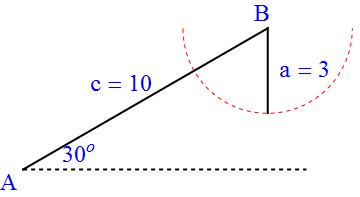
SSA1

Case 2. b = c \sin \alpha. This rarely arises in practice (except by careful writers of textbooks). In this case, there is exactly one solution. When the Law of Sines is employed, we obtain

\sin \gamma = 1

We conclude that \gamma = 90^\circ, so that \triangle ABC is a right triangle.

SSA2

Case 3. c \sin \alpha < b < c. This is the ambiguous case that yields two solutions. The Law of Sines yields

\sin \gamma = \hbox{something}

so that there are two possible choices for \gamma, \hbox{some angle} and 180^\circ - \hbox{some angle}.

SSA4

Case 4. b > c. This yields one solution. Similar to Case 3, the Law of Sines yields

\sin \gamma = \hbox{something}

so that there are two possible choices for \gamma, \hbox{some angle} and 180^\circ - \hbox{some angle}. However, when the second larger value of \gamma is attempted, we end up with a negative angle for \beta, which is impossible (unlike Case 3).


SSA3Many mathematics students prefer to memorize rules like those listed above. However, I try to encourage my students not to blindly use rules when solving the SSA case, as it’s just too easy to make a mistake in identifying the proper case. Instead, I encourage them to use the Law of Sines and to remember that the equation

\sin \gamma = t

has two solutions in [0^\circ, 180^\circ] as long as $0 < t < 1$:

\gamma = \sin^{-1} t \qquad \hbox{and} \qquad \gamma = 180^\circ - \sin^{-1} t

If they can remember this fact, then students can just follow their noses when applying the Law of Sines, identifying impossible and ambiguous cases when the occasions arise.


Inverse functions: Arcsine and SSA (Part 16)

We’ve seen in this series that blinding using the arcsine function on a calculator is insufficient for finding all solutions of an equation like \sin \theta = 0.8. In today’s post, I discuss one of the first places that this becomes practically important: solving the ambiguous case of solving a triangle given two sides and an nonincluded angle.

A note on notation: when solving for the parts of \triangle ABC, a will be the length of the side opposite \angle A, b will be the length of the side opposite \angle B, and c will be the length of the side opposite angle C. Also \alpha will be the measure of \angle A, \beta will be measure of \angle B, and \gamma will be the measure of \angle C. Modern textbooks tend not to use \alpha, \beta, and \gamma for these kinds of problems, for which I have only one response:

philistines

Why does an SSA triangle produce an ambiguous case (unlike the SAS, SSS, or ASA cases)? Here’s a possible problem that has two different solutions:

Solve \triangle ABC if a = 8, c = 10, and \alpha = 30^\circ.

A student new to the Law of Sines might naively start solving the problem by drawing something like this:

badSSA4

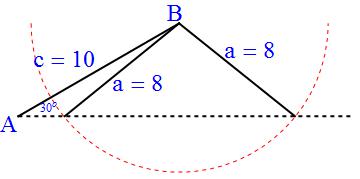
Of course, that’s an inaccurate picture that isn’t drawn to scale. A more accurate picture would look like this:

SSA4This time, the red circle intersects the dashed black line at two different points. So there will be two different solutions for this case. In other words, the phrasing of the question is somewhat deceptive. Usually when the question asks, “Solve the triangle…”, it’s presumed that there is only one solution. In this case, however, there are two different solutions.

These two different solutions appear when using the Law of Sines:

\displaystyle \frac{\sin \alpha}{a} = \displaystyle \frac{\sin \gamma}{c}

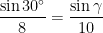
\displaystyle \frac{\sin 30^\circ}{8} = \displaystyle \frac{\sin \gamma}{10}

\displaystyle \frac{1/2}{8} = \displaystyle \frac{\sin \gamma}{10}

\displaystyle \frac{5}{8} = \sin \gamma

At this point, the natural inclination of a student is to pop out the calculator and find \sin^{-1} \frac{1}{3}.

SSAcalc4

This is incorrect logic that, as discussed extensively in earlier in this series of posts, there are two angles between 0^\circ and 180^\circ with a sine of 5/8:

\sin^{-1} \frac{5}{8} \qquad \hbox{and} \qquad \pi - \sin^{-1} \frac{5}{8},

or, in degrees,

\gamma \approx 38.68^\circ \qquad \hbox{and} \qquad \gamma \approx 141.32^\circ

So we have two different cases to check. Unlike the previous posts in this series, it’s really, really important that we list both of these cases.

Case 1: \gamma \approx 38.68^\circ. We begin by solving for \beta:

\beta = 180^\circ - \alpha - \gamma \approx 111.32^\circ

Then we can use the Law of Sines to find b. In this case, it’s best to use the pair \alpha - a instead of \gamma - c since the values of \alpha and a are both known exactly.

\displaystyle \frac{\sin \alpha}{a} = \displaystyle \frac{\sin \beta}{b}

\displaystyle \frac{\sin 30^\circ}{5} = \displaystyle \frac{\sin 111.32^\circ}{b}

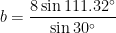
b = \displaystyle \frac{8 \sin 111.32^\circ}{\sin 30^\circ}

b \approx 14.9

This triangle with \gamma \approx 38.68^\circ, \beta \approx 111.32^\circ, and b \approx 14.9 corresponds to the bigger of the two triangles in the above picture, or the rightmost of the two places where the dotted circle intersects the black dotted line.

Case 2: \gamma \approx 141.32^\circ. We again begin by solving for \beta:

\beta = 180^\circ - \alpha - \gamma \approx 8.68^\circ

Unlike yesterday’s example, this is possible. So we have to continue the calculation to find b:

\displaystyle \frac{\sin \alpha}{a} = \displaystyle \frac{\sin \beta}{b}

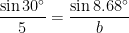
\displaystyle \frac{\sin 30^\circ}{5} = \displaystyle \frac{\sin 8.68^\circ}{b}

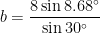
b = \displaystyle \frac{8 \sin 8.68^\circ}{\sin 30^\circ}

b \approx 2.4

This second triangle with \gamma \approx 141.32^\circ, \beta \approx 8.68^\circ, and b \approx 2.4 corresponds to the thinner of the two triangles in the above picture, or the leftmost of the two places where the dotted circle intersects the black dotted line.

Inverse functions: Arcsine and SSA (Part 15)

We’ve seen in this series that blinding using the arcsine function on a calculator is insufficient for finding all solutions of an equation like \sin \theta = 0.8. In today’s post, I discuss one of the first places that this becomes practically important: solving the ambiguous case of solving a triangle given two sides and an nonincluded angle.

A note on notation: when solving for the parts of \triangle ABC, a will be the length of the side opposite \angle A, b will be the length of the side opposite \angle B, and c will be the length of the side opposite angle C. Also \alpha will be the measure of \angle A, \beta will be measure of \angle B, and \gamma will be the measure of \angle C. Modern textbooks tend not to use \alpha, \beta, and \gamma for these kinds of problems, for which I have only one response:

philistines

Why does an SSA triangle produce an ambiguous case (unlike the SAS, SSS, or ASA cases)? Here’s a possible problem that has exactly one solution:

Solve \triangle ABC if a = 15, c = 10, and \alpha = 30^\circ.

A student new to the Law of Sines might naively start solving the problem by drawing something like this:

badSSA3

Of course, that’s an inaccurate picture that isn’t drawn to scale. A more accurate picture would look like this:

SSA3

Notice that the red circle intersects the dashed black line at exactly one point. Therefore, we know that there will be exactly one solution for this case. We also note that the circle would have intersected the black dashed line had the dashed line been extended to the left. This will become algebraically clear in the solution below.

Of course, students should not be expected to make a picture this accurately when doing homework. Fortunately, this impossibility naturally falls out of the equation when using the Law of Sines:

\displaystyle \frac{\sin \alpha}{a} = \displaystyle \frac{\sin \gamma}{c}

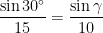
\displaystyle \frac{\sin 30^\circ}{15} = \displaystyle \frac{\sin \gamma}{10}

\displaystyle \frac{1/2}{15} = \displaystyle \frac{\sin \gamma}{10}

\displaystyle \frac{1}{3} = \sin \gamma

At this point, the natural inclination of a student is to pop out the calculator and find \sin^{-1} \frac{1}{3}.

SSAcalc1

This is incorrect logic that, as discussed extensively in yesterday’s post, there are two angles between 0^\circ and 180^\circ with a sine of 1/3:

\sin^{-1} \frac{1}{3} \qquad \hbox{and} \qquad \pi - \sin^{-1} \frac{1}{3},

or, in degrees,

\gamma \approx 19.47^\circ \qquad \hbox{and} \qquad \gamma \approx 160.53^\circ

So we have two different cases to check.

Case 1: \gamma \approx 19.47^\circ. We begin by solving for \beta:

\beta = 180^\circ - \alpha - \gamma \approx 130.53^\circ

Then we can use the Law of Sines (or, in this case, the Pythagorean Theorem), to find b. In this case, it’s best to use the pair \alpha - a instead of \gamma - c since the values of \alpha and a are both known exactly.

\displaystyle \frac{\sin \alpha}{a} = \displaystyle \frac{\sin \beta}{b}

\displaystyle \frac{\sin 30^\circ}{15} = \displaystyle \frac{\sin 130.53^\circ}{b}

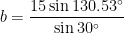
b = \displaystyle \frac{15 \sin 130.53^\circ}{\sin 30^\circ}

b \approx 22.8

Case 2: \gamma \approx 130.53^\circ. We again begin by solving for \beta:

\beta = 180^\circ - \alpha - \gamma \approx -10.53^\circ

Oops. That’s clearly impossible. So there is only one possible triangle, and the missing pieces are \gamma \approx 19.47^\circ, \beta \approx 130.53^\circ, and b \approx 22.8. Judging from the above (correctly drawn) picture, these numbers certainly look plausible.

It turns out that Case 2 will always fail in SSA will always fail as long as the side opposite the given angle is longer than the other given side (in this case, a > c). However, I prefer that my students not memorize this rule. Instead, I’d prefer that they list the two possible values of \gamma and then run through the logical consequences, stopping when an impossibility is reached. As we’ll see in tomorrow’s post, it’s perfectly possible for Case 2 to produce a second valid solution with the proper choice for the length of the side opposite the given angle.