Engaging students: Deriving the proportions of a 45-45-90 right triangle

In my capstone class for future secondary math teachers, I ask my students to come up with ideas for engaging their students with different topics in the secondary mathematics curriculum. In other words, the point of the assignment was not to devise a full-blown lesson plan on this topic. Instead, I asked my students to think about three different ways of getting their students interested in the topic in the first place.

I plan to share some of the best of these ideas on this blog (after asking my students’ permission, of course).

This student submission comes from my former student Amber Northcott. Her topic, from Geometry: deriving the proportions of a 45-45-90 right triangle.

green line

How could you as a teacher create an activity or project that involves your topic?

There are ways to make the 45-45-90 right triangle not only interesting, but make it fun. A project or activity that I made up involves architecture using the special right triangle 45-45-90. In the project the students become architects. Their job is to create their own architecture, whether it is a bridge or house, etc. by using 45-45-90 right triangles. They must use a three to ten 45-45-90 right triangles. Once the students figured out how many they will use, they are going to draw their architecture. Then the students will label the sides and angles of what they drew. At the end of the activity or project they will solve the 45-45-90 triangles they used. An option for a long project is to actually build the architecture using measurable materials. The project will allow them to be creative and connect real life to the 45-45-90 right triangle. The students will also present their projects.

Another way to do the activity or project is make it a group activity and give the students some word problems dealing with architecture and have them choose one of those word problems. The students will then take the word problem and create the architecture in the word problem. They can draw it or create it, but it has to be measured and labeled along with finding the missing piece. Then they can present their findings, which includes how they came up with their measurements of sides and angles.

All the ways to do the activity or project will still need the student to be able to answer any questions that their peers or myself may ask. Also, at the end their will be a reflection on the project and their interpretation of how to solve the 45-45-90 right triangle.


green line

How has this topic appeared in high culture (art, classical music, theatre, etc.)?

Triangles can be seen everywhere. For example, they can be seen on bridges and buildings. The website geometrinarchitecture.weebly.com has a section talking about the special right triangles, which includes the 45-45-90 right triangle. On the bottom of the page the website shares pictures of windows, roofs, and even a front door is seen within a triangle. The webpage also gives examples of how the special triangles can be used in architecture.

green line

How can technology (YouTube, Khan Academy [khanacademy.org], Vi Hart, Geometers Sketchpad, graphing calculators, etc.) be used to effectively engage students with this topic? Note: It’s not enough to say “such-and-such is a great website”; you need to explain in some detail why it’s a great website.

The dynamicgeometry.com website talks about the Geometers Sketchpad. After checking it out, I find that the program can be useful. The students can create their own 45-45-90 right triangles and explore the idea of 45-45-90 right triangles on their own after instructions on how to use the program. This engages them because the student will be able to think, how can I create a 45-45-90 right triangle? What is a 45-45-90 right triangle?  The students will have these questions and more, but those questions will soon be answered throughout the lesson itself.

References

http://geometrinarchitecture.weebly.com/special-triangles.html

http://www.dynamicgeometry.com/index.html


Geometry and Halloween Costumes

From a friend’s Facebook post (shared with her permission):

For every time a geometry student asks, “When am I ever going to use this in real life?” Well, if your child ever asks you to make her a Harley Quinn costume, and there is no pattern, so you have to draft your own, you will need to find the sides of a square using the measurement of the diagonal…

[I]f you need to have a square patchwork of different colored fabrics which line up on diagonal points for a specific measurement so that you have four colored diagonal squares from the shoulder to just below the waist, you would need to find the measurement of the four equal sides of each square. Then you would add seam allowances so you could cut the squares out of the different colored fabrics and sew them together in exact lines to line up just right so you could make a top that looks like the top the character wears. And since this character is only a cartoon character who has been made into a little doll, not many people out there in the world have yet attempted an actual costume to be worn by a real live girl. Of course, a person could just take a pencil and a ruler and draw squares, but without using math, that person could not put together a patchwork of colored fabric squares with this result.

The finished product:


Engaging students: Deriving the Pythagorean Theorem

In my capstone class for future secondary math teachers, I ask my students to come up with ideas for engaging their students with different topics in the secondary mathematics curriculum. In other words, the point of the assignment was not to devise a full-blown lesson plan on this topic. Instead, I asked my students to think about three different ways of getting their students interested in the topic in the first place.

I plan to share some of the best of these ideas on this blog (after asking my students’ permission, of course).

This student submission comes from my former student Emma Sivado. Her topic, from Geometry: deriving the Pythagorean Theorem.

green line

How has this topic appeared in pop culture?

What if I told you that knowing the Pythagorean Theorem could help you become a millionaire? We’re all familiar with the popular game show “Who Wants to be a Millionaire” so let me take you back to 2007 when Ryan was playing for $16,000. The question asks “which of these square numbers is the sum of two smaller square numbers.” We see the sweat immediately begin to accumulate on his brow as he struggles to find the right answer. He quickly goes to his life lines and asks the audience. The majority say the answer is 16. Ryan contemplates for a minute before going with the audience and selecting 16. Disappointment follows as we discover this is the wrong answer and Meredith explains that the answer is 25 or 42+32=52.

https://www.youtube.com/watch?v=BbX44YSsQ2I

green line

How can this topic be used in your student’s future courses in mathematics or science?

The Pythagorean Theorem is first taught in Geometry, according to the TEKS, and is expected to be defined, proved, and executed by these students. However, many people say that the Pythagorean Theorem is the basis of trigonometry, which is studied in depth in the student’s pre-calculus course. Beyond pre-calculus applications, the Pythagorean Theorem is used in physics to calculate kinetic energy, in computer science to compute processing time, and in social media to prove Metcalfe’s Law. Beyond math and science, the theorem is used in architecture and construction to determine distances, heights, and angles, in video games to draw in 3-D, and in triangulation to locate cell phone signals.


The antiderivative of 1/(x^4+1): Part 9

In the course of evaluating the antiderivative

\displaystyle \int \frac{1}{x^4 + 1} dx,

I have stumbled across a very curious trigonometric identity:

\tan^{-1} ( x\sqrt{2} - 1 ) + \tan^{-1}( x \sqrt{2} + 1) = \tan^{-1} \left( \displaystyle \frac{x \sqrt{2}}{1 - x^2} \right) -\pi if x < x_2,

\tan^{-1} ( x\sqrt{2} - 1 ) + \tan^{-1}( x \sqrt{2} + 1) = \tan^{-1} \left( \displaystyle \frac{x \sqrt{2}}{1 - x^2} \right) if x_2 < x < x_1,

\tan^{-1} ( x\sqrt{2} - 1 ) + \tan^{-1}( x \sqrt{2} + 1) = \tan^{-1} \left( \displaystyle \frac{x \sqrt{2}}{1 - x^2} \right) + \pi if x> x_1,

where x_1 and x_2 are the unique values so that

\tan^{-1} ( x_1\sqrt{2} - 1 ) + \tan^{-1}( x_1 \sqrt{2} + 1) = \displaystyle \frac{\pi}{2},

\tan^{-1} ( x_2\sqrt{2} - 1 ) + \tan^{-1}( x_2 \sqrt{2} + 1) = -\displaystyle \frac{\pi}{2}.

I will now show that x_1 = 1 and x_2 = -1. Indeed, it’s apparent that these have to be the two transition points because these are the points where \displaystyle \frac{x \sqrt{2}}{1 - x^2} is undefined. However, it would be more convincing to show this directly.

To show that x_1 = 1, I need to show that

\tan^{-1} (\sqrt{2} - 1 ) + \tan^{-1}( \sqrt{2} + 1) = \displaystyle \frac{\pi}{2}.

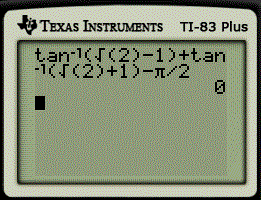
I could do this with a calculator…

arctangent…but that would be cheating.

Instead, let \alpha = \tan^{-1} (\sqrt{2} - 1 ) and \beta = \tan^{-1} (\sqrt{2} + 1 ), so that

\tan \alpha = \sqrt{2} - 1,

\tan \beta = \sqrt{2} + 1.

Indeed, by SOHCAHTOA, the angles \alpha and \beta can be represented in the figure below:
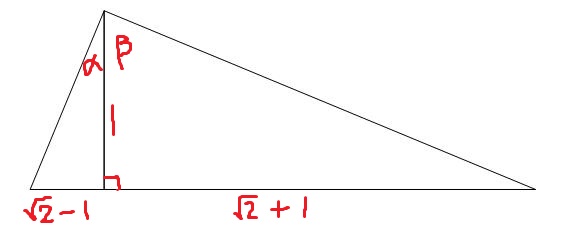

arctangenttriangle2The two small right triangles make one large triangle, and I will show that the large triangle is also a right triangle. To do this, let’s find the lengths of the three sides of the large triangle. The length of the longest side is clearly \sqrt{2} - 1 + \sqrt{2} + 1 = 2\sqrt{2}. I will use the Pythagorean theorem to find the lengths of the other two sides. For the small right triangle containing \alpha, the missing side is

\sqrt{ \left(\sqrt{2} - 1 \right)^2 + 1^2} = \sqrt{2 - 2\sqrt{2} + 1 + 1} = \sqrt{4-2\sqrt{2}}

Next, for the small right triangle containing \beta, the missing side is

\sqrt{ \left(\sqrt{2} + 1 \right)^2 + 1^2} = \sqrt{2 + 2\sqrt{2} + 1 + 1} = \sqrt{4+2\sqrt{2}}

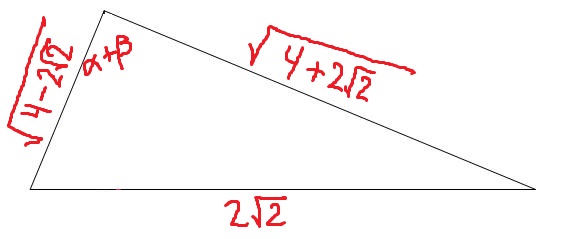
So let me redraw the figure, eliminating the altitude from the previous figure:

arctangenttriangle3

Notice that the condition of the Pythagorean theorem is satisfied, since

\left( \sqrt{4-2\sqrt{2}} \right)^2 + \left( \sqrt{4+2\sqrt{2}} \right)^2 = 4 - 2\sqrt{2} + 4 + 2 \sqrt{2} = 8,

or

\left( \sqrt{4-2\sqrt{2}} \right)^2 + \left( \sqrt{4+2\sqrt{2}} \right)^2 = \left( 2\sqrt{2} \right)^2.

Therefore, by the converse of the Pythagorean theorem, the above figure must be a right triangle (albeit a right triangle with sides of unusual length), and so \alpha + \beta = \pi/2. In other words, x_1 = 1, as required.

To show that x_2 = -1, I will show that the function f(x) = \tan^{-1} ( x\sqrt{2} - 1 ) + \tan^{-1}( x \sqrt{2} + 1) is an odd function using the fact that \tan^{-1} x is also an odd function:

f(-x) = \tan^{-1} ( -x\sqrt{2} - 1 ) + \tan^{-1}( -x \sqrt{2} + 1)

= \tan^{-1} ( -[x\sqrt{2} + 1] ) + \tan^{-1}( -[x \sqrt{2} - 1])

= -\tan^{-1} ( x\sqrt{2} + 1 ) - \tan^{-1}( x \sqrt{2} - 1)

= - \left[ \tan^{-1} ( x\sqrt{2} + 1 ) + \tan^{-1}( x \sqrt{2} - 1) \right]

= -f(x).

Therefore, f(-1) = -f(1) = -\displaystyle \frac{\pi}{2}, and so x_2 = -1.