Engaging students: Deriving the proportions of a 45-45-90 right triangle

In my capstone class for future secondary math teachers, I ask my students to come up with ideas for engaging their students with different topics in the secondary mathematics curriculum. In other words, the point of the assignment was not to devise a full-blown lesson plan on this topic. Instead, I asked my students to think about three different ways of getting their students interested in the topic in the first place.

I plan to share some of the best of these ideas on this blog (after asking my students’ permission, of course).

This student submission comes from my former student Morgan Mayfield. His topic, from Geometry: deriving the proportions of a 45-45-90 right triangle.

green line

How could you as a teacher create an activity or project that involves your topic?

I included a lesson plan from Virgina Lynch of Oklahoma Panhandle State University. In her lesson plan, she includes a section where students draw a 45-45-90 triangle, or right-isosceles triangles, and then uses the variable x for the leg lengths to prove the proportion for students. Then, she uses a section where she has students cut out actual 45-45-90 triangles with 4-in leg lengths. Each student measures their hypotenuse to some degree of accuracy and reports their length. Lastly, Ms.Lynch averages the lengths and has students divide the average by root 2 on a calculator to show that the answer is incredibly close to 4.

My likes: These are two different styles of proving the 1:1:root 2 proportions of a triangle for students: one mathematical and the other more deductive after knowing the mathematical proof. This provides students with an auditory, tactile, and visual way to understand the proportion of the side lengths. I think that the tactile part can be the biggest thing for students. Rarely do we end up building a triangle and measuring its sides to show that this relationship makes rough sense in the real world.

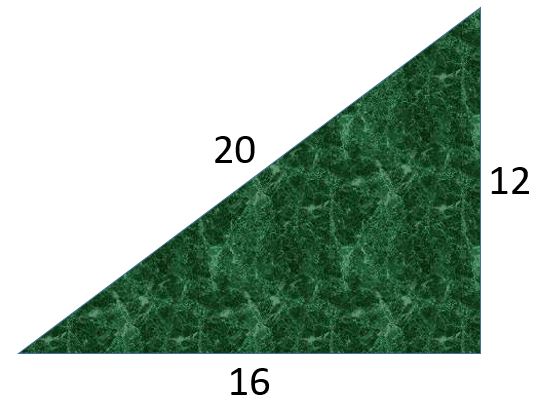
My adaptation: In a geometry class, I would find the mathematical proof to be a fun exercise for students to flex their understanding of algebra, geometry, and the Pythagorean theorem. I would group students up and probably help them start connecting the algebra portion by giving them the leg length “x” and saying I want to know the length of the hypotenuse in exact terms. Group members can collaborate and use their collective knowledge to apply the understanding that a 45-45-90 triangle is isosceles and right, then use the Pythagorean theorem to find the length of the hypotenuse in terms of x.

Then, I would have some groups cut out 45-45-90 triangles of some leg length and other groups cut out 45-45-90 triangles of some other leg length to have more variety, but still show the root 2 proportion in our physical environment.

green line

How can this topic be used in your students’ future courses in mathematics or science?

45-45-90 triangles are very helpful in understanding the unit circle. This may be taught at the geometry level or in precalculus. In a unit circle, our radius is 1, so when we want to know the sine or cosine of 45 degrees or 45+ \pi/2, then we can apply the relationship that we already know about 45-45-90 triangles. So, on the unit circle, build a right triangle where the hypotenuse connects the center to the circumference of the circle at a 45-degree angle from the x-axis. Since the triangle is both right and has one 45-degree angle, we know the other angle is 45 degrees as well. This should immediately invoke the sacred root 2 ratio, but this time we only know the length of the hypotenuse, which is 1, which is the radius. Thus, we divide the radius, 1, by root 2, and then get rid of the root 2 from the denominator to get \sqrt{2}/2 for both legs. Lastly, we apply our knowledge of sine and cosine to understand that sine of an angle in a right triangle, that is not the right angle, is the “length of the opposite side over the hypotenuse”, which is just \sqrt{2}/2 because we have the convenience of being in a unit circle.

green line

How does this topic extend what your students should have learned in previous courses?

The basis for understanding a 45-45-90 triangle takes its understanding from 8th grade math when students are introduced to the Pythagorean theorem and the beginning of the geometry course when students cover identities of isosceles triangles, mostly from a Euclid perspective. Even before that, students learn other basic things about triangles such as the interior angles add up to 180 degrees and that a right triangle has a 90-degree angle.

This is how students connect the three Euclid book I propositions: 5, 6, and 47. Students learn that from propositions 5 and 6 in a geometry class, isosceles triangles have two sides of equal length which imply the angles between those equal sides and the third sides are equal and vice-versa. So, a 45-45-90 triangle implies that it has two equal sides, which are the legs of the right triangle. Now, we apply proposition 47, the Pythagorean theorem because this is a right triangle, to then show algebraically the hypotenuse is x\sqrt{2} where x is the length of one of the legs.

green line

How has this topic appeared in pop culture (movies, TV, current music, video games, etc.)?

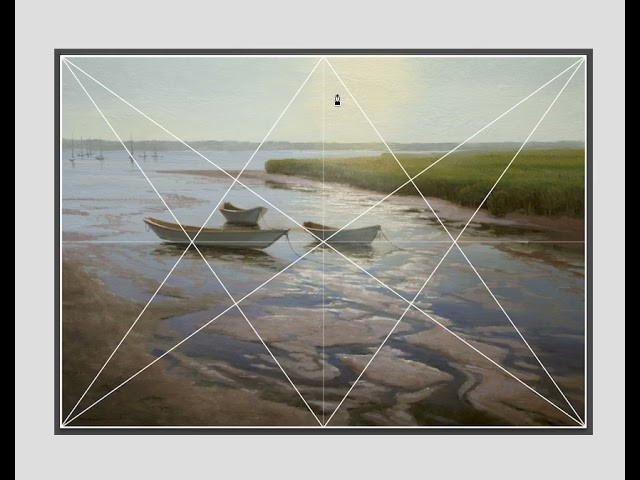
I find the topic of “Dynamic Rectangles” and “Dynamic Symmetry” very fascinating. This is frequently used in art, usually in drawing, painting, and photography. Jay Hambridge formalized the idea that classical art used Dynamic Symmetry which includes the ratio of 1:. This ratio is usually built inside of a rectangle or square to give very interesting, symmetrical focal points within a piece that could not be achieved within just any regular rectangle. The photothunk blog below details how the diagonals of the dynamic rectangles and the perpendiculars to the diagonals form a special symmetry that is lost when used in a rectangle that doesn’t have the 1:\sqrt{x} ratio. For example, I’ve included a piece of art by Thomas Kegler and a Youtube analysis of the piece of art that uses Root 2 Dynamic Symmetry.


What does this mean for the 45-45-90 triangles? Well, to build these dynamic rectangles, we must start off with a square. Think about the diagonal of a square. When we form this diagonal, we form a right triangle with two 45-degree angles. All squares are two 45-45-90 triangles. Now, using the length of the diagonal, which we know mathematically to be x\sqrt{2} where x is the length of one of the legs, we can build our dynamic rectangle and then build other dynamic rectangles because 1^2 + (\sqrt{x})^2 = x+1 . I’ve included a diagram I made in Geogebra to show off a way to build the root 2 dynamic rectangle using just circles and lines.

Starting with a square ABCD, we can place two circles with centers C and D and radii AC. Why AC? This is because AC is the diagonal of the square, which we know to be x\sqrt{2} where x is the length of one of the sides of the square. Now, we know our radii is equal to x\sqrt{2}. We can extend the sides of our square CB and DA to find the intersection points of the circles and the extended lines E and F. Now, all we must do is connect E to F and voila, we have a root 2 dynamic rectangle FECD.

green line

How have different cultures throughout time used this topic in their society?

This answer will be my most speculative answer using concepts of the 45-45-90 triangles. First, I must ask the reader to suspend the round world belief and act that we live on a relatively flat plane of existence. Our societies have been build around organizing land into rectangular and square shaped pieces of land. I will talk about the “Are” system which has shaped a lot of Western Europe and the Americas due to colonization by the European powers. You may have heard the term “hectare”, which is still popular in the United States. It is literally a mash up of the words “hecto-”, coming from Greek and meaning one-hundred and “are”, coming from Latin and meaning area. So, this is 100 ares, which is a measure of land that is 10 meters x 10 meters. That means a hectare is 100 meters x 100 meters.

Well, one would imagine that with Greek, Latin, and Western European obsession with symmetry, we would want to split these square pieces of land in half with many different diagonals, so it must have been useful to understand the proportions of the 45-45-90 triangle to makes paths and roads that travel from one end of the hectare to the other end efficiently while also utilizing the space and human travel within the hectare efficiently. Again, this is my speculation, but knowing that two 45-45-90 triangles form a square means that all squares and symmetry involve using this 1:\sqrt{2} ratio; they are inseparable.

References:

https://www.youtube.com/watch?v=w1aQtBOHFkM

https://ipoxstudios.com/the-simplicity-and-beauty-of-dynamic-symmetry-visual-glossary/

https://www.youtube.com/watch?v=iJ_nQWyKVJQ

http://photothunk.blogspot.com/2016/03/dynamic-symmetry-and-jay-hambridge.html

http://www.opsu.edu/www/education/MATH-ESE%204%20ALL/Virginia%20Lynch/Special%20Right%20Triangles-%20Lesson%20Plan.pdf

https://en.wikipedia.org/wiki/Hectare

Engaging students: Deriving the Pythagorean theorem

In my capstone class for future secondary math teachers, I ask my students to come up with ideas for engaging their students with different topics in the secondary mathematics curriculum. In other words, the point of the assignment was not to devise a full-blown lesson plan on this topic. Instead, I asked my students to think about three different ways of getting their students interested in the topic in the first place.

I plan to share some of the best of these ideas on this blog (after asking my students’ permission, of course).

This student submission comes from my former student Gary Sin. His topic, from Geometry: deriving the Pythagorean theorem.

green line

How could you as a teacher create an activity or project that involves your topic?

The Pythagorean Theorem is an extremely important topic in mathematics that is useful even when after the students graduate high school and proceed to college. As a student majoring in mathematics, I always like to explore the fundamental proofs of different theorems; I feel that if the student is able to derive a formula or theorem; it displays mastery over a mathematical topic.

As such, I will have the students work with a geometrical proof of the theorem. The students will be given 4 triangles with sides a, b, and c, and a square with sides c. I will instruct the students to fidget with the shapes and allow them to explore the different combinations that might lead to the theorem. As the class slowly figures out what combinations work, I will provide algebraic hints to the proof of the theorem. (including (a+b)^2 and c^2).

Finally, once a majority of the students figure out the geometric proof of the theorem; I will recap and reiterate the different findings of the students and summarize the geometric proof of the theorem.

green line

How can this topic be used in your students’ future courses in mathematics or science?

Pythagorean Theorem is extremely useful when beginning geometry, it applies to all right triangles and one could use it too to find the area of regular polgyons as they are also made up of right triangles. The surface area and volumes of pyramids, triangular prisms also rely on the theorem. Another major topic in geometry is trigonometry, where the trigonometric ratios are introduced and they are also based on right triangles. The Law of Cosines is also derived from the theorem. The theorem is also used in the distance formula between 2 points on the Cartesian plane.

The theorem is also used in Pre-Calculus and Calculus. Complex numbers uses it (similar to the distance formula). The basis of the unit circle and converting Cartesian coordinates to polar coordinates or vice versa also utilizes the theorem. The fundamental trigonometric identity is also derived from the theorem. Cross products of vectors uses the theorem, the theorem can also be seen in Calculus 3 in 3 dimensional geometry and finding volumes of various shapes because the theorem still applies to planes.

green line

How does this topic extend what your students’ should have learned in previous courses?

The theorem uses algebra to represent unknown sides in a right triangle. The students should have also learned about the names of the different sides on a right triangle, namely the legs and the hypotenuse. Being able to identify which side is the hypotenuse is very important in understanding and applying this theorem. Additionally, the students must be able to recognize what a right angle is which will determine if a triangle is a right triangle or not.

Deriving the theorem requires knowledge on the multiplication of polynomials, and how they are factored out. The students also use powers of 2 in the theorem and should be aware of how to square 2 integers and what the product is equal to. In the case of a non Pythagorean triple, the student must be able to manipulate radicals and simplify them accordingly.

Finally, the student must be able to identify what variables are provided and know what unknown they have to solve for. The variables and unknown side requires basic knowledge on how algebra works and how to use equations and manipulate them accordingly to solve for an unknown.

Engaging students: Deriving the Pythagorean theorem

In my capstone class for future secondary math teachers, I ask my students to come up with ideas for engaging their students with different topics in the secondary mathematics curriculum. In other words, the point of the assignment was not to devise a full-blown lesson plan on this topic. Instead, I asked my students to think about three different ways of getting their students interested in the topic in the first place.

I plan to share some of the best of these ideas on this blog (after asking my students’ permission, of course).

This student submission comes from my former student Haley Higginbotham. Her topic, from Geometry: deriving the Pythagorean theorem.

green line

How could you as a teacher create an activity or project that involves your topic?

An interesting hands-on activity would be to do a visual proof of Pythagorean Theorem by using just paper, scissors, a ruler, and a pencil. Starting with a square piece of paper, the students will make a square with a length in the bottom left corner and a square of b length in the upper right hand corner, similar to the picture below on the right-hand side. Then the students would cut out the squares, and end up with two squares and two rectangles. The students would then be instructed to cut the both rectangles along their diagonals. Then the challenge is to make a square that contains a square inside by only using the triangles they have cut out. The level of difficult of the challenge will depend on the grade level and on the caliber of students, but it’s still more interesting than writing out a formal proof. Then after everyone has made something similar to the picture below on the left-hand side, I would ask them if they know why this proves the Pythagorean Theorem. If a student has a good explanation, I would ask them to demonstrate their explanation to the rest of the class. If no one figures it out, I would suggest they label the different lengths and see if they figure it out then.

green line

How has this topic appeared in high culture?

The Pythagoras tree is a fractal constructed using squares that are arranged to form right triangles. Fractals are very popular for use in art since the repetitive pattern is very aesthetically pleasing and fairly easy to replicate, especially using technology. The following picture is an example of a Pythagoras tree sculpture extended into 3 dimensions. There is also the Pythagorean snail, which is constructed by making isosceles right triangles in a circular pattern, keeping the smallest leg of each triangle the same size. With this basic design, you can create a variety of designs, an example is pictured below. Even though the base is a bunch of triangles in a spiral, the design overlaid on top of it takes it from purely mathematical to a piece of art. Of course, one could argue that mathematics itself is an art, but the general population would agree that the design really makes it a work of art.


green line

How can technology be used?

I think I would use Desmos to extend the activity described in A2, since they have seen it works for their particular choice of a and b, but they might not see how it works for all choices of a and b (as long as the triangles they have are right triangles). By using Desmos, I can use an activity that allows students to drag the different sides to see that the relationship holds no matter how a and b change. I think something similar to this activity would work: https://teacher.desmos.com/activitybuilder/custom/5adc7bfced2ada678516940e, except I would modify it so it was closer to the activity that we did with paper during class. I would also show them the other explanation of the squares aligned with the lines of the triangles. It’s great because Desmos has activities that you can use but you can also customize the activities however you want to fit your specific ideas. You could also ‘code’ from scratch your own activity.


Engaging students: Deriving the Pythagorean theorem

In my capstone class for future secondary math teachers, I ask my students to come up with ideas for engaging their students with different topics in the secondary mathematics curriculum. In other words, the point of the assignment was not to devise a full-blown lesson plan on this topic. Instead, I asked my students to think about three different ways of getting their students interested in the topic in the first place.

I plan to share some of the best of these ideas on this blog (after asking my students’ permission, of course).

This student submission comes from my former student Julie Thompson. Her topic, from Geometry: deriving the Pythagorean theorem.

green line

How could you as a teacher create an activity or project that involves your topic?

I believe the best way to convince students that a certain theorem is true is to model it visually. Luckily, the Pythagorean Theorem has several ways to derive it and show that it works. My favorite is showing it with squares. You ask students to consider the numbers 3, 4, and 5. Given paper, ask them to create three squares with each of those dimensions. Then, see if they can form a right triangle out of the three squares they made. Next, ask them if they can find a way to make two squares fit exactly into another square (cutting the squares up if necessary). Hopefully, they will get the squares with dimensions 3 and 4 to fit into the biggest square. Finally, ask them to write a conjecture about what they find. It turns out that the two smaller squares fit perfectly into the bigger square, or, more mathematically, 32+42=52. Generally, a2+b2=c2

I did the activity myself and it is pictured below:


green line

How does this topic extend what your students should have learned in previous courses?

Students learn how to derive the Pythagorean Theorem in Geometry. However, they should have prior knowledge on square numbers, finding the area of a square, and simple algebraic equations. Students should also be able to solve equations and evaluate expressions when given values for the variables. The students will then be able to use all of this prior knowledge and apply it to one fantastic theorem: The Pythagorean Theorem. They can then use the theorem to find missing side lengths of a triangle. This extends their prior knowledge because they are now using their mathematical skills and applying it to the real world.

An example of this extension would be assigning this problem to my students: Think about your rectangular room at home. We want to estimate the length of the diagonal from corner to corner. Estimate that length to 3 decimal places. Then create a model to show why it is true, using the area of squares proof (from my A2 activity). The students are using their prior knowledge of square numbers, area of squares, and solving equations for this problem.


green line

What interesting things can you say about the people who contributed to the discovery?

Pythagoras contributed greatly to the discovery of the Pythagorean Theorem (clearly it is named after him). ”It is sometimes claimed that we owe pure mathematics to Pythagoras, and he is often called the first “true” mathematician.” We think of him as having been a very logical man, but he had some very weird, illogical beliefs as well. According to the article, “Pythagoras imposed odd rules on all the members of his school (including bizarre and apparently random edicts about never urinating towards the sun, never marrying a woman who wears gold jewelry, never passing an ass lying in the street, never eating or even touching black fava beans, etc.”

The Pythagoreans (Pythagoras and his followers) discovered something very interesting about the number 10. Today, when we wonder why we use base 10, we attribute it to the simple fact that we have ten fingers and ten toes. Our ten fingers are what we use to count with. Pythagoras deemed 10 to be a very special number, but for a more abstract reason. You can form an equilateral triangle with rows of 4, 3, 2 and 1. Altogether this triangle contains 10 points. He called it the tetractys. And 10 was thought to be a very holy number. Of course, he is most known for this theorem. “it has become one of the best-known of all mathematical theorems, and as many as 400 different proofs now exist, some geometrical, some algebraic, some involving advanced differential equations, etc.”

REFERENCES:

https://www.storyofmathematics.com/greek_pythagoras.html


Engaging students: Vectors in two dimensions

In my capstone class for future secondary math teachers, I ask my students to come up with ideas for engaging their students with different topics in the secondary mathematics curriculum. In other words, the point of the assignment was not to devise a full-blown lesson plan on this topic. Instead, I asked my students to think about three different ways of getting their students interested in the topic in the first place.

I plan to share some of the best of these ideas on this blog (after asking my students’ permission, of course).

This student submission comes from my former student Sarah McCall. Her topic, from Precalculus: vectors in two dimensions.

green line

What interesting (i.e., uncontrived) word problems using this topic can your students do now?

For such an applicable topic, I believe that it is beneficial to have students see how this might apply to their lives and to real world problems. I selected the following word problems because they are challenging, but I think it is necessary for students to be a little frustrated initially so that they are able to learn well and remember what they’ve learned.

1. A DC-10 jumbo jet maintains an airspeed of 550 mph in a southwesterly direction. The velocity of the jet stream is a constant 80 mph from the west. Find the actual speed and direction of the aircraft.

2. The pilot of an aircraft wishes to head directly east, but is faced with a wind speed of 40 mph from the northwest. If the pilot maintains an airspeed of 250 mph, what compass heading should be maintained? What is the actual speed of the aircraft?

3. A river has a constant current of 3 kph. At what angle to a boat dock should a motorboat, capable of maintaining a constant speed of 20 kph, be headed in order to reach a point directly opposite the dock? If the river is ½ a kilometer wide, how long will it take to cross?

Because these problems are difficult, students would be instructed to work together to complete them. This would alleviate some frustrations and “stuck” feelings by allowing them to ask for help. Ultimately, talking through what they are doing and successfully completing challenging problems will take students to a deeper level of involvement with their own learning.


green line

How could you as a teacher create an activity or project that involves your topic?

I believe vectors are fairly easy to teach because there are so many real life applications of vectors. However, it can be difficult to get students initially engaged. For this activity, I would have students work in groups to complete a project inspired by Khan Academy’s videos on vector word problems. Students would split off into groups and watch each of the three videos on Khan Academy that have to do with applications of vectors in two dimensions. Using these videos as an example, students will be instructed to come up with a short presentation or video that teaches other students about vectors in two dimensions using real world applications and examples.


green line

How has this topic appeared in pop culture (movies, TV, current music, video games, etc.)?

Immediately when I see vectors, I think of one specific movie quote from my late childhood that I’ll always remember. The villain named Vector from Despicable Me who “commits crimes with both direction AND magnitude” is a fellow math nerd and is therefore one of my favorite Disney villains of all time. So of course, I had to find the clip (linked below) because I think it is absolutely perfect for engaging students in a lesson about vectors as soon as they walk in the door, and it is memorable and educational. I would refer back to this video several times throughout the lesson and in future lessons because it is a catchy way to remember the two components to vectors. This would also be great to kick off a unit on scalars and vectors, because it would get kids laughing and therefore engaged, plus they will always remember the difference between a scalar and a vector (direction AND magnitude!).  

References:

  1. https://www.khanacademy.org/math/precalculus/vectors-precalc/applications-of-vectors/v/vector-component-in-direction
  2. https://www.google.com/url?sa=t&rct=j&q=&esrc=s&source=web&cd=2&cad=rja&uact=8&ved=0ahUKEwj42PaGqojXAhXKSiYKHTvLD8oQFgguMAE&url=http%3A%2F%2Fwww.jessamine.k12.ky.us%2Fuserfiles%2F1038%2FClasses%2F17195%2FVector%2520Word%2520Problems%2520Practice%2520Worksheet%25202.docx&usg=AOvVaw1IHTinEQtGK4Ww1_JkBhHf
  3. https://www.youtube.com/watch?v=bOIe0DIMbI8

Engaging students: Deriving the double angle formulas for sine, cosine, and tangent

In my capstone class for future secondary math teachers, I ask my students to come up with ideas for engaging their students with different topics in the secondary mathematics curriculum. In other words, the point of the assignment was not to devise a full-blown lesson plan on this topic. Instead, I asked my students to think about three different ways of getting their students interested in the topic in the first place.

I plan to share some of the best of these ideas on this blog (after asking my students’ permission, of course).

This student submission comes from my former student Daniel Adkins. His topic, from Precalculus: deriving the double angle formulas for sine, cosine, and tangent.

green line

How does this topic extend what your students should have already learned?

A major factor that simplifies deriving the double angle formulas is recalling the trigonometric identities that help students “skip steps.” This is true especially for the Sum formulas, so a brief review of these formulas in any fashion would help students possibly derive the equations on their own in some cases. Listed below are the formulas that can lead directly to the double angle formulas.

A list of the formulas that students can benefit from recalling:

  • Sum Formulas:
    • sin(a+b) = sin(a)cos(b) + cos(a)sin(b)
    • cos(a+b) = cos(a)cos(b) – sin(a)sin(b)
    • tan(a+b) = [tan(a) +tan(b)] / [1-tan(a)tan(b)]


  • Pythagorean Identity:
    • Sin2 (a) + Cos2(a) = 1


This leads to the next topic, an activity for students to attempt the equation on their own.


green line

How could you as a teacher create an activity or project that involves your topic?

I’m a firm believer that the more often a student can learn something of their own accord, the better off they are. Providing the skeletal structure of the proofs for the double angle formulas of sine, cosine, and tangent might be enough to help students reach the formulas themselves. The major benefit of this is that, even though these are simple proofs, they have a lot of variance on how they may be presented to students and how “hands on” the activity can be.

I have an example worksheet demonstrating this with the first two double angle formulas attached below. This is in extremely hands on format that can be given to students with the formulas needed in the top right corner and the general position where these should be inserted. If needed the instructor could take this a step further and have the different Pythagorean Identities already listed out (I.e. Cos2(a) = 1 – Sin2(a), Sin2(a) = 1 – Cos2(a)) to emphasize that different formats could be needed. This is an extreme that wouldn’t take students any time to reach the conclusions desired. Of course a lot of this information could be dropped to increase the effort needed to reach the conclusion.

A major benefit with this also is that even though they’re simple, students will still feel extremely rewarded from succeeding on this paper on their own, and thus would be more intrinsically motivated towards learning trig identities.


green line

How can Technology be used to effectively engage students with this topic?

When it comes to technology in the classroom, I tend to lean more on the careful side. I know me as a person/instructor, and I know I can get carried away and make a mess of things because there was so much excitement over a new toy to play with. I also know that the technology can often detract from the actual math itself, but when it comes to trigonometry, and basically any form of geometric mathematics, it’s absolutely necessary to have a visual aid, and this is where technology excels.

The Wolfram Company has provided hundreds of widgets for this exact purpose, and below, you’ll find one attached that demonstrates that sin(2a) appears to be equal to its identity 2cos(a)sin(a). This is clearly not a rigorous proof, but it will help students visualize how these formulas interact with each other and how they may be similar. The fact that it isn’t rigorous may even convince students to try to debunk it. If you can make a student just irritated enough that they spend a few minutes trying to find a way to show you that you’re wrong, then you’ve done your job in that you’ve convinced them to try mathematics for a purpose.

After all, at the end of the day, it doesn’t matter how you begin your classroom, or how you engage your students, what matters is that they are engaged, and are willing to learn.

Wolfram does have a free cdf reader for its demonstrations on this website: http://demonstrations.wolfram.com/AVisualProofOfTheDoubleAngleFormulaForSine/


References