Confirming Einstein’s Theory of General Relativity With Calculus, Part 6g: Rationale for Method of Undetermined Coefficients IV

In this series, I’m discussing how ideas from calculus and precalculus (with a touch of differential equations) can predict the precession in Mercury’s orbit and thus confirm Einstein’s theory of general relativity. The origins of this series came from a class project that I assigned to my Differential Equations students maybe 20 years ago.

We have shown that the motion of a planet around the Sun, expressed in polar coordinates (r,\theta) with the Sun at the origin, under general relativity follows the initial-value problem

u''(\theta) + u(\theta) = \displaystyle \frac{1}{\alpha} + \frac{\delta}{\alpha^2} + \frac{\delta \epsilon^2}{2\alpha^2} + \frac{2\delta \epsilon \cos \theta}{\alpha^2} + \frac{\delta \epsilon^2 \cos 2\theta}{2\alpha^2},

u(0) = \displaystyle \frac{1}{P},

u'(0) = 0,

where u = \displaystyle \frac{1}{r}, \displaystyle \frac{1}{\alpha} = \frac{GMm^2}{\ell^2}, \delta = \displaystyle \frac{3GM}{c^2}, G is the gravitational constant of the universe, m is the mass of the planet, M is the mass of the Sun, \ell is the constant angular momentum of the planet, c is the speed of light, and P is the smallest distance of the planet from the Sun during its orbit (i.e., at perihelion).

In this post, we will use the guesses

u(\theta) = f(\theta) \cos \theta \qquad \hbox{or} u(\theta) = f(\theta) \sin \theta

that arose from the technique/trick of reduction of order, where f(\theta) is some unknown function, to find the general solution of the differential equation

u^{(4)} + 2u'' + u = 0.

To do this, we will need to use the Product Rule for higher-order derivatives that was derived in the previous post:

(fg)'' = f'' g + 2 f' g' + f g''

and

(fg)^{(4)} = f^{(4)} g + 4 f''' g' + 6 f'' g'' + 4f' g''' + f g^{(4)}.

In these formulas, Pascal’s triangle makes a somewhat surprising appearance; indeed, this pattern can be proven with mathematical induction.

We begin with u(\theta) = f(\theta) \cos \theta. If g(\theta) = \cos \theta, then

g'(\theta) = - \sin \theta,

g''(\theta) = -\cos \theta,

g'''(\theta) = \sin \theta,

g^{(4)}(\theta) = \cos \theta.

Substituting into the fourth-order differential equation, we find the differential equation becomes

(f \cos \theta)^{(4)} + 2 (f \cos \theta)'' + f \cos \theta = 0

f^{(4)} \cos \theta - 4 f''' \sin \theta - 6 f'' \cos \theta + 4 f' \sin \theta + f \cos \theta + 2 f'' \cos \theta - 4 f' \sin \theta - 2 f \cos \theta + f \cos \theta = 0

f^{(4)} \cos \theta - 4 f''' \sin \theta - 6 f'' \cos \theta  + 2 f'' \cos \theta  = 0

f^{(4)} \cos \theta - 4 f''' \sin \theta - 4 f'' \cos \theta = 0

The important observation is that the terms containing f and f' cancelled each other. This new differential equation doesn’t look like much of an improvement over the original fourth-order differential equation, but we can make a key observation: if f'' = 0, then differentiating twice more trivially yields f''' = 0 and f^{(4)} = 0. Said another way: if f'' = 0, then u(\theta) = f(\theta) \cos \theta will be a solution of the original differential equation.

Integrating twice, we can find f:

f''(\theta) = 0

f'(\theta) = c_1

f(\theta) = c_1 \theta + c_2.

Therefore, a solution of the original differential equation will be

u(\theta) = c_1 \theta \cos \theta + c_2 \cos \theta.

We now repeat the logic for u(\theta) = f(\theta) \sin \theta:

(f \sin \theta)^{(4)} + 2 (f \sin \theta)'' + f \sin \theta = 0

f^{(4)} \sin \theta + 4 f''' \cos \theta - 6 f'' \sin \theta - 4 f' \cos\theta + f \sin \theta + 2 f'' \sin \theta + 4 f' \cos \theta - 2 f \sin \theta + f \sin \theta = 0

f^{(4)} \sin\theta + 4 f''' \cos \theta - 6 f'' \sin \theta + 2 f'' \sin \theta = 0

f^{(4)} \sin\theta - 4 f''' \cos\theta - 4 f'' \sin\theta = 0.

Once again, a solution of this new differential equation will be f(\theta) = c_3 \theta + c_4, so that f'' = f''' = f^{(4)} = 0. Therefore, another solution of the original differential equation will be

u(\theta) = c_3 \theta \sin \theta + c_4 \sin \theta.

Adding these provides the general solution of the differential equation:

u(\theta) = c_1 \theta \cos \theta + c_2 \cos \theta + c_3 \theta \sin \theta + c_4 \sin \theta.

Except for the order of the constants, this matches the solution that was presented earlier by using techniques taught in a proper course in differential equations.

Confirming Einstein’s Theory of General Relativity With Calculus, Part 6f: Rationale for Method of Undetermined Coefficients III

In this series, I’m discussing how ideas from calculus and precalculus (with a touch of differential equations) can predict the precession in Mercury’s orbit and thus confirm Einstein’s theory of general relativity. The origins of this series came from a class project that I assigned to my Differential Equations students maybe 20 years ago.

We have shown that the motion of a planet around the Sun, expressed in polar coordinates (r,\theta) with the Sun at the origin, under general relativity follows the initial-value problem

u''(\theta) + u(\theta) = \displaystyle \frac{1}{\alpha} + \frac{\delta}{\alpha^2} + \frac{\delta \epsilon^2}{2\alpha^2} + \frac{2\delta \epsilon \cos \theta}{\alpha^2} + \frac{\delta \epsilon^2 \cos 2\theta}{2\alpha^2},

u(0) = \displaystyle \frac{1}{P},

u'(0) = 0,

where u = \displaystyle \frac{1}{r}, \displaystyle \frac{1}{\alpha} = \frac{GMm^2}{\ell^2}, \delta = \displaystyle \frac{3GM}{c^2}, G is the gravitational constant of the universe, m is the mass of the planet, M is the mass of the Sun, \ell is the constant angular momentum of the planet, c is the speed of light, and P is the smallest distance of the planet from the Sun during its orbit (i.e., at perihelion).

In the previous post, I used a standard technique from differential equations to find the general solution of

u^{(4)} + 2u'' + u = 0.

to be

u(theta) = c_1 \cos \theta + c_2 \sin \theta + c_3 \theta \cos \theta + c_4 \theta \sin \theta.

However, as much as possible in this series, I want to take the perspective of a talented calculus student who has not yet taken differential equations — so that the conclusion above is far from obvious. How could this be reasonable coaxed out of such a student?

To begin, we observe that the characteristic equation is

r^4 + 2r^2 + 1 = 0,

or

(r^2 + 1)^2 = 0.

Clearly this has the same roots as the simpler equation r^2 + 1 = 0, which corresponds to the second-order differential equation u'' + u = 0. We’ve already seen that u_1(\theta) = \cos \theta and u_2(\theta) = \sin \theta are solutions of this differential equation; perhaps they might also be solutions of the more complicated differential equation also? The answer, of course, is yes:

u_1^{(4)} + 2 u_1'' + u_1 = \cos \theta - 2 \cos \theta + \cos \theta = 0

and

u_2^{(4)} + 2u_2'' + u_2 = \sin \theta - 2 \sin \theta + \sin \theta = 0.

The far trickier part is finding the two additional solutions. To find these, we use a standard trick/technique called reduction of order. In this technique, we guess that any additional solutions much have the form of either

u(\theta) = f(\theta) \cos \theta \qquad \hbox{or} \qquad  u(\theta) = f(\theta) \sin \theta,

where f(\theta) is some unknown function that we’re multiplying by the solutions we already have. We then substitute this into the differential equation u^{(4)} + 2u'' + u = 0 to form a new differential equation for the unknown f, which we can (hopefully) solve.

Doing this will require multiple applications of the Product Rule for differentiation. We already know that

(fg)' = f' g + f g'.

We now differentiate again, using the Product Rule, to find (fg)'':

(fg)'' = ( [fg]')' = (f'g)' + (fg')'

= f''g + f' g' + f' g' + f g''

= f'' g + 2 f' g' + f g''.

We now differential twice more to find (fg)^{(4)}:

(fg)''' = ( [fg]'')' = (f''g)' + 2(f'g')' +  (fg'')'

= f'''g + f'' g' + 2f'' g' + 2f' g'' + f' g'' + f g'''

= f''' g + 3 f'' g' + 3 f' g'' + f g'''.

A good student may be able to guess the pattern for the next derivative:

(fg)^{(4)} = ( [fg]''')' = (f'''g)' + 3(f''g')' +3(f'g'')' + (fg''')'

= f^{(4)}g + f''' g' + 3f''' g' + 3f'' g'' + 3f'' g'' + 3f'g''' + f' g''' + f g^{(4)}

= f^{(4)} g + 4 f''' g' + 6 f'' g'' + 4f' g''' + f g^{(4)}.

In this way, Pascal’s triangle makes a somewhat surprising appearance; indeed, this pattern can be proven with mathematical induction.

In the next post, we’ll apply this to the solution of the fourth-order differential equation.

Confirming Einstein’s Theory of General Relativity With Calculus, Part 6e: Rationale for Method of Undetermined Coefficients II

In this series, I’m discussing how ideas from calculus and precalculus (with a touch of differential equations) can predict the precession in Mercury’s orbit and thus confirm Einstein’s theory of general relativity. The origins of this series came from a class project that I assigned to my Differential Equations students maybe 20 years ago.

We have shown that the motion of a planet around the Sun, expressed in polar coordinates (r,\theta) with the Sun at the origin, under general relativity follows the initial-value problem

u''(\theta) + u(\theta) = \displaystyle \frac{1}{\alpha} + \frac{\delta}{\alpha^2} + \frac{\delta \epsilon^2}{2\alpha^2} + \frac{2\delta \epsilon \cos \theta}{\alpha^2} + \frac{\delta \epsilon^2 \cos 2\theta}{2\alpha^2},

u(0) = \displaystyle \frac{1}{P},

u'(0) = 0,

where u = \displaystyle \frac{1}{r}, \displaystyle \frac{1}{\alpha} = \frac{GMm^2}{\ell^2}, \delta = \displaystyle \frac{3GM}{c^2}, G is the gravitational constant of the universe, m is the mass of the planet, M is the mass of the Sun, \ell is the constant angular momentum of the planet, c is the speed of light, and P is the smallest distance of the planet from the Sun during its orbit (i.e., at perihelion).

In the previous post, we derived the method of undetermined coefficients for the simplified differential equation

u''(\theta) + u(\theta) = \displaystyle \frac{1}{\alpha} + \frac{\delta}{\alpha^2} + \frac{\delta \epsilon^2}{2\alpha^2}.

In this post, we consider the simplified differential equation if the right-hand side has only the fourth term,

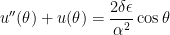
u''(\theta) + u(\theta) =  \displaystyle \frac{2\delta \epsilon }{\alpha^2}\cos \theta.

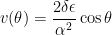
Let v(\theta) =  \displaystyle \frac{2\delta \epsilon }{\alpha^2}\cos \theta. Then v satisfies the new differential equation v'' + v = 0. Since u'' + u = v, we may substitute:

(u''+u)'' + (u'' + u) = 0

u^{(4)} + u'' + u'' + u = 0

u^{(4)} + 2u'' + u = 0.

The characteristic equation of this homogeneous differential equation is r^4 + 2r^2 + 1 = 0, or (r^2+1)^2 = 0. Therefore, r = i and r = -i are both double roots of this quartic equation. Therefore, the general solution for u is

u(\theta) = c_1 \cos \theta + c_2 \sin \theta + c_3 \theta \cos \theta + c_4 \theta \sin \theta.

Substituting into the original differential equation will allow for the computation of c_3 and c_4:

u''(\theta) + u(\theta) = -c_1 \cos \theta - c_2 \sin \theta - 2c_3 \sin \theta - c_3 \theta \cos \theta + 2c_4 \cos \theta - c_4 \theta \sin \theta

+   c_1 \cos \theta + c_2 \sin \theta + c_3 \theta \cos \theta + c_4 \theta \sin \theta

\displaystyle \frac{2\delta \epsilon }{\alpha^2}\cos \theta = - 2c_3 \sin \theta+ 2c_4 \cos \theta

Matching coefficients, we see that c_3 = 0 and c_4 = \displaystyle \frac{\delta \epsilon }{\alpha^2}. Therefore,

u(\theta) = c_1 \cos \theta + c_2 \sin \theta + \displaystyle \frac{\delta \epsilon }{\alpha^2} \theta \sin \theta

is the general solution of the simplified differential equation. Setting c_1 = c_2 = 0, we find that

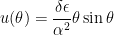
u(\theta) =  \displaystyle \frac{\delta \epsilon }{\alpha^2} \theta \sin \theta

is one particular solution of this simplified differential equation. Not surprisingly, this matches the result is the method of undetermined coefficients had been blindly followed.

As we’ll see in a future post, the presence of this \theta \sin \theta term is what predicts the precession of a planet’s orbit under general relativity.

Confirming Einstein’s Theory of General Relativity With Calculus, Part 6d: Rationale for Method of Undetermined Coefficeints I

In this series, I’m discussing how ideas from calculus and precalculus (with a touch of differential equations) can predict the precession in Mercury’s orbit and thus confirm Einstein’s theory of general relativity. The origins of this series came from a class project that I assigned to my Differential Equations students maybe 20 years ago.

We have shown that the motion of a planet around the Sun, expressed in polar coordinates (r,\theta) with the Sun at the origin, under general relativity follows the initial-value problem

u''(\theta) + u(\theta) = \displaystyle \frac{1}{\alpha} + \delta \left( \frac{1 + \epsilon \cos \theta}{\alpha} \right)^2,

u(0) = \displaystyle \frac{1}{P},

u'(0) = 0,

where u = \displaystyle \frac{1}{r}, \displaystyle \frac{1}{\alpha} = \frac{GMm^2}{\ell^2}, \delta = \displaystyle \frac{3GM}{c^2}, G is the gravitational constant of the universe, m is the mass of the planet, M is the mass of the Sun, \ell is the constant angular momentum of the planet, c is the speed of light, and P is the smallest distance of the planet from the Sun during its orbit (i.e., at perihelion).

We now take the perspective of a student who is taking a first-semester course in differential equations. There are two standard techniques for solving a second-order non-homogeneous differential equations with constant coefficients. One of these is the method of constant coefficients. To use this technique, we first expand the right-hand side of the differential equation and then apply a power-reduction trigonometric identity:

u''(\theta) + u(\theta) = \displaystyle \frac{1}{\alpha} + \frac{\delta}{\alpha^2} + \frac{2\delta  \epsilon \cos \theta}{\alpha^2} + \frac{\delta \epsilon^2 \cos^2 \theta}{\alpha^2}

= \displaystyle \frac{1}{\alpha} + \frac{\delta}{\alpha^2} + \frac{2\delta \epsilon \cos \theta}{\alpha^2} + \frac{\delta \epsilon^2}{\alpha^2} \frac{1 + \cos 2\theta}{2}

= \displaystyle \frac{1}{\alpha} + \frac{\delta}{\alpha^2} + \frac{\delta \epsilon^2}{2\alpha^2} + \frac{2\delta \epsilon \cos \theta}{\alpha^2} + \frac{\delta \epsilon^2 \cos 2\theta}{2\alpha^2}

This is now in the form for using the method of undetermined coefficients. However, in this series, I’d like to take some time to explain why this technique actually works. To begin, we look at a simplified differential equation using only the first three terms on the right-hand side:

u''(\theta) + u(\theta) = \displaystyle\frac{1}{\alpha} + \frac{\delta}{\alpha^2} + \frac{\delta \epsilon^2}{2\alpha^2}  .

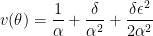
Let v(\theta) =\displaystyle \frac{1}{\alpha} + \frac{\delta}{\alpha^2} + \frac{\delta \epsilon^2}{2\alpha^2}  . Since v is a constant, this function satisfies the simple differential equation v' = 0. Since u''+u=v, we can substitute:

(u'' + u)' = 0

u''' + u' = 0

(We could have more easily said, “Take the derivative of both sides,” but we’ll be using a more complicated form of this technique in future posts.) The characteristic equation of this differential equation is r^3 + r = 0. Factoring, we obtain r(r^2 + 1) = 0, so that the three roots are r = 0 and r = \pm i. Therefore, the general solution of this differential equation is

u(\theta) = c_1 \cos \theta + c_2 \sin \theta + c_3.

Notice that this matches the outcome of blindly using the method of undetermined coefficients without conceptually understanding why this technique works.

The constants c_1 and c_2 are determined by the initial conditions. To find c_3, we observe

u''(\theta) +u(\theta) =  -c_1 \cos \theta - c_2 \sin \theta +c_1 \cos \theta + c_2 \sin \theta + c_3

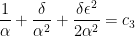
\displaystyle \frac{1}{\alpha} + \frac{\delta}{\alpha^2} + \frac{\delta \epsilon^2}{2\alpha^2}  = c_3.

Therefore, the general solution of this simplified differential equation is

u(\theta) = c_1 \cos \theta + c_2 \sin \theta + \displaystyle \frac{1}{\alpha} + \frac{\delta}{\alpha^2} + \frac{\delta \epsilon^2}{2\alpha^2}.

Furthermore, setting c_1 = c_2 = 0, we see that

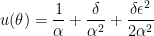
u(\theta) = \displaystyle\frac{1}{\alpha} + \frac{\delta}{\alpha^2} + \frac{\delta \epsilon^2}{2\alpha^2}

is a particular solution to the differential equation

u''(\theta) + u(\theta) = \displaystyle \frac{1}{\alpha} + \frac{\delta}{\alpha^2} + \frac{\delta \epsilon^2}{2\alpha^2} .

In the next couple of posts, we find the particular solutions associated with the other terms on the right-hand side.

Confirming Einstein’s Theory of General Relativity With Calculus, Part 3: Method of Successive Approximations

In this series, I’m discussing how ideas from calculus and precalculus (with a touch of differential equations) can predict the precession in Mercury’s orbit and thus confirm Einstein’s theory of general relativity. The origins of this series came from a class project that I assigned to my Differential Equations students maybe 20 years ago.

One technique that will be necessary for this confirmation is the method of successive approximations. This will be needed in the context of a differential equation; however, we can illustrate the concept by finding the roots of a polynomial. Consider the quadratic equation

x^2 - x - 1 = 0.

(Naturally, we can solve for x using the quadratic formula; more on that later.) To apply the method of successive approximation, we will rewrite this so that x appears on the left side and some function of x appears on the right side. I will choose

x^2 = x + 1, or

x = 1 + \displaystyle \frac{1}{x}.

Here’s the idea of the method of successive approximations to obtain a recursively defined sequence that (hopefully) convergence to a solution of this equation:

  • Start with an initial guess x_0.
  • Plug x_0 into the right-hand side to get a new guess, x_1.
  • Plug x_1 into the right-hand side to get a new guess, x_2.
  • And repeat.

For example, suppose that we choose x_0 = 1. Then

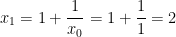
x_1 = 1 + \displaystyle \frac{1}{x_0} = 1 + \displaystyle \frac{1}{1} = 2

x_2 = 1 + \displaystyle \frac{1}{x_1} = 1 + \displaystyle \frac{1}{2} = \displaystyle \frac{3}{2} = 1.5

x_3 = 1 + \displaystyle \frac{1}{x_2} = 1 + \displaystyle \frac{1}{3/2} = \displaystyle \frac{5}{3} \approx 1.667

x_4 = 1 + \displaystyle \frac{1}{x_3} = 1 + \displaystyle \frac{1}{5/3} = \displaystyle \frac{8}{5} = 1.6

x_5 = 1 + \displaystyle \frac{1}{x_4} = 1 + \displaystyle \frac{1}{8/5} = \displaystyle \frac{13}{8} = 1.625

x_6 = 1 + \displaystyle \frac{1}{x_5} = 1 + \displaystyle \frac{1}{13/8} = \displaystyle \frac{21}{13} \approx 1.615

x_7 = 1 + \displaystyle \frac{1}{x_6} = 1 + \displaystyle \frac{1}{21/13} = \displaystyle \frac{34}{21} \approx 1.619

This sequence can be computed by entering 1 into a calculator, then entering 1 + 1 \div \hbox{Ans}, and then repeatedly hitting the = button.

We see that the sequence appears to be converging to something, and that something is a root of the equation x^2 - x - 1 = 0, which we now find via the quadratic formula:

x = \displaystyle \frac{1 \pm \sqrt{1 - 4 \cdot 1 \cdot (-1)}}{2} = \frac{1 \pm \sqrt{5}}{2}.

So it looks like the above sequence is converging to the positive root (1 + \sqrt{5})/2 \approx 1.618.

(Parenthetically, you might notice that the Fibonacci sequence appears in the numerators and denominators of this sequence. As you might guess, that’s not a coincidence.)

Like most numerical techniques, this method doesn’t always work like we think it would. Another solution is the negative root (1 - \sqrt{5})/2 \approx -0.618. Unfortunately, if we start with a guess near this root, like x_0 = -0.62, the sequence unexpectedly diverges from -0.618\dots but eventually converges to the positive root 1.618\dots:

x_1 = 1 + \displaystyle \frac{1}{x_0} = 1 + \displaystyle \frac{1}{-0.62} = -0.6129\dots

x_2 = 1 + \displaystyle \frac{1}{x_1} = 1 + \displaystyle \frac{1}{-0.6129\dots} = -0.6315\dots

x_3 = 1 + \displaystyle \frac{1}{x_2} = 1 + \displaystyle \frac{1}{-0.6315\dots} = -0.5833\dots

x_4 = 1 + \displaystyle \frac{1}{x_3} = 1 + \displaystyle \frac{1}{-0.5833\dots} = -0.7142\dots

x_5 = 1 + \displaystyle \frac{1}{x_4} = 1 + \displaystyle \frac{1}{-0.5833\dots} = -0.4

x_6 = 1 + \displaystyle \frac{1}{x_5} = 1 + \displaystyle \frac{1}{-0.4\dots} = -1.5

x_7 = 1 + \displaystyle \frac{1}{x_6} = 1 + \displaystyle \frac{1}{-1.5\dots} = 0.3333\dots

x_8 = 1 + \displaystyle \frac{1}{x_7} = 1 + \displaystyle \frac{1}{0.3333\dots} = 4

x_9 = 1 + \displaystyle \frac{1}{x_8} = 1 + \displaystyle \frac{1}{4} = 1.25

x_{10} = 1 + \displaystyle \frac{1}{x_9} = 1 + \displaystyle \frac{1}{1.25} = 1.8

x_{11} = 1 + \displaystyle \frac{1}{x_{10}} = 1 + \displaystyle \frac{1}{1.8} = 1.555\dots

x_{12} = 1 + \displaystyle \frac{1}{x_{11}} = 1 + \displaystyle \frac{1}{1.555\dots} = 1.6428\dots

x_{13} = 1 + \displaystyle \frac{1}{x_{12}} = 1 + \displaystyle \frac{1}{1.6428\dots} = 1.6086\dots

x_{14} = 1 + \displaystyle \frac{1}{x_{13}} = 1 + \displaystyle \frac{1}{1.6086\dots} = 1.6216\dots

x_{15} = 1 + \displaystyle \frac{1}{x_{14}} = 1 + \displaystyle \frac{1}{1.6216\dots} = 1.6166\dots

x_{16} = 1 + \displaystyle \frac{1}{x_{15}} = 1 + \displaystyle \frac{1}{1.6216\dots} = 1.6185\dots

I should note that the method of successive approximations generally converges at a slower pace than Newton’s method. However, this method will be good enough when we use it to predict the precession in Mercury’s orbit.

An elementary proof of the insolvability of the quintic

When I was in middle school, I remember my teacher telling me, after I learned the quadratic formula, that there was a general formula for solving cubic and quartic equations, but no such formula existed for solving the quintic. This was also when I first heard the infamous story of young Galois’s death from a duel.

Using my profound middle-school logic, I took this story as a challenge to devise my own formula for solving the quintic. Naturally, my efforts came up short.

When I was in high school, with this obsession still fully intact, I attempted to read through the wonderful monograph Field Theory and Its Classical Problems. Here’s the MAA review of this book:

Hadlock’s book sports one of the best prefaces I’ve ever read in a mathematics book. The rest of the book is even better: in 1984 it won the first MAA Edwin Beckenbach Book Prize for excellence in mathematical exposition.

Hadlock says in the preface that he wrote the book for himself, as a personal path through Galois theory as motivated by the three classical Greek geometric construction problems (doubling the cube, trisecting angles, and squaring the circle — all with just ruler and compass) and the classical problem of solving equations by radicals. Unlike what happens in most books on the subject, all three Greek problems are solved in the first chapter, with just the definition of field as a subfield of the real numbers, but without even defining degree of field extensions, much less proving its multiplicativity (this is done in chapter 2). Doubling the cube is proved to be impossible by proving that the cube root of 2 cannot be an element of a tower of quadratic extensions: if the cube root of 2 is in a quadratic extension, then it is actually in the base field. Repeating the argument, we conclude that it is not constructible because it is not rational. A similar argument works for proving that trisecting a 60 degree angle is impossible. Of course, proving that duplicating the cube is impossible needs a different argument: chapter 1 ends with Niven’s proof of the transcendence of π.

After this successful bare-hands attack at three important problems, Chapter 2 discusses in detail the construction of regular polygons and explains Gauss’s characterization of constructible regular polygons, including the construction of the regular 17-gon. Chapter 3 describes Galois theory and the solution of equations by radicals, including Abel’s theorem on the impossibility of solutions by radicals for equations of degree 5 or higher. Chapter 4, the last one, considers a special case of the inverse Galois problem and proves that there are polynomials with rational coefficients whose Galois group is the symmetric group, a result that is established via Hilbert’s irreducibility theorem.

Many examples, references, exercises, and complete solutions (taking up a third of the book!) are included and make this enjoyable book both an inspiration for teachers and a useful source for independent study or supplementary reading by students.

As I recall, I made it successfully through the first couple of chapters but started to get lost with the Galois theory somewhere in the middle of Chapter 3. Despite not completing the book, this was one of the most rewarding challenges of my young mathematical life. Perhaps one of these days I’ll undertake this challenge again.

Anyway, this year I came across the wonderful article The Abel–Ruffini Theorem: Complex but Not Complicated in the March issue of the American Mathematical Monthly. The article presents a completely different way of approaching the insolvability of the quintic that avoids Galois theory altogether.

The proof is elementary; I’m confident that I could have understood this proof had I seen it when I was in high school. That said, the word “elementary” in mathematics can be a bit loaded — this means that it is based on simple ideas that are perhaps used in a profound and surprising way. Perhaps my favorite quote along these lines was this understated gem from the book Three Pearls of Number Theory after the conclusion of a very complicated proof in Chapter 1:

You see how complicated an entirely elementary construction can sometimes be. And yet this is not an extreme case; in the next chapter you will encounter just as elementary a construction which is considerably more complicated.

I believe that a paid subscription to the Monthly is required to view the above link, but the main ideas of the proof can be found in the video below as well as this short PDF file by Leo Goldmakher.

Engaging students: Factoring quadratic polynomials

In my capstone class for future secondary math teachers, I ask my students to come up with ideas for engaging their students with different topics in the secondary mathematics curriculum. In other words, the point of the assignment was not to devise a full-blown lesson plan on this topic. Instead, I asked my students to think about three different ways of getting their students interested in the topic in the first place.

I plan to share some of the best of these ideas on this blog (after asking my students’ permission, of course).

This student submission comes from my former student Chris Brown. His topic, from Algebra: factoring quadratic polynomials.

green line

What interesting word problems using this topic can your students do now?


The ability to factor quadratic polynomials is at the essence of many two-dimensional kinematic word problems that students will encounter in the future physics courses. One specific word problem that students can now solve, is, “In a tied game between the Golden State Warriors and the Houston Rockets, Steph Curry has the ball for his team. If Steph Curry is 20ft away from the basketball hoop and throws the basketball up in the air at a velocity of 3 m/s, will he be able to make the shot if 3 seconds is left on the clock and win the game for his team? Consider this to be an isolated system.” This special type of problem gives them initial distance, final distance, initial velocity, and acceleration. He student then needs to solve for time, which turns this into a quadratic scenario that requires factoring. I feel like this problem situation is super relevant to the high school age group as it seems to be popular amongst that age group, and with this problem they can extend it to any real-world scenario that searches for time when given distance and velocity.

green line

How does this topic extend what your students should have learned in previous courses?


When factoring quadratic equations, one of the universal methods of factoring is called factoring by grouping. Let’s identify a quadratic equation to be ax2 + bx + c = 0. When factoring by grouping, the students must first multiply ‘a’ and ‘c,’ and then find factors of the product which sum to ‘b’. Let’s call these specific factors ‘n’ and ‘m’. Thus far, this brings in students abilities to create factor trees from 3rd grade mathematics. The next step requires students to replace ‘b’ with the factors ‘n’ and ‘m,’ such that we now have ax2 + nx + mx + c = 0. Now the students have to group the ‘ax2’ term and ‘c’ with either the ‘nx’ and ‘mx’ terms in such a way that when the greatest common divisor is pulled away, what’s left is identical for each group. The ability to identify the greatest common divisor between two terms stems from what they learned in 5th grade mathematics. Then, the last step would be to factor out the common term. This entire process, which was not completed here, has used two very fundamental skills from elementary mathematics.

green line

How can technology be used to effectively engage students with this topic?


I believe Symbolab is an amazing website, that the students can use to aid them in the understanding of the process of factoring quadratic polynomials. I chose this website, because it focuses on the process of factoring and uses common language to explain their steps which the students should be aware of. Lastly, I love this website because it gives students the option to hide the steps and just see the answer. With this, the students can type in random quadratics and work towards the solution, and if they get stuck, they can see all the steps. All in all, it is an amazing way to practice the skill of factoring quadratic equations for as long as they please!

Here is the link to Symbolab: https://www.symbolab.com/solver/factor-calculator/factor%20x%5E%7B2%7D-4x%2B3%3D0


My Favorite One-Liners: Part 90

In this series, I’m compiling some of the quips and one-liners that I’ll use with my students to hopefully make my lessons more memorable for them.

Here’s a typical problem that arises in Algebra II or Precalculus:

Find all solutions of 2 x^4 + 3 x^3 - 7 x^2 - 35 x -75 =0.

There is a formula for solving such quartic equations, but it’s very long and nasty and hence is not typically taught in high school. Instead, the one trick that’s typically taught is the Rational Root Test: if there’s a rational root of the above equation, then (when written in lowest terms) the numerator must be a factor of -10 (the constant term), while the denominator must be a factor of 2 (the leading coefficient). So, using the rational root test, we conclude

Possible rational roots = \displaystyle \frac{\pm 1, \pm 3, \pm 5, \pm 15, \pm 25, \pm 75}{\pm 1, \pm 2}

= \pm 1, \pm 3, \pm 5, \pm 15, \pm 25, \pm 75 \displaystyle \pm \frac{1}{2}, \pm \frac{3}{2}, \pm \frac{5}{2}, \pm \frac{15}{2}, \pm \frac{25}{2}, \pm \frac{75}{2}.

Before blindly using synthetic division to see if any of these actually work, I’ll try to address a few possible misconceptions that students might have. One misconception is that there’s some kind of guarantee that one of these possible rational roots will actually work. Here’s another: students might think that we haven’t made much progress toward finding the solutions… after all, we might have to try synthetic division 24 times before finding a rational root. So, to convince my students that we actually have made real progress toward finding the answer, I’ll tell them:

Yes, 24 is a lot\dots but it’s better than infinity.


My Favorite One-Liners: Part 85

In this series, I’m compiling some of the quips and one-liners that I’ll use with my students to hopefully make my lessons more memorable for them.

Today’s one-liner is one that I’ll use when I want to discourage students from using a logically correct and laboriously cumbersome method. For example:

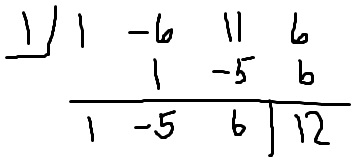
Find a polynomial q(x) and a constant r so that x^3 - 6x^2 + 11x + 6 = (x-1)q(x) + r.

Hypothetically, this can be done by long division:

However, this takes a lot of time and space, and there are ample opportunities to make a careless mistake along the way (particularly when subtracting negative numbers). Since there’s an alternative method that could be used (we’re dividing by something of the form x-c or x+c, I’ll tell my students:

Yes, you could use long division. You could also stick thumbtacks in your eyes; I don’t recommend it.

Instead, when possible, I guide students toward the quicker method of synthetic division: