
In this series of posts, I explore properties of complex numbers that explain some surprising answers to exponential and logarithmic problems using a calculator (see video at the bottom of this post). These posts form the basis for a sequence of lectures given to my future secondary teachers.
To begin, we recall that the trigonometric form of a complex number 

where 


In the previous post, I proved the following theorem which provides a geometric interpretation for multiplying complex numbers.
Theorem. ![\left[ r_1 (\cos \theta_1 + i \sin \theta_1) \right] \cdot \left[ r_2 (\cos \theta_2 + i \sin \theta_2) \right] = r_1 r_2 (\cos [\theta_1+\theta_2] + i \sin [\theta_1+\theta_2])](https://s0.wp.com/latex.php?latex=%5Cleft%5B+r_1+%28%5Ccos+%5Ctheta_1+%2B+i+%5Csin+%5Ctheta_1%29+%5Cright%5D+%5Ccdot+%5Cleft%5B+r_2+%28%5Ccos+%5Ctheta_2+%2B+i+%5Csin+%5Ctheta_2%29+%5Cright%5D+%3D+r_1+r_2+%28%5Ccos+%5B%5Ctheta_1%2B%5Ctheta_2%5D+%2B+i+%5Csin+%5B%5Ctheta_1%2B%5Ctheta_2%5D%29&bg=ffffff&fg=000000&s=0&c=20201002)
Perhaps unsurprisingly, there’s also a theorem for dividing complex numbers. Students can using guess the statement of this theorem.
Theorem. ![\displaystyle \frac{ r_1 (\cos \theta_1 + i \sin \theta_1) }{ r_2 (\cos \theta_2 + i \sin \theta_2) } = \displaystyle \frac{r_1}{r_2} (\cos [\theta_1-\theta_2] + i \sin [\theta_1-\theta_2])](https://s0.wp.com/latex.php?latex=%5Cdisplaystyle+%5Cfrac%7B+r_1+%28%5Ccos+%5Ctheta_1+%2B+i+%5Csin+%5Ctheta_1%29+%7D%7B+r_2+%28%5Ccos+%5Ctheta_2+%2B+i+%5Csin+%5Ctheta_2%29+%7D+%3D+%5Cdisplaystyle+%5Cfrac%7Br_1%7D%7Br_2%7D+%28%5Ccos+%5B%5Ctheta_1-%5Ctheta_2%5D+%2B+i+%5Csin+%5B%5Ctheta_1-%5Ctheta_2%5D%29&bg=ffffff&fg=000000&s=0&c=20201002)
Proof. The proof begins by separating the 





At this juncture in the proof, there are two legitimate ways to proceed.
Method #1: Multiply out the right-hand side. After all, this is how we proved the theorem yesterday. For this reason, students naturally gravitate toward this proof, and the proof works after recognizing the trig identities for the sine and cosine of the difference of two angles.
However, this isn’t the most elegant proof.
Method #2: I break out my old joke about the entrance exam at MIT and the importance of using previous work. I rewrite the right-hand side as
![= \displaystyle \frac{r_1}{r_2} (\cos \theta_1 + i \sin \theta_1)( \cos [-\theta_2] + i \sin [-\theta_2])](https://s0.wp.com/latex.php?latex=%3D+%5Cdisplaystyle+%5Cfrac%7Br_1%7D%7Br_2%7D+%28%5Ccos+%5Ctheta_1+%2B+i+%5Csin+%5Ctheta_1%29%28+%5Ccos+%5B-%5Ctheta_2%5D+%2B+i+%5Csin+%5B-%5Ctheta_2%5D%29&bg=ffffff&fg=000000&s=0&c=20201002)
this also serves as a reminder about the odd/even identities for sine and cosine, respectively. Then students observe that the right-hand side is just a product of two complex numbers in trigonometric form, and so the angle of the product is found by adding the angles.

For completeness, here’s the movie that I use to engage my students when I begin this sequence of lectures.
 ) that I’ll justify later in this series.
 and
and  , they are taught to just distribute (or, using the nomenclature that I don’t like, FOIL it out):
 .
.![\left[ r_1 (\cos \theta_1 + i \sin \theta_1) \right] \cdot \left[ r_2 (\cos \theta_2 + i \sin \theta_2) \right]](https://s0.wp.com/latex.php?latex=%5Cleft%5B+r_1+%28%5Ccos+%5Ctheta_1+%2B+i+%5Csin+%5Ctheta_1%29+%5Cright%5D+%5Ccdot+%5Cleft%5B+r_2+%28%5Ccos+%5Ctheta_2+%2B+i+%5Csin+%5Ctheta_2%29+%5Cright%5D+&bg=ffffff&fg=000000&s=0&c=20201002)

![= r_1 r_2 (\cos \theta_1 \cos \theta_2 - \sin \theta_1 \sin \theta_2 + i[ \sin \theta_1 \cos \theta_2 + \cos \theta_1 \sin \theta_2])](https://s0.wp.com/latex.php?latex=%3D+r_1+r_2+%28%5Ccos+%5Ctheta_1+%5Ccos+%5Ctheta_2+-+%5Csin+%5Ctheta_1+%5Csin+%5Ctheta_2+%2B+i%5B+%5Csin+%5Ctheta_1+%5Ccos+%5Ctheta_2+%2B+%5Ccos+%5Ctheta_1+%5Csin+%5Ctheta_2%5D%29&bg=ffffff&fg=000000&s=0&c=20201002)
![= r_1 r_2 (\cos [\theta_1+\theta_2] + i \sin [\theta_1+\theta_2])](https://s0.wp.com/latex.php?latex=%3D+r_1+r_2+%28%5Ccos+%5B%5Ctheta_1%2B%5Ctheta_2%5D+%2B+i+%5Csin+%5B%5Ctheta_1%2B%5Ctheta_2%5D%29&bg=ffffff&fg=000000&s=0&c=20201002) .
.
![1 + 2i = \sqrt{5} \left( \cos[\tan^{-1} 2] + i \sin[\tan^{-1} 2] \right) \approx \sqrt{5} \left( \cos 63.435^\circ + i \sin 63.435^\circ \right)](https://s0.wp.com/latex.php?latex=1+%2B+2i+%3D+%5Csqrt%7B5%7D+%5Cleft%28+%5Ccos%5B%5Ctan%5E%7B-1%7D+2%5D+%2B+i+%5Csin%5B%5Ctan%5E%7B-1%7D+2%5D+%5Cright%29+%5Capprox+%5Csqrt%7B5%7D+%5Cleft%28+%5Ccos+63.435%5E%5Ccirc+%2B+i+%5Csin+63.435%5E%5Ccirc+%5Cright%29&bg=ffffff&fg=000000&s=0&c=20201002)
 . Indeed,
 .
.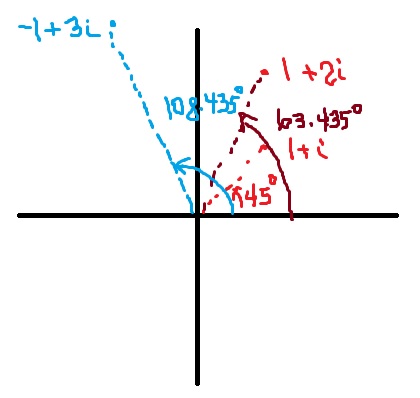
 is in the second quadrant of the complex plane. The modulus is
 .
. , and not
  , appears in the above expression.) Also,
 , so that
 is in the second quadrant, we choose
 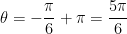 . Therefore,

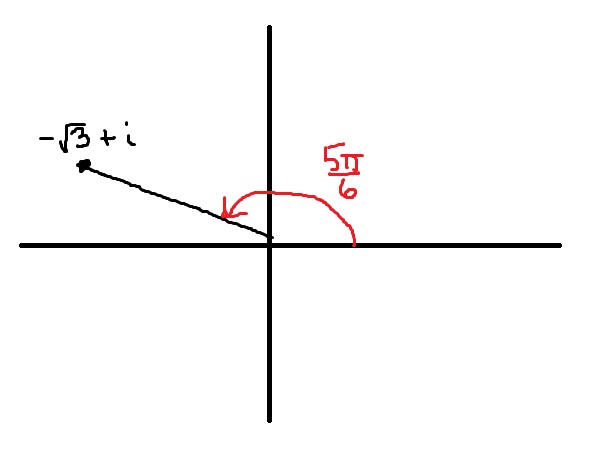
 would also have worked. For example,

 . After all, the arctangent of an angle must lie between
  and
and  , which won’t work for complex numbers in either the second or third quadrant. That said, it is true that
 , and take two steps to arrive at the point
  , and take two steps to arrive at the same point.
 (getting more than a little dizzy while doing so), and take two steps to arrive at the same point.
 , and take two steps backwards (while doing the moonwalk) to arrive at the same point.
 for the area of a circle. However, they often tell me that they don’t remember a proof or justification for why this formula is true. And they certainly don’t remember a justification that would be appropriate for showing geometry students.
 denotes a circular region with radius
  centered at the origin, then
 to
to  , while the angle varies from
  to
to  . Using the
  , we see that
![A = \displaystyle \int_0^{2\pi} \left[ \frac{r^2}{2} \right]_0^a \, d\theta](https://s0.wp.com/latex.php?latex=A+%3D+%5Cdisplaystyle+%5Cint_0%5E%7B2%5Cpi%7D+%5Cleft%5B+%5Cfrac%7Br%5E2%7D%7B2%7D+%5Cright%5D_0%5Ea+%5C%2C+d%5Ctheta&bg=ffffff&fg=000000&s=0&c=20201002)


![[0,2\pi]](https://s0.wp.com/latex.php?latex=%5B0%2C2%5Cpi%5D&bg=ffffff&fg=000000&s=0&c=20201002) and not
and not ![[0^o, 360^o]](https://s0.wp.com/latex.php?latex=%5B0%5Eo%2C+360%5Eo%5D&bg=ffffff&fg=000000&s=0&c=20201002) .
. Mean Green Math