Lessons from teaching gifted elementary school students (Part 6a)

Every so often, I’ll informally teach a class of gifted elementary-school students. I greatly enjoy interacting with them, and I especially enjoy the questions they pose. Often these children pose questions that no one else will think about, and answering these questions requires a surprising depth of mathematical knowledge.

Here’s a question I once received:

255/256 to what power is equal to 1/2? And please don’t use a calculator.

Answering this question is pretty straightforward using algebra:

\displaystyle \left( \frac{255}{256} \right)^x = \displaystyle \frac{1}{2}.

\displaystyle x \ln  \frac{255}{256} = \ln \displaystyle \frac{1}{2}

x \displaystyle \frac{ \displaystyle \ln \frac{1}{2} }{\ln \displaystyle \frac{255}{256}}

However, doing this without a calculator — and thus maintaining my image in front of these elementary school students — is a little formidable.

I’ll reveal how I did this — getting the answer correct to the nearest integer — in tomorrow’s post. In the meantime, I’ll leave a thought bubble if you’d like to think about it on your own.

green_speech_bubble

Slide rule

To give my students a little appreciation for their elders, I’ll demonstrate for them how to use a slide rule. Though I have my own slide rule which I can pass around the classroom, demonstrating how to use a slide rule is a little cumbersome since they don’t have their own slide rules to use.

I recently found an applet to make this demonstration a whole lot easier: https://code.google.com/p/java-slide-rule/

The antiderivative of 1/(x^4+1): Index

I’m doing something that I should have done a long time ago: collecting a series of posts into one single post. The following links comprised my series on the computation of

\displaystyle \int \frac{dx}{x^4+1}

Part 1: Introduction.

Part 2: Factoring the denominator using De Moivre’s Theorem.

Part 3: Factoring the denominator using the difference of two squares.

Part 4: The partial fractions decomposition of the integrand.

Part 5: Partial evaluation of the resulting integrals.

Part 6: Evaluation of the remaining integrals.

Part 7: An apparent simplification using a trigonometric identity.

Part 8: Discussion of the angles for which the identity holds.

Part 9: Proof of the angles for which the identity holds.

Part 10: Implications for using this identity when computing definite integrals.


Lessons from teaching gifted elementary school students: Index (updated)

I’m doing something that I should have done a long time ago: collect past series of posts into a single, easy-to-reference post. The following posts formed my series on various lessons I’ve learned while trying to answer the questions posed by gifted elementary school students. (This is updated from my previous index.)

Part 1: A surprising pattern in some consecutive perfect squares.

Part 2: Calculating 2 to a very large exponent.

Part 3a: Calculating 2 to an even larger exponent.

Part 3b: An analysis of just how large this number actually is.

Part 4a: The chance of winning at BINGO in only four turns.

Part 4b: Pedagogical thoughts on one step of the calculation.

Part 4c: A complicated follow-up question.

Part 5a: Exponentiation is multiplication as multiplication is to addition. So, multiplication is to addition as addition is to what? (I offered the answer of incrementation, but it was rejected: addition requires two inputs, while incrementation only requires one.)

Part 5b: Why there is no binary operation that completes the above analogy.

Part 5c: Knuth’s up-arrow notation for writing very big numbers.

Part 5d: Graham’s number, reputed to be the largest number ever to appear in a mathematical proof.

Thoughts on Infinity (Part 3g)

We have seen in recent posts that

$latex  \displaystyle 1 – \frac{1}{2} + \frac{1}{3} – \frac{1}{4} + \frac{1}{5} – … = \ln 2$

One way of remembering this fact is by using the Taylor series expansion for \ln(1+x):

\ln(1+x) = x - \displaystyle \frac{x^2}{2} + \frac{x^3}{3} - \frac{x^4}{4} + \frac{x^5}{5} \dots

“Therefore,” the first series can be obtained from the second series by substituting x=1.

I placed “therefore” in quotation marks because this reasoning is completely invalid, even though it happens to stumble across the correct answer in this instance. The radius of convergence for the above Taylor series is 1, which can be verified by using the Ratio Test. So the series converges absolutely for |x| < 1 and diverges for |x| > 1. The boundary of |x| = 1, on the other hand, has to be checked separately for convergence.

In other words, plugging in x=1 might be a useful way to remember the formula, but it’s not a proof of the formula and certainly not a technique that I want to encourage students to use!

It’s easy to find examples where just plugging in the boundary point happens to give the correct answer (see above). It’s also easy to find examples where plugging in the boundary point gives an incorrect answer because the series actually diverges: for example, substituting x = -1 into the geometric series

\displaystyle \frac{1}{1-x} = 1 + x + x^2 + x^3 + x^4 + \dots

However, I’ve been scratching my head to think of an example where plugging in the boundary point gives an incorrect answer because the series converges but converges to a different number. I could’ve sworn that I saw an example like this when I was a calculus student, but I can’t see to find an example in reading Apostol’s calculus text.


Thoughts on Infinity (Part 3f)

In recent posts, we’ve seen the curious phenomenon that the commutative and associative laws do not apply to a conditionally convergent series or infinite product: while

\displaystyle 1 - \frac{1}{2} + \frac{1}{3} - \frac{1}{4} + \frac{1}{5} - ... = \ln 2,

a rearranged series can be something completely different:

\displaystyle 1 + \frac{1}{3} - \frac{1}{2} + \frac{1}{5} + \frac{1}{7} - \frac{1}{4} + \frac{1}{9} + \frac{1}{11} - \frac{1}{6} ... = \displaystyle \frac{3}{2} \ln 2.

This very counterintuitive result can be confirmed using commonly used technology — in particular, Microsoft Excel. In the spreadsheet below, I typed:

  • =IF(MOD(ROW(A1),3)=0,ROW(A1)*2/3,IF(MOD(ROW(A1),3)=1,4*(ROW(A1)-1)/3+1,4*(ROW(A1)-2)/3+3)) in cell A1
  • =POWER(-1,A1-1)/A1 in cell B1
  • =B1 in cell C1
  • I copied cell A1 into cell A2
  • =POWER(-1,A2-1)/A2 in cell B2
  • =C1+B2 in cell C2

The unusual command for cell A1 was necessary to get the correct rearrangement of the series.

Then I used the FILL DOWN command to fill in the remaining rows. Using these commands cell C9 shows the sum of all the entries in cells B1 through B9, so that

\displaystyle 1 + \frac{1}{3} - \frac{1}{2} + \frac{1}{5} + \frac{1}{7} - \frac{1}{4} + \frac{1}{9} + \frac{1}{11} - \frac{1}{6} \approx 0.961544012

log2series6

Filling down to additional rows demonstrates that the sum converges to \displaystyle \frac{3}{2}\ln 2 and not to \ln 2. Here’s the sum up to 10,000 terms… the entry in column E is the first few digits in the decimal expansion of \displaystyle \frac{3}{2} \ln 2. log2series7

Clearly the partial sums are not approaching \ln 2 \approx 0.693, and there’s good visual evidence to think that the answer is \displaystyle \frac{3}{2} \ln 2 instead. (Incidentally, the 10,000th partial sum is very close to the limiting value because 10,000 is one more than a multiple of 3.)


Thoughts on Infinity (Part 3e)

In recent posts, we’ve seen the curious phenomenon that the commutative and associative laws do not apply to a conditionally convergent series or infinite product. Here’s another classic example of this fact that’s attributed to Cauchy.

We’ve already seen in this series (pardon the pun) that

\displaystyle 1 - \frac{1}{2} + \frac{1}{3} - \frac{1}{4} + \frac{1}{5} - ... = \ln 2.

Let’s now see what happens if I rearrange the terms of this conditionally convergent series. Let

T = \displaystyle 1 + \frac{1}{3} - \frac{1}{2} + \frac{1}{5} + \frac{1}{7} - \frac{1}{4} + \frac{1}{9} + \frac{11} - \frac{1}{6} \dots,

where two positive numbers alternate with a single negative term. By all rights, this shouldn’t affect anything… right?

Let s_n be the nth partial sum of this series, so that s_{3n} contains 2n positive terms with odd denominators and n negative terms with even denominators:

s_{3n} = \displaystyle \sum_{k=1}^{2n} \frac{1}{2n-1} - \sum_{k=1}^n \frac{1}{2n}.

Let me now add and subtract the “missing” even terms in the first sum:

s_{3n} = \displaystyle \sum_{k=1}^{2n} \frac{1}{2n-1} + \sum_{k=1}^{2n} \frac{1}{2n} - \sum_{k=1}^{2n} \frac{1}{2n} - \sum_{k=1}^n \frac{1}{2n}

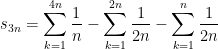
s_{3n} = \displaystyle \sum_{k=1}^{4n} \frac{1}{n} - \sum_{k=1}^{2n} \frac{1}{2n} - \sum_{k=1}^n \frac{1}{2n}

s_{3n} = \displaystyle \sum_{k=1}^{4n} \frac{1}{n} - \frac{1}{2} \sum_{k=1}^{2n} \frac{1}{n} - \frac{1}{2} \sum_{k=1}^n \frac{1}{n}.

For reasons that will become apparent, I’ll now rewrite this as

s_{3n} = \displaystyle \int_1^{4n} \frac{dx}{x} + \left( \sum_{k=1}^{4n} \frac{1}{k} - \displaystyle \int_1^{4n} \frac{dx}{x} \right)

- \displaystyle \frac{1}{2} \int_1^{2n} \frac{dx}{x} - \frac{1}{2} \left( \sum_{k=1}^{2n} \frac{1}{k} - \int_1^{2n} \frac{dx}{x} \right)

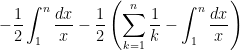
- \displaystyle \frac{1}{2} \int_1^{n} \frac{dx}{x} - \frac{1}{2} \left( \sum_{k=1}^{n} \frac{1}{k} - \int_1^{n} \frac{dx}{x} \right),

or

s_{3n} = \ln(4n) - \ln 1 + \displaystyle \left( \sum_{k=1}^{4n} \frac{1}{k} - [\ln(4n) - \ln 1]\right)

- \displaystyle \frac{1}{2}[\ln (2n) - \ln 1] - \displaystyle \frac{1}{2} \left( \sum_{k=1}^{2n} \frac{1}{k} - [\ln (2n) - \ln 1]\right)

- \displaystyle \frac{1}{2}[\ln n - \ln 1] - \displaystyle \frac{1}{2} \left( \sum_{k=1}^{n} \frac{1}{k} - [\ln n - \ln 1]\right)

Since \ln 1 = 0, \ln(2n) = \ln 2 + \ln n, and \ln(4n) = \ln 4 + \ln n = 2\ln 2 + \ln n, we have

s_{3n} = 2\ln 2 + \ln n + \displaystyle \left( \sum_{k=1}^{4n} \frac{1}{k} - \ln 4n \right)

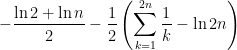
\displaystyle - \frac{\ln 2 + \ln n}{2} - \displaystyle \frac{1}{2} \left( \sum_{k=1}^{2n} \frac{1}{k} - \ln 2n \right)

\displaystyle - \frac{\ln n}{2} - \frac{1}{2} \displaystyle \left( \sum_{k=1}^{n} \frac{1}{k} - \ln n \right),

or

s_{3n}= \displaystyle \frac{3}{2}\ln 2 + \displaystyle \left( \sum_{k=1}^{4n} \frac{1}{k} - \ln 4n \right) - \frac{1}{2}\left( \sum_{k=1}^{2n} \frac{1}{k} - \ln 2n\right) - \frac{1}{2}\left( \sum_{k=1}^{n} \frac{1}{k} - \ln n\right).

I now take the limit as m \to \infty:

\displaystyle \lim_{n \to \infty} s_{3n} = \displaystyle \frac{3}{2}\ln 2 + \lim_{n \to \infty} \left( \sum_{k=1}^{4n} \frac{1}{k} - \ln 4n \right) - \frac{1}{2} \lim_{n \to \infty} \left( \sum_{k=1}^{2n} \frac{1}{k} - \ln 2n\right) - \frac{1}{2} \lim_{n \to \infty} \left( \sum_{k=1}^{n} \frac{1}{k} - \ln n\right).

This step reveals why I added and subtracted the integrals above: those gymnastics were necessary in order to reach a limit that converges.

As shown earlier in this series, if

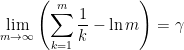
\displaystyle \lim_{m \to \infty} \left( \sum_{k=1}^m \frac{1}{k} - \ln m \right) = \gamma,

the Euler-Mascheroni constant. Therefore, since the limit of any subsequence must converge to the same limit, we have

Applying these above, we conclude

\displaystyle \lim_{m \to \infty} s_{3n} = \displaystyle \frac{3}{2}\ln 2 + \gamma - \frac{1}{2}\gamma - \frac{1}{2} \gamma = \displaystyle \frac{3}{2} \ln 2,

which is different than \ln 2.

Technically, I’ve only shown so far that the limit of partial sums 3, 6, 9, … is \displaystyle\frac{3}{2} \ln 2. For the other partial sums, I note that

\displaystyle \lim_{n \to \infty} t_{3n+1} = \displaystyle \lim_{n \to \infty} \left(s_{3n} + \displaystyle \frac{1}{4n+1} \right) = \displaystyle \frac{3}{2} \ln 2 + 0 = \displaystyle \frac{3}{2} \ln 2

and

\displaystyle \lim_{n \to \infty} t_{3n-1} = \displaystyle \lim_{n \to \infty} \left(s_{3n} - \displaystyle \frac{1}{2n} \right) = \displaystyle \frac{3}{2} \ln 2 - 0 = \displaystyle \frac{3}{2} \ln 2.

Therefore, I can safely conclude that

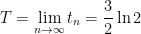
T = \displaystyle \lim_{n \to \infty} t_n = \displaystyle \frac{3}{2} \ln 2,

which is different than the original sum S.

Thoughts on Infinity (Part 3d)

In recent posts, we’ve seen the curious phenomenon that the commutative and associative laws do not apply to a conditionally convergent series or infinite product. Here’s another classic example of this fact that’s attributed to Cauchy.

In yesterday’s post, I showed that

\displaystyle 1 - \frac{1}{2} + \frac{1}{3} - \frac{1}{4} + \frac{1}{5} - ... = \ln 2.

This can be (sort of) confirmed using commonly used technology — in particular, Microsoft Excel. In the spreadsheet below, I typed:

  • 1 in cell A1
  • =POWER(-1,A1-1)/A1 in cell B1
  • =B1 in cell C1
  • =A1+1 in cell A2
  • =POWER(-1,A2-1)/A2 in cell B2
  • =C1+B2 in cell C2
  • Then I used the FILL DOWN command to fill in the remaining rows. Using these commands cell C10 shows the sum of all the entries in cells B1 through B10, so that

1 - \displaystyle \frac{1}{2} + \frac{1}{3} - \frac{1}{4} + \frac{1}{5} - \frac{1}{6} + \frac{1}{7} - \frac{1}{8} + \frac{1}{9} - \frac{1}{10} \approx 0.645634921

log2series1


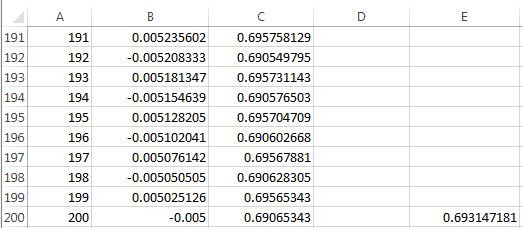
Filling down to additional rows demonstrates that the sum converges to \ln 2, albeit very slowly (as is typical for conditionally convergent series). Here’s the sum up to 200 terms… the entry in column E is the first few digits in the decimal expansion of \ln 2.

log2series2

Here’s the result after 2000 terms:

log2series3

20,000 terms:

log2series4

And finally, 200,000 terms. (It takes a few minutes for Microsoft Excel to scroll this far.)

log2series5We see that, as expected, the partial sums are converging to \ln 2, as expected. Unfortunately, the convergence is extremely slow — we have to compute 10 times as many terms in order to get one extra digit in the final answer.


Thoughts on Infinity (Part 3c)

In recent posts, we’ve seen the curious phenomenon that the commutative and associative laws do not apply to a conditionally convergent series or infinite product. Here’s another classic example of this fact that’s attributed to Cauchy.

Define

S = \displaystyle 1 - \frac{1}{2} + \frac{1}{3} - \frac{1}{4} + \frac{1}{5} - ...

By the alternating series test, this series converges. However,

\displaystyle \sum_{n=1}^\infty |a_n| = \displaystyle \sum_{n=1} \frac{1}{n},

which is the divergent harmonic series which was discussed earlier in this series. Therefore, the series S converges conditionally and not absolutely.

To calculate the value of S, let s_n = \displaystyle \sum_{k=1}^n \frac{(-1)^{k-1}}{k}, the nth partial sum of S. Since the series converges, we know that \displaystyle \lim_{n \to \infty} s_n converges. Furthermore, the limit of any subsequence, like \displaystyle \lim_{n \to \infty} s_{2n}, must also converge to S.

If n is even, so that n = 2m and m is an integer, then

s_{2m} = \displaystyle \sum_{k=1}^n \frac{(-1)^{k-1}}{k}

= \displaystyle \sum_{k=1}^{m} \frac{1}{2k-1} - \sum_{k=1}^m \frac{1}{2k}

= \displaystyle \left( \sum_{k=1}^{2m} \frac{1}{k} - \sum_{k=1}^m \frac{1}{2k} \right) - \sum_{k=1}^m \frac{1}{2k}

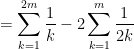
= \displaystyle \sum_{k=1}^{2m} \frac{1}{k} - 2 \sum_{k=1}^m \frac{1}{2k}

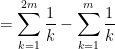
= \displaystyle \sum_{k=1}^{2m} \frac{1}{k} - \sum_{k=1}^m \frac{1}{k}.

For reasons that will become apparent, I’ll now rewrite this as

s_{2m} = \displaystyle \int_1^{2m} \frac{dx}{x} + \left( \sum_{k=1}^{2m} \frac{1}{k} - \displaystyle \int_1^{2m} \frac{dx}{x} \right) - \displaystyle \int_1^m \frac{dx}{x} - \left( \sum_{k=1}^m \frac{1}{k} - \int_1^m \frac{dx}{x} \right),

or

s_{2m} = \ln(2m) - \ln 1 + \displaystyle \left( \sum_{k=1}^{2m} \frac{1}{k} - [\ln(2m) - \ln 1]\right)

- [\ln m - \ln 1] - \displaystyle \left( \sum_{k=1}^m \frac{1}{k} - [\ln m - \ln 1]\right).

Since ln 1 = 0 and \ln(2m) = \ln 2 + \ln m, we have

s_{2m} = \ln 2 + \ln m + \displaystyle \left( \sum_{k=1}^{2m} \frac{1}{k} - \ln 2m \right) - \ln m - \displaystyle \left( \sum_{k=1}^m \frac{1}{k} - \ln m \right)

= \ln 2 + \displaystyle \left( \sum_{k=1}^{2m} \frac{1}{k} - \ln 2m \right) - \left( \sum_{k=1}^m \frac{1}{k} - \ln m\right).

I now take the limit as m \to \infty:

\displaystyle \lim_{m \to \infty} s_{2m} = \ln 2 + \displaystyle \lim_{m \to \infty} \left( \sum_{k=1}^{2m} \frac{1}{k} - \ln 2m\right) - \lim_{m \to \infty} \left( \sum_{k=1}^m \frac{1}{k} - \ln m \right).

This step reveals why I added and subtracted the integrals above: those gymnastics were necessary in order to reach a limit that converges.

In yesterday’s post, I showed that if

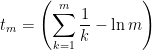
t_m = \displaystyle \left( \sum_{k=1}^m \frac{1}{k} - \ln m \right)

\displaystyle \lim_{m \to \infty} t_m = \displaystyle \lim_{m \to \infty} \left( \sum_{k=1}^m \frac{1}{k} - \ln m \right) = \gamma,

the Euler-Mascheroni constant. Therefore, the limit of any subsequence must converge to the same limit; in particular,

\displaystyle \lim_{m \to \infty} t_{2m} =\displaystyle \lim_{m \to \infty} \left( \sum_{k=1}^{2m} \frac{1}{k} - \ln 2m \right)= \gamma.

Applying these above, we conclude

\displaystyle \lim_{m \to \infty} s_{2m} = \ln 2 + \gamma - \gamma,

or

S = \ln 2.

Thoughts on Infinity (Part 3b)

The five most important numbers in mathematics are 0, 1, e, \pi, and i. In sixth place (a distant sixth place) is probably \gamma, the Euler-Mascheroni constant. See Mathworld or Wikipedia for more details. (For example, it’s astounding that we still don’t know if \gamma is irrational or not.)

In yesterday’s post, we’ve seen the curious phenomenon that the commutative and associative laws do not apply to a conditionally convergent series or infinite product. In tomorrow’s post, I’ll present another classic example of this phenomenon due to Cauchy. However, to be ready for this fact, I’ll need to see how \gamma arises from a certain conditionally convergent series.

Separately define the even and odd terms of the sequence \{a_n\} by

a_{2n} = \displaystyle \int_n^{n+1} \frac{dx}{x}

and

a_{2n-1} = \displaystyle \frac{1}{n}.

It’s pretty straightforward to show that this sequence is decreasing. The function f(x) = \displaystyle \frac{1}{x} is clearly decreasing for x > 0, and so the maximum value of f(x) on the interval [n,n+1] must occur at the left endpoint, while the minimum value must occur at the right endpoint. Since the length of this interval is 1, we have

\displaystyle \frac{1}{n+1} \cdot 1 < \displaystyle \int_n^{n+1} \frac{dx}{x} < \displaystyle \frac{1}{n} \cdot 1,

or

a_{2n+1} < a_{2n} < a_{2n-1}.

Since the subsequence \{a_{2n-1}\} clearly decreases to 0, this shows the full sequence \{a_n\} is a decreasing sequence with limit 0.

By the alternating series test, this implies that the series

\displaystyle \sum_{n=1}^\infty (-1)^{n-1} a_n

converges. This limit is called the

Since this series converges, that means that the limit of the partial sums converges to \gamma:

\displaystyle \lim_{M \to \infty} \sum_{n=1}^M (-1)^{n-1} a_n = \gamma.

Let’s take the upper limit to be an odd number M, where M = 2N-1 and N is an integer. Then by separating the even and odd terms, we obtain

\displaystyle \sum_{n=1}^{2N-1} (-1)^{n-1} a_n = \displaystyle \sum_{n=1}^{N} (-1)^{2n-1-1} a_{2n-1} + \sum_{n=1}^{N-1} (-1)^{2n-1} a_{2n}

= \displaystyle \sum_{n=1}^N a_{2n-1} - \sum_{n=1}^{N-1} a_{2n}

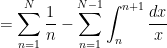
= \displaystyle \sum_{n=1}^N \frac{1}{n} - \sum_{n=1}^{N-1} \int_n^{n+1} \frac{dx}{x}

= \displaystyle \sum_{n=1}^N \frac{1}{n} - \int_1^N \frac{dx}{x}.

Therefore,

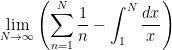
\displaystyle \lim_{N \to \infty} \left( \sum_{n=1}^N \frac{1}{n} - \int_1^N \frac{dx}{x} \right) = \gamma.

With this interpretation, the sum can be viewed as the sum of the N rectangles in the above picture, while the integral is the area under the hyperbola. Therefore, the limit \gamma can be viewed as the limit of the blue part of the above picture.

In other words, it’s an amazing fact that while both

\displaystyle \sum_{n=1}^\infty \frac{1}{n}

and

\displaystyle \int_1^\infty \frac{dx}{x}

diverge, somehow the difference

\displaystyle \lim_{N \to \infty} \left(\sum_{n=1}^N \frac{1}{n} - \int_1^N \frac{dx}{x} \right)

converges… and this limit is defined to be the number \gamma.