Engaging students: Graphs of linear equations

In my capstone class for future secondary math teachers, I ask my students to come up with ideas for engaging their students with different topics in the secondary mathematics curriculum. In other words, the point of the assignment was not to devise a full-blown lesson plan on this topic. Instead, I asked my students to think about three different ways of getting their students interested in the topic in the first place.

I plan to share some of the best of these ideas on this blog (after asking my students’ permission, of course).

This student submission again comes from my former student Anna Park. Her topic, from Algebra: graphs of linear equations.

green line

How could you as a teacher create an activity or project that involves your topic?

  • Have the students enter the room with all of the desks and chairs to the wall, to create a clear floor. On the floor, put 2 long pieces of duct tape that represent the x and y-axis. Have the students get into groups of 3 or 4 and on the board put up a linear equation. One of the students will stand on the Y-axis and will represent the point of the Y-Intercept. The rest of the students have to represent the slope of the line. The students will be able to see if they are graphing the equation right based on how they form the line. This way the students will be able to participate with each other and get immediate feedback. Have the remaining groups of students, those not participating in the current equation, graph the line on a piece of paper that the other group is representing for them. By the end of the engage, students will have a full paper of linear equation examples. The teacher can make it harder by telling the students to make adjustments like changing the y intercept but keeping the slope the same. Or have two groups race at once to see who can physically graph the equation the fastest. Because there is only one “graph” on the floor, have each group go separately and time each group.
  • Have the students put their desks into rows of even numbers. Each group should have between 4 and 5 students. On the wall or white board the teacher has an empty, laminated graph. The teacher will have one group go at a time. The teacher will give the group a linear equation and the student’s have to finish graphing the equation as fast as possible. Each group is given one marker, once the equation is given the first student runs up to the graph and will graph ONLY ONE point. The first student runs back to the second student and hands the marker off to them. That student runs up to the board and marks another point for that graph. The graph is completed once all points are on the graph, the x and y intercepts being the most important. If there are two laminated graphs on the board two groups can go at one time to compete against the other. Similar to the first engage, students will have multiple empty graphs on a sheet of paper that they need to fill out during the whole engage. This activity also gives the students immediate feedback.

green line

What interesting things can you say about the people who contributed to the discovery and/or the development of this topic?

Sir William Rowan Hamilton was an Irish mathematician who lived to be 60 years old. Hamilton invented linear equations in 1843. At age 13 he could already speak 13 languages and at the age of 22 he was a professor at the University of Dublin. He also invented quaternions, which are equations that help extend complex numbers. A complex number of the form w + xi + yj + zk, where wxyz are real numbers and ijk are imaginary units that satisfy certain conditions. Hamilton was an Irish physicist, mathematician and astronomer. Hamilton has a paper written over fluctuating functions and solving equations of the 5th degree. He is celebrated in Ireland for being their leading scientist, and through the years he has been celebrated even more because of Ireland’s appreciation of their scientific heritage.


green line

Culture: How has this topic appeared in pop culture?


An online video game called “Rescue the Zogs” is a fun game for anyone to play. In order for the player to rescue the zogs, they have to identify the linear equation that the zogs are on. This video game is found on mathplayground.com.


References

https://www.teachingchannel.org/videos/graphing-linear-equations-lesson


https://www.reference.com/math/invented-linear-equations-ad360b1f0e2b43b8#


https://en.wikipedia.org/wiki/William_Rowan_Hamilton


http://www.mathplayground.com/SaveTheZogs/SaveTheZogs.html


Engaging students: Solving systems of linear inequalities

In my capstone class for future secondary math teachers, I ask my students to come up with ideas for engaging their students with different topics in the secondary mathematics curriculum. In other words, the point of the assignment was not to devise a full-blown lesson plan on this topic. Instead, I asked my students to think about three different ways of getting their students interested in the topic in the first place.

I plan to share some of the best of these ideas on this blog (after asking my students’ permission, of course).

This student submission again comes from my former student Heidee Nicoll. Her topic, from Algebra: solving linear systems of inequalities.

green line

How could you as a teacher create an activity or project that involves your topic?

I found a fun activity on a high school math teacher’s blog that makes solving systems of linear inequalities rather exciting.

Link: (https://livelovelaughteach.files.wordpress.com/2013/09/treasure-hunt1.pdf)

The students are given a map of the U.S. with a grid and axes over the top, and their goal is to find where the treasure is hidden.  At the bottom of the page there are six possible places the treasure has been buried, marked by points on the map.  The students identify the six coordinate points, and then use the given system of inequalities to find the buried treasure.  This teacher’s worksheet has six equations, and once the students have graphed all of them, the solution contains only one of the six possible burial points.  I think this activity would be very engaging and interesting for the students.  Using the map of the U.S. is a good idea, since it gives them a bit of geography as well, but you could also create a map of a fictional island or continent, and use that as well.  To make it even more interesting, you could have each student create their own map and system of equations, and then trade with a partner to solve.

green line

How does this topic extend what your students should have learned in previous courses?

If students have a firm understanding of inequalities as well as linear systems of equations, then they have all the pieces they need to understand linear systems of inequalities quite easily and effectively.  They know how to write an inequality, how to graph it on the coordinate plane, and how to shade in the correct region.  They also know the different processes whereby they can solve linear systems of equations, whether by graphing or by algebra.  The main difference they would need to see is that when solving a linear system of equations, their solution is a point, whereas with a linear system of inequalities, it is a region with many, possibly infinitely many, points that fit the parameters of the system.  It would be very easy to remind them of what they have learned before, possibly do a little review if need be, and then make the connection to systems of inequalities and show them that it is not something completely different, but is simply an extension of what they have learned before.

green line

How can technology be used effectively to engage students with this topic?

Graphing calculators are sufficiently effective when working with linear systems of equations, but when working with inequalities, they are rather limited in what they can help students visualize.  They can only do ≥, not just >, and have the same problem with <.  It is also difficult to see the regions if you have multiple inequalities because the screen has no color.  This link is an online graphing calculator that has several options for inequalities: https://www.desmos.com/calculator.  You can choose any inequality, <, >, ≤, or ≥, type in several equations or inequalities, and the regions show up on the graph in different colors, making it easier to find the solution region.  Another feature of the graphing calculator is that the equations or inequalities do not have to be in the form of y=.  You can type in something like 3x+2y<7 or solve for y and then type it in.  I would use this graphing calculator to help students visualize the systems of inequalities, and see the solution.  When working with more than two inequalities, I would add just one region at a time to the graph, which you can do in this graphing calculator by clicking the equation on or off, so the students could keep track of what was going on.

References

Live.Love.Laugh.Teach.  Blog by Mrs. Graves.  https://livelovelaughteach.wordpress.com/category/linear-inequalities/

Graphing calculator https://www.desmos.com/calculator


Engaging students: Graphs of linear equations

In my capstone class for future secondary math teachers, I ask my students to come up with ideas for engaging their students with different topics in the secondary mathematics curriculum. In other words, the point of the assignment was not to devise a full-blown lesson plan on this topic. Instead, I asked my students to think about three different ways of getting their students interested in the topic in the first place.

I plan to share some of the best of these ideas on this blog (after asking my students’ permission, of course).

This student submission again comes from my former student Nada Al-Ghussain. Her topic, from Algebra: graphs of linear equations.

green line

How could you as a teacher create an activity or project that involves your topic?

Positive slope, negative slope, no slope, and undefined, are four lines that cross over the coordinate plane. Boring. So how can I engage my students during the topic of graphs of linear equations, when all they can think of is the four images of slope? Simple, I assign a project that brings out the Individuality and creativity of each student. Something to wake up their minds!

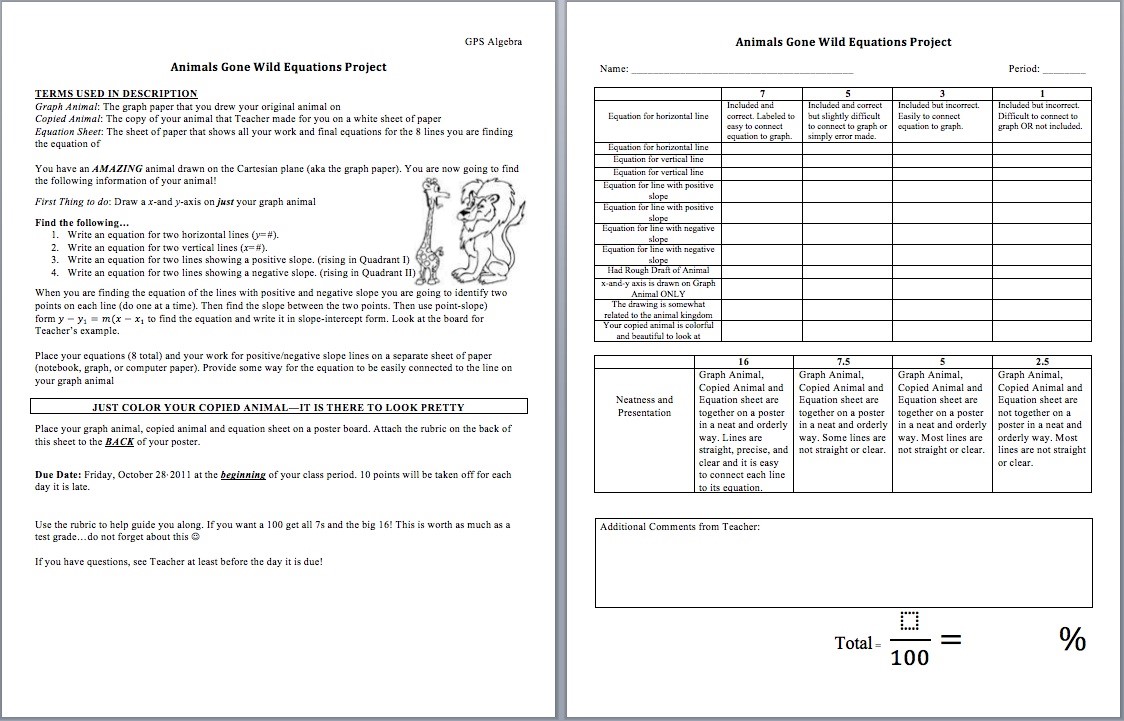
An individualized image-graphing project. I would give each student a large coordinate plane, where they will graph their picture using straight lines only. I would ask them to use only points at intersections, but this can change to half points if needed. Then each student will receive an Equation sheet where they will find and write 2 equations for each different type of slope. So a student will have equations for two horizontal lines, vertical lines, positive slope, and negative slope. The best part is the project can be tailored to each class weakness or strength. I can also ask them to write the slop-intercept form, point slope form, or to even compare slopes that are parallel or perpendicular. When they are done, students would have practiced graphing and writing linear equations many times using their drawn images. Some students would be able to recognize slopes easier when they recall this project and their specific work on it.


Example of a project template:


projecttemplate

Examples of student work:

studentwork2


studentwork1


green line

How has this topic appeared in the news?


Millions of people tune in to watch the news daily. Information is poured into our ears and images through our eyes. We cannot absorb it all, so the news makes it easy for us to understand and uses graphs of linear equations. Plus, the Whoa! Factor of the slopping lines is really the attention grabber. News comes in many forms either through, TV, Internet, or newspaper. Students can learn to quickly understand the meaning of graphs with the different slopes the few seconds they are exposed to them.


On television, FOX news shows a positive slope of increasing number of job losses through a few years. (Beware for misrepresented data!)

graph1

A journal article contains the cost of college increase between public and private colleges showing the negative slope of private costs decreasing.

graph2

Most importantly line graphs can help muggles, half bloods, witches, and wizards to better understand the rise and decline of attractive characters through the Harry Potter series.

graph3

green line

How can this topic be used in your students’ future courses in mathematics or science?


Students are introduced to simple graphs of linear equations where they should be able to name and find the equation of the slope. In a student’s future course with computers or tablets, I would use the Desmos graphing calculator online. This tool gives the students the ability to work backwards. I would ask a class to make certain lines, and they will have to come up with the equation with only their knowledge from previous class. It would really help the students understand the reason behind a negative slope and positive slope plus the difference between zero slope and undefined. After checking their previous knowledge, students can make visual representations of graphing linear inequalities and apply them to real-world problems.


References:

http://www.hoppeninjamath.com/teacherblog/?p=217

http://walkinginmathland.weebly.com/teaching-math-blog/animal-project-graphing-linear-lines-and-stating-equations

http://mediamatters.org/research/2012/10/01/a-history-of-dishonest-fox-charts/190225

http://money.cnn.com/2010/10/28/pf/college/college_tuition/

http://dailyfig.figment.com/2011/07/13/harry-potter-in-charts/

https://www.desmos.com/calculator


Engaging students: Slope-intercept form of a line

In my capstone class for future secondary math teachers, I ask my students to come up with ideas for engaging their students with different topics in the secondary mathematics curriculum. In other words, the point of the assignment was not to devise a full-blown lesson plan on this topic. Instead, I asked my students to think about three different ways of getting their students interested in the topic in the first place.

I plan to share some of the best of these ideas on this blog (after asking my students’ permission, of course).

This student submission again comes from my former student Kelley Nguyen. Her topic, from Algebra: slope-intercept form of a line.

green line

How has this topic appeared in high culture (art, classical music, theatre, etc.)?


The slope-intercept form of a line is a linear function. Linear functions are dealt with in many ways in everyday life, some of which you probably don’t even notice.


One example where the slope-intercept form of a line appears in high culture is through music and arts. Suppose a band wants to book an auditorium for their upcoming concert. As most bands do, they meet with the manager of the location, book a date, and determine a payment. Let’s say it costs $1,500 to rent the building for 2 hours. In addition to this fee, the band earns 20% of each $30 ticket sold. Write an equation that determines whether the band made profit or lost money due to the number of tickets sold – the equation would be y = 0.2(30)x – 1500, where y is the amount gained or lost and x is the number of tickets sold that night. This can also help the band determine their goal on how many tickets to sell. If they want to make a profit of $2,000, they would have to sell x-many tickets to accomplish that.


In reality, most arts performances make a profit from their shows or concerts. Not only do mathematicians and scientists use slope-intercept of a line, but with this example, it shows up in many types of arts and real-world situations. Not only does the form work for calculating cost or profit, it can relate to the number of seats in a theatre, such as x rows of 30 seats and a VIP section of 20 seats. The equation to find how many seats are available in the theatre is y = 30x + 20, where x is the number of rows.


green line

How can technology be used to effectively engage students with this topic?


A great way to engage students when learning about slope-intercept form of a line is to use Geometer’s Sketchpad. After opening a graph with an x- and y-axis, use the tools to create a line. From there, you can drag the line up or down and notice that the slope increases as you move upward and decreases as you move downward. Students can also find the equation of the line by selecting the line, clicking “Measure” in the menu bar, and selecting “Equation” in the drop-down list. This gives the students an accurate equation of the line they selected in slope-intercept form. Geometer’s Sketchpad allows students to experiment and explore directions of lines, determine whether or not it has an increasing slope, and help create a visual image for positive and negative slopes.


Also, with this program, students can play a matching game with slope-intercept equations and lines. You will instruct the student to create five random lines that move in any direction. Next, they will select all of the lines, go to “Measure” in the menu bar, and click “Equation.” From there, it’ll give them the equation of each line. Then, the student will go back and select the lines once again, go to “Edit” on the menu bar, hover over “Action Buttons,” and select “Hide/Show.” Once a box comes up, they will click the “Label” tab and type Scramble Lines in the text line. Next, the lines will scramble and stop when clicked on. Once the lines are done scrambling, the student could then match the equations with their lines. This activity gives the students the chance to look at equations and determine whether the slope is increasing and decreasing and where the line hits the y-axis.


green line

How could you as a teacher create an activity or project that involves your topic?


With this topic, I could definitely do a project that consists of slope-intercept equations, their graphs, and word problems that involve computations. For example, growing up, some students had to earn money by doing chores around the house. Parents give allowance on daily duties that their children did.


The project will give the daily amount of allowance that each student earned. With that, say the student needed to reach a certain amount of money before purchasing the iPad Air. In part one of the project, the student will create an equation that reflects their daily allowing of $5 and the amount of money they have at the moment. In part two, the student will construct a graph that shows the rate of their earnings, supposing that they don’t skip a day of chores. In part three, the students will answer a series of questions, such as,

  • What will you earn after a week?
  • What is your total amount of money after that week?
  • When will you have enough money to buy that iPad Air at $540 after tax?


This would be a short project, but it’s definitely something that the students can do outside of class as a fun activity. It can also help them reach their goals of owning something they want and making a financial plan on how to accomplish that.


References


Engaging students: Approximating data by a straight line

In my capstone class for future secondary math teachers, I ask my students to come up with ideas for engaging their students with different topics in the secondary mathematics curriculum. In other words, the point of the assignment was not to devise a full-blown lesson plan on this topic. Instead, I asked my students to think about three different ways of getting their students interested in the topic in the first place.

I plan to share some of the best of these ideas on this blog (after asking my students’ permission, of course).

This student submission again comes from my former student Delaina Bazaldua. Her topic, from Algebra: approximating data to a straight line.

green line

How has this topic appeared in pop culture (movies, TV, current music, video games, etc.)?

One of my favorite shows to watch is How I Met Your Mother. I specifically chose this topic for this class because of how it relates to an episode of the show. A piece of the episode that I’m referring to is shown in the YouTube video:

Barney, one of the main characters, describes the graph as the Crazy/Hot Scale. According to him, a girl cannot be crazier than hot which means she has to be above the diagonal straight line. This relates to the topic because one can approximate data by the straight line that Barney gives the viewer. I think the students will be able to relate to this and also find it humorous. Because this video has both of these characteristics, they will be able to remember the concept for upcoming homework and tests which is ultimately the most important part of math: understanding it and being able to recall it.


green line

How has this topic appeared in the news?

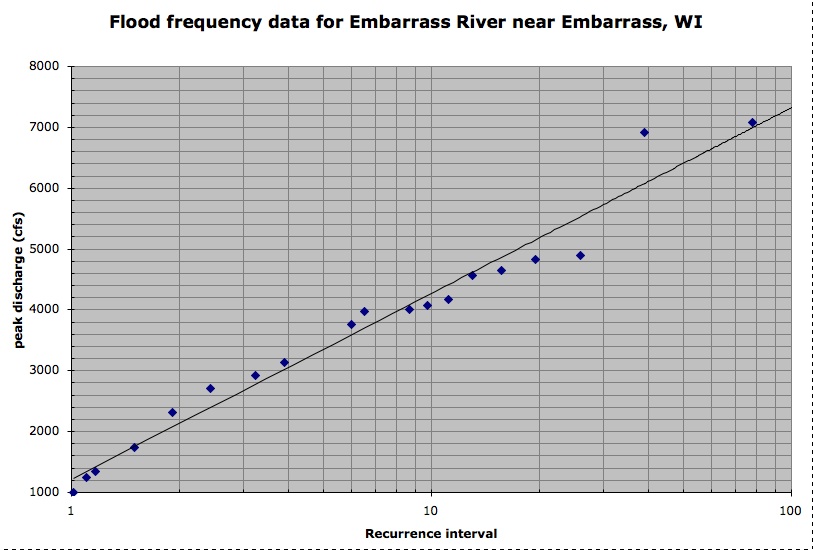
Most lines are drawn for the purpose of seeing if there is a relationship between the x and y axis and trying to figure out if you can approximate data from the straight line that is drawn. Graphs like this are found all over the news, and they often relate to natural disasters. For example, this linear regression, http://d32ogoqmya1dw8.cloudfront.net/images/quantskills/methods/quantlit/bestfit_line.v2.jpg, describes floods. In http://serc.carleton.edu/mathyouneed/graphing/bestfit.html, where the picture is found, describes more activities that can be used to create a linear regression which can be converted into a straight line. These examples of straight lines can be used to find more data that isn’t necessarily shown from the points that are plotted. The examples the website gave are: flood frequency curves, earthquake forecasting, meteorite impact prediction, earthquake frequency vs. magnitude, and climate change. This is beneficial for math because it allows students to realize that math isn’t abstract like it is often perceived to be, but rather, it is used for something very important and something that occurs several times a year such as natural disasters and weather.


green line

How can this topic be used in your students’ future courses in mathematics or science?

One of the purposes for teachers to teach is for students to learn what they should for the following year so they can be successful in the particular topic. When it comes to approximating data based on a straight line, the knowledge a student learns in algebra will carry them through statistics, physics, and other higher math and science classes. Linear regression is shown in statistics as one can see in this statistics website: http://onlinestatbook.com/2/regression/intro.html while physics is represented in the physics website: http://dev.physicslab.org/Document.aspx?doctype=3&filename=IntroductoryMathematics_DataAnalysisMethods.xml. A lot can be predicted from these straight lines which is why these graphs aren’t foreign to upper level math and science classes. As I stated before, a lot can be predicted from the graph where data points aren’t necessarily on the trend the data is setting which allows students to expect what would occur at a particular x or y value. A background in this area can help students through the rest of school and perhaps even the rest of their life in some cases.


References:

https://www.youtube.com/watch?v=uN_sSXKbzHk

http://serc.carleton.edu/mathyouneed/graphing/bestfit.html

http://onlinestatbook.com/2/regression/intro.html

http://dev.physicslab.org/Document.aspx?doctype=3&filename=IntroductoryMathematics_DataAnalysisMethods.xml


Engaging students: Solving one-step linear equations

In my capstone class for future secondary math teachers, I ask my students to come up with ideas for engaging their students with different topics in the secondary mathematics curriculum. In other words, the point of the assignment was not to devise a full-blown lesson plan on this topic. Instead, I asked my students to think about three different ways of getting their students interested in the topic in the first place.

I plan to share some of the best of these ideas on this blog (after asking my students’ permission, of course).

This student submission again comes from my former student Jessica Trevizo. Her topic, from Pre-Algebra: solving one-step linear equations.

green line

A2. How could you as a teacher create an activity or project that involves your topic?

            Many students have played “Around the World” at one point in their elementary childhood, or have at least heard of the game. Around the World is an activity that is commonly used by elementary school teachers when they are teaching multiplication. Students are supposed to sit in the form of a circle. One person is chosen to attempt to go around the world. He/she will stand behind a student and will compete against the student that is sitting down. Once both students are ready the teacher holds up a multiplication card. The student who responds with the correct answer first gets the chance to move on to the next person. If the student who is standing up loses then he/she gets to sit down while the other student who obtained the correct answer advances. Every person has to attempt the problem on a sheet of paper, but they are not allowed to call out the answer. The student who “goes around the world” first is the winner. If a student is not able to complete the entire circle then the student who advanced the farthest is the winner. The same idea will be used after the students have learned how to solve one step linear equations.  After having a deep conceptual understanding of the topic it is very important for the students to keep practicing problems.  Around the World allows the students to keep practicing in an entertaining way. The students should be able to solve the equations within 30 seconds since it only requires one step to solve. The ability to use calculators with this activity will vary depending on the level of difficulty of the problems as well as the teacher.


green line

B1. How can this topic be used in your students’ future courses in mathematics or science?

            Being able to solve one step linear equations is an important skill that every student should acquire. After the students learn how to solve one step linear equations they are expected to be able to solve multi-step equations, solve absolute value equations, solve inequalities, finding the side lengths of a shape given a certain area in geometry, etc. If the students are not able to master solving one step linear equations then they will have a very difficult time in other math courses.

In geometry the Pythagorean Theorem requires the skill to solve one step equations. Students are expected to solve for the missing variable in order to find the missing side length of a right triangle. In Algebra II the students are required to manipulate equations in order to solve systems of linear equations through substitution. Also this basic skill is necessary when finding the inverse of a function. This topic is also used in physics. For example, if the student is asked to find the acceleration of an object given only the force and the mass, then it involves using Newton’s second law which states Force=mass*acceleration.


green line

E1. How can technology (YouTube, Khan Academy [khanacademy.org], Vi Hart, Geometers Sketchpad, graphing calculators, etc.) be used to effectively engage students with this topic?

This website is an amazing tool that allows the students to visualize how to solve linear equations using algebra tiles. If the teacher decides to teach this lesson using algebra tiles in the classroom, then this website will allow the students to continue to practice at home. Also, the website automatically lets the student know if he/she responded correctly. Obtaining quick results allows the student to know whether or not they truly understand how to solve the equations as opposed to having a worksheet with 50 problems for homework and not knowing if the same mistake was repeated.  Also, by using the online algebra tiles the students are able to understand the zero pair concept and see how it is being applied. This website can also be used for other algebra topics such as factoring, the distributive property, and substitution.

http://illuminations.nctm.org/Activity.aspx?id=3482