I’m doing something that I should have done a long time ago: collecting a series of posts into one single post. The links below show my series on solving problems submitted to the journals of the Mathematical Association of America.
Part 1: Introduction
Part 2a: Suppose that  and
and  are independent, uniform random variables over
 ![[0,1]](https://s0.wp.com/latex.php?latex=%5B0%2C1%5D&bg=ffffff&fg=000000&s=0&c=20201002) . Now define the random variable
. Now define the random variable  by
by
 .
.
Prove that is uniform over . Here, ![{\bf 1}[S]](https://s0.wp.com/latex.php?latex=%7B%5Cbf+1%7D%5BS%5D&bg=ffffff&fg=000000&s=0&c=20201002) is the indicator function that is equal to 1 if
is the indicator function that is equal to 1 if  is true and 0 otherwise.
Part 2b: Suppose that and are independent, uniform random variables over . Define  ,
,  ,
,  , and
, and  as follows:
is uniform over ![[0,X]](https://s0.wp.com/latex.php?latex=%5B0%2CX%5D&bg=ffffff&fg=000000&s=0&c=20201002) ,
,
is uniform over ![[X,1]](https://s0.wp.com/latex.php?latex=%5BX%2C1%5D&bg=ffffff&fg=000000&s=0&c=20201002) ,
,
 with
with  and
and  , and
, and
 .
.
Prove that is uniform over .
Part 3: Define, for every non-negative integer  , the th Catalan number by
 .
.
Consider the sequence of complex polynomials in  defined by
  for every non-negative integer
  , where
  . It is clear that
  has degree
  and thus has the representation
 ,
,
where each  is a positive integer. Prove that
  for
for  .
.
Part 4: Let  be arbitrary events in a probability field. Denote by
  the event that at least of
  occur. Prove that
  .
.
Parts 5a, 5b, 5c, 5d, and 5e: Evaluate the following sums in closed form:

and
 .
.
Parts 6a, 6b, 6c, 6d, and 6e: Two points  and
and  are chosen at random (uniformly) from the interior of a unit circle. What is the probability that the circle whose diameter is segment
  lies entirely in the interior of the unit circle?
Parts 7a, 7b, 7c, 7d, 7e, 7f, 7g, 7h, and 7i: Let and be independent normally distributed random variables, each with its own mean and variance. Show that the variance of conditioned on the event  is smaller than the variance of alone.


 .
. and
and  and flipping the order of a double sum, I was able to show that
  .
. ,
,


![= x \displaystyle \left[ (a_0)' + \sum_{k=1}^\infty \left(a_k x^k \right)' \right]](https://s0.wp.com/latex.php?latex=%3D+x+%5Cdisplaystyle+%5Cleft%5B+%28a_0%29%27+%2B++%5Csum_%7Bk%3D1%7D%5E%5Cinfty+%5Cleft%28a_k+x%5Ek+%5Cright%29%27+%5Cright%5D&bg=ffffff&fg=000000&s=0&c=20201002)


 .
.
 and write out the full Taylor series expansion, including zero coefficients:
 ,
,


 .
. .
. ,
,

 ,
,

 .
. by writing the series as a double sum and then reversing the order of summation. We proceed with very similar logic to evaluate
  . Since


 .
. . I want to cancel the factor of
  in the summand; however, the denominator is
 ,
, . Hypothetically, I could cancel as follows:
 ,
, and then distribute and split into two different sums:

![= \displaystyle \frac{1}{2} \sum_{k=1}^\infty \left[ (-1)^k (2k+1) \frac{x^{2k+1}}{(2k+1)!} - (-1)^k \cdot 1 \frac{x^{2k+1}}{(2k+1)!} \right]](https://s0.wp.com/latex.php?latex=%3D+%5Cdisplaystyle+%5Cfrac%7B1%7D%7B2%7D+%5Csum_%7Bk%3D1%7D%5E%5Cinfty+%5Cleft%5B+%28-1%29%5Ek+%282k%2B1%29+%5Cfrac%7Bx%5E%7B2k%2B1%7D%7D%7B%282k%2B1%29%21%7D+-+%28-1%29%5Ek+%5Ccdot+1+%5Cfrac%7Bx%5E%7B2k%2B1%7D%7D%7B%282k%2B1%29%21%7D+%5Cright%5D&bg=ffffff&fg=000000&s=0&c=20201002)


 .
. from the first sum. In this way, the two sums are the Taylor series expansions of

 .
.

 .
.
 .
. .
. ), we see
 .
. cancels:

 and a power of
  .
. Part 1
 and
and  , the number of 2-tiles and 4-tiles (respectively) that appeared throughout the course of the game:
 .
.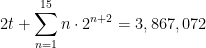


 terms, common ratio of 2, and initial term
  . Therefore,

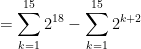
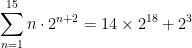
 . So
. So


 Mean Green Math