Mathematical Allusions in Shantaram (Part 1)

I recently finished the novel Shantaram, by Gregory David Roberts. As I’m not a professional book reviewer, let me instead quote from the Amazon review:

Crime and punishment, passion and loyalty, betrayal and redemption are only a few of the ingredients in Shantaram, a massive, over-the-top, mostly autobiographical novel. Shantaram is the name given Mr. Lindsay, or Linbaba, the larger-than-life hero. It means “man of God’s peace,” which is what the Indian people know of Lin. What they do not know is that prior to his arrival in Bombay he escaped from an Australian prison where he had begun serving a 19-year sentence. He served two years and leaped over the wall. He was imprisoned for a string of armed robberies performed to support his heroin addiction, which started when his marriage fell apart and he lost custody of his daughter. All of that is enough for several lifetimes, but for Greg Roberts, that’s only the beginning.

He arrives in Bombay with little money, an assumed name, false papers, an untellable past, and no plans for the future. Fortunately, he meets Prabaker right away, a sweet, smiling man who is a street guide. He takes to Lin immediately, eventually introducing him to his home village, where they end up living for six months. When they return to Bombay, they take up residence in a sprawling illegal slum of 25,000 people and Linbaba becomes the resident “doctor.” With a prison knowledge of first aid and whatever medicines he can cadge from doing trades with the local Mafia, he sets up a practice and is regarded as heaven-sent by these poor people who have nothing but illness, rat bites, dysentery, and anemia. He also meets Karla, an enigmatic Swiss-American woman, with whom he falls in love. Theirs is a complicated relationship, and Karla’s connections are murky from the outset.

While it was a cracking good read, what struck me particularly were the surprising mathematical allusions that the author used throughout the novel. In this mini-series, I’d like to explore the ones that I found.

In this first installment, the narrator describes a life-or-death situation as he is being choked:

He was a hard man. He didn’t give up. His hands squeezed tighter. My neck was strong and the muscles were well developed, but I knew he had the strength to kill me. My hand reached, groping for the pistol in my pocket. I had to shoot him. I had to kill him. That was all right. I didn’t care. The air in my lungs was spent, and my brain was exploding in Mandelbrot whirls of colored light, and I was dying, and I wanted to kill him.

Shantaram, Chapter 25

Someone being choked to death might be prosaically described as “seeing stars,” but the author instead to choose the more vivid imagery of “exploding in Mandelbrot whirls of colored light.” The Mandelbrot set is a fractal that solves a famous mathematical problem:

And the Mandelbrot set is quite colorful and complex, which might indeed be a better description than “seeing stars” of what might be going through someone’s mind when being choked to death. Although somewhat dated, here’s my favorite Mandelbrot zoom video:

Confirming Einstein’s Theory of General Relativity With Calculus, Part 9: Pedagogical Thoughts

At long last, we have reached the end of this series of posts.

The derivation is elementary; I’m confident that I could have understood this derivation had I seen it when I was in high school. That said, the word “elementary” in mathematics can be a bit loaded — this means that it is based on simple ideas that are perhaps used in a profound and surprising way. Perhaps my favorite quote along these lines was this understated gem from the book Three Pearls of Number Theory after the conclusion of a very complicated proof in Chapter 1:

You see how complicated an entirely elementary construction can sometimes be. And yet this is not an extreme case; in the next chapter you will encounter just as elementary a construction which is considerably more complicated.

Here are the elementary ideas from calculus, precalculus, and high school physics that were used in this series:

  • Physics
    • Conservation of angular momentum
    • Newton’s Second Law
    • Newton’s Law of Gravitation
  • Precalculus
    • Completing the square
    • Quadratic formula
    • Factoring polynomials
    • Complex roots of polynomials
    • Bounds on \cos \theta and \sin \theta
    • Period of \cos \theta and \sin \theta
    • Zeroes of \cos \theta and \sin \theta
    • Trigonometric identities (Pythagorean, sum and difference, double-angle)
    • Conic sections
    • Graphing in polar coordinates
    • Two-dimensional vectors
    • Dot products of two-dimensional vectors (especially perpendicular vectors)
    • Euler’s equation
  • Calculus
    • The Chain Rule
    • Derivatives of \cos \theta and \sin \theta
    • Linearizations of \cos x, \sin x, and 1/(1-x) near x \approx 0 (or, more generally, their Taylor series approximations)
    • Derivative of e^x
    • Solving initial-value problems
    • Integration by u-substitution

While these ideas from calculus are elementary, they were certainly used in clever and unusual ways throughout the derivation.

I should add that although the derivation was elementary, certain parts of the derivation could be made easier by appealing to standard concepts from differential equations.

One more thought. While this series of post was inspired by a calculation that appeared in an undergraduate physics textbook, I had thought that this series might be worthy of publication in a mathematical journal as an historical example of an important problem that can be solved by elementary tools. Unfortunately for me, Hieu D. Nguyen’s terrific article Rearing Its Ugly Head: The Cosmological Constant and Newton’s Greatest Blunder in The American Mathematical Monthly is already in the record.

Confirming Einstein’s Theory of General Relativity With Calculus, Part 6i: Rationale for Method of Undetermined Coefficients VI

In this series, I’m discussing how ideas from calculus and precalculus (with a touch of differential equations) can predict the precession in Mercury’s orbit and thus confirm Einstein’s theory of general relativity. The origins of this series came from a class project that I assigned to my Differential Equations students maybe 20 years ago.

In the last few posts, I’ve used a standard technique from differential equations: to solve the nth order homogeneous differential equation with constant coefficients

a_n y^{(n)} + \dots + a_3 y''' + a_2 y'' + a_1 y' + a_0 y = 0,

we first solve the characteristic equation

a_n r^n + \dots + a_3 r^3 + a_2 r^2 + a_1 r + a_0 = 0

using techniques from Precalculus. The form of the roots r determines the solutions of the differential equation.

While this is a standard technique from differential equations, the perspective I’m taking in this series is scaffolding the techniques used to predict the precession in a planet’s orbit using only techniques from Calculus and Precalculus. So let me discuss why the above technique works, assuming that the characteristic equation does not have repeated roots. (The repeated roots case is a little more complicated but is not needed for the present series of posts.)

We begin by guessing that the above differential equation has a solution of the form y = e^{rt}. Differentiating, we find y' = re^{rt}, y'' = r^2 e^{rt}, etc. Therefore, the differential equation becomes

a_n r^n e^{rt} + \dots + a_3 r^3 e^{rt} + a_2 r^2 e^{rt} + a_1 r e^{rt} + a_0 e^{rt} = 0

e^{rt} \left(a_n r^n  + \dots + a_3 r^3 + a_2 r^2 + a_1 r  + a_0 \right) = 0

a_n r^n  + \dots + a_3 r^3 + a_2 r^2 + a_1 r  + a_0 = 0

The last step does not “lose” any possible solutions for r since e^{rt} can never be equal to 0. Therefore, solving the differential equation reduces to finding the roots of this polynomial, which can be done using standard techniques from Precalculus.

For example, one of the differential equations that we’ve encountered is y''+y=0. The characteristic equation is r^2+1=0, which has roots r=\pm i. Therefore, two solutions to the differential equation are e^{it} and e^{-it}, so that the general solution is

y = c_1 e^{it} + c_2 e^{-it}.

To write this in a more conventional way, we use Euler’s formula e^{ix} = \cos x + i \sin x, so that

y = c_1 (\cos t + i \sin t) + c_2 (\cos (-t) + i \sin (-t))

= c_1 \cos t + i c_1 \sin t + c_2 \cos t - i c_2 \sin t

= (c_1 + c_2) \cos t + (ic_1 - ic_2) \sin t

= C_1 \cos t + C_2 \sin t.

Likewise, in the previous post, we encountered the fourth-order differential equation y^{(4)}+5y''+4y = 0. To find the roots of the characteristic equation, we factor:

r^4 + 5r^2 + 4r = 0

(r^2+1)(r^2+4) = 0

r^2 +1 = 0 \qquad \hbox{or} \qquad \hbox{or} r^2 + 4 = 0

r = \pm i \qquad \hbox{or} \qquad r = \pm 2i.

Therefore, four solutions of this differential equation are e^{it}, e^{-it}, e^{2it}, and e^{-2it}, so that the general solution is

y = c_1 e^{it} + c_2 e^{-it} + c_3 e^{2it} + c_4 e{-2it}.

Using Euler’s formula as before, this can be rewritten as

y = C_1 \cos t + C_2 \sin t + C_3 \cos 2t + C_4 \sin 2t.

Confirming Einstein’s Theory of General Relativity With Calculus, Part 6h: Rationale for Method of Undetermined Coefficients V

In this series, I’m discussing how ideas from calculus and precalculus (with a touch of differential equations) can predict the precession in Mercury’s orbit and thus confirm Einstein’s theory of general relativity. The origins of this series came from a class project that I assigned to my Differential Equations students maybe 20 years ago.

We have shown that the motion of a planet around the Sun, expressed in polar coordinates (r,\theta) with the Sun at the origin, under general relativity follows the initial-value problem

u''(\theta) + u(\theta) = \displaystyle \frac{1}{\alpha} + \frac{\delta}{\alpha^2} + \frac{\delta \epsilon^2}{2\alpha^2} + \frac{2\delta \epsilon \cos \theta}{\alpha^2} + \frac{\delta \epsilon^2 \cos 2\theta}{2\alpha^2},

u(0) = \displaystyle \frac{1}{P},

u'(0) = 0,

where u = \displaystyle \frac{1}{r}, \displaystyle \frac{1}{\alpha} = \frac{GMm^2}{\ell^2}, \delta = \displaystyle \frac{3GM}{c^2}, G is the gravitational constant of the universe, m is the mass of the planet, M is the mass of the Sun, \ell is the constant angular momentum of the planet, c is the speed of light, and P is the smallest distance of the planet from the Sun during its orbit (i.e., at perihelion).

In the two previous posts, we derived the method of undetermined coefficients for the simplified differential equations

u''(\theta) + u(\theta) = \displaystyle \frac{1}{\alpha} + \frac{\delta}{\alpha^2} + \frac{\delta \epsilon^2}{2\alpha^2}.

and

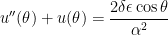
u''(\theta) + u(\theta) = \displaystyle \frac{2\delta \epsilon \cos \theta}{\alpha^2}.

In this post, we consider the simplified differential equation if the right-hand side has only the fifth term,

u''(\theta) + u(\theta) =  \displaystyle \frac{\delta \epsilon^2 \cos 2\theta}{2\alpha^2}.

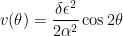
Let v(\theta) = \displaystyle \frac{\delta \epsilon^2 }{2\alpha^2} \cos 2\theta. Then v satisfies the new differential equation v'' + 4v = 0. Also, v = u'' + u. Substituting, we find

(u''+u)'' + 4(u''+u) = 0

u^{(4)} + u'' + 4u'' + 4u = 0

u^{(4)} + 5u'' + 4u = 0

The characteristic equation of this new differential equation is

r^4 + 5r^2 + 4 = 0

(r^2 + 1)(r^2 + 4) = 0

r^2 + 1 = 0 \qquad \hbox{or} \qquad r^2 + 4 = 0

r = \pm i \qquad \hbox{or} \qquad r = \pm 2i

Therefore, the general solution of the new differential equation is

u(\theta) = c_1 \cos \theta + c_2 \sin \theta + c_3 \cos 2\theta + c_4 \sin 2\theta.

The constants c_3 and c_4 can be found by substituting back into the original differential equation:

u''(\theta) + u(\theta) =  \displaystyle \frac{\delta \epsilon^2 \cos 2\theta}{2\alpha^2}

-c_1 \cos \theta - c_2 \sin \theta - 4c_3 \cos 2\theta - 4c_4 \sin 2\theta + c_1 \cos \theta + c_2 \sin \theta + c_3 \cos 2\theta + c_4 \sin 2\theta = \displaystyle \frac{\delta \epsilon^2 \cos 2\theta}{2\alpha^2}

- 3c_3 \cos 2\theta - 3c_4 \sin 2\theta  = \displaystyle \frac{\delta \epsilon^2 \cos 2\theta}{2\alpha^2}

Matching coefficients, we see that c_3 = \displaystyle -\frac{\delta \epsilon^2}{6\alpha^2} and c_4 = 0. Therefore, the solution of the simplified differential equation is

u(\theta) = c_1 \theta + c_2 \theta \displaystyle -\frac{\delta \epsilon^2}{6\alpha^2} \cos 2\theta.

In particular, setting c_1 = 0 and c_2 = 0, we see that

u(\theta) =  \displaystyle -\frac{\delta \epsilon^2}{6\alpha^2} \cos 2\theta

is a particular solution to the simplified differential equation.

In the next post, we put together the solutions of these three simplified differential equations to solve the original differential equation,

u''(\theta) + u(\theta) = \displaystyle \frac{1}{\alpha} + \frac{\delta}{\alpha^2} + \frac{\delta \epsilon^2}{2\alpha^2} + \frac{2\delta \epsilon \cos \theta}{\alpha^2} + \frac{\delta \epsilon^2 \cos 2\theta}{2\alpha^2}.

Confirming Einstein’s Theory of General Relativity With Calculus, Part 6g: Rationale for Method of Undetermined Coefficients IV

In this series, I’m discussing how ideas from calculus and precalculus (with a touch of differential equations) can predict the precession in Mercury’s orbit and thus confirm Einstein’s theory of general relativity. The origins of this series came from a class project that I assigned to my Differential Equations students maybe 20 years ago.

We have shown that the motion of a planet around the Sun, expressed in polar coordinates (r,\theta) with the Sun at the origin, under general relativity follows the initial-value problem

u''(\theta) + u(\theta) = \displaystyle \frac{1}{\alpha} + \frac{\delta}{\alpha^2} + \frac{\delta \epsilon^2}{2\alpha^2} + \frac{2\delta \epsilon \cos \theta}{\alpha^2} + \frac{\delta \epsilon^2 \cos 2\theta}{2\alpha^2},

u(0) = \displaystyle \frac{1}{P},

u'(0) = 0,

where u = \displaystyle \frac{1}{r}, \displaystyle \frac{1}{\alpha} = \frac{GMm^2}{\ell^2}, \delta = \displaystyle \frac{3GM}{c^2}, G is the gravitational constant of the universe, m is the mass of the planet, M is the mass of the Sun, \ell is the constant angular momentum of the planet, c is the speed of light, and P is the smallest distance of the planet from the Sun during its orbit (i.e., at perihelion).

In this post, we will use the guesses

u(\theta) = f(\theta) \cos \theta \qquad \hbox{or} u(\theta) = f(\theta) \sin \theta

that arose from the technique/trick of reduction of order, where f(\theta) is some unknown function, to find the general solution of the differential equation

u^{(4)} + 2u'' + u = 0.

To do this, we will need to use the Product Rule for higher-order derivatives that was derived in the previous post:

(fg)'' = f'' g + 2 f' g' + f g''

and

(fg)^{(4)} = f^{(4)} g + 4 f''' g' + 6 f'' g'' + 4f' g''' + f g^{(4)}.

In these formulas, Pascal’s triangle makes a somewhat surprising appearance; indeed, this pattern can be proven with mathematical induction.

We begin with u(\theta) = f(\theta) \cos \theta. If g(\theta) = \cos \theta, then

g'(\theta) = - \sin \theta,

g''(\theta) = -\cos \theta,

g'''(\theta) = \sin \theta,

g^{(4)}(\theta) = \cos \theta.

Substituting into the fourth-order differential equation, we find the differential equation becomes

(f \cos \theta)^{(4)} + 2 (f \cos \theta)'' + f \cos \theta = 0

f^{(4)} \cos \theta - 4 f''' \sin \theta - 6 f'' \cos \theta + 4 f' \sin \theta + f \cos \theta + 2 f'' \cos \theta - 4 f' \sin \theta - 2 f \cos \theta + f \cos \theta = 0

f^{(4)} \cos \theta - 4 f''' \sin \theta - 6 f'' \cos \theta  + 2 f'' \cos \theta  = 0

f^{(4)} \cos \theta - 4 f''' \sin \theta - 4 f'' \cos \theta = 0

The important observation is that the terms containing f and f' cancelled each other. This new differential equation doesn’t look like much of an improvement over the original fourth-order differential equation, but we can make a key observation: if f'' = 0, then differentiating twice more trivially yields f''' = 0 and f^{(4)} = 0. Said another way: if f'' = 0, then u(\theta) = f(\theta) \cos \theta will be a solution of the original differential equation.

Integrating twice, we can find f:

f''(\theta) = 0

f'(\theta) = c_1

f(\theta) = c_1 \theta + c_2.

Therefore, a solution of the original differential equation will be

u(\theta) = c_1 \theta \cos \theta + c_2 \cos \theta.

We now repeat the logic for u(\theta) = f(\theta) \sin \theta:

(f \sin \theta)^{(4)} + 2 (f \sin \theta)'' + f \sin \theta = 0

f^{(4)} \sin \theta + 4 f''' \cos \theta - 6 f'' \sin \theta - 4 f' \cos\theta + f \sin \theta + 2 f'' \sin \theta + 4 f' \cos \theta - 2 f \sin \theta + f \sin \theta = 0

f^{(4)} \sin\theta + 4 f''' \cos \theta - 6 f'' \sin \theta + 2 f'' \sin \theta = 0

f^{(4)} \sin\theta - 4 f''' \cos\theta - 4 f'' \sin\theta = 0.

Once again, a solution of this new differential equation will be f(\theta) = c_3 \theta + c_4, so that f'' = f''' = f^{(4)} = 0. Therefore, another solution of the original differential equation will be

u(\theta) = c_3 \theta \sin \theta + c_4 \sin \theta.

Adding these provides the general solution of the differential equation:

u(\theta) = c_1 \theta \cos \theta + c_2 \cos \theta + c_3 \theta \sin \theta + c_4 \sin \theta.

Except for the order of the constants, this matches the solution that was presented earlier by using techniques taught in a proper course in differential equations.

Confirming Einstein’s Theory of General Relativity With Calculus, Part 6f: Rationale for Method of Undetermined Coefficients III

In this series, I’m discussing how ideas from calculus and precalculus (with a touch of differential equations) can predict the precession in Mercury’s orbit and thus confirm Einstein’s theory of general relativity. The origins of this series came from a class project that I assigned to my Differential Equations students maybe 20 years ago.

We have shown that the motion of a planet around the Sun, expressed in polar coordinates (r,\theta) with the Sun at the origin, under general relativity follows the initial-value problem

u''(\theta) + u(\theta) = \displaystyle \frac{1}{\alpha} + \frac{\delta}{\alpha^2} + \frac{\delta \epsilon^2}{2\alpha^2} + \frac{2\delta \epsilon \cos \theta}{\alpha^2} + \frac{\delta \epsilon^2 \cos 2\theta}{2\alpha^2},

u(0) = \displaystyle \frac{1}{P},

u'(0) = 0,

where u = \displaystyle \frac{1}{r}, \displaystyle \frac{1}{\alpha} = \frac{GMm^2}{\ell^2}, \delta = \displaystyle \frac{3GM}{c^2}, G is the gravitational constant of the universe, m is the mass of the planet, M is the mass of the Sun, \ell is the constant angular momentum of the planet, c is the speed of light, and P is the smallest distance of the planet from the Sun during its orbit (i.e., at perihelion).

In the previous post, I used a standard technique from differential equations to find the general solution of

u^{(4)} + 2u'' + u = 0.

to be

u(theta) = c_1 \cos \theta + c_2 \sin \theta + c_3 \theta \cos \theta + c_4 \theta \sin \theta.

However, as much as possible in this series, I want to take the perspective of a talented calculus student who has not yet taken differential equations — so that the conclusion above is far from obvious. How could this be reasonable coaxed out of such a student?

To begin, we observe that the characteristic equation is

r^4 + 2r^2 + 1 = 0,

or

(r^2 + 1)^2 = 0.

Clearly this has the same roots as the simpler equation r^2 + 1 = 0, which corresponds to the second-order differential equation u'' + u = 0. We’ve already seen that u_1(\theta) = \cos \theta and u_2(\theta) = \sin \theta are solutions of this differential equation; perhaps they might also be solutions of the more complicated differential equation also? The answer, of course, is yes:

u_1^{(4)} + 2 u_1'' + u_1 = \cos \theta - 2 \cos \theta + \cos \theta = 0

and

u_2^{(4)} + 2u_2'' + u_2 = \sin \theta - 2 \sin \theta + \sin \theta = 0.

The far trickier part is finding the two additional solutions. To find these, we use a standard trick/technique called reduction of order. In this technique, we guess that any additional solutions much have the form of either

u(\theta) = f(\theta) \cos \theta \qquad \hbox{or} \qquad  u(\theta) = f(\theta) \sin \theta,

where f(\theta) is some unknown function that we’re multiplying by the solutions we already have. We then substitute this into the differential equation u^{(4)} + 2u'' + u = 0 to form a new differential equation for the unknown f, which we can (hopefully) solve.

Doing this will require multiple applications of the Product Rule for differentiation. We already know that

(fg)' = f' g + f g'.

We now differentiate again, using the Product Rule, to find (fg)'':

(fg)'' = ( [fg]')' = (f'g)' + (fg')'

= f''g + f' g' + f' g' + f g''

= f'' g + 2 f' g' + f g''.

We now differential twice more to find (fg)^{(4)}:

(fg)''' = ( [fg]'')' = (f''g)' + 2(f'g')' +  (fg'')'

= f'''g + f'' g' + 2f'' g' + 2f' g'' + f' g'' + f g'''

= f''' g + 3 f'' g' + 3 f' g'' + f g'''.

A good student may be able to guess the pattern for the next derivative:

(fg)^{(4)} = ( [fg]''')' = (f'''g)' + 3(f''g')' +3(f'g'')' + (fg''')'

= f^{(4)}g + f''' g' + 3f''' g' + 3f'' g'' + 3f'' g'' + 3f'g''' + f' g''' + f g^{(4)}

= f^{(4)} g + 4 f''' g' + 6 f'' g'' + 4f' g''' + f g^{(4)}.

In this way, Pascal’s triangle makes a somewhat surprising appearance; indeed, this pattern can be proven with mathematical induction.

In the next post, we’ll apply this to the solution of the fourth-order differential equation.

Confirming Einstein’s Theory of General Relativity With Calculus, Part 6e: Rationale for Method of Undetermined Coefficients II

In this series, I’m discussing how ideas from calculus and precalculus (with a touch of differential equations) can predict the precession in Mercury’s orbit and thus confirm Einstein’s theory of general relativity. The origins of this series came from a class project that I assigned to my Differential Equations students maybe 20 years ago.

We have shown that the motion of a planet around the Sun, expressed in polar coordinates (r,\theta) with the Sun at the origin, under general relativity follows the initial-value problem

u''(\theta) + u(\theta) = \displaystyle \frac{1}{\alpha} + \frac{\delta}{\alpha^2} + \frac{\delta \epsilon^2}{2\alpha^2} + \frac{2\delta \epsilon \cos \theta}{\alpha^2} + \frac{\delta \epsilon^2 \cos 2\theta}{2\alpha^2},

u(0) = \displaystyle \frac{1}{P},

u'(0) = 0,

where u = \displaystyle \frac{1}{r}, \displaystyle \frac{1}{\alpha} = \frac{GMm^2}{\ell^2}, \delta = \displaystyle \frac{3GM}{c^2}, G is the gravitational constant of the universe, m is the mass of the planet, M is the mass of the Sun, \ell is the constant angular momentum of the planet, c is the speed of light, and P is the smallest distance of the planet from the Sun during its orbit (i.e., at perihelion).

In the previous post, we derived the method of undetermined coefficients for the simplified differential equation

u''(\theta) + u(\theta) = \displaystyle \frac{1}{\alpha} + \frac{\delta}{\alpha^2} + \frac{\delta \epsilon^2}{2\alpha^2}.

In this post, we consider the simplified differential equation if the right-hand side has only the fourth term,

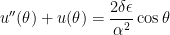
u''(\theta) + u(\theta) =  \displaystyle \frac{2\delta \epsilon }{\alpha^2}\cos \theta.

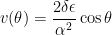
Let v(\theta) =  \displaystyle \frac{2\delta \epsilon }{\alpha^2}\cos \theta. Then v satisfies the new differential equation v'' + v = 0. Since u'' + u = v, we may substitute:

(u''+u)'' + (u'' + u) = 0

u^{(4)} + u'' + u'' + u = 0

u^{(4)} + 2u'' + u = 0.

The characteristic equation of this homogeneous differential equation is r^4 + 2r^2 + 1 = 0, or (r^2+1)^2 = 0. Therefore, r = i and r = -i are both double roots of this quartic equation. Therefore, the general solution for u is

u(\theta) = c_1 \cos \theta + c_2 \sin \theta + c_3 \theta \cos \theta + c_4 \theta \sin \theta.

Substituting into the original differential equation will allow for the computation of c_3 and c_4:

u''(\theta) + u(\theta) = -c_1 \cos \theta - c_2 \sin \theta - 2c_3 \sin \theta - c_3 \theta \cos \theta + 2c_4 \cos \theta - c_4 \theta \sin \theta

+   c_1 \cos \theta + c_2 \sin \theta + c_3 \theta \cos \theta + c_4 \theta \sin \theta

\displaystyle \frac{2\delta \epsilon }{\alpha^2}\cos \theta = - 2c_3 \sin \theta+ 2c_4 \cos \theta

Matching coefficients, we see that c_3 = 0 and c_4 = \displaystyle \frac{\delta \epsilon }{\alpha^2}. Therefore,

u(\theta) = c_1 \cos \theta + c_2 \sin \theta + \displaystyle \frac{\delta \epsilon }{\alpha^2} \theta \sin \theta

is the general solution of the simplified differential equation. Setting c_1 = c_2 = 0, we find that

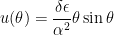
u(\theta) =  \displaystyle \frac{\delta \epsilon }{\alpha^2} \theta \sin \theta

is one particular solution of this simplified differential equation. Not surprisingly, this matches the result is the method of undetermined coefficients had been blindly followed.

As we’ll see in a future post, the presence of this \theta \sin \theta term is what predicts the precession of a planet’s orbit under general relativity.

Confirming Einstein’s Theory of General Relativity With Calculus, Part 5d: Deriving Orbits under Newtonian Mechanics Using Variation of Parameters

In this series, I’m discussing how ideas from calculus and precalculus (with a touch of differential equations) can predict the precession in Mercury’s orbit and thus confirm Einstein’s theory of general relativity. The origins of this series came from a class project that I assigned to my Differential Equations students maybe 20 years ago.

We previously showed that if the motion of a planet around the Sun is expressed in polar coordinates (r,theta), with the Sun at the origin, then under Newtonian mechanics (i.e., without general relativity) the motion of the planet follows the differential equation
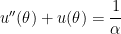
u''(\theta) + u(\theta) = \displaystyle \frac{1}{\alpha},

where u = 1/r and \alpha is a certain constant. We will also impose the initial condition that the planet is at perihelion (i.e., is closest to the sun), at a distance of P, when \theta = 0. This means that u obtains its maximum value of 1/P when \theta = 0. This leads to the two initial conditions

u(0) = \displaystyle \frac{1}{P} \qquad \hbox{and} \qquad u'(0) = 0;

the second equation arises since u has a local extremum at \theta = 0.

We now take the perspective of a student who is taking a first-semester course in differential equations. There are two standard techniques for solving a second-order non-homogeneous differential equations with constant coefficients. One of these is the method of variation of parameters. First, we solve the associated homogeneous differential equation

u''(\theta) + u(\theta) = 0.

The characteristic equation of this differential equation is r^2 + 1 = 0, which clearly has the two imaginary roots r = \pm i. Therefore, two linearly independent solutions of the associated homogeneous equation are u_1(\theta) = \cos \theta and u_2(\theta) = \sin \theta.

(As an aside, this is one answer to the common question, “What are complex numbers good for?” The answer is naturally above the heads of Algebra II students when they first encounter the mysterious number i, but complex numbers provide a way of solving the differential equations that model multiple problems in statics and dynamics.)


According to the method of variation of parameters, the general solution of the original nonhomogeneous differential equation

u''(\theta) + u(\theta) = g(\theta)

is

u(\theta) = f_1(\theta) u_1(\theta) + f_2(\theta) u_2(\theta),

where

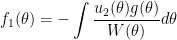
f_1(\theta) = -\displaystyle \int \frac{u_2(\theta) g(\theta)}{W(\theta)} d\theta ,

f_2(\theta) = \displaystyle \int \frac{u_1(\theta) g(\theta)}{W(\theta)} d\theta ,

and W(\theta) is the Wronskian of u_1(\theta) and u_2(\theta), defined by the determinant

W(\theta) = \displaystyle \begin{vmatrix} u_1(\theta) & u_2(\theta) \\ u_1'(\theta) & u_2'(\theta) \end{vmatrix}  = u_1(\theta) u_2'(\theta) - u_1'(\theta) u_2(\theta).

Well, that’s a mouthful.

Fortunately, for the example at hand, these computations are pretty easy. First, since u_1(\theta) = \cos \theta and u_2(\theta) = \sin \theta, we have

W(\theta) = (\cos \theta)(\cos \theta) - (\sin \theta)(-\sin \theta) = \cos^2 \theta + \sin^2 \theta = 1

from the usual Pythagorean trigonometric identity. Therefore, the denominators in the integrals for f_1(\theta) and f_2(\theta) essentially disappear.

Since g(\theta) = \displaystyle \frac{1}{\alpha}, the integrals for f_1(\theta) and f_2(\theta) are straightforward to compute:

f_1(\theta) = -\displaystyle \int u_2(\theta) \frac{1}{\alpha} d\theta = -\displaystyle \frac{1}{\alpha} \int \sin \theta \, d\theta = \displaystyle \frac{1}{\alpha}\cos \theta + a,

where we use +a for the constant of integration instead of the usual +C. Second,

f_2(\theta) = \displaystyle \int u_1(\theta)  \frac{1}{\alpha} d\theta = \displaystyle \frac{1}{\alpha} \int \cos \theta \, d\theta = \displaystyle \frac{1}{\alpha}\sin \theta + b,

using +b for the constant of integration. Therefore, by variation of parameters, the general solution of the nonhomogeneous differential equation is


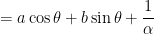
u(\theta) = f_1(\theta) u_1(\theta) + f_2(\theta) u_2(\theta)

= \left( \displaystyle \frac{1}{\alpha}\cos \theta + a \right) \cos \theta + \left( \displaystyle \frac{1}{\alpha}\sin\theta + b \right) \sin \theta

= a \cos \theta + b\sin \theta + \displaystyle \frac{\cos^2 \theta + \sin^2 \theta}{\alpha}

= a \cos \theta + b \sin \theta + \displaystyle \frac{1}{\alpha}.

Unsurprisingly, this matches the answer in the previous post that was found by the method of undetermined coefficients.

For the sake of completeness, I repeat the argument used in the previous two posts to determine a and b. This is require using the initial conditions u(0) = \displaystyle \frac{1}{P} and u'(0) = 0. From the first initial condition,

u(0) = a \cos 0 + b \sin 0 + \displaystyle \frac{1}{\alpha}

\displaystyle \frac{1}{P} = a + \frac{1}{\alpha}

\displaystyle \frac{1}{P} - \frac{1}{\alpha} = a

\displaystyle \frac{\alpha - P}{\alpha P} = a

From the second initial condition,

u'(\theta) = -a \sin \theta + b \cos \theta

u'(0) = -a \sin 0 + b \cos 0

0 = b.

From these two constants, we obtain

u(\theta) = \displaystyle \frac{\alpha - P}{\alpha P}  \cos \theta + 0 \sin \theta + \displaystyle \frac{1}{\alpha}

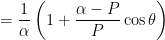
= \displaystyle \frac{1}{\alpha} \left(  1 + \frac{\alpha-P}{P} \cos \theta \right)

= \displaystyle \frac{1 + \epsilon \cos \theta}{\alpha},

where \epsilon = \displaystyle \frac{\alpha - P}{P}.

Finally, since r = 1/u, we see that the planet’s orbit satisfies
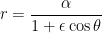
r = \displaystyle \frac{\alpha}{1 + \epsilon \cos \theta},

so that, as shown earlier in this series, the orbit is an ellipse with eccentricity \epsilon.

Confirming Einstein’s Theory of General Relativity With Calculus, Part 5c: Deriving Orbits under Newtonian Mechanics with the Method of Undetermined Coefficients

In this series, I’m discussing how ideas from calculus and precalculus (with a touch of differential equations) can predict the precession in Mercury’s orbit and thus confirm Einstein’s theory of general relativity. The origins of this series came from a class project that I assigned to my Differential Equations students maybe 20 years ago.

We previously showed that if the motion of a planet around the Sun is expressed in polar coordinates (r,theta), with the Sun at the origin, then under Newtonian mechanics (i.e., without general relativity) the motion of the planet follows the differential equation

u''(\theta) + u(\theta) = \displaystyle \frac{1}{\alpha},

where u = 1/r and \alpha is a certain constant. We will also impose the initial condition that the planet is at perihelion (i.e., is closest to the sun), at a distance of P, when \theta = 0. This means that u obtains its maximum value of 1/P when \theta = 0. This leads to the two initial conditions

u(0) = \displaystyle \frac{1}{P} \qquad \hbox{and} \qquad u'(0) = 0;

the second equation arises since u has a local extremum at \theta = 0.

We now take the perspective of a student who is taking a first-semester course in differential equations. There are two standard techniques for solving a second-order non-homogeneous differential equations with constant coefficients. One of these is the method of undetermined coefficients. First, we solve the associated homogeneous differential equation

u''(\theta) + u(\theta) = 0.

The characteristic equation of this differential equation is r^2 + 1 = 0, which clearly has the two imaginary roots r = \pm i. Therefore, the solution of the associated homogeneous equation is u_h(\theta) = a \cos \theta + b \sin \theta.

(As an aside, this is one answer to the common question, “What are complex numbers good for?” The answer is naturally above the heads of Algebra II students when they first encounter the mysterious number i, but complex numbers provide a way of solving the differential equations that model multiple problems in statics and dynamics.)

Next, we find a particular solution to the original differential equation. Since the right-hand side is a constant and r=0 is not a solution of the characteristic equation, this leads to trying something of the form U(\theta) = A as a solution, where A is a soon-to-be-determined constant. (Guessing this form of U(\theta) is a standard technique from differential equations; later in this series, I’ll give some justification for this guess.)

Clearly, U'(\theta) = 0 and U''(\theta) = 0. Substituting, we find

U''(\theta) + U(\theta) = \displaystyle \frac{1}{\alpha}

0 + A = \displaystyle \frac{1}{\alpha}

A = \displaystyle \frac{1}{\alpha}

Therefore, U(\theta) = \displaystyle \frac{1}{\alpha} is a particular solution of the nonhomogeneous differential equation.

Next, the general solution of the nonhomogeneous differential equation is found by adding the general solution to the associated homogeneous differential equation and the particular solution:

u(\theta) = u_h(\theta) + U(\theta) = a \cos \theta + b\sin \theta + \displaystyle \frac{1}{\alpha}.

Finally, to determine a and b, we use the initial conditions u(0) = \displaystyle \frac{1}{P} and u'(0) = 0. From the first initial condition,

u(0) = a \cos 0 + b \sin 0 + \displaystyle \frac{1}{\alpha}

\displaystyle \frac{1}{P} = a + \frac{1}{\alpha}

\displaystyle \frac{1}{P} - \frac{1}{\alpha} = a

\displaystyle \frac{\alpha - P}{\alpha P} = a

From the second initial condition,

u'(\theta) = -a \sin \theta + b \cos \theta

u'(0) = -a \sin 0 + b \cos 0

0 = b.

From these two constants, we obtain

u(\theta) = \displaystyle \frac{\alpha - P}{\alpha P}  \cos \theta + 0 \sin \theta + \displaystyle \frac{1}{\alpha}

= \displaystyle \frac{1}{\alpha} \left(  1 + \frac{\alpha-P}{P} \cos \theta \right)

= \displaystyle \frac{1 + \epsilon \cos \theta}{\alpha},

where \epsilon = \displaystyle \frac{\alpha - P}{P}.

Finally, since r = 1/u, we see that the planet’s orbit satisfies

r = \displaystyle \frac{\alpha}{1 + \epsilon \cos \theta},

so that, as shown earlier in this series, the orbit is an ellipse with eccentricity \epsilon.

The reader will notice that this solution is pretty much a carbon-copy of the previous post. The difference is that calculus students wouldn’t necessarily be able to independently generate the solutions of the associated homogeneous differential equation and a particular solution of the nonhomogeneous differential equation, and so the line of questioning is designed to steer students toward the answer.