In this series, I’m discussing how ideas from calculus and precalculus (with a touch of differential equations) can predict the precession in Mercury’s orbit and thus confirm Einstein’s theory of general relativity. The origins of this series came from a class project that I assigned to my Differential Equations students maybe 20 years ago.
We have shown that under general relativity, the motion of a planet around the Sun precesses by
,
where is the semi-major axis of the planet’s orbit, is the orbit’s eccentricity, is the gravitational constant of the universe, is the mass of the Sun, and is the speed of light.
Notice that for to be as observable as possible, we’d like to be as small as possible and to be as large as possible. By a fortunate coincidence, the orbit of Mercury — the closest planet to the sun — has the most elliptical orbit of the eight planets.
Here are the values of the constants for Mercury’s orbit in the SI system:
The last constant, , is the time for Mercury to complete one orbit. This isn’t in the SI system, but using Earth years as the unit of time will prove useful later in this calculation.
Using these numbers, and recalling that , we find that
.
Notice that all of the units cancel out perfectly; this bit of dimensional analysis is a useful check against careless mistakes.
Again, the units of are in radians per Mercury orbit, or radians per 0.2408 years. We now convert this to arc seconds per century:
.
This indeed matches the observed precession in Mercury’s orbit, thus confirming Einstein’s theory of relativity.
This same computation can be made for other planets. For Venus, we have the new values of , , and . Repeating this calculation, we predict the precession in Venus’s orbit to be 8.65” per century. Einstein made this prediction in 1915, when the telescopes of the time were not good enough to measure the precession in Venus’s orbit. This only happened in 1960, 45 years later and 5 years after Einstein died. Not surprisingly, the precession in Venus’s orbit also agrees with general relativity.
In this series, I’m discussing how ideas from calculus and precalculus (with a touch of differential equations) can predict the precession in Mercury’s orbit and thus confirm Einstein’s theory of general relativity. The origins of this series came from a class project that I assigned to my Differential Equations students maybe 20 years ago.
We have shown that the motion of a planet around the Sun, expressed in polar coordinates with the Sun at the origin, under general relativity is
,
where , , is the semi-major axis of the planet’s orbit, is the orbit’s eccentricity, , is the gravitational constant of the universe, is the mass of the planet, is the mass of the Sun, is the planet’s perihelion, is the constant angular momentum of the planet, and is the speed of light.
The above function is maximized (i.e., the distance from the Sun is minimized) when is as large as possible. This occurs when is a multiple of .
Said another way, the planet is at its closest point to the Sun when . One orbit later, the planet returns to its closest point to the Sun when
We now use the approximation
;
this can be demonstrated by linearization, Taylor series, or using the first two terms of the geometric series . With this approximation, the closest approach to the Sun in the next orbit occurs when
,
which is coterminal with the angle
.
Substituting and , we see that the amount of precession per orbit is
.
The units of are radians per orbit. In the next post, we will use Mercury’s data to find in seconds of arc per century.
A brief aside from the current series on general relativity — and the mysterious 43 seconds of arc per century in Mercury’s orbit — that turned into further discussion about angle measurement.
A few months ago, I received this clever postcard from someone visiting Spokane, Washington. The sender clearly knew the recipient (me) well: rather than sending me a postcard showing the jaw-dropping beauty of the Spokane area, I was impressed with the mathematical precision given for Spokane’s location.
I started wondering about exactly how precisely the postcard was measuring the location of Spokane — was it the location of City Hall or some other important landmark? — and I went to Google Maps to find out. (For what it’s worth, xkcd had a comic about this some time ago.)
And then it finally hit me, after far longer than it should have taken, that the postcard is utterly nonsensical.
We would never say that someone’s height is 4 feet, 20 inches. There are 12 inches in a foot, and so we would instead say that the height is 5 feet, 8 inches.
Likewise, when specifying an angle with minutes and seconds, there are (just like with ordinary time) 60 seconds in a minute and 60 minutes in a degree (so that there are 3600 seconds in a degree). Therefore, specifying an angle with 67′ or 66″, as in the postcard, makes absolutely no sense.
Furthermore, if converted into standard notation, we obtain a location of north, west, which is about 40 miles NNW of Spokane. (Images made by https://www.gps-coordinates.net/). Note on the conversion into decimal:
and
It’s a shame that the designer of the postcard made this error, as I genuinely thought this was a clever and aesthetically pleasing design idea for a postcard.
While I’m not sure how this mistake happened, my best guess is that the designer used the location of north, west — which is indeed in Spokane — and then misconverted from decimal notation to minutes and seconds.
In my capstone class for future secondary math teachers, I ask my students to come up with ideas for engaging their students with different topics in the secondary mathematics curriculum. In other words, the point of the assignment was not to devise a full-blown lesson plan on this topic. Instead, I asked my students to think about three different ways of getting their students interested in the topic in the first place.
I plan to share some of the best of these ideas on this blog (after asking my students’ permission, of course).
This student submission comes from my former student Morgan Mayfield. His topic, from Geometry: deriving the proportions of a 45-45-90 right triangle.
How could you as a teacher create an activity or project that involves your topic?
I included a lesson plan from Virgina Lynch of Oklahoma Panhandle State University. In her lesson plan, she includes a section where students draw a 45-45-90 triangle, or right-isosceles triangles, and then uses the variable x for the leg lengths to prove the proportion for students. Then, she uses a section where she has students cut out actual 45-45-90 triangles with 4-in leg lengths. Each student measures their hypotenuse to some degree of accuracy and reports their length. Lastly, Ms.Lynch averages the lengths and has students divide the average by root 2 on a calculator to show that the answer is incredibly close to 4.
My likes: These are two different styles of proving the 1:1:root 2 proportions of a triangle for students: one mathematical and the other more deductive after knowing the mathematical proof. This provides students with an auditory, tactile, and visual way to understand the proportion of the side lengths. I think that the tactile part can be the biggest thing for students. Rarely do we end up building a triangle and measuring its sides to show that this relationship makes rough sense in the real world.
My adaptation: In a geometry class, I would find the mathematical proof to be a fun exercise for students to flex their understanding of algebra, geometry, and the Pythagorean theorem. I would group students up and probably help them start connecting the algebra portion by giving them the leg length “x” and saying I want to know the length of the hypotenuse in exact terms. Group members can collaborate and use their collective knowledge to apply the understanding that a 45-45-90 triangle is isosceles and right, then use the Pythagorean theorem to find the length of the hypotenuse in terms of x.
Then, I would have some groups cut out 45-45-90 triangles of some leg length and other groups cut out 45-45-90 triangles of some other leg length to have more variety, but still show the root 2 proportion in our physical environment.
How can this topic be used in your students’ future courses in mathematics or science?
45-45-90 triangles are very helpful in understanding the unit circle. This may be taught at the geometry level or in precalculus. In a unit circle, our radius is 1, so when we want to know the sine or cosine of 45 degrees or , then we can apply the relationship that we already know about 45-45-90 triangles. So, on the unit circle, build a right triangle where the hypotenuse connects the center to the circumference of the circle at a 45-degree angle from the x-axis. Since the triangle is both right and has one 45-degree angle, we know the other angle is 45 degrees as well. This should immediately invoke the sacred root 2 ratio, but this time we only know the length of the hypotenuse, which is 1, which is the radius. Thus, we divide the radius, 1, by root 2, and then get rid of the root 2 from the denominator to get for both legs. Lastly, we apply our knowledge of sine and cosine to understand that sine of an angle in a right triangle, that is not the right angle, is the “length of the opposite side over the hypotenuse”, which is just because we have the convenience of being in a unit circle.
How does this topic extend what your students should have learned in previous courses?
The basis for understanding a 45-45-90 triangle takes its understanding from 8th grade math when students are introduced to the Pythagorean theorem and the beginning of the geometry course when students cover identities of isosceles triangles, mostly from a Euclid perspective. Even before that, students learn other basic things about triangles such as the interior angles add up to 180 degrees and that a right triangle has a 90-degree angle.
This is how students connect the three Euclid book I propositions: 5, 6, and 47. Students learn that from propositions 5 and 6 in a geometry class, isosceles triangles have two sides of equal length which imply the angles between those equal sides and the third sides are equal and vice-versa. So, a 45-45-90 triangle implies that it has two equal sides, which are the legs of the right triangle. Now, we apply proposition 47, the Pythagorean theorem because this is a right triangle, to then show algebraically the hypotenuse is where is the length of one of the legs.
How has this topic appeared in pop culture (movies, TV, current music, video games, etc.)?
I find the topic of “Dynamic Rectangles” and “Dynamic Symmetry” very fascinating. This is frequently used in art, usually in drawing, painting, and photography. Jay Hambridge formalized the idea that classical art used Dynamic Symmetry which includes the ratio of 1:. This ratio is usually built inside of a rectangle or square to give very interesting, symmetrical focal points within a piece that could not be achieved within just any regular rectangle. The photothunk blog below details how the diagonals of the dynamic rectangles and the perpendiculars to the diagonals form a special symmetry that is lost when used in a rectangle that doesn’t have the 1: ratio. For example, I’ve included a piece of art by Thomas Kegler and a Youtube analysis of the piece of art that uses Root 2 Dynamic Symmetry.
What does this mean for the 45-45-90 triangles? Well, to build these dynamic rectangles, we must start off with a square. Think about the diagonal of a square. When we form this diagonal, we form a right triangle with two 45-degree angles. All squares are two 45-45-90 triangles. Now, using the length of the diagonal, which we know mathematically to be where is the length of one of the legs, we can build our dynamic rectangle and then build other dynamic rectangles because . I’ve included a diagram I made in Geogebra to show off a way to build the root 2 dynamic rectangle using just circles and lines.
Starting with a square ABCD, we can place two circles with centers C and D and radii AC. Why AC? This is because AC is the diagonal of the square, which we know to be where is the length of one of the sides of the square. Now, we know our radii is equal to . We can extend the sides of our square CB and DA to find the intersection points of the circles and the extended lines E and F. Now, all we must do is connect E to F and voila, we have a root 2 dynamic rectangle FECD.
How have different cultures throughout time used this topic in their society?
This answer will be my most speculative answer using concepts of the 45-45-90 triangles. First, I must ask the reader to suspend the round world belief and act that we live on a relatively flat plane of existence. Our societies have been build around organizing land into rectangular and square shaped pieces of land. I will talk about the “Are” system which has shaped a lot of Western Europe and the Americas due to colonization by the European powers. You may have heard the term “hectare”, which is still popular in the United States. It is literally a mash up of the words “hecto-”, coming from Greek and meaning one-hundred and “are”, coming from Latin and meaning area. So, this is 100 ares, which is a measure of land that is 10 meters x 10 meters. That means a hectare is 100 meters x 100 meters.
Well, one would imagine that with Greek, Latin, and Western European obsession with symmetry, we would want to split these square pieces of land in half with many different diagonals, so it must have been useful to understand the proportions of the 45-45-90 triangle to makes paths and roads that travel from one end of the hectare to the other end efficiently while also utilizing the space and human travel within the hectare efficiently. Again, this is my speculation, but knowing that two 45-45-90 triangles form a square means that all squares and symmetry involve using this 1: ratio; they are inseparable.
A quick programming note: I am transitioning to another administrative role at my university, and I expect that I’ll have much less time to post original content to this blog in the future. For this reason, I’ll only be posting on Fridays for the foreseeable future.
In my capstone class for future secondary math teachers, I ask my students to come up with ideas for engaging their students with different topics in the secondary mathematics curriculum. In other words, the point of the assignment was not to devise a full-blown lesson plan on this topic. Instead, I asked my students to think about three different ways of getting their students interested in the topic in the first place.
I plan to share some of the best of these ideas on this blog (after asking my students’ permission, of course).
This student submission again comes from my former student Sydney Araujo. Her topic, from Geometry: defining the terms corresponding angles, alternate interior angles, and alternate exterior angles
.
How can technology (YouTube, Khan Academy [khanacademy.org], Vi Hart, Geometers Sketchpad, graphing calculators, etc.) be used to effectively engage students with this topic?
Geogebra is a great source for this topic. It’s an interactive program where students can make their own geometric shapes. Geogebra even has ready-made animations and programs that correspond with different geometry concepts. I found several ready-made explorations and animations that explain and visually show corresponding, alternate interior, and alternate exterior angles. Some of them come with questions for students to answer which would be a great activity for students to do. They have the ability with the program to adjust angles, shapes, and see how much of a difference a small change makes. It’s great for students for them to make their own discoveries and they have the ability to with this program and the different activities available. Instead of students simply being told about these angles and doing a simple worksheet, they can explore on their own which is more organic and engaging for them.
How could you as a teacher create an activity or project that involves your topic?
Using the program Geogebra that I describe, there’s several different activities already prepared on the website that can used to define corresponding, alternate interior, and alternate exterior angles. Because of the technology resources available, I could either do a jigsaw activity or a stations activity. Using a jigsaw activity I could have students form groups of 3 and each student would be in charge of learning one of the three angles. They would each complete a Geogebra activity that corresponds to their topic they are responsible for. Then after they have mastered their topic they will come back to their original groups and teach the other group members what they have learned. They could also do a stations activity where they rotate around during the class time doing a Geogebra activity for corresponding, alternate interior, and alternate exterior angles.
What interesting things can you say about the people who contributed to the discovery and/or the development of this topic?
Euclid is known as the father of geometry and wrote The Elements. He was a Greek mathematician who lived from 325 BC to 265 BC. The Elements is divided into 13 books is widely famous and used among mathematicians, even in current times. It is quite amazing the discoveries Euclid made and proved during that time. In total, The Elements contains 465 theorems and proofs in which Euclid only used a compass and a straight edge. He reworked the math concepts of his predecessors, like Plato and Hippocrates, into a whole which would later become known as Euclidean geometry. Which still holds today, 2,300 years later. We actually see his proof of alternate angles in Book 1 of The Elements, it is proposition 29. It is actually the first proposition in The Elements that depends on the parallel postulate.
In my capstone class for future secondary math teachers, I ask my students to come up with ideas for engaging their students with different topics in the secondary mathematics curriculum. In other words, the point of the assignment was not to devise a full-blown lesson plan on this topic. Instead, I asked my students to think about three different ways of getting their students interested in the topic in the first place.
I plan to share some of the best of these ideas on this blog (after asking my students’ permission, of course).
This student submission comes from my former student Mason Maynard. His topic, from Geometry: defining the terms complementary angles, supplementary angles, and vertical angles.
How can technology (YouTube, Khan Academy [khanacademy.org], Vi Hart, Geometers Sketchpad, graphing calculators, etc.) be used to effectively engage students with this topic?
I found this website that is an interactive game that students can play when learning about this topic. With this type of topic, the main thing that you want your students to remember is vocabulary. The website that I found uses a game to get kids identify the missing angle in degrees and each angle is either complementary, supplementary or vertical. I really like this game because our students need to develop that muscle memory of seeing an angle and knowing whether it is a complementary, supplementary or vertical set. Once you can get the students to see it and immediately identify it, they can then transition into finding the specific degrees. I also think that anytime you can put something into a game format, students will try harder. Everyone is competitive so why not channel that into learning. The game on the website is very straight forward with the students so you can count on it not causing any misconceptions.
The article that I found touches on angles but I feel like you could use in throughout the entire unit and just touch on in during every topic you cover. Overall, the article refers to the history of the Geometric Abstract Art Movement. It mainly focuses on the use of lines and shapes and angles but I really feel like you could connect this to the students in your classroom. Within a lot of these paintings or sculptures during this period, you will find all three angle types. These artists needed these angles to make the piece balanced and have harmony. Other needs to use a specific angle to demonstrate contrast. That is really the most beautiful thing about mixing art with math. The artist has the power to use it in a way that conveys their feelings and allows for expression. This is really a way to go beyond the scope of math and show students that we are learning real life and important topics.
How could you as a teacher create an activity or project that involves your topic?
An activity that I found online was that you just give students papers and have them fold them in specific patterns and then they use the protractor to measure out the degree of angles. I really like this because it is simple but yet you can branch out with it in many ways. With students folding papers, you will get many different folds from the students and this allows them to do some investigation on their own and then afterward, you can allow them to share their findings with their classmates. This cooperative learning allows for all of them to pounce ideas of one another and for the teacher, it can show you who is struggling with anything specific. The really cool thing about it is that if you fold the paper twice then you can setup the scenario of them finding adjacent angles. Then this could potentially lead them to discovering opposite angles on their own for future lessons.
In my capstone class for future secondary math teachers, I ask my students to come up with ideas for engaging their students with different topics in the secondary mathematics curriculum. In other words, the point of the assignment was not to devise a full-blown lesson plan on this topic. Instead, I asked my students to think about three different ways of getting their students interested in the topic in the first place.
I plan to share some of the best of these ideas on this blog (after asking my students’ permission, of course).
This student submission again comes from my former student Jesus Alanis. His topic: how to engage geometry students when defining the words acute, right, and obtuse.
How could you as a teacher create an activity or project that involves your topic?
The way you as a teacher can create an activity for defining angles is with Snowing Angles. The way you could start this lesson is by explaining that right angles are 90 degrees, acute angles are less than 90 degrees, and obtuse angles are greater than 90 degrees. Then make students get 3 different color markers to label the different types of angles. On this website, there is a worksheet that has different snowflakes. On the worksheet, you would get students to use a protractor(you are going to have to teach students how to use a protractor) to measure the angles so that students get to determine what kind of angle it is and use the marker to mark the type of angle it is.
Once students are done with the worksheet and understand the types of angles, they can start building their own snowflake. While the students get to building their snowflakes, you could ask students questions to get them thinking. Example: Is this a right angle or an acute angle? Something I would add to this project or activity would be to make sure that the students have at least one of each of the angles that were taught.
Also, this is a great project for the holidays and students get to take it home becoming a memory of what was taught in class.
How can this topic be used in your students’ future courses in mathematics or science?
The use of angles in this lesson is for students to know about the name of angles which are acute, right, and obtuse. The importance that students need to take away is that students need to know what the degrees of the angles are. When they continue talking about angles students will realize that a straight line is 180 degrees. When given a missing angle either an acute angle or an obtuse angle you could realize that an acute angle plus an obtuse angle equals 180 degrees. Also, with 180 degrees, you could find an angle that is missing with enough information. Later with this fact, students will learn about the interior, exterior, supplementary, and commentary angles. Students will also use the knowledge of angles towards triangles and specifically right angles with using the Pythagorean Theorem. Later, trigonometry will be added to this idea. Angles would then be used for the Unit Circle.
How has this topic appeared in high culture?
The way that angles are used in high culture is photography. Photography has become an appreciated form of art. Angles are literally everywhere. For example, if you look at the cables on bridges or the beams that hold building form angles. Also by using your camera you could use angles to take pictures a certain way whether if you want to take a straight picture of your city or it could be at an angle to make the building looks a certain way.
Also, angles are used in cinematography. The way the camera is angled plays a major role in the film process. Cameras are angled to help the viewers feel a part of the journey that the character is experiencing. The angle helps provide the film with what the setting is like or how characters are moving in the film. The angles are there to make the experience more realistic. The angles are important because they provide the setting, the character’s storyline, or give a view of where the different character may be in the same scene. (https://wolfcrow.com/15-essential-camera-shots-angles-and-movements/)
In my capstone class for future secondary math teachers, I ask my students to come up with ideas for engaging their students with different topics in the secondary mathematics curriculum. In other words, the point of the assignment was not to devise a full-blown lesson plan on this topic. Instead, I asked my students to think about three different ways of getting their students interested in the topic in the first place.
I plan to share some of the best of these ideas on this blog (after asking my students’ permission, of course).
This student submission again comes from my former student Johnny Aviles. His topic: how to engage geometry students when defining the words acute, right, and obtuse.
A1.) How could you as a teacher create an activity or project that involves your topic?
To have the students get engaged with the topic of Defining the terms acute, right, and obtuse, I will begin with having the classroom set up into groups of 4-5. Within their group they will create 10 examples of where each acute, right, and obtuse angles or triangles can be found in the classroom or in the real world in general. For example, the letter Y, end of a sharpened pencil, and the angle under a ladder can be used. They will be given about 10-15 minutes depending on how fast they can all finish. This is a great activity as the students can work together to try to come up with these examples and can familiarize themselves with amount of ways these terms are used in life. I will tell them before I begin the activity that the group that comes up with the most examples will be given extra credit in the next exam or quiz. This will give them extra incentive to stay on task as I am well aware that some groups may finish earlier than the rest and may take that extra time to cause disruptions.
B1.) How can this topic be used in your students’ future courses in mathematics or science?
In previous courses, students have learned had some exposure to these types of angles. Most students have been familiar with the use of right triangles and have learned methods like the Pythagorean theorem. When we extend the terms acute, right, and obtuse in geometry, it begins to be more intensified. These angles then extend in terms of triangle that will then have many uses. Students will then be expected to not only find missing side lengths but also angles. Students will then be exposed to methods later like, law of sines and cosines, special right triangles, triangle inequality theorem and triangle congruency in. This topic essentially is the stepping stone for a large part of what is soon to be learned. Other courses will use a variety of other was to incorporate the terms acute, right, and obtuse. Geometry, precalculus and trigonometry will essentially have a great deal of uses for these terms for starters and can then also be extended in many higher-level math courses in universities.
E1.) How can technology be used to effectively engage students with this topic?
An effective way to teach this topic using technology and the terms acute, right, and obtuse would be games. There is a magnitude of game that involve angles and be beneficial in the understanding of these angles. I have found this one game called Alien Angles. In this game, you are given the angle of where the friendly alien at and you have to launch your rocket to rescue them. the purpose of the game is for students to be familiar with angles and how to find them. after you launch the rocket, you are given a protractor that shows the angles and I believe this is beneficial for students as they can also be more familiar with the application of protractors. I can post this on the promethean board and have students identify what the angle I need to rescue the aliens. I can then call for volunteers to go on the board and try to find the correct angle to launch the rocket.
In my capstone class for future secondary math teachers, I ask my students to come up with ideas for engaging their students with different topics in the secondary mathematics curriculum. In other words, the point of the assignment was not to devise a full-blown lesson plan on this topic. Instead, I asked my students to think about three different ways of getting their students interested in the topic in the first place.
I plan to share some of the best of these ideas on this blog (after asking my students’ permission, of course).
This student submission comes from my former student Michael Garcia. His topic, from Geometry: defining the terms complementary angles, supplementary angles, and vertical angles.
What interesting (i.e., uncontrived) word problems using this topic can your students do now?
Using complementary, supplementary, and vertical angles, students can do simple angle problems. For example, give them a picture of a slice of pizza (or actual pizza if you’re truly nice). You can then make up questions regarding the pizza. For example, “Sally and John are going to split half a pizza. After they cut the pizza in two, John goes to wash his hands. Meanwhile, Sally slices herself a pretty generous slice. In fact, her pizza was cut at an angle of 130˚. After John realized he was bamboozled, he sadly settled for his piece. What was the angle of John’s one pizza slice?”
When you are working with a pizza, you can modify the scenario/question to fit complementary and vertical angles as well. For this question, the students could draw on a separate pizza pie the 130˚ by using a protractor. They will hopefully see that these are supplementary angles and subtract 130˚ from 180˚.
What interesting things can you say about the people who contributed to the discovery and/or the development of this topic?
If your name is in the title of a subject, activity, or anything else, you more than likely had a tremendous impact on that thing. Euclid of Alexandria was a mathematician who is sometimes known as the “father of Geometry.” Not much information is known about Euclid, but his book Elements stands as the foundation of Euclidean Geometry. It is comprised of 13 books based off the work of his predecessors, but that is not to diminish Euclid’s work. He redefined geometry, introduced new concepts such as the Fundamental Theorem of Arithmetic, the intersection of planes and lines in three-dimensional figure, and more. In Book 1 Proposition 13, we see the concept of supplementary and complementary angles. In Book 1 Proposition 15, vertical angles are introduced in this section. Euclid was definitely one of the shoulders of giants upon who Newton, Kepler, and Descartes stood on.
How has this topic appeared in pop culture (movies, TV, current music, video games, etc.)?
When I took Geometry in high school, I was a huge WWE fan. I thought Shawn Michaels “The Heartbreak Kid” was the best wrestler on the planet. For his finisher move, he would kick his opponent in the chin (it was very effective), and it was appropriately named “Sweet Chin Music.” As I grew older, I began to see how Geometry can fit into wrestling.
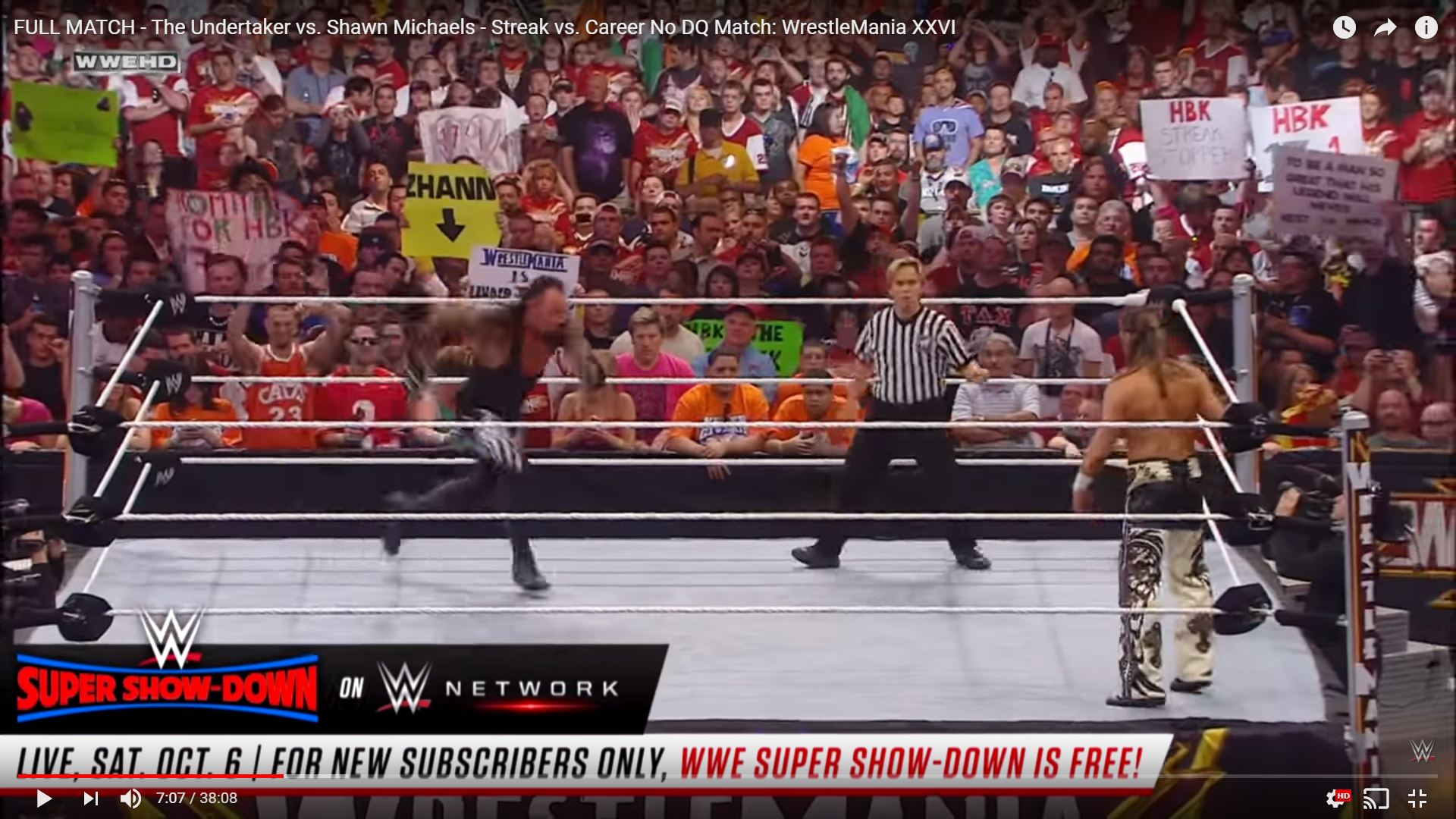
Below is an image of The Undertaker vs. Shawn Michaels at WrestleMania XXVI. As you look at the dimensions of the ring, notice that there are 4 right angles. If you were to take the consecutive angles of this ring, you would have a pair of angles that are supplementary.
We also have complementary angles. At the beginning of the match, each actor (I mean wrestler) goes to their corner. When the bell rings, they obviously start wrestling. In this match, The Undertaker sprints out of his corner towards Shawn Michaels (see image below). If we were to take his direction and put a ray on top of it, we know have complementary angles. Thanks to the dimension of the ring, we can model supplementary and complementary angles.
In my capstone class for future secondary math teachers, I ask my students to come up with ideas for engaging their students with different topics in the secondary mathematics curriculum. In other words, the point of the assignment was not to devise a full-blown lesson plan on this topic. Instead, I asked my students to think about three different ways of getting their students interested in the topic in the first place.
I plan to share some of the best of these ideas on this blog (after asking my students’ permission, of course).
This student submission again comes from my former student Katelyn Kutch. Her topic: how to engage geometry students when defining the words acute, right, and obtuse.
How could you as a teacher create an activity or project that involves your topic?
As a teacher I think that a fun activity that is not too difficult but will need the students to be up and around the room is kind of like a mix and match game. I will give a bunch a students, a multiple of three, different angles. And then I will give the rest of the students cards with acute, obtuse, and right triangle listed on them. The students with the angles will then have to get in groups of three to form one of the three triangles. Once the students are in groups of three, they will then find another student with the type of triangle and pair with them. They will then present and explain to rest of the class why they paired up the way that they did. I think that it would be a good way for the students to be up and around and decide for themselves what angles for what triangles and then to show their knowledge by explaining it to the class.
How does this topic extend what your students should have learned in previous courses?
The topic of defining acute, right, and obtuse triangles extend what my students should already know about the different types, acute, right, and obtuse, angles. The students should already know the different types of angles and their properties. We can use their previous knowledge to build towards defining the different types of triangles. I will explain to the students that defining the triangles is like defining the angles. If they can tell me what angles are in the triangle and then tell me the properties of the triangles then they can reason with it and discover which triangle it is by looking at the angles.
How has this topic appeared in pop culture (movies, TV, current music, theatre, etc.)?
I found an article that I like that was written about a soccer club, FC Harlem. FC Harlem was getting a new soccer field as part of an initiative known as Operation Community Cup, which revitalizes soccer fields in Columbus and Los Angeles. This particular field, when it was opened, had different triangles and angles spray painted on the field in order to show the kids how soccer players use them in games. Time Warner Cable was the big corporation in on this project.


 with the Sun at the origin, under general relativity is
 ![u(\theta) \approx \displaystyle \frac{1}{\alpha} \left[ 1 + \epsilon \cos \left( \theta - \frac{\delta \theta}{\alpha} \right) \right]](https://s0.wp.com/latex.php?latex=u%28%5Ctheta%29+%5Capprox++%5Cdisplaystyle+%5Cfrac%7B1%7D%7B%5Calpha%7D+%5Cleft%5B+1+%2B+%5Cepsilon+%5Ccos+%5Cleft%28+%5Ctheta+-+%5Cfrac%7B%5Cdelta+%5Ctheta%7D%7B%5Calpha%7D+%5Cright%29+%5Cright%5D&bg=ffffff&fg=000000&s=0&c=20201002) ,
, ,
,  ,
,  ,
,  is the mass of the planet,
  is the planet’s perihelion,
  is the constant angular momentum of the planet, and
  is maximized (i.e., the distance from the Sun
  is minimized) when
  is as large as possible. This occurs when
  is a multiple of
  .
. . One orbit later, the planet returns to its closest point to the Sun when


 ;
; . With this approximation, the closest approach to the Sun in the next orbit occurs when
 ,
, .
. .
.
 north,
  west, which is about 40 miles NNW of Spokane. (Images made by

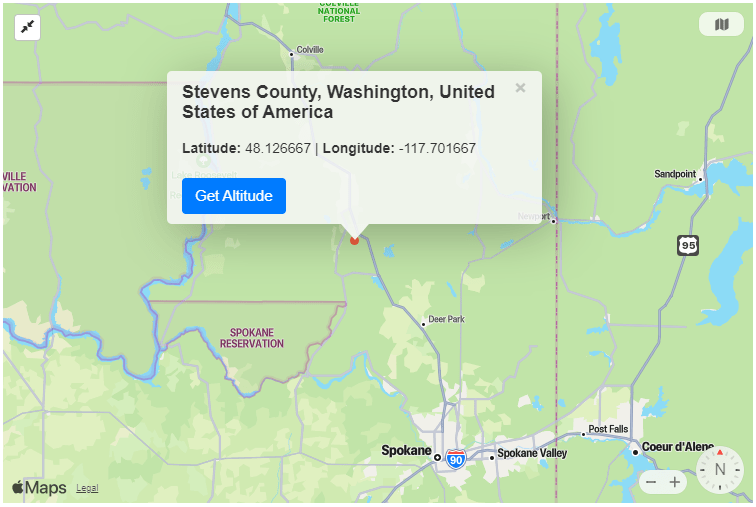
 north,
  west — which is indeed in Spokane — and then misconverted from decimal notation to minutes and seconds.
 , then we can apply the relationship that we already know about 45-45-90 triangles. So, on the unit circle, build a right triangle where the hypotenuse connects the center to the circumference of the circle at a 45-degree angle from the x-axis. Since the triangle is both right and has one 45-degree angle, we know the other angle is 45 degrees as well. This should immediately invoke the sacred root 2 ratio, but this time we only know the length of the hypotenuse, which is 1, which is the radius. Thus, we divide the radius, 1, by root 2, and then get rid of the root 2 from the denominator to get
  for both legs. Lastly, we apply our knowledge of sine and cosine to understand that sine of an angle in a right triangle, that is not the right angle, is the “length of the opposite side over the hypotenuse”, which is just
  where
where  is the length of one of the legs.
 ratio. For example, I’ve included a piece of art by Thomas Kegler and a Youtube analysis of the piece of art that uses Root 2 Dynamic Symmetry.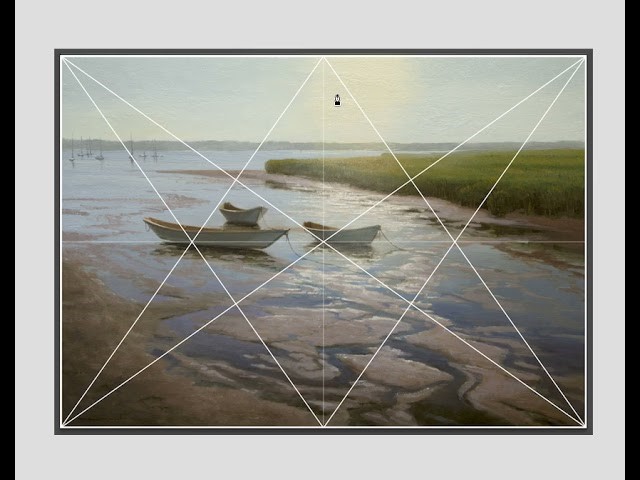
 . I’ve included a diagram I made in Geogebra to show off a way to build the root 2 dynamic rectangle using just circles and lines.
 ratio; they are inseparable.
 Mean Green Math