Confirming Einstein’s Theory of General Relativity With Calculus, Part 4b: Acceleration in Polar Coordinates

In this series, I’m discussing how ideas from calculus and precalculus (with a touch of differential equations) can predict the precession in Mercury’s orbit and thus confirm Einstein’s theory of general relativity. The origins of this series came from a class project that I assigned to my Differential Equations students maybe 20 years ago.

In this part of the series, we will show that if the motion of a planet around the Sun is expressed in polar coordinates (r,\theta), with the Sun at the origin, then under Newtonian mechanics (i.e., without general relativity) the motion of the planet follows the differential equation

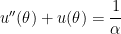
u''(\theta) + u(\theta) = \displaystyle \frac{1}{\alpha},

where u = 1/r and \alpha is a certain constant. Deriving this governing differential equation will require some principles from physics. If you’d rather skip the physics and get to the mathematics, we’ll get to solving this differential equations in the next post.

Part of the derivation of this governing differential equation will involve Newton’s Second Law

{\bf F} = m {\bf a},

where m is the mass of the planet and the force {\bf F} and the acceleration a are vectors. In usual rectangular coordinates, the acceleration vector would be expressed as

{\bf a} = x''(t) {\bf i} + y''(t) {\bf j},

where the components of the acceleration in the x- and y-directors are x''(t) and y''(t), and the unit vectors {\bf i} and {\bf j} are perpendicular, pointing in the positive x and positive y directions.

Unfortunately, our problem involves polar coordinates, and rewriting the acceleration vector in polar coordinates, instead of rectangular coordinates, is going to take some work.

Suppose that the position of the planet is (r,\theta) in polar coordinates, so that the position in rectangular coordinates is {\bf r} = (r\cos \theta, r \sin \theta). This may be rewritten as

{\bf r} = r \cos \theta {\bf i} + r \sin \theta {\bf j} = r ( \cos \theta {\bf i} + \sin \theta {\bf j}) = r {\bf u}_r,

where

{\bf u}_r = \cos \theta {\bf i} + \sin \theta {\bf j}

is a unit vector that points away from the origin. We see that this is a unit vector since

\parallel {\bf u}_r \parallel = {\bf u}_r \cdot {\bf u}_r = \cos^2 \theta + \sin^2 \theta =1.

We also define

{\bf u}_\theta = -\sin \theta {\bf i} + \cos \theta {\bf j}

to be a unit vector that is perpendicular to {\bf u}_r; it turns out that {\bf u}_\theta points in the direction of increasing \theta. To see that {\bf u}_r and {\bf u}_\theta are perpendicular, we observe

{\bf u}_r \cdot {\bf u}_\theta = -\sin \theta \cos \theta + \sin \theta \cos \theta = 0.

Computing the velocity and acceleration vectors in polar coordinates will have a twist that’s not experienced with rectangular coordinates since both {\bf u}_r and {\bf u}_\theta are functions of \theta. Indeed, we have

\displaystyle \frac{d{\bf u}_r}{d\theta} =  \frac{d \cos \theta}{d\theta} {\bf i} + \frac{d\sin \theta}{d\theta} {\bf j} = -\sin \theta {\bf i} + \cos \theta {\bf j} = {\bf u}_\theta.

Furthermore,

\displaystyle \frac{d{\bf u}_\theta}{d\theta} =  -\frac{d \sin \theta}{d\theta} {\bf i} + \frac{d\cos \theta}{d\theta} {\bf j} = -\cos \theta {\bf i} - \sin \theta {\bf j} = -{\bf u}_r.

These two equations will be needed in the derivation below.

We are now in position to express the velocity and acceleration of the orbiting planet in polar coordinates. Clearly, the position of the planet is r {\bf u}_r, or a distance r from the origin in the direction of {\bf u}_r. Therefore, by the Product Rule, the velocity of the planet is

{\bf v} = \displaystyle \frac{d}{dt} (r {\bf u}_r) = \displaystyle \frac{dr}{dt} {\bf u}_r + r \frac{d {\bf u}_r}{dt}

We now apply the Chain Rule to the second term:
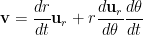
{\bf v} = \displaystyle \frac{dr}{dt} {\bf u}_r + r \frac{d {\bf u}_r}{d\theta} \frac{d\theta}{dt}

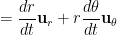
= \displaystyle \frac{dr}{dt} {\bf u}_r + r \frac{d\theta}{dt} {\bf u}_\theta.

Differentiating a second time with respect to time, and again using the Chain Rule, we find

{\bf a} = \displaystyle \frac{d {\bf v}}{dt} = \displaystyle \frac{d^2r}{dt^2} {\bf u}_r + \frac{dr}{dt} \frac{d{\bf u}_r}{dt} + \frac{dr}{dt} \frac{d\theta}{dt} {\bf u}_\theta + r \frac{d^2\theta}{dt^2} {\bf u}_\theta + r \frac{d\theta}{dt} \frac{d{\bf u}_\theta}{dt}

= \displaystyle \frac{d^2r}{dt^2} {\bf u}_r + \frac{dr}{dt} \frac{d{\bf u}_r}{d\theta} \frac{d\theta}{dt} + \frac{dr}{dt} \frac{d\theta}{dt} {\bf u}_\theta + r \frac{d^2\theta}{dt^2} {\bf u}_\theta +  r \frac{d\theta}{dt} \frac{d{\bf u}_\theta}{d\theta} \frac{d\theta}{dt}

= \displaystyle \frac{d^2r}{dt^2} {\bf u}_r + \frac{dr}{dt} \frac{d\theta}{dt} {\bf u}_\theta  + \frac{dr}{dt} \frac{d\theta}{dt} {\bf u}_\theta + r \frac{d^2\theta}{dt^2} {\bf u}_\theta -  r \left(\frac{d\theta}{dt} \right)^2 {\bf u}_r

= \displaystyle \left[ \frac{d^2r}{dt^2} -  r \left(\frac{d\theta}{dt} \right)^2 \right] {\bf u}_r + \left[ 2\frac{dr}{dt} \frac{d\theta}{dt} + r \frac{d^2\theta}{dt^2} \right] {\bf u}_\theta.

This will be needed in the next post, when we use both Newton’s Second Law and Newton’s Law of Gravitation, expressed in polar coordinates.