 0
Most apps and computer games that claim to assist with the development of mathematical knowledge only focus on rote memorization. There’s certainly a place for rote memorization, but I’ve been very disappointed with the paucity of games that encourage mathematical creativity beyond, say, immediate recall of the times tables.
Enter WuzzitTrouble, a new app that was developed by Keith Devlin, a professor of mathematics at Stanford and one of the great popularizers of mathematics today. An introduction to WuzzitTrouble can be seen in this promotional video:
One minor complaint about WuzzitTrouble is that the first few levels are so easy that it’s easy for children to low-ball the game… in much the same way that the first few levels of Angry Birds are utterly easy. (My other complaints is that the game only assume one user, so that a parent can’t play the game without affecting a child’s settings.) However, the level of difficulty does eventually increase. Here’s another promotional video showing how to solve Level 1-25:
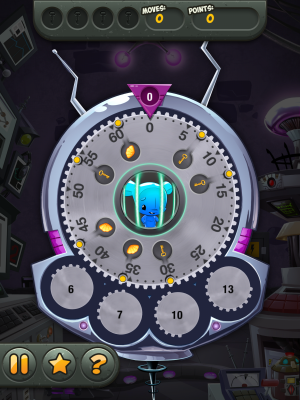
Here’s a sampling of some of the higher levels. Remember that the wheel has 65 steps along the circumference, as shown in the above picture and videos.
- Level 2-5: Using cog wheels of size 5 and 9, pick up keys at 23 and 36 and prizes at 27, 45, and 55.
- Level 2-15: Using cog wheels of size 5, 7, and 9, pick up keys at 11, 16, and 21 and prizes at 32 and 42.
- Level 2-25: Using cog wheels of size 5, 9, and 16, pick up keys at 24, 48, and 59; prizes at 11 and 37; and avoid a penalty at 64.
- Level 3-3: Using cog wheels of size 3, 4, and 5, pick up keys at 7, 17, and 27 and prizes at 12 and 22.
In the words of their promotional materials:
At InnerTube Games, we set out to design and build mobile casual video games and puzzles that can attract and engage a large number of players, yet are built on fundamental mathematical concepts and embed sound mathematics learning principles.
We start with one simple, yet powerful observation. A musical instrument won’t teach you about music. But when you pick up an instrument and start playing – badly at first – you cannot fail to learn about music. And the more you play, the more you learn. In fact, using that one instrument, you can go all the way from stumbling beginner to virtuoso concert performances. It’s the music that changes, not the instrument. In modern parlance, the instrument is a platform. And (well designed) platforms are good for learning because they make the learning meaningful and put the learner in charge.
InnerTube Games does not build video games to “teach mathematics.” Rather, we build instruments which you can play, and we design them so that when you play them, you cannot fail to learn about mathematics. Moreover, each single game can be used to deliver mathematical challenges of increasing sophistication.
Our vision for learning design is to build the game around core mathematical concepts and practice so it looks and plays like the familiar casual games on the market. As a result, you won’t be able to see the difference by playing the first few levels, or by watching someone else play. It’s the educational power under the hood that makes our games different.
We’re not making a secret of the fact that our games are math-based. It’s not “stealth learning;” it’s a form of learning through action that the brain finds natural, having much in common with what educational researchers call embodied learning.
Wuzzit Trouble is our first puzzle to reach the market. It is built around the important mathematical concepts of integer partitions–the expression of a whole number as a sum of other whole numbers–and Diophantine equations. At the easiest levels of the puzzle, these provide engaging practice in basic arithmetic, leading to arithmetical fluency.
But that’s just the start. Integer partitions and Diophantine equations are major areas of mathematics, still being worked on today by leading mathematicians.
Freeing the Wuzzits won’t take you into those dizzy realms—at least in the initial release, which comes loaded with puzzles aimed at the Elementary and Middle School levels. But as you progress, you will face challenges that increasingly require higher-order arithmetical thinking, algebraic thinking, strategy design and modification, optimization, and algorithm design, all crucial abilities in today’s world. Getting three stars can require considerable ingenuity.
As you attempt to free each Wuzzit and maximize your score, you will be developing and applying valuable conceptual, analytic thinking skills that sharpen your mind—all without lifting pencil to paper.
As educators and former educators, all of us at InnerTube are very aware of the importance of learners meeting agreed standards. In its initial release version Wuzzit Trouble provides natural learning in the following areas of the US Common Core Curriculum:
- *Grade 2, Operations & Algebraic Thinking #2
- *Grade 2, Number & Operations in Base Ten #2, #8
- *Grade 3, Operations & Algebraic Thinking #1, #4
- *Grade 4, Operations & Algebraic Thinking #5
- *Grade 6, Number System #5, #6
But we don’t want anyone to play our game purely to hit those Common Core markers. We want you to play it because it’s fun and challenging. Improvement in those CC areas comes automatically. Just like learning music by playing a musical instrument!
The analogy that I prefer is playing basketball. When young children are first learning to play basketball, there’s a place for learning how to dribble, how to pass, how to shoot free throws, etc. (These are analogous to learning how to add, subtract, multiply, and divide.) But children don’t just learn skills: they also go out and play. That’s where the WuzzitTrouble app fits in: it offers children a chance to just play with mathematics and enjoy it.
More references:
http://profkeithdevlin.org/2013/09/03/the-wuzzits-free-at-last/
Review: Wuzzit Trouble



 .





 , then the rejection region lies to the right of
 . On the other hand, if the alternative hypothesis has the form
 , then the rejection region lies to the left of
 , then the rejection region has two parts: one part to the left of

