Engaging students: Finding the inverse of a matrix

In my capstone class for future secondary math teachers, I ask my students to come up with ideas for engaging their students with different topics in the secondary mathematics curriculum. In other words, the point of the assignment was not to devise a full-blown lesson plan on this topic. Instead, I asked my students to think about three different ways of getting their students interested in the topic in the first place.

I plan to share some of the best of these ideas on this blog (after asking my students’ permission, of course).

This student submission again comes from my former student Donna House. Her topic, from Algebra: finding the inverse of a matrix.

green line

How could you as a teacher create an activity or project that involves your topic?

Engage the students by asking them how they think our military (or a secret agent) sends and receives messages without the enemy knowing what message is being sent. Then the discussion can be guided by asking how math is used in encoding and de-coding secret messages. Since they already will have learned about matrices, tell them they are going to learn how to use matrices to create a secret message and de-code a secret message from a classmate.

First they need to learn to compute the inverse of a simple matrix A (provide this matrix to be certain it has an integer inverse.) I prefer a three-by-three, but this can also be done with any size matrix – even a two-by-two. Next, they create their own short message and code it using numbers to represent the letters of the alphabet (A=1, B=2, etc., with 0=space). This coded message should be written into a matrix form, filling in one row at a time (the number of columns MUST match the number of rows in matrix A.) If the secret message does not fill the last row add zeros for spaces. Now, multiply the message matrix by matrix A (with matrix A on the right.)


Message: 7 15 0 21 14 20 0 5 1 7 12 5 19
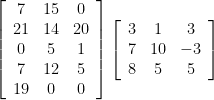
\displaystyle \left[ \begin{array}{ccc} 7 & 15 & 0 \\ 21 & 14 & 20 \\ 0 & 5 & 1 \\ 7 & 12 & 5 \\ 19 & 0 & 0 \end{array} \right] \left[ \begin{array}{ccc}3 & 1 & 3 \\ 7 & 10 & -3 \\ 8 & 5 & 5 \end{array} \right]

This will result in your encoded message:

\displaystyle \left[ \begin{array}{ccc} 126 & 157 & -24 \\ 321 & 261 & 121 \\ 43 & 55 & -10 \\ 145 & 152 & 10 \\ 57 & 19 & 57 \end{array} \right]

Now have each student pass this encoded message to another student. Each student must use the inverse of matrix A to de-code the message!

Have them multiply this message matrix by B A^{-1} with the inverse on the right. They will get the de-coded Message matrix. From this they can discover the message!


green line


How has this topic appeared in pop culture (movies, TV, current music, video games, etc.)?

            Written as an engage:

We are going to begin with a short video today!

(Published on Feb 21, 2013)

This video introduces the Computer Graphics chapter of the “Computer Science Field Guide”, an online interactive “textbook” about computer science, written for high school students. The guide is free, and is available from cosc.canterbury.ac.nz/csfieldguide/ . This video may be downloaded if you need to play it offline.)


What did you notice about the movement of the objects in the video? Does this movement – rotation, position, size – remind you of anything you have done in math class before? What happened to the graph of a function when we multiplied the x value? What about when we multiplied the y value? What happened when we added or subtracted a number to x or y? Do these transformations of functions move in a similar manner as the computer graphics in the video? (Of course, the video shows three-dimensional movement while our graphs only showed two-dimensional movement.)

So what kind of transformations do you think are used to create computer graphics? The graphics you see in your video games, in the movies, on TV, in flight simulators for training pilots, and in many other applications are all created with the transformations of matrices. Matrix multiplication is used in computer graphics to size and scale objects as well as rotate and translate them. Today we are going to learn to compute a special matrix transformation – the inverse of a matrix!


green line

How can technology be used to effectively engage students with this topic?

            After the students have learned how to calculate the inverse of a 3 x 3 matrix by hand, you could tell them they are now going to calculate the inverse of a 4 x 4 matrix. After they all roll their eyes and groan, you can ask if they would rather do the calculations by hand or on their graphing calculators.

Now you can introduce a method for entering the data into a calculator (such as the TI83 or TI84.) Since many graphing calculators can handle large matrices, the matrix and the identity matrix can be entered together as a 4 x 8 matrix. By using the “rref(” application, the inverse matrix will automatically be calculated. Another way to calculate the inverse is to enter the matrix then press the x-1 key.

However, you may want to wait before teaching this “short-cut” method. You may choose to have the students enter the 4 x 8 (matrix and identity matrix) and show them how to do the row operations on the calculator. This is useful in helping them see the steps involved in the calculation (and tortures them just a little.)


Engaging students: Finding the asymptotes of a rational function

In my capstone class for future secondary math teachers, I ask my students to come up with ideas for engaging their students with different topics in the secondary mathematics curriculum. In other words, the point of the assignment was not to devise a full-blown lesson plan on this topic. Instead, I asked my students to think about three different ways of getting their students interested in the topic in the first place.

I plan to share some of the best of these ideas on this blog (after asking my students’ permission, of course).

This student submission again comes from my former student Belle Duran. Her topic, from Algebra: finding the asymptotes of a rational function.

green line

How has this topic appeared in high culture?

Although the topic itself has not appeared in high culture, idea of asymptotes brings me the idea of the myth of Tantalus. In a nutshell, Tantalus was always committing crimes against the Gods of Olympus but always going unpunished. One day, he invites the Gods to his home for a feast in which he serves the Gods a rather vile dish. This ultimately angered the Gods to the point of punishing Tantalus by hanging him from a fruit tree amidst a lake, sentencing him to suffer eternal hunger and thirst. Tantalus was always so close to the water and fruits, yet they stayed beyond his reach. In the same way, when a graph has an asymptote then a part of the graph will approach that asymptote without ever touching it or being equal to it.


green line

What interesting things can you say about the people who contributed to the discovery and/or the development of this topic?

The word, “asymptote” derives from the Greek word, “asumptotos” which translates to “not falling together.” The term was first introduced by Apollonius of Perga in his work on conic sections, but used the term to represent a line that will not meet the curve in any finite point. Other achievements by Apollonius includes the introduction of eccentric and epicyclic motion to explain the motion of the planets as well as the hemicyclium which is a sundial with hour lines drawn on the surface of a conic section to give greater accuracy.


green line

How does this topic be used in your students’ future courses in mathematics or science?

One way finding asymptotes can be used in students’ future courses are to understand finding the limits of a function. When it comes to limits, it can be shown that vertical asymptotes are concerned with objectives in which the function is not usually defined and near which the function becomes large positively or negatively, or if a line x=a is called a vertical asymptote for the graph of a function of either the limit to positive infinity as x approaches positive a or negative a. Likewise, horizontal asymptotes are concerned with finite values approached by the function as the independent variable grows large positively or negatively. In other words, a line y=b is a horizontal asymptote for the graph is either the limit of the function is b as x approaches positive infinity or negative infinity.

References

The myth of Tantalus

http://www-history.mcs.st-and.ac.uk/Biographies/Apollonius.html

http://jwilson.coe.uga.edu/emat6680/greene/emat6000/greek%20geom/Apollonius/apollonius.html

http://www.education.com/study-help/article/horizontal-vertical-asymptotes/

http://oregonstate.edu/instruct/mth251/cq/Stage3/Lesson/asymptotes.html


Design Zone at Fort Worth Museum of Science and History

If you live in the Dallas-Fort Worth metroplex or are visiting this summer, I highly recommend Design Zone, which is on exhibit at the Fort Worth Museum of Science and History until September 7. I’ve been to a lot of science museums, so I don’t make the following statement lightly: this may well be the most fun and most engaging physics exhibit for children to enjoy that I’ve ever seen. There’s all kinds of things to lift, throw, balance, and blast off so that children have so much fun that they don’t even realize that they’ve learned something.

Here’s the information posted by the museum: http://fwmuseum.org/design-zone

Here’s a short promotional video:

And here’s a longer video describing the exhibit:


Engaging students: Multiplying binomials

In my capstone class for future secondary math teachers, I ask my students to come up with ideas for engaging their students with different topics in the secondary mathematics curriculum. In other words, the point of the assignment was not to devise a full-blown lesson plan on this topic. Instead, I asked my students to think about three different ways of getting their students interested in the topic in the first place.

I plan to share some of the best of these ideas on this blog (after asking my students’ permission, of course).

This student submission again comes from my former student Andy Nabors. His topic, from Algebra: multiplying binomials.

green line

A2. How could you as a teacher create an activity or project that involves your topic?

Multiplying binomials is an interesting concept because there are so many ways in which this can be done. I can think of five ways that binomials can be multiplied: FOIL, the box method, distribution, vertical multiplication, and with algebra tiles. I would incorporate these methods into one of two different ways. In either case, I would split the class into five groups.

  1. In the first way, I would assign each group a different method of multiplication. The groups would each be responsible for exploring their method, working together to master it. Then each group would be responsible for making a poster describing their method in detail. Then would then present their poster to the class, and the students not presenting would be taking notes. Already having one concept of binomial multiplication, the students would be seeing other methods and deciding which makes most sense to them.
  2. In my second idea, I would have five stations in the classroom each with their own method. The groups would rotate station to station figuring out the different methods collaboratively. The groups would rotate every 7-10 minutes until they had been to every station. Then the class would discuss the strengths/weaknesses of each method compared to the others in a class discussion moderated by the teacher.

These activities rely on the students being able to work and learn in groups effectively, which would present difficulty if the class was not used to group work.

green line

B1. How can this topic be used in your students’ future courses in mathematics or science?

I had the privilege of teaching a multiplying binomial lesson to a freshmen algebra one class in CI last spring. My partner and I focused on the box method first, and then used that to introduce FOIL. The box method was easier to grasp because of the visual nature of it. In fact, it looks a lot like something that the students will definitely see in their biology classes. The box method looks almost identical to gene Punnet Squares in biology. In fact, my partner and I used Punnet Squares in our Engage of that lesson. We reminded the students of what a Punnet Square was, and then showed them a filled out square. We went over how the boxes were filled: the letter on top of each column goes into the boxes below and the letters to the left of the box go in each box to the right. Then we showed them an empty Punnet Square with the same letters before. We inquired about what happens when two variables are multiplied together, then filled out the boxes with multiplication signs in between the letters. The students responded well and were able to grasp the concept fairly well from the onset.

green line

E1. How can technology be used to effectively engage students with this topic?

The internet is fast becoming the only place students will go for helpful solutions to school problems. This activity is designed to be a review of multiplying binomials that would allow students to use some internet resources, but make them report as to why the resource is helpful. The class will go to the computer lab or have laptops wheeled in and they will be given a list of sites that cover binomial multiplication. They will pick a site and write about the following qualities of their chosen site: what kind of site? (calculator, tutorial, manipulative, etc.), how is it presented? (organized/easy to use), was it helpful? (just give an answer opposed to listing the steps), did it describe the method it used?, can you use it to do classwork?, etc.

This is a sample list, I would want more sites, but it gives the general idea I’m going for. (general descriptions in parentheses for this project’s sake)

http://www.mathcelebrity.com/binomult.php (calculator, shows basic steps of FOIL of inputted problem)

http://www.webmath.com/polymult.html (calculator, shows very detailed and specific steps of FOIL of inputted problem)

http://calculator.tutorvista.com/foil-calculator.html (calculator, shows general steps of FOIL, not the inputted problem)

http://www.coolmath.com/crunchers/algebra-problems-multiplying-polynomials-FOIL-1.html (calculator but only problems it gives itself, more of a practice site)

http://www.mathwarehouse.com/algebra/polynomial/foil-method-binomials.php (FOIL tutorial site with practice problems with hidden steps)

http://www.themathpage.com/alg/quadratic-trinomial.htm (wordy explanation, lots of practice problems with hidden answers)

https://www.khanacademy.org/math/algebra/multiplying-factoring-expression/multiplying-binomials/v/multiplying-polynomials-2 (many tutoring videos, just the writing no person)

http://www.zooktutoring.com/now-available-my-very-first-instructional-math-video/ (many tutoring videos, tutor is seen with the work)

http://illuminations.nctm.org/Activity.aspx?id=3482 (algebra tile manipulator)

I will assume as a teacher that my students already look for easy solutions online, so I want to make sure they look in places that will help them gain understanding. I would stress that calculator sites are dangerous because if you just use them then you will not be able to perform on your own, but could be helpful to check your answer if you were worried. At the end of the lesson they would have a greater understanding of how to use internet sources effectively and have reviewed multiplying binomials.


Resources:

http://www.mathcelebrity.com/binomult.php

http://www.webmath.com/polymult.html

http://calculator.tutorvista.com/foil-calculator.html

http://www.coolmath.com/crunchers/algebra-problems-multiplying-polynomials-FOIL-1.html

http://www.mathwarehouse.com/algebra/polynomial/foil-method-binomials.php

http://www.themathpage.com/alg/quadratic-trinomial.htm

https://www.khanacademy.org/math/algebra/multiplying-factoring-expression/multiplying-binomials/v/multiplying-polynomials-2

http://www.zooktutoring.com/now-available-my-very-first-instructional-math-video/

http://illuminations.nctm.org/Activity.aspx?id=3482

John Nash: A Tragic but Meaningful Life

Princeton University’s Office of Communications put together a well-written news release concerning the life and tragic death of John Nash: http://www.princeton.edu/main/news/archive/S43/27/52G52/index.xml?section=featured. This very readable article discusses not only his mathematical contributions that ultimately led to his winning the 1994 Nobel Prize in Economics but also the very human side of his mental illness.

See also http://www.nytimes.com/2015/05/25/science/john-nash-a-beautiful-mind-subject-and-nobel-winner-dies-at-86.html?_r=0

How to Avoid Thinking in Math Class (Part 6)

Math With Bad Drawings had a terrific series on how students try to avoid thinking in math class. A quote:

I had a surreal moment this year. I’d almost finished a lesson when one boy, usually a hyperkinetic little bundle of enthusiasm, raised his hand.

“So, like, I don’t really understand anything you’re saying,” he informed me, “But I can still get the right answer.”

He smiled, waiting.

“Which part is giving you trouble?” I asked.

“Oh, you were talking about this extra stuff,” he said, “like the ideas behind it and everything. I don’t… you know… do that.”

I blinked. He blinked. We stood in silence.

“So is that okay?” he concluded. “I mean, as long as I can get the right answer?”

Here is Part 6: http://mathwithbaddrawings.com/2015/02/11/the-church-of-the-right-answer/

How to Avoid Thinking in Math Class (Part 5)

Math With Bad Drawings had a terrific series on how students try to avoid thinking in math class. A quote:

As for students, it can be frightening to start a math problem. You don’t know quite where it will lead. Will my approach be fruitful? Will it falter? Where do I even begin?

But unlike my desk-perching student, most kids don’t recognize that one rope holding them back is fear of the unknown. They just hesitate: too afraid to leap without a net, but never bothering to go in search of a net for themselves…

In all these cases, students are refusing to engage with their uncertainty. But if you’re uncomfortable with doubt, you’ll never break through to the other side. You’ll never have a “Eureka!” moment or an intellectual “Aha!” You’ll never… well… learn. After all, if you can’t bear to face the unknown, how will you ever come to know it?

I find that my desk-percher has it right. At times like these, the mere presence of an expert can supply the confidence you’re lacking.

Here is Part 5, introducing what happens when students get stuck getting started on a problem: http://mathwithbaddrawings.com/2015/02/04/fearing-the-unknown/

How to Avoid Thinking in Math Class (Part 4)

Math With Bad Drawings had a terrific series on how students try to avoid thinking in math class. A quote:

This speaks more to my naiveté as a first-year teacher than anything else, but I was shocked to find how fervently my students despised the things they called “word problems.”

“I hate these! What is this, an English lesson?”

“Can’t we do regular math?”

“Why are there words in math class?”

Their chorus: I’m okay with math, except word problems.

They treated “word problems” as some exotic and poisonous breed. These had nothing to do with the main thrust of mathematics, which was apparently to chug through computations and arrive at clean numerical solutions.

I was mystified—which is to say, clueless. Why all this word-problem hatred?

Here is Part 4, addressing students’ fears of word problems: http://mathwithbaddrawings.com/2015/01/28/the-word-problem-problem/

How to Avoid Thinking in Math Class (Part 3)

Math With Bad Drawings had a terrific series on how students try to avoid thinking in math class. A quote:

Every rule – even the craziest, most arbitrary mandate – has a reason rooted in this essential purpose. (Why leave the dishes with big particles? Because the person is still eating!) And so it is in math class. If you understand slope not as “that list of steps I’m supposed to follow” but as “a rate of change,” things start making more sense. (Why is it the ratio of the coefficients? Because, look what happens when x increases by 1!)

You get to work a lot less, and think a lot more.

Now, conceptual understanding alone isn’t enough, any more than procedures alone are enough. You must connect the two, tracing how the rules emerge from the concepts. Only then can you learn to apply procedures flexibly, and to anticipate exceptions. Only then will you get the pat on the back that every robot craves.

With my students on Friday, I garbled the whole analogy. I tend to do that.

But there’s a simple takeaway. Even if you don’t care about understanding for its own sake; even if you’re indifferent to the beauty and deeper logic of mathematics; even if you care only about test results and right answers; even then, you should remember that the “how” is rooted in the “why,” and you’re unlikely to master methods if you disregard their reasons.

Here is Part 3, addressing the importance of both computational proficiency and conceptual understanding: http://mathwithbaddrawings.com/2015/01/21/are-you-a-dish-washing-robot/

How to Avoid Thinking in Math Class (Part 2)

Math With Bad Drawings had a terrific series on how students try to avoid thinking in math class. A quote:

Occasionally, we teachers grow frustrated with our formula-thirsty students. (Okay, more like “often” or “weekly.”) Sometimes, we even denounce formulas altogether, deriding them as “brainless plug-and-chug” or “not real math.”

Of course, that’s going too far. The intelligent use of formulas is an important part of mathematics. But we’re right about one thing: there’s a lot more to formulas than just throwing numbers into a blender.

Here is Part 2, addressing students’ natural desire to mindlessly plug numbers into a formula without conceptual understanding: http://mathwithbaddrawings.com/2015/01/14/mmm-strawberry-rhuburb-root-2/